In an advertisement wording, the year which really describes the object sold is the one which adjoins the name of a collection or a publisher, never the one which adjoins the name of the character. On the August 30, 2026 statement around "Supergirl Action Comics 252 1959", the five least expensive ads: from $8.00 to $31.00 - all carry the year 1959 in their title, and none offer the 1959 issue: they are reissues, one of which itself announces "1992" and another "2000". Two dates in the same title are enough to request a photo before purchasing.
An ad title is not a sentence. It is a list of keywords placed end to end by a seller who wants to be found by the greatest number of queries possible, and this list does not obey any grammar. Nothing indicates which word qualifies which other. When the same wording contains the year of an original issue and the name of a collection of reissues, the reader must decide alone which of the two describes what he will receive in his envelope, and most of the time, no one has written it anywhere.
The case of Supergirl is particularly clear because her first appearance, in Action Comics issue 252 dated 1959, has been reissued more than once under different skins. The words “Action Comics”, “252”, “1959” and “first Supergirl” are therefore found both in the announcements of the old issue and in those of its reissues. This article does not seek to unmask cheaters: it proposes a method of reading, in the order in which it should be read, based on the principle that most sellers are clumsy rather than dishonest.
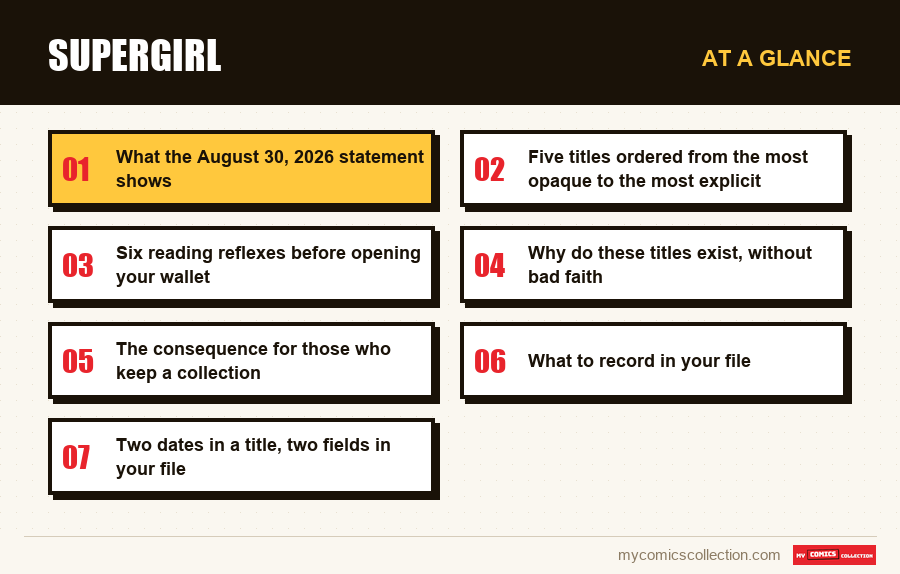
What the August 30, 2026 statement shows
The following figures come from an observation made on August 30, 2026 on a general auction site in the American market, around the query “Supergirl Action Comics 252 1959”. These are amounts that sellers are claiming at this moment, on advertisements that are still open. None correspond to a concluded transaction, none prove that a buyer ever accepted this price. A reading taken only once cannot by construction show any movement: there is no “before” to compare it to, so no sentence in this article will say that a price goes up or down.
The segment of unverified advertisements, those whose copy has not passed through the hands of a verification organization, included only 27 offers. The lowest amount there was $8.00, the middle value was $160.00, the highest amount was $2,895.00. The verified copies, counted separately because they described a different object, formed a set of 26 listings, from a low of $599.99 to a central value of $2,491.91, with a high of $22,500.00.
Twenty-seven on one side, twenty-six on the other: these are two small numbers. On sets of this size, a single eccentric announcement moves the mean and two removals are enough to change the central value. So I'm not drawing any conclusions about a price level, and neither should you. The maximum of $22,500.00 measures nothing other than the hope of the person who entered it; no one validated it. What remains usable in this statement is not the price scale: it is the composition of the securities.
Five titles ordered from the most opaque to the most explicit
The five cheapest ads in the unverified segment form, almost by chance, a perfect readability scale. None openly lie. They differ only in the amount of effort they leave to the reader.
$8.00: per year alone, without its owner
“ACTION COMICS 252 NM WHITE PAGES SILVER AGE CLASSICS FIRST SUPERGIRL 1959”. The title contains both the year 1959 and the name of a collection of reissues, without any words connecting one to the other. The year floats at the end of the chain, detached. The name of the collection is buried in the middle and can be read as a simple qualifier of the period. This is the most expensive wording to decode in the entire statement.
$19.99: two dates in the same row
“1959 ACTION COMICS #252 VF/NM 2000 DC MILLENNIUM EDITION”. Here the two dates are present and visible: 1959 at the top, 2000 just before the name of the edition. The title therefore says it all, but in an order which highlights the oldest year. A reader in a hurry will remember the first, while it is the second which qualifies the object.
$24.97: same wording, different seller
The same title is found identically with a different seller, at an amount five dollars more. This is the sign that a wording circulates, is copied, and ceases to be a written description to become an inherited formula. Nobody rewrote it: nobody reread it either.
$26.00 then $31.00: the collection returns to its place
“DC Silver Age Classics #252 1992 - DC: VG” finally places the collection and its year of printing at the front, where they describe the item. The last ad, at $31.00, goes all the way: it says that the issue reprints Action Comics issue 252 with the first appearance. The word is settled, the reader has nothing more to guess.
None of these five objects is the 1959 issue. The verified segment only starts at $599.99. The difference between $8.00 and $599.99 therefore does not measure what certification adds to a copy: it separates two categories of objects which only have a number and a cover in common. To confuse the two is to compare a modern print to an ancient booklet and conclude that one is a bargain.
The rule is contained in one sentence: in an announcement title, the year that counts is the one that accompanies the name of the collection or the publisher, not the one that accompanies the name of the character. Everything else is keywords, placed there to capture queries.
Apply it to the $8.00 label: the only named entity that can have a date on it is the reissue collection, and the year 1959 isn't stuck to anything. So the title doesn't say what it seems to say, and the asking price is the most honest confirmation it contains.
Six reading reflexes before opening your wallet
Count dates
First operation, mechanical: how many four-digit years are in the title? Only one, the ambiguity is low. Two, the ad implicitly asks you to decide for them. This counting is done in one second and eliminates most misunderstandings before even looking at the image.
Attach each date to a neighbor
An isolated date at the start or end of the string does not belong to anyone: it was added for research. A date attached to a publisher or collection name, such as 1992 following the reissue collection, describes a real object. Read dates as labels, not statements.
Locate collection names
A collection name is a strong signal: it designates an editorial reprint program, not an original issue. Two appear in the statement, one in three advertisements and the other in two. As soon as such a name appears somewhere in the title, it takes precedence over the accompanying old year.
Treat the price as information
The amount requested is often the most sincere part of an ambiguous ad. A seller who asks $8.00 for what he presents as a 1959 booklet tells you, without saying it, that he is not selling what you think you are reading. The price contradicts the title: believe the price, then check.
Don't trust the number alone
The number 252 is found on the original issue as well as on its reissues, since these use the numbering that they reprint. A number identifies content, not an item. It can therefore never serve alone as proof of identity for a physical object.
Demander la bonne photo
A single view of the cover does not decide, a reissue reproducing it identically. What stands out is the printed cover price and the legal notices given inside. Claim both of these things before you buy: the request is legitimate and an evasive response is an answer.
Collecting this series?
Track what you own, what you are missing and what your collection is worth. 7 day trial.
Start my trial →Why do these titles exist, without bad faith
You have to understand the mechanism to stop seeing it as a maneuver. A seller who puts a reissue online knows very well what he is selling; what he doesn't know is under what words the buyer will look for it. However, the buyer types in the name of the character and the year he knows. The seller therefore adds this year to his title to be visible, exactly as he adds the condition, the blank pages and the mention of first appearance. Each added word increases its search surface.
The available field is short and does not tolerate any useful punctuation. It's impossible to write a sentence like "reprint published in 1992 of an episode initially published in 1959": there is no space, and a sentence is less referenced than a series of keywords. The seller therefore chooses juxtaposition, and it is this juxtaposition which produces the ambiguity. The wording at $31.00, however, proves that clarity holds in the same length, provided you devote a word to it.
Added a copy effect. The same title appears from two different sellers, at $19.99 and $24.97. The wording is spread from ad to ad because it is simpler to use an existing wording than to write one. An awkward title is then reproduced without anyone rereading it, and the original ambiguity is mechanically duplicated. It's not an intention, it's copying.
Finally, state vocabulary, conservation abbreviations, takes up an inordinate amount of space in these headlines and distracts. A reader who sees a flattering condition statement at the top of the description spontaneously links it to the old object he is hoping for, whereas it simply qualifies the example offered, whatever it may be. A reissue in very good condition remains a reissue: the condition never provides information on the identity.
The consequence for those who keep a collection
This reading problem does not end with purchase. It propagates into the form you then create, and that's where it gets expensive. If the title of the ad made you remember 1959 while the object on your shelf bears a print from 1992, your file contains an identity error that nothing will subsequently point out. It will not correct itself, and it will contaminate any estimates you attempt later.
The only robust solution is to not just have a “year” field. A correct record distinguishes the year of publication of the story, which belongs to the work, and the year of printing of the copy, which belongs to the object you own. For an original copy, the two coincide. For a reissue, they diverge, and it is precisely this divergence that should be visible at a glance in your inventory. The same reasoning applies to other emblematic titles from the same publisher: the question of the year of printing arises in exactly the same way as soon as an old episode has been reprinted, as our analysis of the value of Action Comics 1.
A collection whose records confuse these two dates becomes invaluable in the literal sense of the term: we can no longer attribute value to it, because we no longer know what it contains. It's not a question of maniacal rigor. It's the difference between an inventory that answers one question and a list of titles that answers none. Reading the ads and holding the collection are two sides of the same gesture, and the second reveals the errors of the first.
It is therefore better to acquire this reflex early, including on modest purchases. Seek Superman comics at low prices is an excellent school, as long as you know each time whether you are buying a cheap old issue or a recent reprint: both are legitimate, they just don't fit in the same place.
What to record in your file
Two date fields, never just one. Explicitly create a year of publication of the story and a year of printing of the copy. For the original booklet, enter 1959 in both. For a reissue like the one dated 1992, enter 1959 in the first and 1992 in the second. A single field will one day force you to choose, and you will choose poorly.
The purchase wording copied as is. Keep the exact title of the ad on which you purchased in a free field, without reformulating it. This is the only trace of what was presented to you at the time of the decision. If a doubt of identity arises in two years, this crude wording will tell you whether the error comes from the seller, from his clumsy writing or from your reading.
The collection mention, when it exists. If the object belongs to a named reissue program, note this name in a dedicated field rather than in a free note. A field is filtered and sorted; a note is not found. This way you will know, at any time, how many lines in your inventory describe reprints, and the overall estimate will stop mixing two categories of objects.
Photographic proof requested from the seller. Attach to the form the images which were used to make the decision: the printed cover price and the internal legal notices. These are not memories, they are the proof of identity that you have retained. A record that states a year without providing proof of that year relies on your memory, and your memory fades.
Verification status, separate from price. Indicate whether or not the item is verified in its own field, without incorporating it into an estimated value. The statement shows why: between $8.00 and $599.99, what changes first is not the verification status but the nature of the item. Keeping the two pieces of information separate will prevent you from attributing a discrepancy to the certification that comes from elsewhere.
Count the four-digit years in the title, then look at what affects each. A year attached to a publisher or collection name describes the item sold; an isolated year at the beginning or end of the chain has been added for the search. If the title contains a reprint collection name, it takes precedence over the old year, regardless of word order.
There is nothing to confirm this, and the five announcements noted suggest the opposite. They form a continuous gradation, from the most opaque title to the title which explicitly states that it is a reprint. The difference between them is not moral, it is editorial: some are readable, others leave all the decoding to the reader.
No, and this is the most common misinterpretation. The low amount corresponds to reissues, the high amount to the first verified copy of the statement. The gap therefore separates two natures of objects before separating two statuses. Attributing this distance to verification alone would amount to comparing a modern print with an old booklet.
Not always. A reissue often reproduces the original cover, including illustration and logo, which makes the visual comparison inconclusive. What stands out is found elsewhere: the printed cover price and the legal notices given inside. Ask for these specific views rather than just an additional photo of the front.
These are amounts claimed on August 30, 2026 on open listings, not concluded sales. With 27 unverified offers and 26 verified, the numbers are too low to deduce a price level, and a single observation cannot show any evolution. These figures serve here to illustrate a way of reading the titles, nothing more.
Two dates in a title, two fields in your file
My Comics Collection allows you to distinguish the year of publication of the story and the year of printing of your copy, to keep the original purchase label and to isolate reissues of your old booklets. Your inventory then answers the question that the ad title left open.