
In short
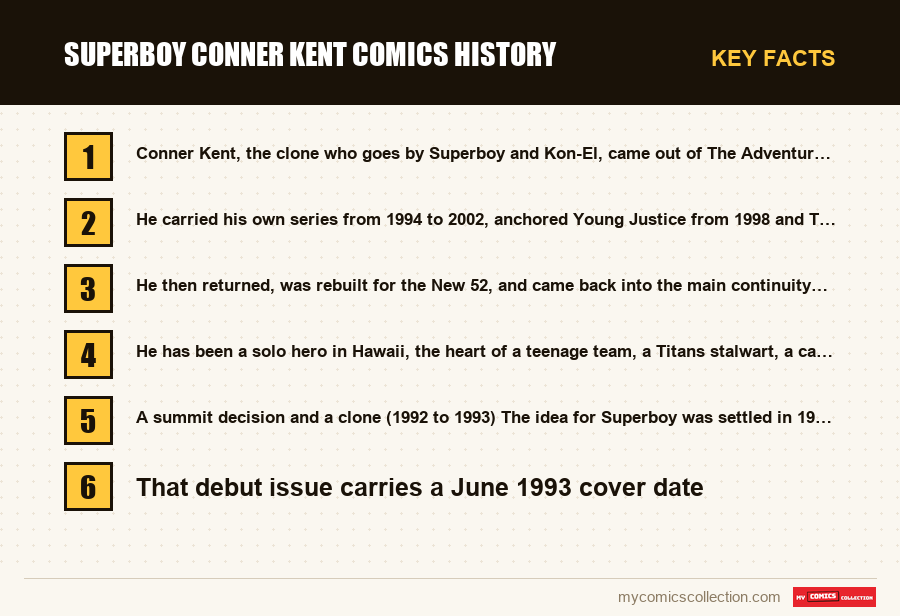
Conner Kent, the clone who goes by Superboy and Kon-El, came out of The Adventures of Superman #500 (June 1993), the work of Karl Kesel and Tom Grummett. He carried his own series from 1994 to 2002, anchored Young Justice from 1998 and Teen Titans from 2003, and was killed in Infinite Crisis #6 in 2006. He then returned, was rebuilt for the New 52, and came back into the main continuity in 2019.
Conner Kent is a character who was designed by committee and then taken over by readers. He began as a corporate answer to a story problem, a teenager created to stand near an empty Superman costume, and he ended up with a long and often interrupted publication history. He has been a solo hero in Hawaii, the heart of a teenage team, a Titans stalwart, a casualty of a company-wide crossover, a Black Lantern, a New 52 laboratory product and a farm boy again.
Every Conner credit below was confirmed against issue by issue records, and an unconfirmed name simply stays out of the timeline. What each stretch means for him is our interpretation, with no pages or speech reproduced.
A summit decision and a clone (1992 to 1993)
The idea for Superboy was settled in 1992 at the annual gathering where the Superman editorial teams plan the following year of stories. Writer Karl Kesel and artist Tom Grummett were handed the concept, with editor Mike Carlin overseeing the result. The name Superboy is credited to Jon Bogdanove and Jackson Guice, and Grummett sketched the look before faxing it to Carlin. The commercial logic is plain: Superman had been killed by Doomsday, a story every collector of the period knows, and the line needed several candidates to fill the vacuum.
That debut issue carries a June 1993 cover date. In its story, Paul Westfield of Project Cadmus plans a replacement for the dead hero; after failing to obtain Superman's DNA, his team alters a human clone, Experiment 13, to resemble him, and after twelve failed attempts the subject is given implanted memories and artificially aged. The boy is released early, as a teenager rather than a finished adult, and escapes with help from clones of the Newsboy Legion. His signature power is tactile telekinesis, a field around the body that lets him move objects by touch. The Adventures of Superman #506 (November 1993), "Payback!", explains it: a bio-electric aura taken from Superman's corpse was translated into that ability for the clone.
This origin matters for everything that follows. Conner starts as a deliberately incomplete Superman, made by a laboratory and handed the costume of a legend. Nearly every later writer returns to the same tension between the borrowed identity and the person who wears it.
His own series: Hawaii, Cadmus and Hypertime (1994 to 2002)
The Superboy series launched in 1994 begins with a February 1994 cover date, Kesel and Grummett carrying over as its first writer and penciller. It is cancelled at #100, cover-dated July 2002, after one hundred numbered issues plus a #0 and a #1,000,000, with two specials and four annuals. Kesel and Grummett leave after #26, return at #50, depart again after #80 (though Grummett's covers continue) and come back together for the finale in #100. For a collector, that structure means the run reads in creative blocks, not as one smooth stretch.
The setting is the surprise. Rather than keeping him in Metropolis, the series places Conner in Hawaii, and a long storyline known as "The Hero of Hawaii" (1994 to 1998) sees him rejoin Cadmus as a field agent, working with Dubbilex and Guardian. That choice gives the character what an event creation normally lacks: a home, a supporting cast and a tone of his own, closer to a teenage adventure serial than to the solemn Superman family books of the time.
Two issues stand out inside the run. Superboy #59 (February 1999), "Mission to Krypton," is the source of the concept that the next issue puts to work. Superboy #60 (April 1999) is where the Hypertime concept is first applied to the character, which Kesel has called the high point of his run. If you follow Conner as a collector, these two are the quiet landmarks of the solo years.
Young Justice: becoming part of a team (1998 to 2003)
Issue #1 of Young Justice arrives in September 1998 as "Young, Just Us," with Peter David scripting and Todd Nauck penciling. Conner is a founding member beside Robin (Tim Drake) and Impulse (Bart Allen), a trio first brought together in the one-shot Young Justice: The Secret #1 (June 1998) by Todd Dezago and Nauck, and the first volume runs until March 2003. It does something the solo book rarely attempted at that length: it makes Conner a friend among equals, with humor carrying the weight that grim-and-gritty comics of the decade gave to violence. For the character's long arc, this is where readers learn to like him, which is why the later losses land.
The team ends in Titans/Young Justice: Graduation Day (July 2003), "Part One: Invocation," a miniseries in which both groups disband after the apparent death of Donna Troy. Peter David has his own page on this site, at Peter David comics, and the animated adaptation is covered separately in the comparison linked in the guides above.
Teen Titans and the Lex Luthor retcon (2003 to 2005)
Teen Titans (volume 3) #1, cover-dated September 2003, is the relaunch by writer Geoff Johns, with artist Mike McKone on most of the first 23 issues, and it is where Conner takes the shape most readers now know. The same relaunch recasts his genetic origin: he is no longer a clone of Superman alone, but of Superman and Lex Luthor, and the Kryptonian and human sides of that inheritance become a running theme. The change gives him a family problem to solve, a half-heritage he did not choose and cannot easily disown. Our Lex Luthor hub covers the other side of that story.
The team years are also when Conner stops being solely a Superman satellite. Teen Titans #19 (February 2005), "Titans Tomorrow, Part III of III: East Meets West," by Geoff Johns and Mike McKone, closes one of the storylines of that relaunch. For a reader who wants the full modern Titans picture, the best Teen Titans runs guide places this stretch among the franchise's strongest periods.
Infinite Crisis: death at the hands of Superboy-Prime (2005 to 2006)
Conner's death is built over several issues. In Infinite Crisis #2 (January 2006), "The Survivors," the alternate-world Superboy-Prime is shown watching Conner from the dimension where he is hiding. In Infinite Crisis #3 (February 2006), "Divine Intervention," Superboy-Prime moves from watching to attacking him. The death itself comes in Infinite Crisis #6 (cover-dated May 2006), "Touchdown," when Superboy-Prime kills Conner.
The moment hit hard, mostly because it ended a story that had just been given new weight by the Titans years. A collector who reads the death in sequence will notice how little of the pain is in the killing itself: the hit comes from knowing exactly how long Conner had been in print and how much the teen-team books had invested in him.
Do you collect this series?
Track what you own, what you are missing and what your collection is worth. 7-day trial.
Start my trial →
Returning from death (2008 to 2010)
Comics deaths are rarely permanent, and Conner's lasted about three years of publication. The thirty-first century brings him back: in Final Crisis: Legion of 3 Worlds #4 (June 2009), by Geoff Johns and George Pérez, Starman (Thom Kallor) recovers his body, places it in a Kryptonian healing chrysalis and resurrects him. He is recruited into the Black Lantern Corps in Blackest Night #5 (January 2010) by Johns and Ivan Reis, then freed in Adventure Comics (volume 2) #7 (April 2010), "What Did Black Lantern Superboy Do?," written by Tony Bedard, when Wonder Girl lures him to the Fortress and destroys his power ring.
This period is mostly a bridge. His return is spread across three crossover books rather than handed to a clean solo relaunch, which is useful for a collector to know: the issues that bring him back are event issues, not Superboy issues.
The New 52 version (2011 to 2014)
The September 2011 relaunch rebuilds Conner as a human and Kryptonian hybrid made by the facility known as N.O.W.H.E.R.E. The new Superboy series, written by Scott Lobdell and drawn by R. B. Silva and Rob Lean at the start, with Tom DeFalco taking over as writer from #12, runs from November 2011 until its cancellation with #34 (October 2014), plus a #0, an annual and a Futures End one-shot. He also sits on the launch roster of Lobdell's new Teen Titans. The tone is darker and more laboratory-centered than the Hawaii years, and the Cadmus-and-Kansas themes of the original are replaced by captivity and escape.
The crossovers carry the story as much as the solo book. Superman (volume 3) #25 (January 2014), "Krypton Returns: Part 4," by Scott Lobdell and Kenneth Rocafort, brings the Kryptonian side of that version to the foreground, and Teen Titans Annual (volume 4) #3 (July 2014), "Be Careful What You Wish For," by the same pair, belongs to the closing stretch of the hybrid's run. The New 52 Conner is a separate build from the clone readers knew, which is why the 2019 return matters.
Back to the Kent farm: 2019 and after
The restoration begins in Young Justice (volume 3) #1 (January 2019), part of the Wonder Comics imprint and written by Brian Michael Bendis, where Bart Allen finds Conner stranded on Gemworld. He had been teleported there during a fight at S.T.A.R. Labs, which is why the Flashpoint reboot left him untouched. Bendis then folds him into the Superman books: Action Comics #1022 (August 2020), "The House of Kent, Part One," by Brian Michael Bendis and John Romita Jr., opens a Kent family storyline, and Action Comics #1028 (February 2021), "Micro Hopes," has him staying at the Kent farm. It places him inside the Superman family books without a laboratory between him and the Kent name.
The most recent step is Superboy: The Man of Tomorrow #1 (June 2023), by Kenny Porter with Jahnoy Lindsay on art, a new series built around him. The newest chapters are still unfolding, so the useful habit for a collector is to treat the current run as an active build rather than a finished story.
The key issues across his history
- The Adventures of Superman #500 (1993): the debut of Conner Kent, by Karl Kesel and Tom Grummett.
- The Adventures of Superman #506 (1993): "Payback!", which explains his tactile telekinesis.
- Superboy #1 (1994): the launch of the solo series by Kesel and Grummett, cancelled at #100 in 2002.
- Young Justice #1 (1998): "Young, Just Us" by Peter David and Todd Nauck, the start of the team years.
- Superboy #60 (1999): Hypertime first applied to the character.
- Teen Titans (volume 3) #1 (2003): the Geoff Johns relaunch that adds Lex Luthor's DNA to his origin.
- Infinite Crisis #6 (2006): "Touchdown," the death at the hands of Superboy-Prime.
- Young Justice (volume 3) #1 (2019): the return of Conner from Gemworld.
The list is deliberately balanced between origin, solo, team, death and return. A collection built on a single era, such as the 1990s, will miss the point that Conner's story is a loop, from lab product to lost hero to restored family member.
How to collect Conner Kent
Start with the debut and Superboy #1 (1994), then add the Peter David Young Justice run and the Johns and McKone Teen Titans. Because his earliest appearances were issues of an event-driven period, the most useful method is to keep a short numbered list per series, so that team books, crossovers and one-shots do not blur together.
Watch the numbering. Superboy has had several series bearing the name, and the Jon Kent version now holds the Superboy title in some stories, so confirm the volume and year on the cover before buying. The where-to-start guide for Superboy gives the ranking approach; this history gives the order in which events happened.
Frequently asked questions
Writer Karl Kesel and artist Tom Grummett created him in 1992 and 1993, following a decision at the annual Superman editorial planning gathering. His first story ran in The Adventures of Superman #500 with a June 1993 date, and the same pair then opened his own series in 1994.
He debuted as Experiment 13, a human clone that Project Cadmus altered to resemble Superman after failing to obtain his DNA. The 2003 Teen Titans relaunch reworked his makeup so that he is a clone built from the DNA of Superman and Lex Luthor, which became the standard version of his origin for the following years.
He is killed by Superboy-Prime in Infinite Crisis #6, cover-dated May 2006. Superboy-Prime is shown watching Conner earlier in the event, in Infinite Crisis #2. He returns a few years later through Legion of 3 Worlds and Blackest Night, before the New 52 reboot reshapes his story.
Conner Kent, also called Kon-El, is the clone who debuted in 1993. Jon Kent is a different character, the son of Clark Kent and Lois Lane, who has carried the Superboy name in later stories. They are separate people with separate collections.
He returned in Young Justice (volume 3) #1 in January 2019, joined the Superman books through Action Comics in 2020 and 2021, and starred in Superboy: The Man of Tomorrow from June 2023. Each of those steps is a separate series, so the volume and year matter when you shop.
If you hold a Kesel and Grummett Superboy run or an early Young Justice issue, estimate its condition-based value before you decide what to add next.
Estimate my comic