
In short
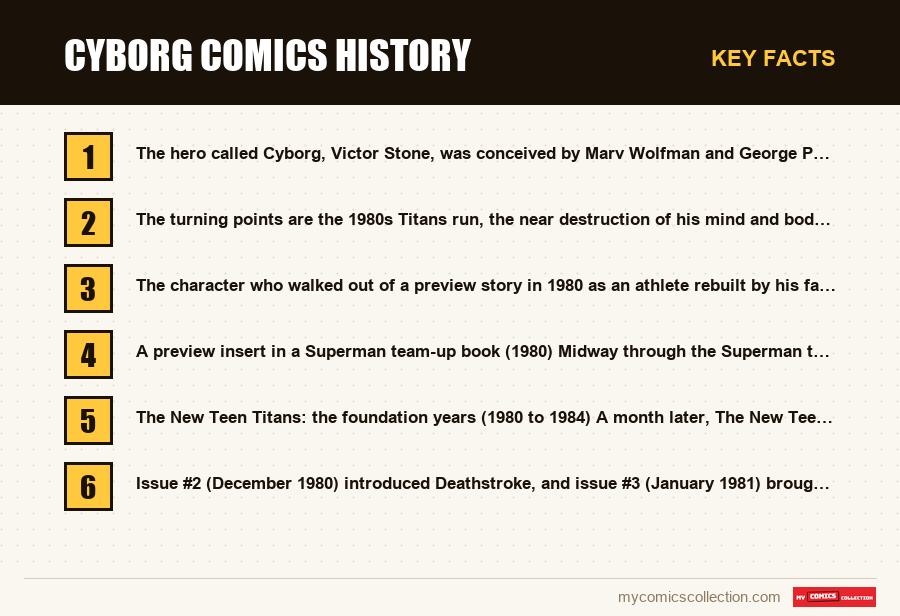
The hero called Cyborg, Victor Stone, was conceived by Marv Wolfman and George Pérez and first seen in DC Comics Presents #26 (October 1980), ahead of the Titans series that launched him. He went from Titans founder to Justice League member. The turning points are the 1980s Titans run, the near destruction of his mind and body in the 2000s, and Geoff Johns and Jim Lee's 2011 Justice League #1.
Few DC heroes have changed their relationship to their own body as often as Victor Stone. The character who walked out of a preview story in 1980 as an athlete rebuilt by his father has been wrecked, merged with another hero, rebuilt again, and rewritten from the ground up at least once. That is a long trajectory for a creation that began as one third of a promotional insert, and it is the reason a Cyborg shelf rewards a collector who reads in sequence rather than by price.
This history follows the character through time rather than ranking his books. Every credit, number and date in this timeline was cross-checked for Victor Stone specifically; only the interpretation of each period is ours, and nothing from the pages themselves is quoted.
A preview insert in a Superman team-up book (1980)
Midway through the Superman team-up book numbered #26 and dated October 1980, a short promotional story by Wolfman (writer) and Pérez (penciller) introduces Victor. Because the title is a Superman team-up series, the Cyborg debut is shelved under a book whose cover has no Titans on it. The same insert introduced Starfire and Raven, which is why the issue is filed as a three-character debut.
The design came with a stated influence. Pérez has pointed to Deathlok as a source for the look of the character, with a half-face plate that gives Victor a metallic side and a human side. What matters for the later trajectory is the choice behind it: Wolfman and Pérez built a hero whose face stays readable. A fully armored figure would have been a gadget; a young man with exposed machinery is a person with a problem. Almost everything that later writers do with Victor Stone, for good or ill, starts from that decision.
The New Teen Titans: the foundation years (1980 to 1984)
A month later, The New Teen Titans #1 (November 1980) opened a forty-issue first volume, closing in March 1984, with Wolfman and Pérez at the helm. Issue #2 (December 1980) introduced Deathstroke, and issue #3 (January 1981) brought the Fearsome Five, so Victor's first months in print happen against a cast of enemies who would define the franchise for decades. For a collector who wants the context of the debut, our guide to The New Teen Titans #2 and the first Deathstroke story covers that neighboring issue in detail.
What the early years establish for Cyborg is tone. In the series, Victor is a teenager who has been rebuilt without being asked: in the original continuity he is the son of scientists Silas and Elinore Stone, who made him the test subject of their intelligence enhancement projects, and after a laboratory accident leaves him close to death, Silas rebuilds him with cybernetic parts. The consent question hangs over everything that follows. A reader who comes to the character through later versions often misses how much of the 1980s run is about resentment of a father and a body, not about superheroics.
The creators gave him his own origin spotlight early. Victor's own backstory got its showcase in 1982: opening issue #1 (June 1982) of the four-part Tales of the New Teen Titans, the same creative pair dedicating one chapter per hero. In collecting terms it is the quiet companion piece of the foundation years: where the monthly series moves fast, the miniseries slows down to say who these people were before they met.
The Judas Contract and the long Titans years (1984 to 1996)
From April 1984 the original series carried on as Tales of the Teen Titans, picking up at #41 and reaching #91 by July 1988. Inside that stretch sits "The Judas Contract", told in issues #42 to #44 plus Annual #3, which brings in Terra and the arrival of Jericho, Deathstroke's son. Cyborg is part of the roster in that period, which makes this arc essential context for his place in the team.
A second series, also titled The New Teen Titans (volume 2), ran from August 1984 to November 1988 for forty-nine issues, with Pérez leaving after issue #5. In December 1988 the numbering resumed at #50 under a new masthead, The New Titans, the "Teen" dropped as the cast aged, and that book closed at #130 in February 1996. For a collector this is the first numbering trap in Cyborg's history: two parallel series, one continuing the first volume's count and one restarting at #1 in 1984, both feature him in the same period.
The darkest stretch of this era is the "Titans Hunt" storyline, which runs through The New Titans issues #71 to #84. In it Cyborg is severely injured and left seemingly mindless, with Sarah Charles and Beast Boy trying to reach him. The effect on the character is lasting: for the first time the body that defined him is not only a source of resentment but a place where he could vanish. Later writers return to that idea repeatedly, and it is one reason the 2000s stories about the machine taking over his mind feel like a continuation rather than a novelty.
Titans in transition and the 2003 relaunch (1999 to 2005)
The 1999 series Titans ran fifty issues from March 1999 to April 2003, created by Devin Grayson with Mark Buckingham and written by Grayson, with Jay Faerber also credited as a writer; Buckingham was the first penciller, followed by Adam DeKraker and Paul Pelletier. Cyborg appears in it, and in that book he is an adult veteran of a franchise that had already been reinvented once. His role narrows to what a long-time member offers: experience, a technical mind, and a body that is a liability as much as an asset.
In 2003 the line was relaunched as Teen Titans (volume 3), written by Geoff Johns with Mike McKone as penciller, following the three-issue miniseries Titans/Young Justice: Graduation Day, which ended both the previous Titans roster and Young Justice. It ran one hundred issues. For a ranked view of this period against the rest, see our Teen Titans runs list; the Geoff Johns page tracks his other DC work.
Infinite Crisis, Firestorm and the Technis years (2005 to 2010)
The mid-2000s are the most turbulent stretch of Victor Stone's history. After a missile crash, a team of Russian scientists repairs his body, and his mind is restored by the Technis, an alien race of computer intelligences, after which he takes the name Cyberion. His consciousness is later downloaded into the Omegadrome, the morphing war suit of former Titan Minion, and a clone of his body that Nightwing had secretly made lets him regain a human form while keeping the suit's abilities. In Infinite Crisis (2005 to 2006) he joins Donna Troy's "New Cronus" team, which helps defeat Alexander Luthor; when Luthor alters the Zeta Beams the heroes use to return home, Cyborg is temporarily fused with Firestorm (Jason Rusch), and he is later rebuilt over time by the Tower caretakers Wendy and Marvin. 52 #5, dated August 2006, shows the Firestorm fusion.
The decade also gives him his first modern spotlight. DC Special: Cyborg is a six-issue miniseries, with issue #5 dated September 2008 and introducing the Phantom Limbs, collected in March 2009 as Teen Titans Spotlight: Cyborg. In Titans (volume 2) #12 (June 2009), while Victor pretends that Jericho still possesses him in order to lure Vigilante out, Vigilante shoots him in the head, a dramatic moment that shows how far the book had moved from the sentimental tone of the 1980s. Around 2010 his path turns toward the League itself: the second volume of Justice League of America brings him into the roster that Kimiyo Hoshi leads, at Donna's invitation, and that move prepares the ground for the next change.
The 2011 Justice League reboot and a new origin
When DC relaunched its line in 2011, Justice League #1 appeared in August 2011 from Geoff Johns and Jim Lee, and Victor Stone became a main member of the original League. For readers who knew him as a Titan, that placement was the largest change of status in his history: he was no longer the youngest member of a team of former sidekicks, but a founding presence in the flagship book. The Jim Lee author page collects the artist's wider run if you want to follow that book's look.
The reboot also rewrote the origin. In the 2011 version Victor is a high school football star whose father Silas works at S.T.A.R. Labs, and a Mother Box from the planet New Genesis, brought to the lab by Superman, explodes, killing the other scientists and destroying most of Victor's body; Silas injects experimental nanites and T. O. Morrow adds robotic parts. Victor is imbued with the Mother Box's energy, and he later absorbs Parademon components that give him boom tube technology. The shift from a lab experiment on a teenage subject to an accident with a New Gods device changes the story's moral center. Silas is no longer a parent who rebuilt his son without consent; he is a parent who saved him in an emergency.
Do you collect this series?
Track what you own, what you are missing and what your collection is worth. 7-day trial.
Start my trial →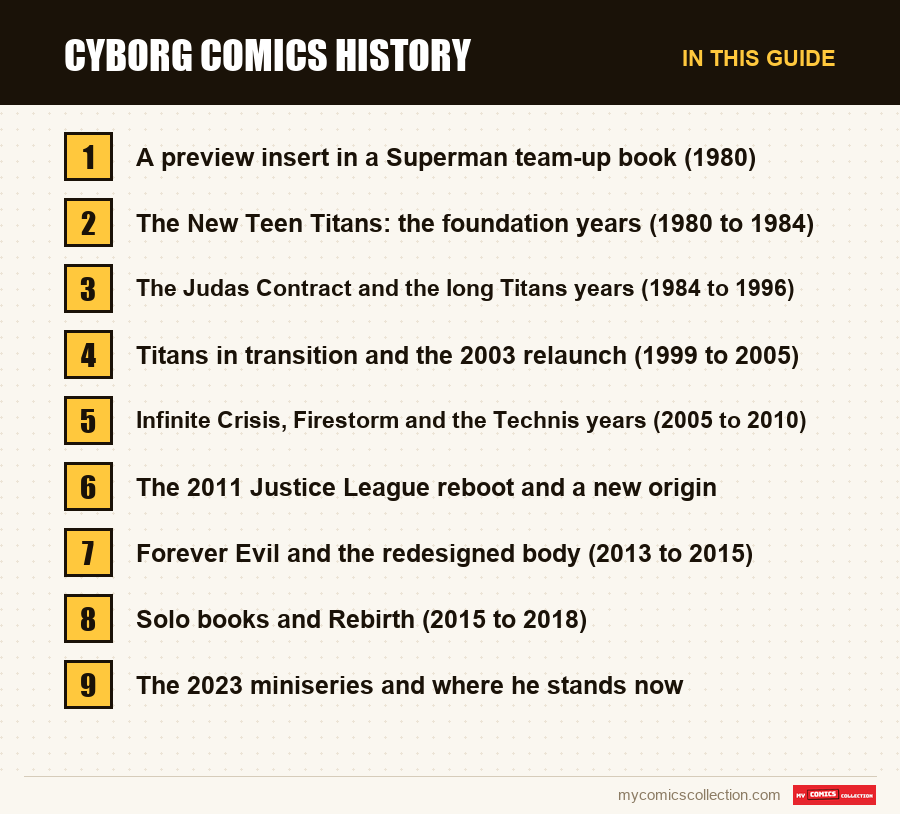
Forever Evil and the redesigned body (2013 to 2015)
The next structural change comes in Forever Evil #2, dated December 2013, when Batman and Catwoman return Victor to his father in Detroit. The follow-up is visible in the League book: Justice League #27 (March 2014) gives him a new, slimmer cybernetic body designed by Silas and Morrow, and Justice League #29 (May 2014) has him working with the Metal Men to shut down Grid. In both cases the pattern repeats: when the character needs a new direction, the writers rebuild the body.
Solo books and Rebirth (2015 to 2018)
A Cyborg series that debuted in July 2015, written by David F. Walker and drawn by Ivan Reis, gave the character a solo ongoing book, collected as Unplugged and Enemy of the State. Under DC Rebirth, Cyborg then received a second monthly series, collected as The Imitation of Life, Danger in Detroit and Singularity, which ended in June 2018 with issue #23. Victor also takes part in Dark Nights: Metal (issues #1 to #6), where the Dark Batmen capture him and he nearly surrenders to his Mother Box before Raven's soul-self helps him resist and free his teammates.
The 2023 miniseries and where he stands now
The most recent chapter is a Dawn of DC solo miniseries, written by Morgan Hampton and drawn by Tom Raney, with issue #3 (November 2023) introducing A.T.L.A.S. and Solace. It is collected as Homecoming in April 2024. The book's premise returns him to Detroit and to the question that began in 1980: what is left of the person when the machine takes up more room?
The key issues across his history
- DC Comics Presents #26 (October 1980): where Victor Stone is first seen, in the preview story.
- The New Teen Titans #2 (December 1980): the issue that brings Deathstroke into the team's world while Cyborg is already on the roster.
- Tales of the New Teen Titans #1 (June 1982): the origin chapter given to Victor Stone.
- 52 #5 (August 2006): the issue that shows Victor fused with Firestorm in the aftermath of Infinite Crisis.
- Titans (volume 2) #12 (June 2009): the issue in which Vigilante shoots Cyborg.
- Justice League #1 (August 2011): Geoff Johns and Jim Lee place Victor Stone in the original League line-up and rewrite his origin.
- Justice League #27 (March 2014): the issue that gives him a new, slimmer body after Forever Evil.
- Cyborg (2023) #3 (November 2023): Morgan Hampton and Tom Raney's miniseries introduces A.T.L.A.S. and Solace.
How to follow Cyborg in a collection
Start with the series, not the single key issue. A sensible order is The New Teen Titans volume 1 for the foundation, Tales of the New Teen Titans for the origin spotlights, then the 2011 Justice League for the reboot. After that, choose a solo run by era: the 2015 series, the Rebirth monthly or the 2023 miniseries. If you want the debut only, our guide to DC Comics Presents #26 explains how to buy the right issue.
Watch three numbering traps. First, the 1980s run exists in two parallel series and in a renamed continuation that carries on the first volume's count. Second, the 2011 reboot and the Wolfman origin are different characters on the page, so label shelves by lineage. Third, the solo series of 2015 and the Rebirth monthly are both called Cyborg, and collected editions are the safest way to tell them apart. Reprints and omnibus collections are the easiest way to read the 1980s material in order, and the check you need before buying a collected edition is the issue range printed on the spine page or in the catalog entry.
Frequently asked questions
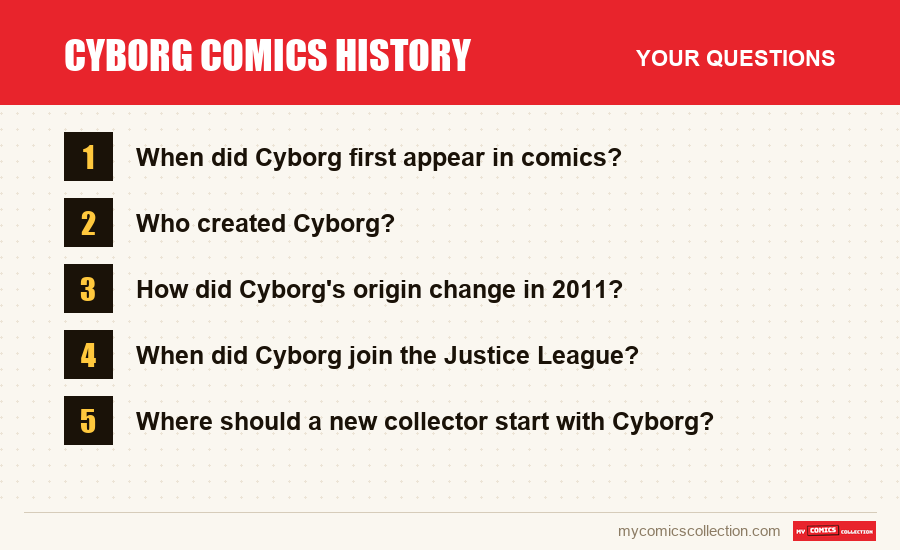
In the October 1980 cover-dated DC Comics Presents #26, a short preview story by Wolfman and Pérez shows Victor Stone for the first time, next to Starfire and Raven. The team series begins the following month.
Victor Stone came from writer Marv Wolfman and artist George Pérez. Wolfman wrote the early stories and Pérez drew them and shaped the design, which he has linked to Deathlok as an influence. The pair then launched the team's own series in November 1980.
In the original version Victor Stone is the son of scientists Silas and Elinore Stone, who used him as a test subject, and after a lab accident Silas rebuilds him. In the 2011 version he is a high school football star saved after a Mother Box explosion at S.T.A.R. Labs, with nanites and robotic parts, and imbued with Mother Box energy.
In the 2011 relaunch, Justice League #1 (August 2011) by Geoff Johns and Jim Lee makes Victor Stone a main member of the original League. He had already appeared in Justice League of America around 2010, but the 2011 book is the point where he is placed in the founding line-up.
Open with the first forty issues of the Titans series, then jump to the 2011 Justice League for the reboot. A trade paperback of either saves hunting for scattered single issues. Keep the original and the 2011 origin on separate shelf sections, because they describe different versions of the character.
Holding a copy of DC Comics Presents #26 or an early New Teen Titans issue? Get an estimate before deciding what to do with it.
Estimate my comic