
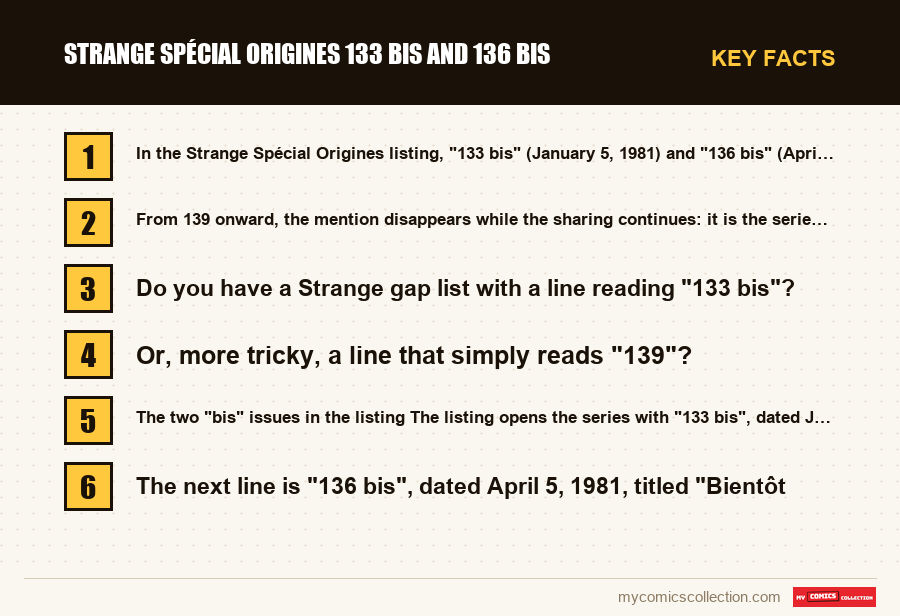
In the Strange Spécial Origines listing, "133 bis" (January 5, 1981) and "136 bis" (April 5, 1981) are the only two issues carrying the "bis" mention. They share the number and cover date of the corresponding monthly Strange. From 139 onward, the mention disappears while the sharing continues: it is the series name that distinguishes, more than the figure.
Do you have a Strange gap list with a line reading "133 bis"? Or, more tricky, a line that simply reads "139"? The "bis" mention is what separates, on paper, the monthly from the special, and it appears only twice in the listing. This page reads the two issues concerned, measures what the catalogue says about them, and draws a method from it so as not to confuse two objects bearing the same figure.
As always in this guide, only verified information (creators, issue numbers, dates) is stated as fact; the analysis is ours, with no reproduction of artwork or protected dialogue.
The two "bis" issues in the listing
The listing opens the series with "133 bis", dated January 5, 1981, whose story title is "L'incollable". The writing credit at issue level carries only one name, Stan Lee, and the art credit brings together three: Jean-Yves Mitton, Jack Kirby and Steve Ditko. The next line is "136 bis", dated April 5, 1981, titled "Bientôt... la métallurgie de l'espace". Its writing credits are longer: one name recorded as "Ph. Jacquot (credited)", then Stan Lee and John Buscema.
What these lines do not establish counts as much as what they do. Each issue has only one story title in the listing, and credits that apply to the whole issue, not to each episode. We therefore cannot say which artist signed which story, nor what the rest of the contents holds. The title "L'incollable" designates a story, not the whole issue: it is not enough to identify it.
Same number, same day as the monthly
The catalogue dates Strange no. 133 to January 5, 1981, exactly the day of the "133 bis". Strange no. 136 is dated April 5, 1981, like the "136 bis". In both cases, the monthly carries a different story title: "Les diamants" for 133, "Mots croisés" for 136. The special therefore does not take over the monthly's title, it sits alongside it.
Between the two "bis" issues, the gap is three full months, from January to April, that is three steps of the counter. The monthly counter, for its part, advances one notch a month: 134 is dated February 5, 135 March 5. These two intermediate numbers exist, in the special's listing, neither with nor without "bis". The special therefore occupies one number in three of the counter, and the monthly alone occupies the other two.
The "bis" stops after two issues
The "bis" mention does not designate everything that borrows the monthly's figure. The listing counts 32 issues, from "133 bis" to 226, and only two carry the mention. The other 30 show a bare figure: 139, 142, 145, and so on up to 226, all separated by three units. Across the 32 issues of the listing, the sharing of the figure with Strange is therefore general, and "bis" is only a temporary mark, limited to the first two.
The date check confirms that the sharing does not stop with the mention. 139 is dated July 5, 1981, like Strange no. 139. 142 is dated October 5, 1981, like Strange no. 142. Across the 32 issues, the two records give the same month and year every time; in 26 cases they also give the same day, and in the other 6 the difference comes only from one of the two records omitting the day. That is not a counter-example: it is the same month.
What this changes for a gap list
The practical consequence is twofold. First, do not look for a 134 or a 135 "Spécial Origines": the listing does not carry them, they belong to the monthly alone. A 137 or 138 special does not appear there either. From 133 onward, the special takes one number in three: 133, 136, 139, 142.
Second, from 139 onward, a line "Strange 139" is ambiguous, since two objects with the same cover date answer to the same figure. Write "Strange Spécial Origines 139" in full, and note the listing's story title: "Jeux" for the special, "Au Népal, un site prestigieux : Katmandou" for the monthly. For the two "bis" issues, the mention is enough, but it is better to add the series name, because a "133 bis" without a series name can be read as a simple variant of monthly no. 133.
Do you collect this series?
Track what you own, what you are missing and what your collection is worth. 7-day trial.
Start my trial →
Recognising the copy, and what the record does not say
The listing does not say whether the "bis" issues were sold separately, attached to the monthly, or in what physical form. It gives neither the page count, nor the format, nor the price, and we do not fill that silence. What can be verified on the object in hand is the series name on the cover or title page, the figure, the "bis" mention where applicable, and the date. Compare these elements with those of your list line before comparing anything else.
Also beware of the story title as the sole criterion. The catalogue gives one title per issue, and two neighbouring monthlies can share it: Strange nos. 136 and 137 are both titled "Mots croisés", whereas the "136 bis" carries a different title. The title helps to decide between the monthly and the special of the same figure, but it does not say what the issue contains in full.
The immediate neighbours
After "136 bis", the next line is 139, titled "Jeux", then 142, "Daredevil et la Veuve Noire", whose title names Daredevil and the Black Widow. To follow these characters, see the Daredevil hub and the Black Widow hub. This title indicates the subject of one story in the issue, nothing more.
On the monthly side, issues 130 to 140 are all present in the Strange listing, from October 5, 1980 to August 5, 1981. A gap in a Strange collection between 133 and 140 is therefore filled by the monthly, and the special is another line on the list, not a substitute.
Condition, tracking and value
The value of an issue of this kind depends on the condition of the paper, the cover, the presence or absence of detached pages, and the relative scarcity of the number on the market. The catalogue carries no price, and we give none. The two "bis" issues have this particularity: a buyer may confuse them with the monthly of the same figure. A seller who advertises "Strange 133" without further detail does not say which of the two they are describing, and the price cannot be compared from one object to the other.
To track your collection, add a separate line per object and keep the cover date in plain text: it is what shows at a glance that "133" and "133 bis" share the same day.
Frequently asked questions
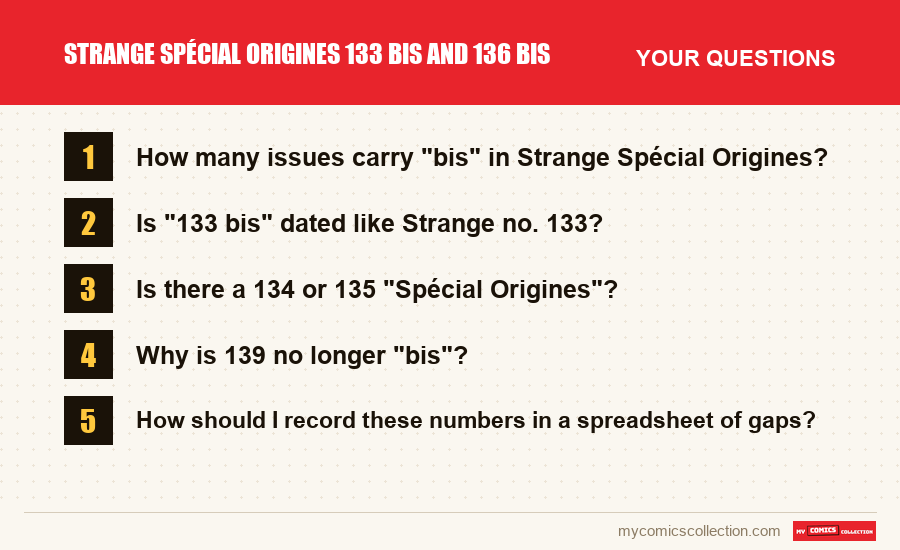
Two, in the listing of 32 issues: "133 bis" and "136 bis". The other 30, from 139 to 226, carry a figure without mention, all spaced by three numbers. The catalogue records no other "bis" in this series.
Yes, both are dated January 5, 1981. "136 bis" and Strange no. 136 are too, dated April 5, 1981. The story titles differ: "L'incollable" for the special, "Les diamants" for monthly no. 133.
Not in the listing: after "133 bis" comes "136 bis", then 139. Numbers 134 and 135 appear there only on the monthly side, dated February 5 and March 5, 1981. No need to look for them as specials.
The data does not explain it. It only shows that 139, dated July 5, 1981, still shares its figure and date with Strange no. 139 without carrying the mention. The editorial reason is not documented here.
One column for the series ("Strange" or "Strange Spécial Origines"), one for the figure with its mention if any, and one for the cover date. Two lines can share the same figure and the same date: it is the series name that separates them.