In short
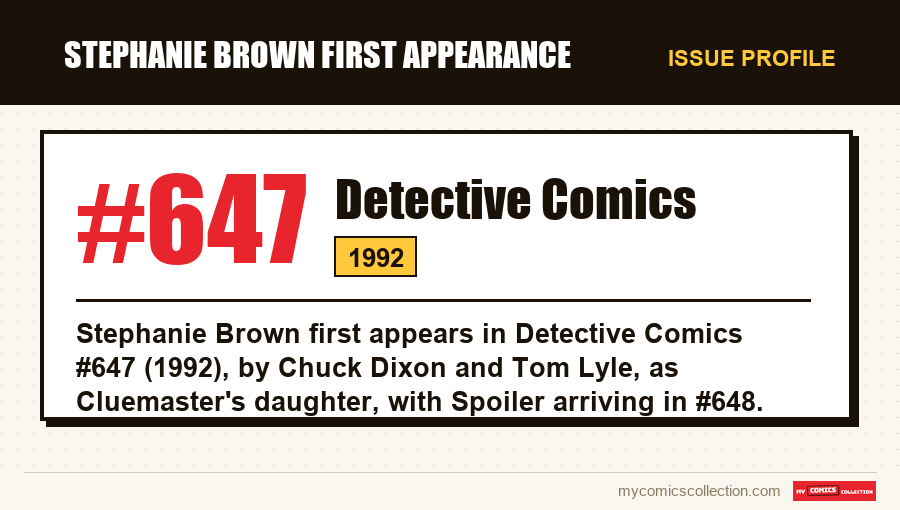
Stephanie Brown first appears in Detective Comics #647, published in 1992 by DC Comics. Dixon is the writer, Lyle the penciller, and together they hold the creator credit. She enters as the daughter of Arthur Brown, the villain Cluemaster, in a three-issue arc that runs through #649. Issue #647 carries Stephanie Brown herself; the Spoiler costume belongs to the following issue, #648. She later became Robin and then Batgirl.
Some key issues announce themselves with a cover gimmick. Detective Comics #647 does not. It sits in the middle of a long run, introduces a teenager whose name means nothing to a casual reader, and starts a three-part story about a second-string villain's family. Its weight came afterward, through three costumed identities and a publication history that readers still argue over.
Before writing this page we checked the creators, the issue numbers of the arc and the later titles against the publication record of the character, issue by issue, and we give the year only where a cover month could not be pinned down. Everything about condition, market behavior and buying method is our own analysis.
What Detective Comics #647 is, and what it is not
Detective Comics #647 is a 1992 issue of the Batman anthology title, and it is the opening chapter of a three-part story that continues in #648 and ends in #649. The writer is Chuck Dixon and the penciller is Tom Lyle. For a collector, that credit line places the issue in the early 1990s Batman output, a period of connected monthly titles that shared one supporting cast.
What the issue is not matters just as much. It is not the issue where Stephanie Brown wears a costume. She appears as a person, the daughter of a man just released on parole, and the Spoiler identity arrives in #648. A seller who lists #647 as "Spoiler debut" is blending two issues, and a buyer who wants the costume on the page is looking at the wrong number. Keep the split in mind: #647 is Stephanie Brown, #648 is Spoiler, #649 closes the arc.
It is also not a Robin issue and not a Batgirl issue. Those identities come twelve and seventeen years later, in different series, under different editors. Treating #647 as the origin of all three overstates what is on its pages; it is the origin of the person, and the three identities came later.
How Stephanie Brown is introduced
The setup is built around her father. Arthur Brown, the Gotham villain known as Cluemaster, comes out of prison on parole, and the arc follows what his release does to the household he left behind. Stephanie is the teenager in that household. Dixon's move was to reinvent Cluemaster by giving him a daughter, which turned a gimmick villain with a puzzle theme into a man whose family has to live with his choices.
That framing explains why the issue reads differently from a typical superhero debut. There is no origin by accident, no inherited power, no mentor figure waiting at the start. She is introduced as a young person responding to a parent she cannot trust. Tom Lyle's art keeps the street-level scale, with Gotham as a place of apartments and rooftops rather than a gallery of spectacle.
We are deliberately not summarizing the dialogue or the panel sequence. What a collector needs from the issue itself is simpler: the arc is three chapters, the daughter appears at the start, and the costumed response comes in the middle chapter. The 1992 arc is short enough to read in one evening, which makes it easy to confirm what you own before you decide how much attention the copy deserves.
Who created her, and the editorial moment
Chuck Dixon and Tom Lyle are the credited creators. Dixon was, in this period, one of the writers working on the monthly Batman books, which is why a Stephanie Brown story could so naturally cross paths with Tim Drake. Lyle's pencils gave the arc a grounded, clean look that suits a story about a teenage girl choosing whether to stay in her father's orbit.
The editorial context is the early 1990s, when the Batman line had several monthly series and a shared supporting cast. A new Gotham teenager could be introduced in one book and picked up by another. She went on to become a recurring presence alongside Tim Drake in the Robin series launched in 1993. For a reader tracing connections, that series is the natural follow-up to the 1992 arc.
It is worth separating creation from adoption. The creators are Dixon and Lyle. The writers who later defined her as Robin and as Batgirl are different people: the Batgirl series of 2009 is by Bryan Q. Miller, and the Batgirls series that ran from 2021 to 2023 is by Becky Cloonan and Michael W. Conrad. A copy of #647 does not carry any of that later work. It carries the setup.
Why #647 became a key issue
Key status here is retrospective. In 1992 nobody could know that the daughter of Cluemaster would carry three titles' worth of identity. The demand grew as the character did, and it grew in steps tied to specific later events.
The first step is the Spoiler costume itself, in the same arc. The second is her stint as Robin: her run in the Robin series begins with issue #126 in 2004, and she is still part of the cast when the 2004 crossover Batman: War Games plays out. In that storyline the character is apparently killed, and the death was later undone: the Robin/Spoiler Special #1 of 2008 is the issue that retconned it. The third step is Batgirl (volume 3), written by Bryan Q. Miller with pencils by Lee Garbett on issue #1, in 2009, which gave her a series of her own in the Batgirl costume rather than a supporting slot. The fourth is Batgirls, which ran from 2021 to 2023, nineteen issues with Stephanie and Cassandra Cain sharing the title.
Each step sent a wave of readers back to 1992. That is the pattern of a character-driven key issue: the pages did not change, the story around them did. For a collector, it means demand for #647 is tied to how visible Stephanie Brown is at a given moment, and that is a variable you cannot predict from the issue itself.
Do you collect this series?
Track what you own, what you are missing and what your collection is worth. 7-day trial.
Start my trial →
Reprints, collections and look-alike issues
The 1992 arc has been collected, and a reader who only wants the story does not need the original comics. If you do want the originals, the point to settle is which issue you are holding. Three numbers are easy to blur.
First, #647 versus #648. As noted above, #648 is the Spoiler issue. A collector who wants the identity debut is looking for #648, and one who wants the person is looking for #647. Second, Detective Comics #647 versus Robin #126. The latter is her Robin debut in 2004, a different series and a different decade. The Robin run that started in 1993 is also a different book from the 2004 issues. Third, listings label the 2004 Robin issues with different volume numbers; rely on the issue number on the cover and the year in the indicia.
When a collected edition is described, look for the contents page: it lists the issues reprinted, and it is the quickest way to confirm that a paperback includes all three chapters of the arc.
What to check before you buy #647
An early 1990s issue is not scarce in the way a Golden Age book is, so the differences between copies are about condition, not about rarity. Work through these points in order.
- Cover gloss and corners. Modern-age covers show handling quickly. Look for white stress lines along the spine and for rounded corners from stacking.
- Spine and staples. Check the staples for rust or lifting, and the spine for roll or splits.
- Interior pages. The story is a three-parter, and a reader copy can have a chipped or missing page near the staples. Page count matters when the copy has been read many times.
- Graded labels. If a copy is encapsulated, confirm that the certification number on the label matches the registry listing of the grading company and that the label names the right issue and year. Mislabeled slabs exist, and a quick check costs nothing.
- Restoration. Color touch, pressed creases and trimmed edges are rare on a 1992 book but possible. A label that mentions restoration should be read, not skimmed.
- The right number. Confirm #647 against the cover; do not trust a title that says only "Spoiler first appearance."
As a method, compare at least three recent sales of copies in the same condition tier before settling on a figure, and ignore asking prices that have sat unsold. We do not list prices here: they move with every new Stephanie Brown release, and a number printed in an article is out of date quickly.
The later issues that matter next
Once you have #647, the sensible next purchases follow the order of her identities.
- Detective Comics #648, the Spoiler costume, which finishes the setup of the arc.
- Detective Comics #649, which closes the three-part story.
- Robin #126 (2004), the beginning of her run in the Robin costume.
- Robin/Spoiler Special #1 (2008), the issue that undoes her death in War Games.
- Batgirl #1 (2009), by Bryan Q. Miller and Lee Garbett, the series that gives her the lead.
For a guided reading order of the whole character, the best Stephanie Brown comics guide covers the order in which to read these books, and the Robin key issues page places her stint in the larger list of Robins. If your interest is the Batgirl line as a whole, the history of Batgirl in comics connects the costume across its different wearers.
How to keep the issue in a collection
A single key issue is easier to value when it sits next to its neighbors. If you hold #647, record #648 and #649 as a set, even if you own them in different conditions, because the arc is a unit. Note the printing details: the cover, the issue number, the year and the indicia. A short file entry per issue, including where and when you bought it and the condition tier, saves you from repeating the checks above if you sell years later.
Store the books bagged and boarded with acid-free backing, upright and not stacked, away from light. A 1992 cover can be glossy, and glossy covers show pressure marks. These are ordinary habits, but they decide whether a modest copy stays modest or slips down a condition tier.
Frequently asked questions
Stephanie Brown debuts in Detective Comics #647 (1992), a Chuck Dixon and Tom Lyle story. The issue opens a three-part arc that continues in #648 and ends in #649. Her Spoiler costume is in the middle chapter, so the person and the costume are split across two numbers.
Issue #648 is the Spoiler issue, where the costume appears. Issue #647 introduces Stephanie Brown as a character, the daughter of Arthur Brown, who is the villain Cluemaster. If you want the costume debut, look for #648; if you want the character, look for #647. Many collectors keep both together.
Chuck Dixon and Tom Lyle are credited as her creators on Detective Comics #647. Dixon wrote the arc and reinvented Cluemaster by making Stephanie his daughter, and Lyle drew it. Later writers developed her as Robin and as Batgirl, including Bryan Q. Miller on the 2009 Batgirl series.
Her run as Robin begins with Robin #126 in 2004, and the 2004 crossover Batman: War Games follows soon after. She takes the Batgirl identity in the Batgirl series that Bryan Q. Miller wrote starting in 2009, with Lee Garbett drawing issue #1.
The Robin/Spoiler Special #1 of 2008 is the issue that retconned her apparent death in Batman: War Games. After that issue she returned to continuity, and the Batgirl series of 2009 built on the return. A reader tracing the character in order should place it between War Games and Batgirl #1.
Holding a copy of Detective Comics #647 or the Spoiler issue #648? Check its condition tier against recent comparable sales before you decide.
Estimate my comic