
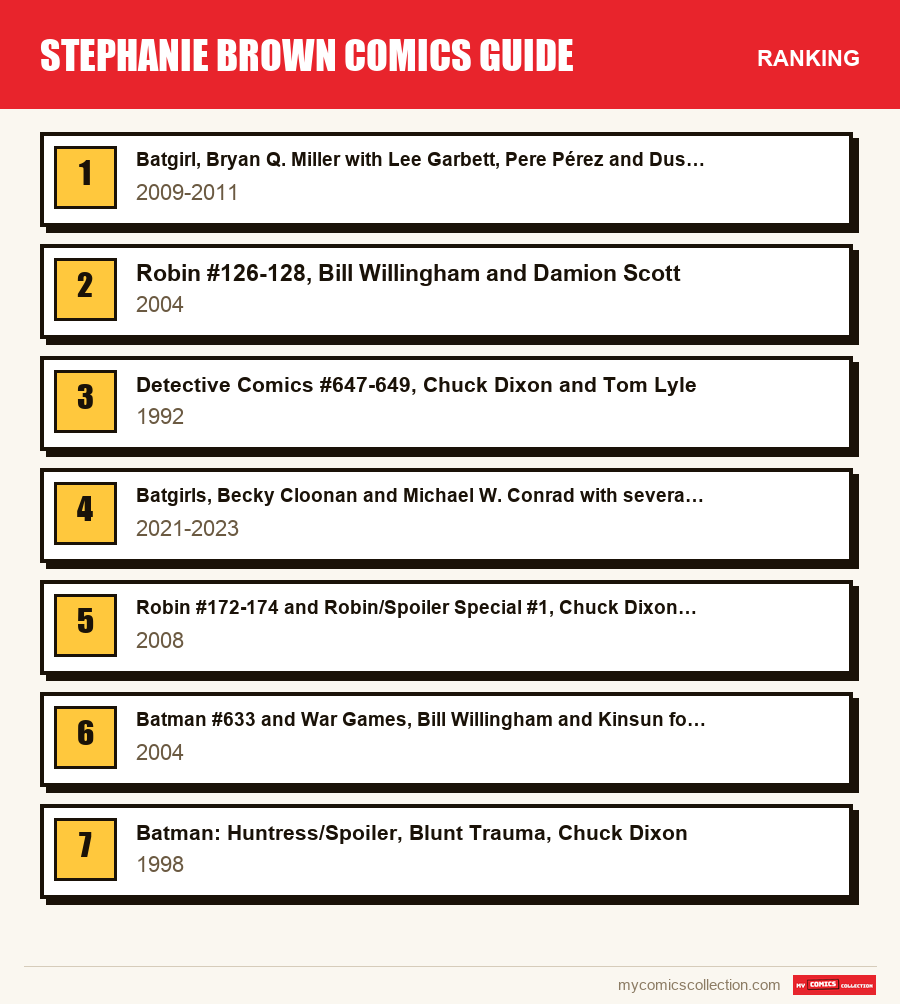
To read the best Stephanie Brown comics, start with Bryan Q. Miller's Batgirl series (2009-2011), which finally gives her a title of her own. Then go back to her Spoiler debut in Detective Comics #647-649 (1992), move on to Robin #126-128 (2004) for her brief stint as Robin, and then Robin #172-174 and the Robin/Spoiler Special (2008) for her return. The Batgirls series (2021-2023) carries her story forward.
Stephanie Brown is the daughter of a small-time Gotham criminal, and her whole publication history comes down to one gesture: refusing the role everyone predicts for her. She carries three identities, Spoiler, Robin and then Batgirl, and each belongs to a different editorial era. Knowing which one you are reading keeps you from mixing stories written twelve years apart.
As always in this guide, we only state verified facts (creators, issue numbers, dates); the analysis is our own, with no reproduction of protected art or dialogue.
Her first appearance
Stephanie Brown debuts in Detective Comics #647 in 1992, in a three-issue arc that reads as a single story. Chuck Dixon writes and Tom Lyle draws; Chuck Dixon and Tom Lyle are the character's creators. The starting point is Arthur Brown, the former Cluemaster, just released on parole. His daughter Stephanie shows up in this first issue, then puts on the Spoiler costume in issue #648 to foil her father's plans.
Keep the issue hierarchy straight: #647 carries the first appearance of Stephanie Brown, #648 the first appearance of Spoiler, and #649 closes the arc. She then returns in the early issues of the Robin series launched in 1993, where she crosses paths with Tim Drake. The 1992 arc can be read in one evening.
1: Batgirl, Bryan Q. Miller with Lee Garbett, Pere Pérez and Dustin Nguyen (2009-2011)
This is the series where Stephanie finally gets the lead role, and it is the best entry point. It runs 24 issues, from fall 2009 to 2011, all written by Bryan Q. Miller. Lee Garbett draws issue #1 and the first chapters; Pere Pérez and Dustin Nguyen then take over arcs or single issues.
Dick Grayson is Batman at this point and Damian Wayne is Robin, with Barbara Gordon, as Oracle, backing Stephanie up. The tone blends humor, college life and street-level detective work, with a character learning her trade in public. Detective Nick Gage, who comes over from the Coast City police, makes his debut in the series. The trade paperbacks split the run into three: Batgirl Rising (#1-7), The Flood (#8-14, with Red Robin #10) and The Lesson (#15-24).
This read suits any newcomer: it doesn't require the Robin years and works as a coming-of-age story. It will also appeal to Barbara Gordon readers, whom our history of Batgirl places within the costume's lineage. Read it straight through, in trade paperback order.
2: Robin #126-128, Bill Willingham and Damion Scott (2004)
Three issues published from July to September 2004. Bill Willingham writes, Damion Scott draws. In the first, Stephanie, recovered from her injuries, turns up at the Batcave and demands the Robin costume; Batman agrees to train her on one condition: the first direct order she ignores, she is fired.
The second issue confronts Tim Drake with the existence of a female Robin. The third shows the firing, after she disobeys in the middle of a fight. These three chapters make a short, self-contained story centered on trust between a mentor and a recruit. They are collected in Batman: War Drums, alongside Detective Comics issues you don't need to read to follow Stephanie.
This entry suits anyone who wants to understand Stephanie's time as Robin before reading the stories that follow it. To place the costume in the role's history, our Robin reading guide details its successive wearers.
3: Detective Comics #647-649, Chuck Dixon and Tom Lyle (1992)
The origin arc is worth reading for what it establishes: a teenager who wants to thwart her father's plan, and a father-daughter pair that structures everything that follows. Tom Lyle gives the character a readable face from the very first issue, and Chuck Dixon keeps writing her in the 1998 and 2008 stories presented below.
Cluemaster plays his role as the master of riddles and serves as a mirror for his daughter: Spoiler's calling is written against him. The tone is that of 1992 Gotham, more crime story than fantasy, with a dose of dark humor. This arc is for fans of character debuts and first-appearance collectors; it is not the easiest read for a modern reader, since the pacing is that of the early 1990s.
4: Batgirls, Becky Cloonan and Michael W. Conrad with several artists (2021-2023)
A 19-issue series plus one annual, written by Becky Cloonan and Michael W. Conrad, with Jorge Corona drawing the first chapters before other artists take over. It teams Stephanie Brown, Cassandra Cain and Barbara Gordon, the latter guiding the duo from Gotham's Clocktower. It is the most recent entry in this ranking.
It is aimed at today's reader who wants to see Stephanie partnered with Cassandra Cain under the same Batgirl name. It reads with no prerequisites, but it gains depth after the 2009 series. To measure what Cassandra Cain brings to it, see our Cassandra Cain key issues. The trade paperbacks collect the entire series.
Do you collect this series?
Track what you own, what you are missing and what your collection is worth. 7-day trial.
Start my trial →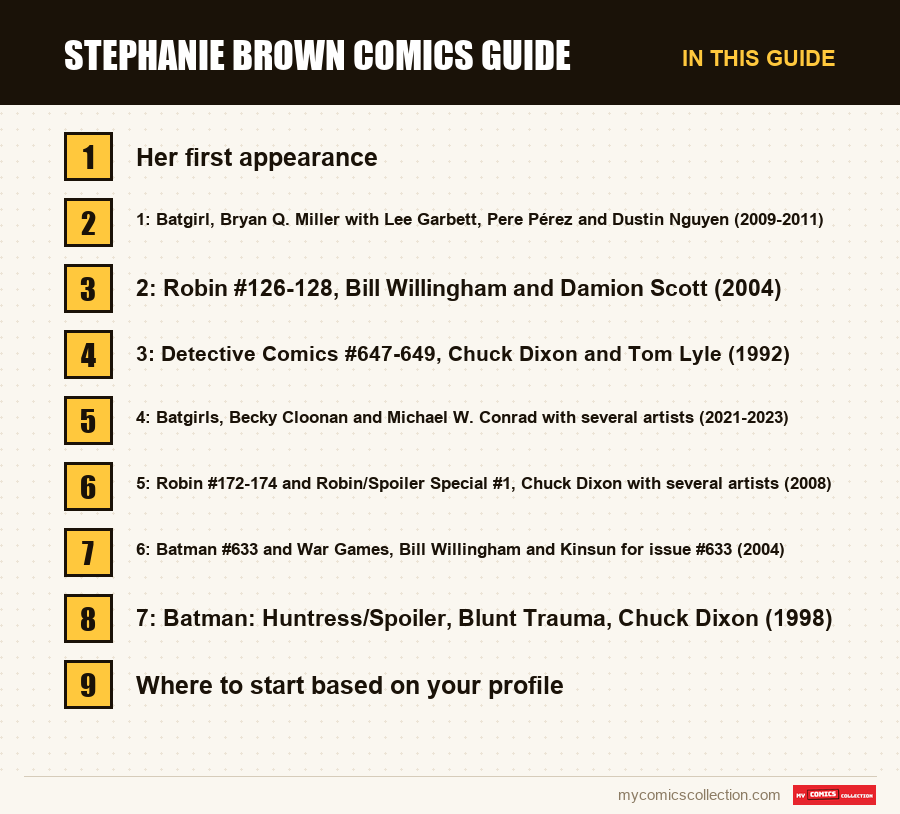
5: Robin #172-174 and Robin/Spoiler Special #1, Chuck Dixon with several artists (2008)
After years of being presumed dead, Stephanie reappears in 2008. Chuck Dixon, back on the series, writes these issues, and Robin #174 reveals that Spoiler really is Stephanie Brown and that she is alive. The Robin/Spoiler Special #1, dated June 2008 and written by the same author, is drawn by Rafael Albuquerque and Victor Ibáñez; it reveals that she spent more than a year in Africa before deciding to come home to Gotham.
The story of the time explains her survival through a swap: Leslie Thompkins supposedly exchanged her body with that of a victim and nursed her in secret. This read is for anyone who wants to see the resolution of one of the longest silences in the Bat-Family. It is better preceded by entry 2, which explains why Tim Drake reacts with such emotion. Robin: Violent Tendencies collects issues #172-174 along with the special.
6: Batman #633 and War Games, Bill Willingham and Kinsun for issue #633 (2004)
This 2004 crossover event brings together many writers and artists. Stephanie Brown is kidnapped and tortured by Black Mask there, then appears to succumb to her injuries. Batman #633, written by Bill Willingham and drawn by Kinsun, contains the hospital scene. In the follow-up War Crimes, Leslie Thompkins lets her die, according to the story of the time.
The read is useful for understanding Spoiler's apparent death. It isn't essential if Stephanie is what you're after: the event spans dozens of issues, some of which have nothing to do with her. Pick the War Games trade paperbacks if you want the context, or read this issue on its own for the turning point. The Batman hub helps place the event within the series.
7: Batman: Huntress/Spoiler, Blunt Trauma, Chuck Dixon (1998)
This 1998 one-shot, written by Chuck Dixon, pairs Spoiler with Helena Bertinelli, the Huntress, and ties into the "Cataclysm" saga that hits Gotham after an earthquake. In a devastated shopping mall, Huntress and Spoiler take on a gang of criminals and capture almost all of them, except the Cluemaster, Stephanie's father. The saga's plot then picks up in Detective Comics #721.
It is a fan's read from the late 1990s, showing Stephanie out of Robin's shadow, in a female field duo. It is for readers who want to round out the Dixon period, not for those looking for an easy entry point: the story stands alone, but the earthquake context calls for a bit of Gotham background.
Where to start based on your profile
You're discovering the character: read the 2009 Batgirl series, then Robin #126-128 to see where her costume comes from. You follow the Bat-Family: go straight through Robin #172-174, the Robin/Spoiler Special and the 2009 series, keeping in mind that Tim Drake plays a major part in it; his path is detailed in our selection of Tim Drake comics.
You like character debuts: start from Detective Comics #647-649, then the early Robin issues where she returns. You prefer a recent read: pick up Batgirls (2021-2023), then work back to the 2009 series. You want the context of her death: read Batman #633 and the War Games trade paperback, saving the 2008 follow-up for the answer.
The key issues to know
Detective Comics #647 (1992) is the first appearance of Stephanie Brown; #648 is the first appearance of Spoiler. The early issues of Robin (1993-1994) mark her return alongside Tim Drake. Robin #126 (2004) shows her as Robin, and #128 closes that stint with her firing. Batman #633 (2004) contains the scene of her apparent death. Robin #174 (2008) reveals she is alive, and the Robin/Spoiler Special #1 (2008) brings her back to Gotham. Batgirl #1 (2009) launches her series. She appears again in Detective Comics starting with #934 (2016).
For each single issue you are considering, note what it tells you about Stephanie: her birth as Spoiler, her Robin costume or her 2008 return. The 1992 first appearance is a period single issue, while the 2009 #1 is more recent and easier to find in good condition. Compare several completed sales and put condition ahead of the buzz that follows an adaptation. For a character whose publishing history is made of comebacks, a trade paperback of the right arc is often worth more than a lone single issue.
Frequently asked questions
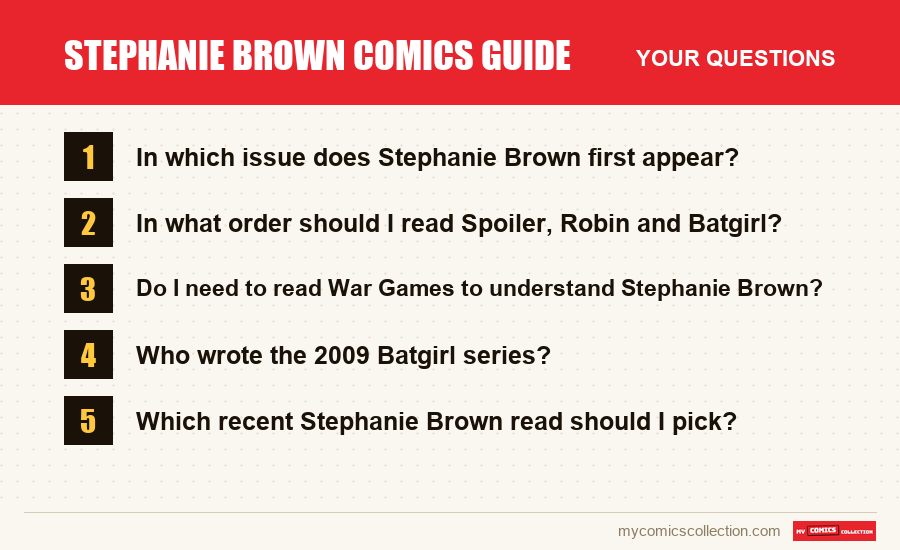
In Detective Comics #647, in 1992, written by Chuck Dixon and drawn by Tom Lyle. Issue #648 then shows Spoiler, and issue #649 closes the arc. There she is the daughter of the Cluemaster, Arthur Brown, who has just been released on parole.
For a first read, start with the 2009 Batgirl series, then read Robin #126-128. For publication order, start from Detective Comics #647 (1992), go through the 2004 issues and then the 2008 ones, before coming back to Batgirl.
No, not all of it. The 2004 event spans dozens of issues, many of which have nothing to do with her. Read Batman #633 by Bill Willingham and Kinsun for the central scene, then Robin #174 (2008) for the reveal of her survival.
Bryan Q. Miller, across all 24 issues. Lee Garbett draws issue #1; Pere Pérez and Dustin Nguyen then draw several issues. The trade paperbacks are Batgirl Rising, The Flood and The Lesson.
Batgirls, published from 2021 to 2023 in 19 issues, written by Becky Cloonan and Michael W. Conrad. It teams Stephanie, Cassandra Cain and Barbara Gordon, and reads with no prerequisites, though the 2009 series gives it more depth.
Do you own a Detective Comics or a Robin featuring Stephanie Brown? Get the copy's condition estimated before you sell it or have it graded.
Estimate my comic