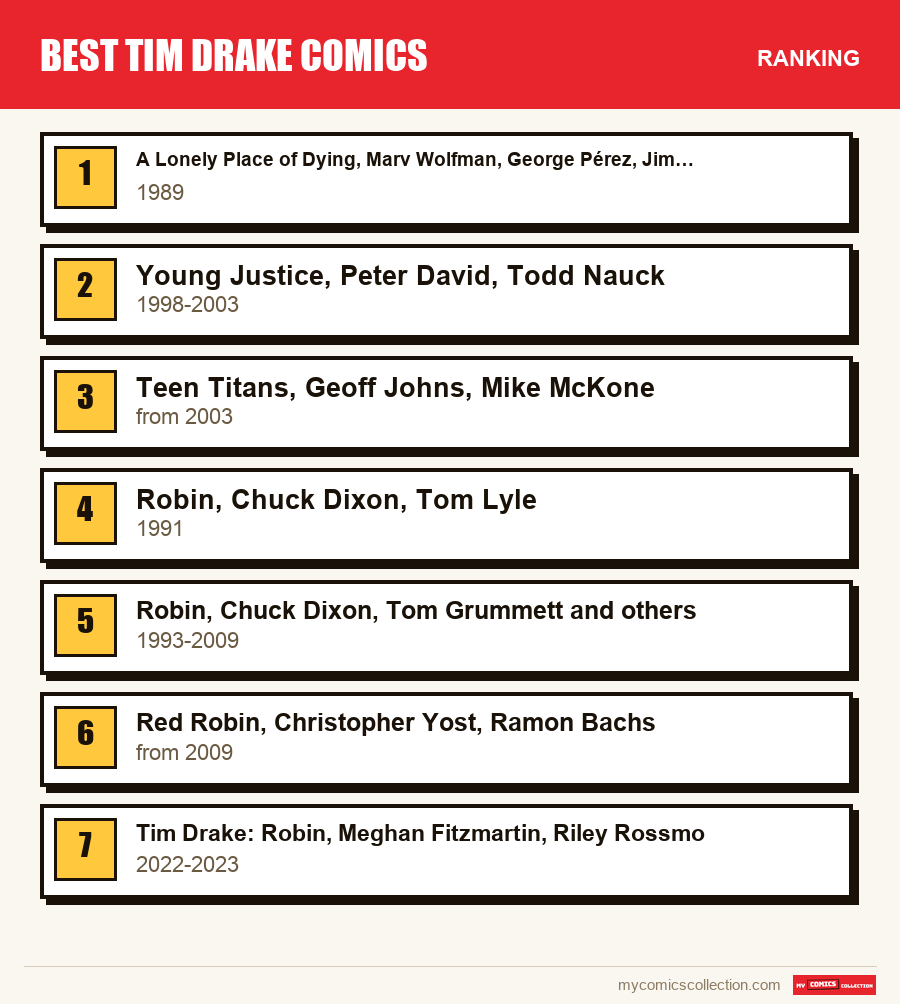
To discover the best Tim Drake comics, read A Lonely Place of Dying (1989) first, the Marv Wolfman, George Pérez and Jim Aparo crossover in which the teenager becomes the third Robin. Continue with Young Justice by Peter David and Todd Nauck (1998), then Geoff Johns's Teen Titans (2003). His first appearance is Batman #436, cover-dated August 1989.
Tim Drake is the Robin who earned his place through detective work: an observant teenager who understands what Batman needs before Batman says it. That profile made him a team leader more than a teammate, and he carried series in his own name for more than fifteen years, which makes his reading path richer than that of most sidekicks.
As always in this guide, only verified information (creators, issue numbers, dates) is stated as fact; the analysis is our own, with no reproduction of protected panels or dialogue.
His first appearance
Tim Drake appears in Batman #436, cover-dated August 1989, written by Marv Wolfman, drawn by Pat Broderick and inked by John Beatty. This issue opens Batman: Year Three, a four-part story that runs from #436 to #439 and whose covers are by George Pérez. The teenager plays only a discreet role there; he is not yet the Robin we know, and the single issue reads first of all as a Batman issue.
The distinction is useful: Tim's first appearance and his first outing as Robin are two separate events. The green and red costume only comes at the end of A Lonely Place of Dying, in Batman #442, written by Marv Wolfman and drawn by Jim Aparo, inked by Mike DeCarlo. In between, Tim has time to prove he is more than a bystander.
1: A Lonely Place of Dying, Marv Wolfman, George Pérez, Jim Aparo (1989)
The crossover has five parts: Batman #440-442 and The New Titans #60-61. Marv Wolfman and George Pérez devised the plot, Marv Wolfman wrote the dialogue; Jim Aparo draws the Batman chapters, with Mike DeCarlo on inks, and George Pérez those of The New Titans. The action follows Jason Todd's death: Batman wrestles with his grief, and a teenager who trails him in the shadows with Nightwing ends up convincing him that he needs a Robin.
This story gives Tim his reason for being: he is not chosen for his training, he imposes himself through his powers of observation and an insistence that Batman can no longer ignore. It also gives the Robin lineage a moment of handing on in which mourning the predecessor sits at the center of the story.
For context, you can read Year Three (Batman #436-439) beforehand, but the 1989 arc is self-sufficient. It is aimed at any reader, with no prerequisite other than knowing that Jason Todd is dead. A collection of the crossover exists, which saves you from hunting for five single issues scattered across two series. To go back afterward to Jason's beginnings, our history of Jason Todd gives the landmarks.
2: Young Justice, Peter David, Todd Nauck (1998-2003)
The series was born from a one-shot, Young Justice: The Secret, written by Todd Dezago, before Peter David took over the writing of the ongoing series, drawn by Todd Nauck. The first volume runs from July 1998 to March 2003, with fifty-six issues counting #1,000,000. The founding members are Robin (Tim Drake), Superboy and Impulse, with Red Tornado as mentor.
Tim is the group's tactician here: serious, calculating, the one the others turn to, and often the target of their teasing for his pragmatism. This is where the character learns to lead, and that experience prepares what he will do later with the Teen Titans.
This series suits the reader who likes teams of teenagers, dialogue humor and long-running plots. The tone is lighter than in the Batman series of the same era. To compare the original with its adaptations, read Young Justice: the animated series versus the comics.
3: Teen Titans, Geoff Johns, Mike McKone (from 2003)
The series launched in September 2003 entrusts Tim Drake with leading a team that includes Cassie Sandsmark as Wonder Girl, Superboy and Bart Allen as Kid Flash, with Starfire, Cyborg and Beast Boy as mentors. Geoff Johns writes the first forty-five issues; Mike McKone draws most of the first twenty-three. The first trade paperback, A Kid's Game, collects issues #1 to 7.
It gives Tim team authority, and the stakes shift from Gotham to a group of young heroes finding their way. This leadership function will return later, when Tim comes back to the team under the name Red Robin.
Recommend it to readers who arrived through the cartoon or through the Young Justice series, as well as to those who want a Geoff Johns run outside Green Lantern. To place this volume within the whole, the ranking of Teen Titans runs compares the different periods.
4: Robin, Chuck Dixon, Tom Lyle (1991)
This five-issue miniseries, published from January to May 1991, is written by Chuck Dixon and drawn by Tom Lyle; the cover is by Brian Bolland. It gives Tim a miniseries in his own name, before the ongoing series. Two other miniseries, Robin II: The Joker's Wild! and Robin III: Cry of the Huntress, follow from December 1992 to March 1993.
It gives Tim an identity that is no longer summed up by his role next to Batman: the title is centered on him, and the follow-up ongoing series builds on this foundation. Brian Bolland, a renowned cover artist, did the cover of the miniseries.
It will please fans of coming-of-age stories and those who like the comic book aesthetic of 1991. It reads in an afternoon; the collections that gather its contents should be looked up in the catalog before buying.
Do you collect this series?
Track what you own, what you are missing and what your collection is worth. 7-day trial.
Start my trial →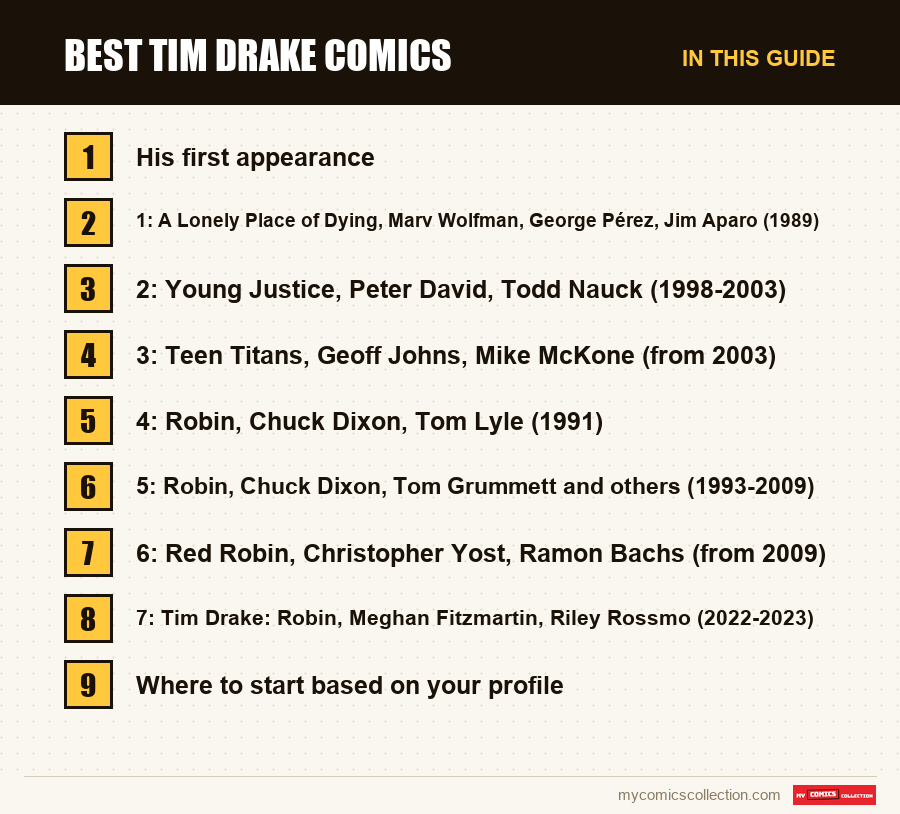
5: Robin, Chuck Dixon, Tom Grummett and others (1993-2009)
The ongoing series runs from November 1993 to April 2009, with one hundred eighty-five issues counting the #0 and the #1,000,000, plus seven annuals. Chuck Dixon writes it at the start; Jon Lewis, Bill Willingham, Adam Beechen and Fabian Nicieza are among the writers who follow him. The artists include Tom Grummett, Phil Jimenez, Mike Wieringo, Pete Woods and Damion Scott. Stephanie Brown shares the spotlight on part of the series.
It gives Tim a territory: a dedicated series that runs for more than fifteen years and lets him evolve across successive writers and artists. Its appeal is its length, which lets you see the character change in look and tone.
It suits patient collectors, because a series of one hundred eighty-five issues is not read in one go. The simplest approach is to choose a period, for example Chuck Dixon's first arcs, and read it in collected form before deciding to go further.
6: Red Robin, Christopher Yost, Ramon Bachs (from 2009)
The first issue is cover-dated August 2009. Christopher Yost writes the first twelve issues, Ramon Bachs draws the first, then Fabian Nicieza takes over. The series follows Tim, who refuses to believe in Bruce Wayne's death and searches for him around the world under a new costume.
It gives Tim an independence that Robin no longer allowed: no more mentor, no inherited title, a name of his own. It extends his path in a way that a reader of the 1990s Robin would not guess.
This is the read aimed at the reader already familiar with the character, who knows what Tim owes to Bruce. Light prerequisite: knowing that Bruce Wayne has disappeared.
7: Tim Drake: Robin, Meghan Fitzmartin, Riley Rossmo (2022-2023)
Launched on September 27, 2022, the series runs ten issues and ends in June 2023. Meghan Fitzmartin writes it; Riley Rossmo draws the first issue, and other artists step in afterward, including Nikola Čižmešija and Matteo Scalera. Meghan Fitzmartin had already written Tim in Batman: Urban Legends #6 (August 2021), where the character is presented as bisexual.
The series puts Tim back at the center of a title in his own name, after several years spent mostly in team series. It reads as an endpoint rather than an entry point.
It is better approached after the earlier series, so you find a Tim already settled in his role. Ten issues read in one go in the collection.
Where to start based on your profile
If you come from the movies or the animated series, start with A Lonely Place of Dying, then move on to Peter David's Young Justice. If you like teams of young heroes, follow with Geoff Johns's Teen Titans. If you prefer Gotham, Chuck Dixon's Robin series will give you a more urban Tim.
The reader who already knows Tim will head to Red Robin, then to Meghan Fitzmartin's series. To set Tim against the other Robins, see the history of Robin in comics or the dedicated reading guide.
The key issues to know
The hierarchy begins with Batman #436 (August 1989), Tim Drake's first appearance, then Batman #442, where he puts on the Robin costume for the first time. The five parts of A Lonely Place of Dying form a set to complete, with The New Titans #60 and #61. Robin #1 (January 1991, a miniseries by Chuck Dixon and Tom Lyle) is his first series in his own name; Young Justice #1 (1998), Teen Titans #1 (September 2003), Red Robin #1 (August 2009) and Tim Drake: Robin #1 (September 2022) mark the later launches.
The method: first look for a copy whose condition is described precisely, then compare several completed sales of the same issue over an extended period. A series-opening issue trades differently from a discreet single issue like #436, whose value rests on the importance of the character and not on the event it tells. The detail of the lineage's issues is in the key Robin issues.
Frequently asked questions
In Batman #436, cover-dated August 1989, written by Marv Wolfman, drawn by Pat Broderick and inked by John Beatty. The issue opens the Year Three arc. Tim is not yet Robin there: he wears the costume for the first time in Batman #442, at the end of A Lonely Place of Dying.
With A Lonely Place of Dying, the five-part crossover published in 1989 in Batman #440-442 and The New Titans #60-61. It tells how Tim becomes Robin and reads without knowing the earlier years, as long as you know that Jason Todd is dead.
Yes. Red Robin is the identity Tim adopts after leaving behind that of Robin, when he searches for Bruce Wayne after his disappearance. The Red Robin series begins in August 2009 with Christopher Yost on script, and Fabian Nicieza takes over after the first twelve issues.
It is not required. The two series read separately. Young Justice (1998-2003) shows Tim leading a younger team; Teen Titans (from 2003) entrusts him with a more established team. Reading the first before the second gives a more natural thread.
The Tim Drake: Robin series, written by Meghan Fitzmartin, ran ten issues from September 2022 to June 2023. Before it, Tim held the lead role in the Robin series from 1993 to 2009, one hundred eighty-five issues, and in Red Robin from 2009.
Do you own Batman #436, an issue of A Lonely Place of Dying or a Tim Drake Robin? Appraise it in a few minutes.
Appraise my comic