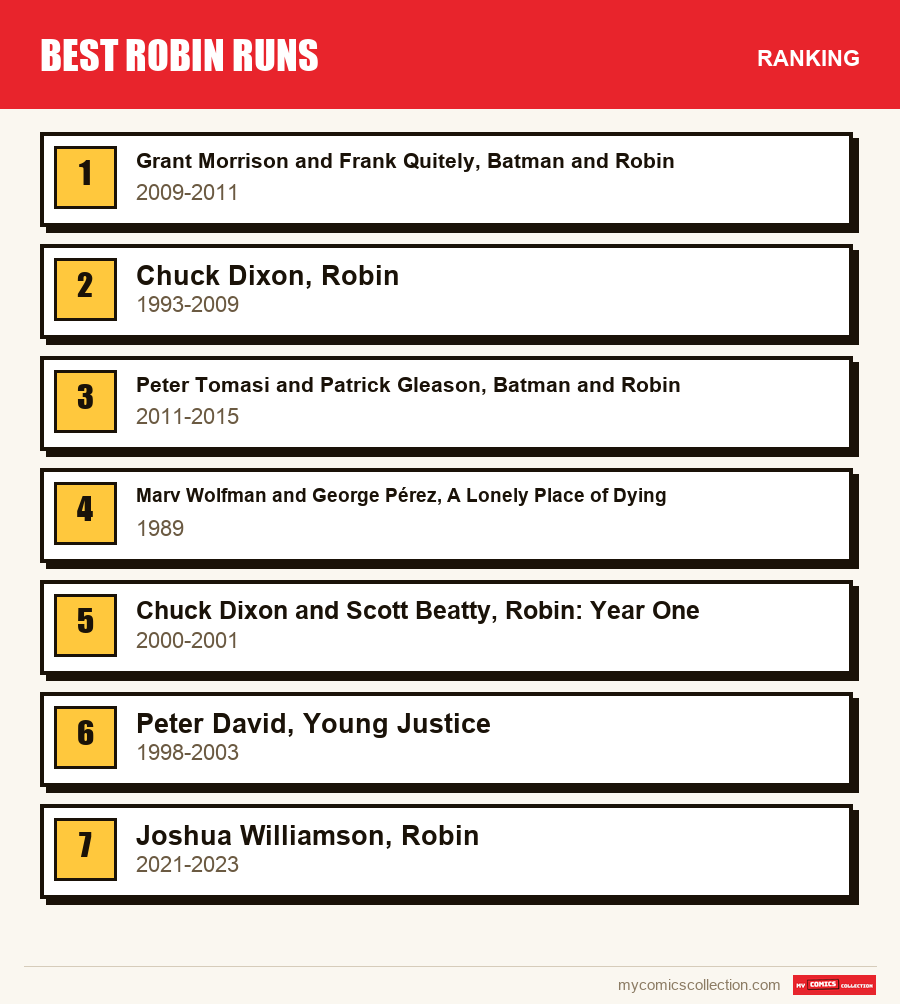
The best run devoted to Robin is Batman and Robin by Grant Morrison and Frank Quitely (2009-2011), centered on Damian Wayne. It beats Chuck Dixon's Robin series on Tim Drake (1993), Peter Tomasi and Patrick Gleason's Batman and Robin (2011), A Lonely Place of Dying (1989), Robin: Year One (2000-2001), Peter David's Young Justice and Joshua Williamson's Robin series (2021). Seven ranked, with the format to read for each.
Five young people have worn the green and red costume in Gotham's continuity, from Dick Grayson to Damian Wayne by way of Jason Todd, Tim Drake and Stephanie Brown, and Carrie Kelley puts it on in a separate future. Ranking "Robin runs" therefore forces us to pick a definition. We keep the stories in which a Robin sits at the center, whether he carries the title or shares it with Batman. The cases of Jason Todd under his red hood and of Dick Grayson as Nightwing have their own rankings, which we do not repeat here.
As always in this guide, we only state verified information (creators, issues, dates); the analysis is our own, with no reproduction of protected pages or dialogue.
How we ordered these seven runs
To separate series as far apart as Young Justice and Morrison's, we set three filters. The first is having a Robin at the center: an arc in which the teenager is only a foil for Batman falls behind an arc that gives him the narration. The second is autonomy: the story must stay readable for someone who has never opened Detective Comics #38. The third is the mark left, measured by how later writers reused the ideas.
Market value does not enter the rank. The issue that concentrates buyers' attention, the first appearance of 1940, belongs to a different debate than that of the best reading. We deal with the collecting side at the end of the ranking.
Top 1: Grant Morrison and Frank Quitely, Batman and Robin (2009-2011)
After Bruce Wayne's disappearance in the preceding event, Dick Grayson takes up Batman's cape and Damian Wayne, son of Bruce and Talia, becomes his Robin. The contrast is the engine of the series: a smiling, acrobatic Batman, backed by a curt, vain child trained by the Assassins. Grant Morrison writes the first sixteen issues, Frank Quitely draws the first arc in a clear but distorted line, then Philip Tan, Cameron Stewart and others take over. Damian had made his debut in Batman #655 in 2006; here is where he becomes a leading character.
The run matters because it reinvents the relationship between mentor and student by inverting it: the elder has to learn to lead a younger one who refuses to be led. It suits readers who enjoy Morrison's eccentric enemies and accept that Batman's city loses some of its usual darkness. It reads without knowing the continuity of the previous twenty years, even if the prologue clarifies certain references.
To collect it, the 2009 issues are common and can be completed one at a time; the variant covers of the first issue are the only ones to watch. The collected edition is the logical route for a reader: Morrison's sixteen issues fit in three volumes, and several French editions exist, to be checked in the catalog before buying.
Top 2: Chuck Dixon, Robin (1993-2009)
This is the first regular series to carry the title, opened after a 1991 miniseries devoted to Tim Drake. Chuck Dixon sets up a teenager who has to balance high school, a strained relationship with his father and patrols in Gotham. The series runs until 2009, around 180 issues; sources differ on the exact issue of Dixon's departure, so we do not pin it down. Several art teams follow one another, with a consistency that is the strength of the title.
It matters because Tim Drake becomes a full character there, with his own gallery of allies and enemies, family stakes and a regular investigation that differs from Batman's register. It is the reference run for anyone who wants to understand why this Robin is often judged the most complete of the Dark Knight's partners. It suits the patient reader, ready to follow a monthly series that moves forward by touches.
On the collecting side, this is the territory of the ordinary issue: the 1993 issue 1 is the landmark, and the rest turns up in lots. Collected editions cover only part of the run; if you want the whole series, you will have to rebuild it in single issues from the catalog's list of numbers.
Top 3: Peter Tomasi and Patrick Gleason, Batman and Robin (2011-2015)
With the 2011 relaunch, Bruce Wayne takes the Batman costume back and Damian stays at his side. Peter Tomasi writes the whole run and Patrick Gleason draws it, in a generous line with big hero shots. The whole is centered on the father-son relationship, which finds here a warmth that Morrison's run had not sought.
The series matters because it gives Damian an emotional depth and extends his evolution, without betraying the character invented by Morrison. It suits the reader who prefers emotion to strangeness. One word of caution: some French editions slice the content differently from the American series, and the numbering of the collected volume does not always line up with that of the single issues.
For the collection, favor the first issues, which are more sought after than the rest, and the annuals, often forgotten in inventories. Collected editions are the most space-saving method for sustained reading.
Top 4: Marv Wolfman and George Pérez, A Lonely Place of Dying (1989)
Five crossed issues, Batman #440 to #442 then The New Titans #60 and #61, telling how Tim Drake, a young fan of Dick Grayson, deduces Batman's identity and decides to help him. Marv Wolfman wrote the script, George Pérez draws the Titans episodes, while Jim Aparo handles the Batman issues. The story answers the question left open by the death of Jason Todd: can you give a partner back to a vigilante who is sinking?
It matters because it founds the third Robin and sets his method, that of a detective who reasons before striking. It suits the reader who wants to understand the character's origin without reading Dixon's whole series. Its two-series construction requires following the reading order given above; if a chapter is missing, the thread breaks.
To collect it, this is a small block of five issues from 1989, assemblable without auctions. Collected editions that contain the arc spare you from hunting two different series. Our piece on Robin's key issues places these issues within the whole lineage.
Do you collect this series?
Track what you own, what you're missing and what your collection is worth. 7-day trial.
Start my trial →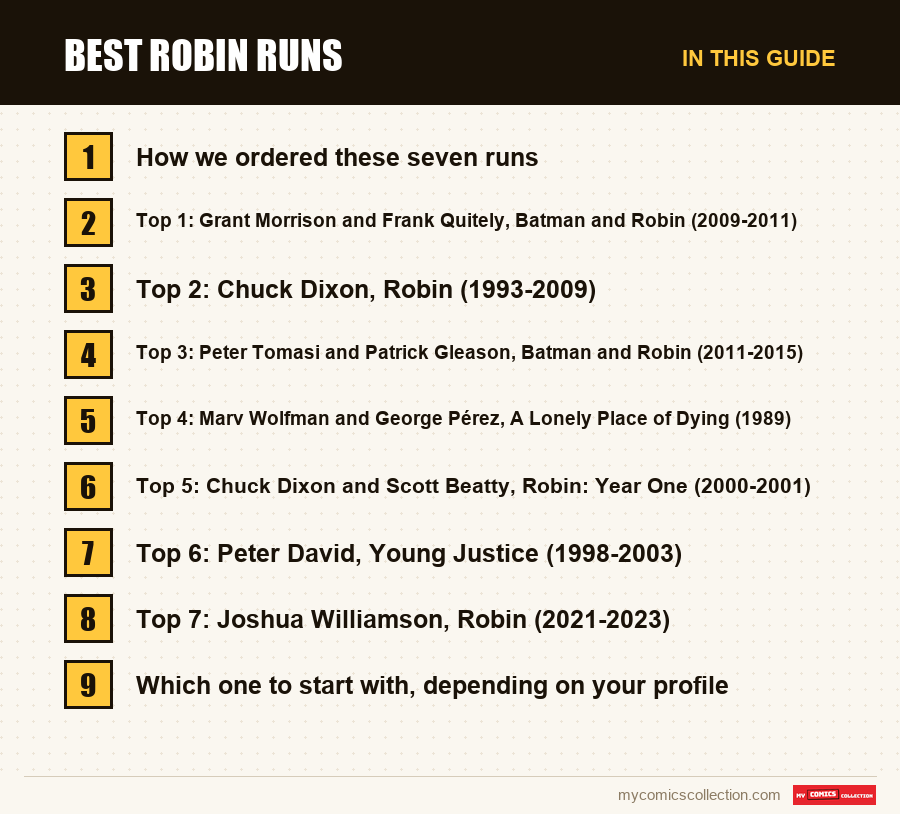
Top 5: Chuck Dixon and Scott Beatty, Robin: Year One (2000-2001)
A four-issue miniseries that revisits Dick Grayson's first months as Robin, with luminous art by Javier Pulido and Marcos Martin. The story shows learning through failure: a boy learning the rules of Gotham while Batman learns to share his territory. The style, close to hand-drawn animation, stands out against the darker productions of the same period.
It matters because it gives a modern answer to the simplest question: why did Batman choose a child? It suits readers discovering the character and collectors looking for a small, complete format, in four single issues or one collected edition. It also serves as a bridge to the character's past, covered in our history of Robin.
For the collection, the miniseries is completed quickly in original issues. The collected edition is more practical, but several editions exist: compare the list of chapters included before paying.
Top 6: Peter David, Young Justice (1998-2003)
When Tim Drake leads a team of teenagers alongside Superboy and Impulse, the tone shifts from crime thriller to teen comedy, with a humor that Peter David clearly wanted. The series runs more than fifty issues over five years; sources differ on the exact count depending on whether you include the specials, so we give no ending number. Todd Nauck is the artist most associated with it.
It matters because it shows Robin out of Batman's shadow, as a team leader rather than a lieutenant. It suits readers who like ensemble series and don't care about Gotham's big dramas. A collector of single issues will find a fully affordable series, with first issues more in demand than the end of the run. The neighboring subject of the Titans is covered in our Teen Titans ranking.
Top 7: Joshua Williamson, Robin (2021-2023)
Launched at the end of 2021, this series follows Damian Wayne in a world martial arts tournament, far from Gotham, with Joshua Williamson writing and artists including Gleason and Simone Di Meo. The number of issues published remains to be confirmed depending on the sources, because the series went through extended arcs and interruptions; we give neither a figure nor an end date.
It matters because it extends the Damian of Morrison and Tomasi into a new setting, where he must earn his place without his father's help. It suits recent readers, who do not need to know the whole of the 2000s. The series is too young for its issues' pricing to be settled; only the length of the run, the reprinting of the first issues and the existence of variant covers will move it. We cite no ratio, for lack of certainty.
To collect it, the collected edition is the reasonable route as long as the series is not closed in your library; the single issue mostly serves to keep a precise inventory of the covers you own.
Which one to start with, depending on your profile
The best entry point depends on how you met Robin.
- You come from reading Batman: start with Morrison's Batman and Robin, then go back to A Lonely Place of Dying to understand why Tim Drake exists.
- You like detective stories: Dixon's series, in single issues or partial collected editions, is made for you.
- You are discovering the character: Robin: Year One, in four issues, asks for nothing but time.
- You prefer humor and teams: Peter David's Young Justice.
- You want something recent: Joshua Williamson's series, in collected-edition order.
If you are torn between Dick Grayson's shoulders and Tim Drake's, the Robin reading guide offers a complete path. For the file on Stephanie Brown and Carrie Kelley, who have no dedicated run in this ranking, the Robin hub gathers the articles that mention them.
What these runs are worth as collectibles
The relationship between a run and its price comes down to two observations. The best-ranked stories here, Morrison and Tomasi, are also the easiest to assemble: large print runs, issues available one at a time, reprinted collected editions. Conversely, the issues that weigh the most in a Robin collection are those from the birth of the role, covered in our Robin key issues, not those of these seven runs.
To estimate a lot, work by category: separate the first issues, which buyers look for, from the middle issues, which sell in bulk. Then compare several completed sales of the same edition, noting the condition and whether or not there is a variant cover. A collected edition is judged on edition, print run and the condition of the spine; it is rarely priced like a single issue.
One method tip for long series like Dixon's: keep a list of missing issues and check it before each purchase, because incomplete lots are paid for by quantity rather than by the issues you are missing.
Frequently asked questions
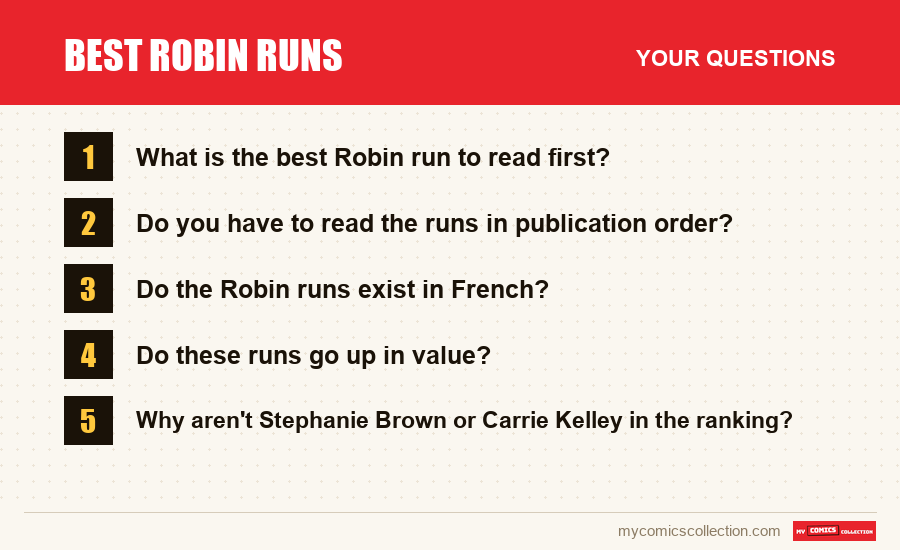
For a Batman reader, Batman and Robin by Grant Morrison and Frank Quitely (2009-2011) is the most accessible and the most striking. For someone who prefers a simple origin, Robin: Year One (2000-2001), in four issues, lays out the role with no prerequisites. The two read separately.
No, each run reads on its own. Only one order is useful: A Lonely Place of Dying (1989) before Dixon's series, because it explains Tim Drake's arrival. Morrison, Tomasi and Williamson follow each other on Damian, but each one recaps the necessary elements.
Some do, notably volumes of Batman and Robin from Urban Comics. Coverage varies by run: Dixon's series is little translated. Before buying a volume, compare its list of chapters with that of the American single issues in the catalog.
Not steadily. The Morrison and Tomasi issues were printed in large numbers and remain accessible. Recent series depend on their length, their print runs and their variant covers. The collecting landmarks of the lineage are rather the debuts of each Robin.
Because their most notable appearances belong to wider events, such as War Games for Stephanie Brown and The Dark Knight Returns for Carrie Kelley, rather than to a run centered on them. They are covered in the Robin hub and in the reading guide.
Your Robin issues, from Dixon's series to Morrison's numbers, deserve an estimate based on the exact edition and condition.
Estimate my comic