A fake comic gives itself away on seven concrete criteria: paper (yellowed cream newsprint vs. modern white), ink (desaturated pigments vs. bright saturated tones), barcode (none before 1974), size (Golden Age 25.9 × 17.8 cm vs. reprints often 25.4 × 16.8 cm), indicia (original legal text vs. a second "Reprint" or "Facsimile Edition" line), weight (35 g for a Silver Age original vs. 45-55 g for a white-paper reprint), and UV fluorescence (1938-1970 paper stays matte under a 365 nm lamp, whereas chemically bleached papers give off a bluish glow). Three titles account for 80% of the scams in 2026: Action Comics #1 (1938), Incredible Hulk #181 (1974), and Amazing Fantasy #15 (1962).
The market for fake comics and reproductions has exploded since key-issue prices took off after 2020. Where an Action Comics #1 in CGC 6.0 tops six million dollars at a Heritage sale, and where a Hulk #181 in CGC 9.8 closes in on sixty thousand dollars, the gap between an original and its clandestine reprint becomes a steady income stream for organized counterfeiters. The line between a legal reproduction (official Marvel facsimile, DC facsimile, promotional reprint) and outright counterfeiting (pirated printing out of Mexico, Hong Kong, Bulgaria) has grown blurry for most American collectors who discover this market through flea markets, yard sales, or online marketplaces.
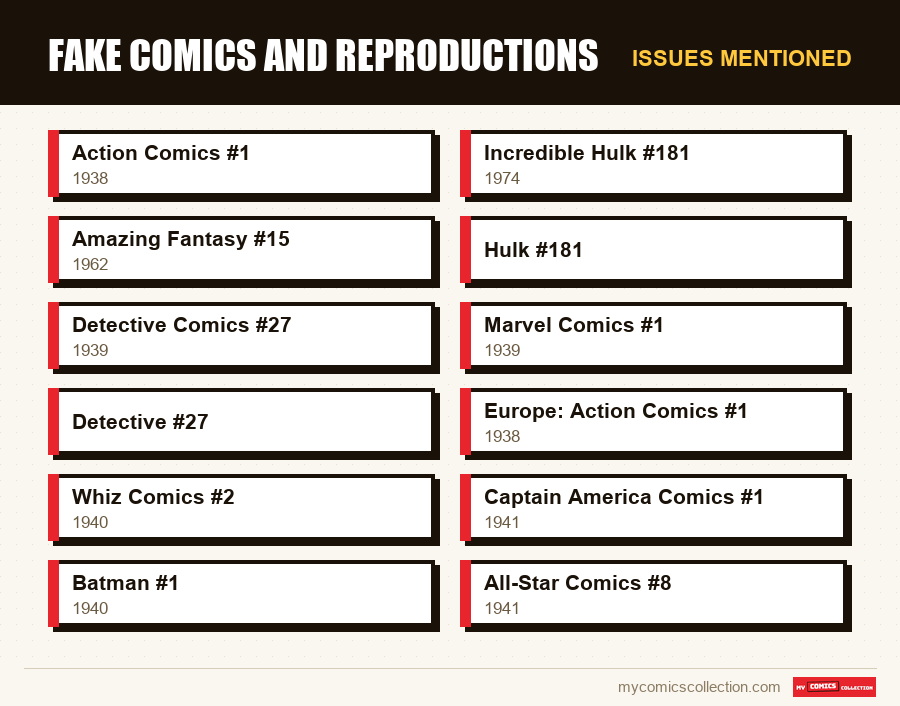
This guide lays out a seven-point authentication method tested by professional graders at CGC, CBCS, and PGX, illustrated with the three most dangerous reproductions in circulation: Action Comics #1 (1938), Detective Comics #27 (1939), and Marvel Comics #1 (1939). It also covers the essential tools (10x loupe, 365 nm UV lamp, pH paper), the classic traps such as the fake newsstand Hulk #181 or the Mexican reprint of Amazing Fantasy #15, and the legal steps to take if you discover after the fact that you were sold a fake. For a safe buying journey, pair it with our checklist for buying used comics in 2026.
Popular reproductions: Action Comics #1, Detective #27, Marvel Comics #1
Three Golden Age titles account on their own for nearly all of the fraudulent reproductions circulating in Europe: Action Comics #1 (June 1938, first appearance of Superman), Detective Comics #27 (May 1939, first appearance of Batman), and Marvel Comics #1 (October 1939, first appearance of the Human Torch and the Sub-Mariner). These three books combine a stratospheric value (between 1.5 and 6 million dollars for CGC 6.0 and higher copies), absolute rarity (fewer than 100 copies recorded for each), and instantly recognizable artwork, which has made them prime targets for counterfeiters since the 1970s.
Action Comics #1 has seen four documented waves of reproductions. The first dates to 1974, when DC published an official 64-page hardcover reprint, "Famous First Edition F-4," faithfully reproducing the entire contents, sold for 1 dollar at the time. This reprint, easily identified by its larger format (28 × 21 cm versus 25.9 × 17.8 cm for the original), remains legal and carries a modest collectible value of around 80 to 150 euros. The second wave covers the 1988 Nestlé promotional copies distributed in batches inside American cereal boxes, on modern white paper with a "Nestlé Quik" note on the back. The third and fourth waves are entirely clandestine: 1990s-2000s Hong Kong printings and post-2015 Bulgarian printings, both designed to deceive online buyers.
Detective Comics #27 follows the same pattern. The official 1974 "Famous First Edition C-28" reprint is the object most often mistaken for the original by heirs who turn up a copy in the family library. This reprint measures 33 × 25 cm, noticeably larger than the Golden Age original. Modern counterfeits, by contrast, use the original 25.9 × 17.8 cm format and call for closer analysis of the paper and ink. Marvel Comics #1 has likewise been available as an official facsimile since 2019 (Marvel Comics #1 Facsimile Edition), sold for 5.99 dollars, reproducing the contents page for page with a "Facsimile Edition" note in the bottom margin. To understand how a recent official facsimile is authenticated, see our comparison Amazing Fantasy #15 facsimile vs. original.
Other regularly reproduced key issues include Whiz Comics #2 (1940, first appearance of Captain Marvel), Captain America Comics #1 (1941), Batman #1 (1940), All-Star Comics #8 (1941, first appearance of Wonder Woman), and Superman #1 (1939). On the European market, reproductions of Batman #1 and Captain America #1 are the ones most frequently seen on Leboncoin, Vinted, and eBay, often listed as "family originals" at prices between 3,000 and 15,000 euros, when in 95% of cases they are the 1974 Famous First Edition reprint or a later counterfeit.
Marvel and DC facsimile editions: the clearly marked official reissue
Marvel launched its Facsimile Edition line in 2018 to make historic issues accessible to new readers without paying prohibitive sums. Each facsimile reproduces the original contents page for page, including the period advertisements (Kellogg's, Charles Atlas, magic kits), the editorial, the letters page, and the upcoming-issue announcements. The suggested retail price ranges from 4.99 to 6.99 dollars depending on page count. Marvel has published more than thirty facsimile titles to date: Amazing Fantasy #15, Tales of Suspense #39, Journey into Mystery #83, X-Men #1, Avengers #1, Incredible Hulk #181, Daredevil #1, and many others.
Identifying a Marvel facsimile takes three seconds by reading the bottom of the cover: the words "FACSIMILE EDITION" are printed in thin black letters in the bottom margin, usually between the title and the edge of the cover. A black-and-white UPC barcode also appears at the bottom left, alongside the modern price ($4.99 or $5.99). The indicia, located at the bottom of the first interior page, always carries a double notice: the original historical text is kept for editorial fidelity, but a second modern legal notice is set beside it with the wording "Originally published in magazine form as [title] #[number]" and the contemporary copyright (for example, "© 2024 MARVEL"). This double indicia is required by U.S. law to flag the reissue status. To analyze a specific facsimile in detail, see our study facsimile vs. original on Amazing Fantasy #15.
DC Comics followed with its "DC Facsimile Edition" program starting in 2019, built on the same editorial logic. DC facsimiles mainly cover Action Comics #1, Detective Comics #27, Action Comics #252 (first appearance of Supergirl), Showcase #4 (first appearance of the modern Flash), and Brave and the Bold #28 (first Justice League). The marking is similar: a "Facsimile Edition" note on the cover, a UPC barcode, a double legal indicia. These official reissues, sold for between 4.99 and 7.99 dollars, pose no authentication problem: any copy sold above 50 euros without a collectible context (creator signature, Foil variant) should be treated as an attempted scam. To verify a certified signature on a facsimile, you can use the official tool described in our guide CGC Lookup Verify Certification.
The resale price of a facsimile on the secondary market stays very modest: 8 to 15 dollars for a raw copy in NM/M condition, 35 to 55 dollars for a CGC 9.8 copy, and 80 to 100 dollars for the rare CGC 10.0. Variants (Director's Cut, Foil cover, signature series) occasionally push prices higher, but the gap with an original stays astronomical: more than 99,999% difference for Amazing Fantasy #15 or Action Comics #1. This market transparency makes any legitimate confusion between a facsimile and an original impossible, which turns any seller who presents a facsimile as an "original" into a clear-cut case of fraud under Article 313-1 of the French Penal Code.
Seven-point authentication methods: paper, ink, barcode, size, indicia, weight, UV
Authenticating a comic follows a protocol of seven complementary steps. No single criterion is enough on its own, but a convergence of at least five positive criteria out of seven establishes a confidence level sufficient for a purchase outside a CGC slab. The first criterion is paper analysis. A Golden Age (1938-1956) or Silver Age (1956-1970) original uses offset newsprint paper, an acidic pulp stock that yellows naturally over the years. The tone ranges from yellowed cream to light brown along the edges after sixty years. To the touch, the paper is fibrous, slightly rough, and gives off a distinctive scent of vanilla and damp earth caused by cellulose breakdown. The pages are thin, almost transparent in places.
The second criterion is ink analysis. On a Silver Age original, the bright colors (red, yellow, blue) have undergone natural desaturation: the red leans toward terracotta, the yellow toward mustard, and the black has bled onto the white areas because of acidic absorption. Modern reproductions, by contrast, show saturated, uniform inks, sometimes slightly glossy because of a contemporary finishing varnish. The third criterion is the presence of the UPC barcode. No Marvel or DC comic before 1974 has a barcode: it was introduced in 1974 for newsstand distribution and in 1976 for the Direct Market. Any pre-1974 cover bearing a barcode is by definition a reprint.
The fourth criterion concerns physical size. The standard Golden Age format measures 25.9 × 17.8 cm. The Silver Age format is slightly more compact at 25.4 × 17.1 cm. Clandestine reprints rarely respect these dimensions to the millimeter: Asian counterfeits are often 25.4 × 16.8 cm, and the 1974 Famous First Edition reprints are noticeably larger (up to 33 × 25 cm). The fifth criterion is reading the indicia, that block of legal text at the bottom of the first interior page. An original indicia names the historical publisher (National Periodical Publications for DC before 1977, Atlas Magazines for Marvel before 1968), a period New York address, and a dated copyright. Any text mentioning "Reprint," "First Printing" followed by a modern date, or "Facsimile Edition" immediately identifies the reissue.
The sixth criterion is weight. An original 32-page Silver Age book weighs 30 to 35 grams on a kitchen scale accurate to the gram. A facsimile or reprint on modern white paper weighs 45 to 55 grams for the same page count, because of the higher density of white offset paper. The seventh criterion is ultraviolet fluorescence. Under a 365 nm UV lamp, original 1938-1970 paper stays matte or gives off a very faint orange luminescence. Modern chemically bleached papers (optical brighteners) give off an immediately visible bluish glow. This UV exam is the fastest discriminating tool in person and remains the one CGC graders use in their first inspection. To compare how the three grading services operate, see our CGC vs. CBCS vs. PGX comparison.
Professional tools: 10x loupe, 365 nm UV lamp, pH paper
Any serious collector investing more than 1,000 euros a year in comics should own five basic authentication tools, whose total cost does not exceed 150 euros. The first tool is a 10x binocular loupe with built-in LED lighting, the "jeweler's loupe" type used in watchmaking. Recommended models: Belomo 10x21, Carson MagniFlip, or Bausch & Lomb Hastings Triplet. This loupe lets you examine the print screen: a Silver Age original shows an offset screen at 65 lines per inch (LPI) with well-defined circular dots, whereas a modern digital print shows a stochastic screen with no regular pattern or a finer 150 LPI screen. This difference is immediately visible under 10x magnification.
The second tool is a professional 365 nm UV lamp. Be careful: the cheap UV lamps sold in big-box stores run at 395 nm and are useless for authentication because they do not properly excite modern optical brighteners. Go for a 365 nm lamp fitted with a Wood's filter (black glass), models such as the Convoy S2+ Nichia 365UV or the UV-Tech UV365B. The test consists of shining light on the cover and several interior pages in a completely dark room: original pre-1970 paper stays matte, whereas modern paper or paper bleached during restoration gives off a characteristic bluish glow. This tool also detects brush touch-ups (modern pigments fluoresce differently) and the glues used in undisclosed restorations.
The third tool is a set of pH paper (0-14 strips) or a pH testing pen. An unrestored Golden Age comic shows a paper pH between 4.5 and 5.5 (the natural acidity of degraded newsprint pulp). Modern paper measures 6.5 to 7.5 (neutral or slightly basic). A pH 7+ reading on a comic presented as dating from the 1940s or 1950s betrays either an alkaline restoration (deacidification) or a counterfeit on modern paper. The fourth tool is a kitchen scale accurate to the gram, under 15 euros, to measure the book's overall weight and compare it with the reference values in CGC databases.
The fifth tool is a digital caliper accurate to a tenth of a millimeter, to measure the book's exact dimensions, the thickness of the pages, and that of the cover. Modern counterfeits often use paper of uniform thickness, whereas originals show a cover (a stiffer cover made of light glossy card stock) clearly distinct from the interior pages (thin newsprint). A cover the same thickness as the interior paper immediately betrays the reproduction. For purchases above 5,000 euros, always request an appraisal by a certified professional before the transaction: the CGC or CBCS pre-screening procedure costs less than 100 euros and offers a guarantee that is hugely disproportionate to the risk it removes.
Collecting this series?
Track what you own, what you are missing and what your collection is worth. 7 day trial.
Start my trial →Classic traps: Hulk #181 fake newsstand, Amazing Fantasy #15 Mexican reprint
Two recurring scams deserve particular vigilance because they target the most coveted key issues of the 2026 market. The first is the Hulk #181 fake newsstand. Incredible Hulk #181 (November 1974) is the first full appearance of Wolverine and one of the three major Bronze Age keys. Its value in CGC 9.8 tops 60,000 dollars in 2026, and the "Mark Jewelers" copies (a special edition meant for U.S. military bases, ultra-rare) top 130,000 dollars. This difference in value has inspired a specific fraud: take a standard "Direct Market" Hulk #181 and add a fake Mark Jewelers advertising insert by hand between pages 12 and 13 to resell it for 50 to 100 times its value.
Authenticating a genuine Mark Jewelers Hulk #181 comes down to examining the insert paper (a glossy paper slightly different from the newsprint of the regular pages), reading the advertising layout (Mark Jewelers logo with a Texas address), and checking the binding alignment (the authentic insert was bound in at the factory, so its binding follows the center stitch perfectly). Any listing for a Hulk #181 Mark Jewelers sold without CGC or CBCS certification should be treated as suspect. To dig into Bronze Age price variants, see our feature Hulk #181 Canadian Price Variant: the collector premium, which details a closely related authentication case.
The second recurring scam is the Mexican reprint of Amazing Fantasy #15. In the 1970s, the Mexican publisher Editorial Novaro released a licensed Spanish-language version of Amazing Fantasy #15 under Marvel license, on local newsprint, with a cover nearly identical to the original and a Spanish indicia naming Editorial Novaro Mexico. Thirty-five years later, unscrupulous sellers remove the Spanish back cover, reconstruct an English-language indicia copied from an original, and sell the result as an "original 1962 with restoration." The trap is effective because the 1972 Mexican paper has indeed aged to yellow with time, giving the illusion of degraded 1962 paper.
Identification comes from three cross-checks. First, reading the interior: despite the doctored indicia, the interior dialogue balloons often stay in Spanish or carry traces of overprinting. Next, the 1972 Mexican print screen is noticeably coarser (45 LPI) than the 1962 American print (65 LPI), a difference visible under a 10x loupe. Finally, the Mexican format typically measures 25.2 × 16.5 cm versus 25.4 × 17.1 cm for the American Silver Age original. Other titles have been the subject of Latin American reprints with the same fraudulent pattern: Tales of Suspense #39, Journey into Mystery #83, and X-Men #1 all have their 1970s Novaro Mexico equivalents regularly disguised as originals. To recognize modern variants such as 3rd printings, see our study New Mutants #98 3rd Print Deadpool: the real value.
What to do if you discover a fake: legal recourse against the seller
Discovering a fake comic after a purchase opens up several legal remedies depending on the sales channel and the seller's status. The first reflex is to document the fake immediately. Photograph the copy from every angle with a graduated ruler, capture the bottom of the cover (barcode, price), the indicia, the print screen under a loupe, and the UV exam (the bluish glow betraying modern paper). Keep the original packaging, the sales listing with a timestamp (an archive.org screenshot if necessary), the written exchanges with the seller, the proof of payment, and the shipping slip. This file will be the cornerstone of any later recourse.
The second step is to obtain an independent appraisal. A written certificate from a CGC or CBCS grader or a certified expert (Heritage Auctions, ComicLink, a court-appointed expert) constitutes the technical evidence you can use against the seller. The cost of such an appraisal (150 to 400 euros depending on the item's value) stays far below the loss and determines whether a legal action is admissible. The third step consists of putting the seller on formal notice by registered letter with acknowledgment of receipt, based on Articles 1641 and following of the French Civil Code (hidden defects) and Article L. 217-4 of the Consumer Code (lack of conformity), backed if necessary by a criminal classification under Article 313-1 of the Penal Code (fraud).
The limitation period is two years from the discovery of the defect for the hidden-defects warranty action (Article 1648 of the Civil Code) and five years for the action to void the sale for fraud (Article 2224). If the seller is a professional (a shop, a dealer registered in the trade register), the competent court is the commercial court or the judicial court depending on the amount. If the seller is a private individual on Leboncoin, Vinted, or Facebook Marketplace, the matter falls to the judicial court, and an amicable resolution through a consumer mediator remains possible. For the overall tax framework of a comic resale in France, see our feature limitation periods and comic resale in France 2026.
For purchases made on eBay, ComicConnect, Heritage Auctions, or Catawiki, each platform offers a specific buyer protection program. The eBay Money Back Guarantee covers items that do not match the description for 30 days after receipt (extendable to 90 days for "Top Rated" buyers). Heritage Auctions guarantees the authenticity of all its lots for life, with a full refund in the event of a documented dispute. ComicConnect offers a 7-day guarantee on Buy It Now purchases. To avoid getting to that point, always get a free preliminary estimate and favor copies already certified by CGC or CBCS. For reading a restored slab, see our feature CGC restored purple label and discount and the one on CGC qualified green label: when to buy. For safe purchases, start with our catalog of authenticated comics.
FAQ: Fake comics and reproductions
How can you tell an original from a Marvel or DC facsimile in under a minute?
Three moves are enough. First, look at the bottom of the cover: every official Marvel or DC facsimile published since 2018 shows a "Facsimile Edition" notice printed in thin black letters in the bottom margin, alongside a modern UPC barcode and a current price ($4.99 or $5.99). Second, open to the first interior page and read the indicia: a facsimile always carries a double legal notice with the wording "Originally published in magazine form as" and a modern copyright (for example, "© 2024 MARVEL"). Third, examine the paper: a Golden Age or Silver Age original shows fibrous yellowed cream paper, whereas a facsimile uses smooth, uniform modern white paper. These three converging criteria remove all ambiguity.
Is a comic sold at a flea market for 50 € as an original Action Comics #1 necessarily a fake?
Yes, 99.9% of the time. The CGC census for Action Comics #1 does not exceed 90 copies recorded as graded, fewer than 10 of which are CGC 6.0 or higher. Any copy identified as an original 1938 is worth at least 500,000 dollars even in grade 0.5 (Poor). An Action Comics #1 sold for less than 50,000 euros without CGC or CBCS certification is statistically a reproduction (the official 1974 Famous First Edition reprint, a 1988 Nestlé promotional copy, an Asian or Bulgarian counterfeit). If the copy is more than 26 cm tall or carries a UPC barcode, it is a reprint. If the paper is modern white, it is an official DC facsimile worth 5 to 30 euros on the secondary market.
Which comics absolutely need to go through a CGC or CBCS grader before purchase?
Any comic worth more than 500 euros warrants professional grading first. The practical rule of seasoned collectors: if the expected value exceeds three times the cost of a CGC Economy grading (about 35 dollars for a modern comic, 75 dollars for a Golden Age book), grading pays off. In concrete terms, this covers all pre-1980 Marvel and DC key issues (Amazing Fantasy #15, Action Comics #1, Hulk #181, X-Men #1, Tales of Suspense #39, Detective Comics #27, Showcase #4, Brave and the Bold #28), rare modern variants (New Mutants #98, Walking Dead #1), and all signed copies. The CGC slab adds a sealed layer of authentication that is verifiable online through the official verification tool.
What is a 1974 Famous First Edition reprint worth (Action Comics #1, Detective #27)?
The Famous First Edition reprints published by DC in 1974 retain a modest but real collectible value. The Action Comics #1 Famous First Edition F-4 trades between 80 and 150 euros for a copy in very good condition, up to 250 euros for a copy still sealed in its original envelope. The Detective Comics #27 Famous First Edition C-28 ranges between 70 and 130 euros, and the Whiz Comics #2 Famous First Edition between 50 and 100 euros. These objects remain legitimate and clearly identifiable (33 × 25 cm format, far larger than the original; white paper; "Famous First Edition" notice on the cover). They have their audience among DC nostalgics but must never be presented or bought as Golden Age originals.
What procedure should you follow if you are sold a fake comic on Vinted, eBay, or Leboncoin?
Four successive steps. First, contact the seller within 48 hours through the platform's messaging, laying out the problem with detailed photos (cover, indicia, barcode, paper under UV) and requesting a full refund. Second, if there is no satisfactory response within 7 days, open an official claim through the platform's buyer protection program (eBay Money Back Guarantee, Vinted Buyer Protection, a Leboncoin report). Third, in parallel, obtain an independent appraisal from CGC, CBCS, or a certified expert (cost 150-400 €, turnaround 2-4 weeks). Fourth, if the dispute is not resolved, put the seller on formal notice by registered letter, invoking hidden defects (Article 1641 of the Civil Code), and consider filing a fraud complaint (Article 313-1 of the Penal Code) with your local police station. The platform will hand over the seller's file on a judicial request.
Related articles
- Amazing Fantasy #15 facsimile vs. original
- CGC Lookup Verify Certification
- CGC vs. CBCS vs. PGX comparison
- Hulk #181 Canadian Price Variant
- Buying a used comic: 2026 checklist