In France, a single booklet can contain four American episodes at once: an announcement noted on August 30, 2026 writes it in black and white, “out of series # 29 = Timestorm 2009-2099 - # US 1 to 4”. French numbering and American numbering therefore never overlap box by box, and there is no official table to go from one to the other. On this survey, carried out on the French market and in euros, and not in dollars like most of the measurements published here -, the query "Spider-Man 2099 Panini" only returned 18 advertisements, between €4.00 and €79.00, median €14.20, without the slightest verified copy. These are amounts requested that day by sellers, not completed transactions.
The collector who owns two editions of the same character quickly encounters a frustration that no product sheet solves: he does not know what he has in duplicate. Its American row advances in units, one episode per issue, and its French row advances in blocks, three or four episodes stapled together under a number that has no connection with the previous ones. Nothing on the French cover indicates which American chapters lie inside. The only information available, on the day of the statement, came from the sellers themselves: some take the trouble to write the correspondence in the title of their ad, most do not.
It is a difference of nature, not of degree. The market reports usually published on this site relate to American announcements denominated in dollars; this was made on the French market, and all the amounts that follow are euros. Directly comparing these euros to dollars recorded elsewhere would make no sense: these are two markets, two editions, two divisions of the material. The following explains why converting a French collection to an American collection is a matching job, and why this work falls entirely on the buyer.
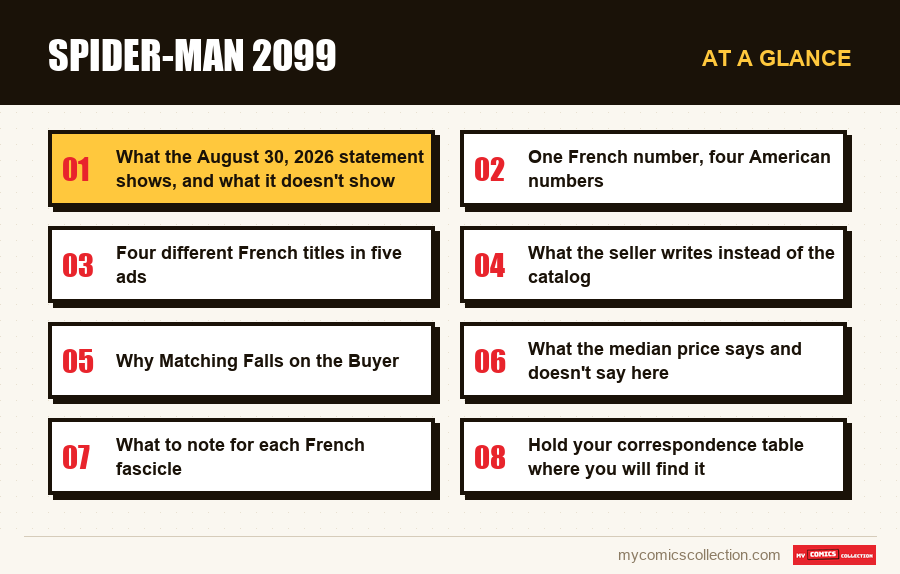
What the August 30, 2026 statement shows, and what it doesn't show
The query “Spider-Man 2099 Panini” returned eighteen listings on August 30, 2026. Eighteen. It's not a deal, it's a sample. The lowest amount was €4.00, the highest was €79.00, and the median value was €14.20. No copies verified by a certification body were included in this set, which means that the entire sample describes raw fascicles, described by their owner and no one else.
These three figures must be handled with care. They describe amounts claimed by sellers on a given date, not amounts collected. An ad can remain online for months without finding a buyer; however, it continues to weigh in a median calculation. The maximum of €79.00, isolated at the top of such a small sample, tells nothing about the level of the market: it only teaches what a seller was hoping to get that day. A single optimist is enough to pull one end up when there are only eighteen lines.
We must also refuse a conclusion that we would be tempted to draw too quickly. A measurement taken on a single date does not describe any movement. Nothing here says that these amounts go up, down or stagnate: to confirm this, we would need at least a second photograph taken later and compared to this one. As long as this second measure does not exist, the only honest sentence is this: this is what was requested on August 30, 2026, period.
Finally, eighteen announcements on a character who has seen several series and several decades of publication, this means that the French offer is narrow. This narrowness has a very concrete practical consequence: anyone looking for a specific booklet does not choose between ten copies, they wait for only one to reappear. And when he reappears, he doesn't necessarily have the time to discuss the price.
One French number, four American numbers
The special edition at €4.00
The announcement “SPIDER-MAN special edition # 29 = Timestorm 2009-2099 - # US 1 to 4” is the central document of this statement. The seller writes the equation himself: one French number equals four American numbers. This is the lowest amount in the sample, €4.00, and it is also the most informative ad of the eighteen.
The letter suffix number
“SPIDER-MAN 17 B 17B Nov 2014 Spiderman 2099 Superior Panini”, offered at €4.80, has a number followed by a letter. The seller also writes the reference twice, with and without a space, a sign that he knows that the letter is part of the identifier and that he fears that it will not be seen.
The three-series booklet
« All New Spider-Man - 005 - 2016 - Amazing, Le Petit Nouveau, 2099 », at €6.90, contains three different series under one cover. This booklet does not belong to any of the three collections: it belongs to all three at the same time, which makes it unclassifiable in an arrangement by series.
The number at volume and position
“SPIDER-MAN # 8 VOLUME 5 (V5) SPIDER-VERSE 3/4 […] PANINI”, at €5.00, stacks three coordinates: a number, a volume, and a position in an arc announced as third out of four. The number 8, alone, does not designate anything specific in this set.
These four ads tell the same story in four forms. The identifier of a French issue is not a number: it is a set of coordinates of which the number is only one component. Title of the publication, number, possible letter suffix, possible volume number, possible position in an arc, and finally actual content expressed in American numbers. Remove just one of these coordinates and you no longer know what object we are talking about.
The correspondence between the two numberings is not systematically published anywhere. It circulates piecemeal, in the wording of advertisements, when the seller considers it useful to write it. This means that information essential to the purchase depends on the care of an individual, and that it disappears the day the ad is removed.
Direct consequence: copy this correspondence into your own inventory at the time of purchase. If you don't do it that day, you won't find her. The booklet does not necessarily have it on its cover.
Four different French titles in five ads
The most destabilizing detail of the survey is not the grouping of the episodes, it is the dispersion of the titles. Of the five detailed announcements, we find a special issue, a title numbered by volume, and two publications with a distinct name, one of which uses the word “new” in its summary. Four different brands, therefore, for a subject which on the American side can be read under a single continuity.
This dispersion is not a publisher's accident: it is the normal functioning of a periodical publication market which recomposes its catalog over the years. A title stops, another takes up the material, a third mixes it with other series, a special issue collects a complete story in one go. The character goes through these changes without anything in his name indicating under which sign to look for him at a particular period.
For the collector, this completely changes the research method. Searching for a character by name is not enough: you need to know the list of titles that published them, and search for each of them separately. This is exactly the opposite of the natural reflex, which consists of typing a hero's name into a search bar and believing that the result is exhaustive. On this survey, a single request returned four signs; nothing says she returned them all.
This is also the reason why a poorly kept French library gives the illusion of being complete. You have all the numbers of the title you are following, so you think you are up to date; but the rest of the story has migrated to another publication that you do not buy, and the hole is not visible in your storage. The lack only becomes apparent when reading, when an episode begins with an event you never saw happen.
This problem is not unique to this character. It is the same for any figure who has spanned several decades of French publishing, and it applies to both leading heroes and supporting roles; anyone who wants to measure the gap between the two logics can compare with the editorial history of the main American series, where the numbering remains continuous over hundreds of publications.
What the seller writes instead of the catalog
Correspondence to the American edition
“# US 1 to 4”: four characters which replace a missing concordance table. When the seller writes it, the ad becomes usable; when he does not write it, the buyer cannot know if he already owns the content.
Month and year of publication
“Nov 2014”, “Feb 2017”, “2016”: the French date serves as a backup reference when the number alone is ambiguous. Two different publications can carry the same figure a few years apart.
Le suffixe de lettre
“17 B”, repeated as “17B” in the same ad. The seller doubles the mention because he knows that a buyer in a hurry will read 17 and think he has it. The letter changes the object, not just its label.
Multi-series content
“Amazing, Le Petit Nouveau, 2099”: the seller lists the three series present in the booklet. Without this listing, the buyer looking for one of the three would never have found the ad.
Le numéro de volume
« VOLUME 5 (V5) »: here again a voluntary redundancy, in full and then in abbreviation. On a title relaunched several times, number 8 exists as many times as there are volumes.
Position in the arc
“3/4” indicates that the booklet is the third in a set of four. This is reading information, not identification: it tells the buyer how many booklets remain to be collected to understand the story.
Added together, these six mentions form the descriptive sheet that the French edition does not provide on its own. They are written by individuals, in a free field, without standards and without obligation. Their quality therefore varies enormously from one ad to another, and the survey shows that the most precise sellers are not the most expensive: the most informative ad of the eighteen was also the least expensive, at €4.00.
Collecting this series?
Track what you own, what you are missing and what your collection is worth. 7 day trial.
Start my trial →Why Matching Falls on the Buyer
A reference catalog lists publications; it does not list equivalences between national editions. Each edition has its own division logic, decided by a local editor according to its format, its calendar and its audience. There is no authority responsible for publishing the table that connects the two. The matching work therefore exists, but no one is responsible for it, and it mechanically falls on the person who buys.
This work is laborious but doable, provided you do it at the right time. The right time is the moment of purchase, when the ad is still in front of you and the seller has written what he knows. Several months later, with the booklet in hand and the announcement gone, it is necessary to reconstruct the correspondence by deduction, by comparing the stories page by page. The cost of reconstruction is out of all proportion to that of simple copying.
There is a second, more insidious effect. Until the match is noted, the buyer cannot detect its own duplicates between editions. One day he will buy, on the American side, an episode that he already owns in French without knowing it, or vice versa. On a sample as narrow as eighteen ads, wasting an opportunity on an unintentional duplicate is not trivial: the next opportunity will not present itself the following week.
Finally, this pairing changes the way you spot a shortage. In an American collection, a hole is visible: a number is missing in the following. In a French collection, there is no continuous sequence to monitor, since the blocks overlap, overlap or skip passages. The only reliable reference remains the original numbering, which requires having recorded it for each French issue. Those who reconstruct a continuity of this type have an interest in relying on the character's publication history rather than in order on their shelf.
What the median price says and doesn't say here
A median of €14.20 calculated over eighteen lines does not have the same robustness as a median calculated over several hundred. It indicates an order of magnitude, nothing more: on this market and on this date, a French booklet linked to this character most often fetched around ten euros. The five detailed listings, all between €4.00 and €6.90, are placed well below this median, suggesting that the top half of the sample is driving the value up without knowing why.
It is also necessary to measure what the absence of verified copies implies. None of the eighteen listings were based on a third-party condition assessment. Each condition description is therefore the seller's word, and the price difference between two identical items can reflect a real condition difference as well as a simple difference in appreciation. For such modest amounts, few sellers undertake a certification process, and this is consistent with what we observe here.
What the price doesn't say is the quantity of content purchased. A €4.00 booklet which contains four American episodes and a €4.80 booklet which contains only one are not comparable, even if their labels are similar. The price per story unit therefore varies much more than the displayed price, and this variation is invisible to anyone who does not read the advertised content. Those who optimize their purchases will find other levers in low budget shopping methods.
Last reservation, the most important: eighteen announcements do not allow us to conclude on a price level. Such a thin sample reacts violently to the arrival or removal of a single line. The median recorded is a provisional benchmark, to be revised as soon as a more detailed reading is available, and certainly not a value to oppose to a seller.
What to note for each French fascicle
The exact French title and its complete number, suffix included.“Spider-Man 17 B” is not “Spider-Man 17,” and “Spider-Man 8 Volume 5” is not “Spider-Man 8.” Note the entire chain as it appears on the cover, letter included, volume included. The number alone is not enough to identify any of the issues in this survey.
Correspondence to American numbers, when known. If the seller writes “# US 1 to 4”, copy it immediately into your file. This is the only data that will allow you to know later if you really miss an American episode. If the seller does not write it, explicitly note "unknown correspondence" rather than leaving the field empty: an empty field is confused with an oversight, an explicit mention is dealt with.
The other series contained in the same issue. A number which brings together three series must appear in the three files concerned, or at least carry the complete list of what it contains. Otherwise, you will put it under a single series and it will become impossible to find when you look for the other two.
The French publication date. November 2014, February 2017: these dates are your safeguard against number homonyms between successive publications. When two issues bear the same number under two different signs or two volumes, the date separates them unambiguously.
The price paid, including shipping, and the date of purchase. In an eighteen-listing marketplace, your own purchase history quickly becomes a better source than any public record. Postage is heavy on booklets costing a few euros: an amount noted excluding shipping costs will mislead you the next time.
No, and that's precisely the problem. The survey shows a documented case where a special issue contains American issues 1 to 4, but the number of episodes grouped varies from one publication to another and from one period to another. There is no general rule to guess: the only reliable method is to read the content announced issue by issue.
There is no published and systematic version. On this statement, the correspondence appeared only in the wording written by a seller, on his own initiative. It is a valuable but fragile source: it disappears with the announcement. The only practical remedy is to build your own table, line by line, as you make your purchases.
Because the reading of August 30, 2026 was carried out on the French market, and not on the American market like most of the measurements published here. The eighteen advertisements identified were denominated in euros. These amounts cannot therefore be directly compared to the statements in dollars: the editions, divisions and sales channels differ.
Little thing taken in isolation. Eighteen lines constitute a very small number, sensitive to the removal or addition of a single ad. The median of €14.20 gives an order of magnitude of the sums requested that day, not an established market level, and it says nothing about a possible evolution since it is based on a single measurement.
By refusing to choose. A booklet bringing together three series does not belong to any of them: it must be recorded once, with the complete list of its contents, then made visible from each of the series it contains. It's the same puzzle posed by old collections with multiple contents, transposed to a modern publication.
Hold your correspondence table where you will find it
French number with suffix, American episodes contained, additional series, publication date, price paid including shipping: five fields that don't fit in a head and get lost in a notebook. My Comics Collection keeps them together, issue by issue, and shows you what's really missing before you buy a duplicate.