On the French market, some comic book announcements are published with a title passed to automatic translation: the name of the series, the name of the arc, the type of variant and the grade are translated into French, each independently. A list of 192 advertisements taken on August 30, 2026 on the query “spider-gwen” had 21 occurrences of the word “Variant” against 17 of the word “Variant”: the same word, cut into two almost equal halves. Direct consequence for those who keep an inventory: the advertisement title is not a reliable source of identification, and two copies of the same issue may have no words in common.
There is a difference in nature between a misspelled ad title and a translated ad title. The first remains relatable: “Spider Gwen” without a hyphen comes effortlessly closer to “ Spider-Gwen ”. The second is not, because the translation does not distort the word, it replaces it with another. “Ghost-Spider” becomes “The Spider Ghost”. There is no longer a common letter between the starting string and the ending string. No spelling tolerance, no character distance, no approximate approximation crosses this gap.
The phenomenon is not anecdotal and it does not concern an isolated seller. It affects €2 ads as well as €48 ads, booklets and collections, and it appears on several layers of the same title at the same time. It is this superposition which makes it a cataloging problem rather than a linguistic curiosity: each layer is translated or not independently of the others, which multiplies the possible forms of a single object.
What exactly the reading shows
The survey relates to a single request, “spider-gwen”, placed on August 30, 2026 on the French market, and to the 192 advertisements retained after excluding the lots and objects which are not publications. All amounts cited in this article are prices asked by sellers on this date. None is a concluded sale, and a statement taken on a single date shows no evolution: it describes the status of the offer at a moment, nothing else.
Of these 192 announcements, the count of forms is as follows. The word “Variant” appears 21 times, the word “Variant” 17 times. The “Amazing Spider-Man” channel appears 22 times. Format notices in parentheses, “(Pocket)” and “(Hardcover)”, appear 26 times. The state vocabulary is translated twice as “Almost Perfect” and left four times as “Near Mint”. The distribution circuit is written twice “Direct Market” and twice “Direct Market”. The word "Virgin", which makes English blank, appears twice.
These numbers are modest taken one by one. It’s their relationship that counts. Twenty-one against seventeen, two against two, two against four: neither form clearly wins over the other. It is therefore not a question of a minority convention that we could ignore, nor of a dominant convention with which we could align ourselves. The two regimes coexist in comparable proportions in the same result set, on the same day, for the same query.
Four layers of translation in the same title
A comic announcement title generally carries four distinct pieces of information: the name of the series, the name of the arc or collection, the nature of the copy, and its declared condition. Machine translation processes each separately, and the result combines translated layers and layers left as is.
The name of the series
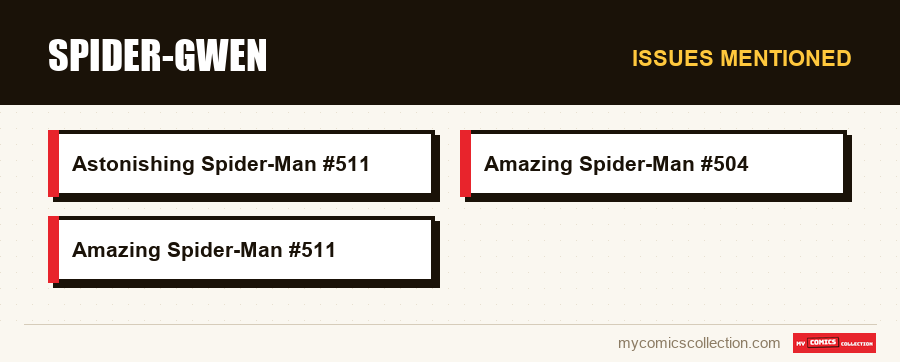
“Astonishing Spider-Man #511”, priced at €3.63, designates a book whose series was never called that. Twenty-two advertisements in the survey bear this form. The number remains true: it is the only element of the title that has survived the passage.
Le nom de l'arc
“Spider-Gwen Shadow Clones#1”, asked €44.33, and “Spider-Gwen The Spider-Ghost#1”, asked €23.70. Two arc titles rendered word for word, without the translation corresponding to a title used by the French edition.
The nature of the copy
“Virgin 1:50 Variant”, “Baby Variant”, “Venomized Variant”. Coverage type is translated, drawdown ratio is not. The €48.34 ad combines the two regimes in the same expression.
The declared state
“Almost Perfect NM” keeps the English acronym alongside its own translation. Another ad from the same market says “NEAR NEW CONDITION NM”. Three formulations for a single notion, two of which do not exist in any scale.
The most instructive case in the report is in two neighboring lines, at the same price of €3.63, from what appears to be the same seller. The first is written “Amazing Spider-Man #504 Marché Direct ~ NEAR MINT NM”. The second, “Amazing Spider-Man #511 Direct Market ~ Almost Perfect NM”. Two issues of the same series, seven numbers apart, put on sale on the same day: the name of the series is translated on one and not on the other, the distribution circuit is translated on the other and not on one, the state is translated on the second and not on the first. The translations are exactly reversed from one line to the next.
This inversion is the decisive point. If the translation were systematic, we could undo it: all that would be needed was a correspondence table applied to all the titles. If she wasn't there, there wouldn't be a problem. It is applied irregularly, layer by layer, line by line, and it is this irregularity that prohibits any automatic processing.
In other words: the title of an ad is not editorial data. It is a sales text, produced by a technical chain whose functioning is unknown, and from which we cannot deduce what the seller really owns.
Why “Variant” and “Variant” never come together
An internal search engine, that of a personal inventory like that of a marketplace, brings together character strings. It tolerates one extra letter, one capital letter, one hyphen. He doesn't make a change of word. “Variant” and “Variant” are close: a letter separates them, a tolerant engine will perhaps bring them together. “Ghost-Spider” and “The Spider Ghost” share nothing, and no tolerance adjustment will ever bring them together without bringing together thousands of pairs that have nothing to do with each other at the same time.
It should be added that certain translations produce collisions within French. The word “Virgin” make english here blank, which designates a cover left blank to be dedicated or drawn. But “virgin” is a common word in the vocabulary of French collectors in a completely different sense, that of a copy never read or never handled. A search for this word will therefore bring up two populations of unrelated ads, and nothing in the title allows them to be separated. The same reasoning applies to “Poche” and “Relié”, which designate specific editorial formats in French, and which are used here to render Anglo-Saxon sales categories whose scope does not coincide.
A final element of the survey deserves to be noted for what it reveals about ambient noise. Among the results of the query is an advert for €36.57 whose title combines the name of the character with a description of a luminous object measured in centimeters. This is not a publication. However, it goes back into the same set of results as the booklets, with a price which is inserted in the middle of their distribution. Any statistics established without deviating from these lines are distorted by objects which are not at all what we think we are measuring.
Collecting this series?
Track what you own, what you are missing and what your collection is worth. 7 day trial.
Start my trial →Six concrete consequences for an inventory
Search by title becomes partial
Search for “Amazing Spider-Man” does not bring back the twenty-two “Amazing Spider-Man” written ads. The collector thinks he has seen the entire offering when he has seen a fraction of it, without any signal warning him of what is missing.
Variant type is no longer comparable
“Baby Variant” and “Baby Variant” denote the same coverage treatment. Placed in the same field, they create two categories where there is only one, and distort any counting by type.
The declared state ceases to be a scale
“Almost Perfect” and “Near new condition” are not included in any state scale. These are paraphrases. Saving them as is amounts to mixing measurements and impressions in the same column.
Only the number remains stable
In all the examples noted, the number passes through the translation without damage. It is the only element on which to rely with confidence, and this is precisely why it is not enough to identify a copy.
Format and support merge
«(Pocket)» appears on collections whose French format does not correspond to what the word usually designates. Twenty-six advertisements in the survey bear a mention of this type: this is the most frequent layer, and the most misleading.
Averages become illegible
An object that is not a publication, slipped into the middle of the issues, shifts the median without any line indicating it. A statistic is only reliable if we know exactly which lines it counted.
What this statement does not establish
Here we must dwell on a temptation. Having noted that the translations reverse from one line to the next, we would like to conclude on their cause: a put-on-sale option activated intermittently, a batch publication tool, a translation layer applied on the marketplace side rather than on the seller side. The survey does not allow us to decide between any of these hypotheses. It shows states, not mechanisms, and the text of an ad is not a source for how it was produced.
Nor does it allow us to assert that the phenomenon is expanding or shrinking. A single date does not measure any movement. What it establishes is more modest and more solid: on this date, on this request, the two writing regimes coexisted in comparable proportions. This is a formal observation, and it is more than enough to decide how to record the information: which is the only question that concerns us here.
Finally, nothing in this statement says that a translated title indicates a less serious announcement or a copy of lower quality. The prices asked on the translated lines cover the same range as the others, from a few euros to several dozen. The title is an identification issue, not a clue to the seller.
Collection side: what to record
The rule can be summed up in one sentence: never register a copy by the title of the ad, register it by the cover. The ad title is used to find the item, not to describe it. Once the copy is received, it is the print that is authentic, and that alone.
Concretely, this involves separating in your file what comes from the seller from what comes from the object. The name of the series, the number, the publisher and the year can be read on the cover or in the title: these are data. Cover type, draw ratio and stated condition come from the seller until you verify it yourself: these are claims. Mixing them in the same fields amounts to giving a sales phrase the status of an established fact.
Three habits make this sorting feasible. The first is to keep the full announcement title in a notes field, without correcting it, rather than copying it into the structured fields. It keeps its trace value, this is what will allow you to find the purchase later, without contaminating the own data. The second is to enter the series name in the form printed on the copy, once and for all, and never vary it depending on how the ad wrote it. The third is to only fill in the state with the values of the scale you are using, leaving the field empty rather than entering a paraphrase taken from an announcement.
This discipline has a real cost: it requires reopening the object rather than recopying a line. It has a benefit which is much greater: your inventory ceases to depend on the way in which a third party has written, or had it written, their showcase. An ad title disappears when the ad is removed. What you read on the cover remains true.
There remains one case that this method does not resolve and which must be accepted: that of the remote purchase not yet received. As long as the copy is not in your hands, you only have the ad title and photographs. The best practice is then to record the line as provisional, with the explicit mention that it has not been verified, and to resume it upon receipt. A listing marked as unverified is useful information. A false sheet presented as secure is not.
Because the title went through an automatic translation which treated the proper name as ordinary text. “Amazing Spider-Man” becomes “Amazing Spider-Man”, form noted twenty-two times on August 30, 2026 on a single request. The series never bore this name: it is a production of the technical channel, not an editorial designation, and it does not correspond to any real French edition.
No. This is a word for word translation of Near Mint, and it does not belong to any state scale. The statement also shows another ad writing “Near new condition” for the same concept. Three formulations circulate for a single idea, two of which are paraphrases. To record, we remember the scale we use, never the paraphrase of the ad.
They should not be corrected, they should be put elsewhere. Keep the full announcement title in a notes field, as is, and fill in the fields structured according to the cover of the copy. Correcting an ad title is like rewriting a trace: you lose proof of what you purchased without gaining reliable data.
Nothing in the statement allows us to confirm this. The prices asked on the translated lines cover the same range as on the others, from a few euros to several dozen. The same seller also appears with translated and untranslated titles, for neighboring issues of the same series. This is an identification problem, not an indication of the quality of the ad.
By querying both forms rather than just one, and accepting that no query is exhaustive. The number passes through the translation without damage: it is the most reliable point of support, associated with the publisher and the year. A search on the name of the series alone, whatever its language, will always leave part of the offer out of the field.
Keep the exact track, not the seller's phrase
My Comics Collection separates what you read on the cover from what the ad claimed, and keeps the two without confusing them.