On modern series, a new printing often arrives with an entirely different cover illustration. The reprinted booklet is therefore no longer a backup copy of the first printing: it is a visually autonomous object, which some readers buy for itself. The statement of August 30, 2026 on Spider-Gwen No. 2 (2015) shows this in detail: 141 current listings, without certification, ask for $3.00 to $250.00 for a median of $19.99, while 33 listings for verified copies, counted separately, ask for $25.00 to $599.95 for a median of $100.00. These are amounts posted by sellers on a single date, not completed transactions: they say nothing about developments.
There is a tenacious reflex among collectors trained in older decades: a reprint is worth less, therefore it counts less. This shortcut has some historical truth, at the time when reprinting meant putting the same object back into circulation, with the same image, a simple banner or a modified color to indicate that it was not the original edition. The second print was then a double: same face, less value. An inventory sheet could legitimately treat this information as a footnote.
Recent production has undone this logic. When a publisher puts an issue back into print, he frequently orders a new illustration from another designer, or uses a reworked interior plate. The result is a booklet which bears the same title and the same number, but which bears no resemblance to that of the first printing. Two copies placed side by side on a table have no common visual element except the logo. For the buyer who collects images, they are no longer two states of the same object: they are two objects. And for those who keep an inventory, it is an additional line to create, not a note to add in the margin.
What exactly the August 30, 2026 statement says
The query used was “Spider-Gwen Spider-Gwen 2 2015 variant”, queried on a general auction site oriented to the American market. It returned 141 current, uncertified listings, ranging from $3.00 to $250.00, with a central value of $19.99. The copies passed by a verification body were isolated and counted separately: 33 advertisements, from $25.00 to $599.95, central value $100.00. It is necessary to emphasize what these numbers are: sums requested by sellers, displayed on a given day, for objects which have not found a buyer at the time of the reading. None of these amounts were paid by anyone to my knowledge.
This clarification is not a formal precaution. A single photograph of the market, taken on a single date, cannot describe a movement. To say that a number is “rising” or “decreasing” would imply at least two readings spaced over time and comparable to each other. I only have one, so I won't say anything about the management. The only thing that this statement describes correctly is dispersion: at a precise moment, sellers are asking twenty times less than others for an object bearing the same reference. It is this gap that is interesting, and it is largely explained by what the ad wordings do not say.
The $250.00 maximum on the regular segment deserves the same treatment. An isolated ceiling is a salesman alone in front of his screen who decides what he hopes to obtain. It does not constitute a market level, and an inventory sheet which records it as a reference would produce a fanciful valuation. The same reasoning goes for the $599.95 in the verified segment: it's a request, not a transaction.
Five ads, five different objects under the same label
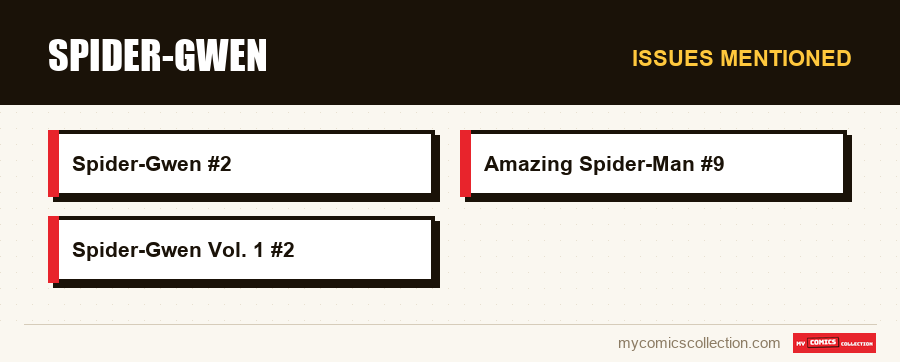
$3.86: a third print identified
The announcement "Spider-Gwen #2 - 3rd Printing Variant (Marvel, 2015) NM" explicitly names the rank of the print run. It is a booklet reprinted twice after the original edition, and it has its own illustration. The wording gives the decisive information: without the word “3rd Printing”, nothing in the price or in the rest of the text would make it possible to know which object we are talking about.
$3.95: an alternative rowless cover
“Spider-Gwen #2 (2015) variant cover” announces an illustration different from the reference one, but does not specify any print. It can be an alternative cover of the first printing like a reprint: the wording does not decide. Nine cents separate this announcement from the previous one, and yet the two objects are not of the same nature.
$3.00: a range of years instead of a date
“SPIDER-GWEN #2 BY MARVEL 2015-2018 $1 COMIC SALE” says 2015-2018. It is not a publication date: it is the interval of existence of a publication, copied as is in the title of the announcement. The item being sold has a unique date, and it does not appear anywhere in the label.
$5.00: a whole different title
"Amazing Spider-Man #9 Variant Cover [...] 2nd Spider-Gwen Appearance" is not an issue of the series Spider-Gwen. This is an episode from another publication, brought up by the request because the character's name appears in his argument. Confusing it with the others would be like comparing the prices of two separate series.
The fifth announcement is of yet another kind: “Spider-Gwen Vol. 1 #2 3rd Print & #3 1st Print (2015) NM” at $6.00. It brings together two different numbers, in two different draw ranks, under a single price. The amount displayed does not relate to either item in particular. You must first break down the purchase before you can get anything out of it, and this breakdown is never given by the seller: it is to be done by the buyer, at the time he registers his receipt.
These five announcements look similar in a table: same character, same order of magnitude for four of them, similar wording. However, they designate a third printing, an alternative cover of unknown rank, an undated copy, an episode from another series and a set of two booklets. An automatic reading that stacks these lines and calculates an average produces a number that describes no real object.
The effective filter is not the price, it's the wording. An ad that names its draw rank is exploitable; an ad that only says “variant” is not, regardless of its amount.
Why the word “reprint” has changed meaning
As long as reprinting meant remaking identically, the hierarchy was simple: the original carried the rarity, the reprint carried the text. A reader bought the second to read the story, a collector sought the first to own the object. The two audiences were not competing for the same copies, and the vocabulary reflected this separation: “reprint” meant “if nothing else.”
When the reprint arrives with a new image, this separation collapses. The collector of images has no reason to prefer the first print: what he wants is the illustration, and it only exists on the reprint. The reader doesn't care since the interior content is identical. A demand specific to the second, third, sometimes fourth draw is therefore formed, independent of that of the first. Two items that are not aimed at the same buyer cannot be classified one under the other.
The practical consequence is immediate for those who keep an inventory. Writing “Spider-Gwen #2” on an index card is no longer enough to identify what you own. The rank of the print must be added, otherwise the file refers to a family of objects rather than to an example. And as the rank of the print does not appear on the spine or in most sales indexes, it must be noted at the time of purchase, while the ad is still available for consultation.
This requirement is specific to recent series. On older publications, the question practically never arises, because the successive editions were rare and visually identical. This is one of the reasons why inventory methods inherited from classic collections do not apply well to titles launched in the last fifteen years, as shown the editorial evolution of the major series of the character compared to modern launches.
The six confusions that this statement makes visible
Withdrawal versus alternative coverage
A third draw at $3.86 and an alternate cover at $3.95 occupy the same slot in a table sorted by price. Nothing, apart from the textual mention of rank, separates them. The first is a reprint, the second may belong to the original edition: these are two different editorial statuses stored in the same place.
A range of years read as a date
“2015-2018” refers to the lifespan of a publication, not the year of a copy. Copied into a form, this range creates a false date or an empty field. The booklet received has a unique date printed on it, and this is the one that must be noted.
The word “variant” used for everything
It appears in the query, in the title of the third printing, in that of the alternative cover and in that of the episode of another series. Used to designate four distinct situations, it no longer filters anything. Searching for this word brings back everything that is not the main cover, without distinguishing the cases.
The lot at a single price
Six dollars for a third drawing of No. 2 and a first printing of No. 3. As long as the sum is not divided between the two lines, it does not provide information on either of them. A poorly broken down lot records two copies at a price neither of them cost.
The number that comes from elsewhere
An episode of Amazing Spider-Man goes back in a search on Spider-Gwen because the character's name serves as a selling point. Number 9 of one series has nothing to do with number 2 of another, and yet the two coexist in the same statement.
The gap between the two segments
Median at $19.99 without certification, $100.00 with. On a recent and abundant series, this discrepancy is mainly due to sorting upstream: only the copies deemed perfect are examined. The two sets therefore do not describe the same population of objects and cannot be compared directly.
Collecting this series?
Track what you own, what you are missing and what your collection is worth. 7 day trial.
Start my trial →What to note when registering a copy
The rank of the draw, in full. First, second, third: this is the information that distinguishes two otherwise identical booklets in reference. It appears in the sales wording when the seller knows it, and sometimes only there. If you do not report it at the time of purchase, it disappears with the ad, and nothing on the item received will then allow it to be reconstructed with certainty. An empty field on this point is not a minor deficiency: it renders the line unusable for any future comparison.
The description of the cover illustration. Since each print carries a different image, a short sentence describing what we see is worth more than a code. Two lines in your inventory bearing the same number can then be distinguished at a glance, without having to take out the copies. This is also the only way to spot an unintentional duplicate: two purchases of the same number two months apart go unnoticed if the cards say nothing about the image.
The actual publication date, never the announced range. A label that displays 2015-2018 describes a publication, not an issue. The date to remember is that shown on the copy itself. Copying the interval amounts to recording information which does not relate to any object, and which will distort any chronological classification of the collection.
The breakdown of a batch, line by line. A group purchase must become as many cards as it contains booklets, each with its number and its edition rank. As long as the lot remains a single entry, it occupies a false place in the inventory: it counts as one when it is worth several, and its composition is forgotten within a few weeks.
The actual unit price, calculated after decomposition. Six dollars for two issues does not mean three dollars each, unless you explicitly decide. Choose a distribution rule, apply it, and note that the amount obtained is a reconstruction and not a displayed price. This mention prevents a calculated figure from being later taken for observed data.
How to read the gap between ordinary segment and verified segment
Thirty-three announcements of verified copies is a modest number. It allows a difference in level to be noted, it does not allow a reference price to be established, and it would be imprudent to build a valuation on such a narrow basis. I therefore stick to my observation: at that date, the sellers of the copies examined demanded more than the others.
The most economical explanation does not involve scarcity. Having a booklet verified costs money and time; no one incurs this expense on an average copy of a recent publication printed in large quantities. Only those copies which their holder judges to be irreproachable are therefore subject to examination. The verified segment is thus the product of a prior selection, and not a representative sample of what is circulating. Comparing its amounts to those of the ordinary segment means comparing a sorted subset to the set from which it was extracted.
For a personal inventory, the consequence is simple: the two segments deserve to be kept separately, with a note indicating whether the copy has been examined or not. Merging the two into the same average produces an intermediate figure that does not correspond to any real purchasing situation. This distinction is similar to that described by reading paths proposed for the series, where the copy intended to be read and that intended to be kept do not obey the same criteria.
An input method that resists approximate labels
What the five ads examined have in common is that their text was written to attract a buyer, not to document an object. The seller uses the words that bring up his ad in searches, adds the name of the best-known character, leaves out what he doesn't know. There's nothing dishonest about it: it's simply a different purpose than yours. Your entry must therefore assume that the wording is incomplete by construction.
The resulting rule is to separate what is established from what is assumed. The number, title of the publication and the date printed on the copy received are established. The rank of the draw is also when the announcement names it. Everything else (the year deducted from a range, the unit price taken from a lot, the status of coverage described as “varying” without further clarification) falls under the deduction and must be marked as such. An inventory that distinguishes these two levels remains usable years later; an inventory that mixes them becomes unverifiable as soon as it is seriously questioned.
The second useful reflex is to copy the original wording into a free field, as is, before any interpretation. It costs nothing to keep and it allows, later, to redo the reasoning with information that we did not have at the time of purchase. This is particularly true for the edition ranks: an ambiguous mention today can become readable when you have seen other copies of the same number pass by.
Finally, you must agree to leave boxes empty. An announcement that does not state its draw rank should not give rise to an assumption recorded as fact. It is better to have an incomplete and honest form than one filled with plausible values, because the first indicates by itself what remains to be verified while the second gives the illusion of being finished. This principle applies well beyond this series: it applies to any purchase where the price is low and information is rare, a common situation when looking to build a collection with a limited budget.
What this statement does not allow us to say
It says nothing about the direction of the market. A single measurement, taken on August 30, 2026, has no term of comparison: neither increase nor decrease can be deduced from it, and any sentence stating the opposite would go beyond the data. A second survey, constructed in the same way, would be necessary to begin to speak of movement.
It also says nothing about what buyers pay. The 141 ordinary ads and the 33 verified ads are current offers, that is to say items still unsold at the time the count was made. An asking price and an obtained price are two different quantities, and the second does not appear here.
Finally, he says nothing about the respective rarity of the different prints. Knowing that a third printing costs $3.86 does not provide information on the number of copies produced, nor on the number that survives in good condition. This information sometimes exists elsewhere, in the catalog data, but it cannot be deduced from a list of announcements. What the survey shows, and it is already useful, is the difficulty of correctly identifying an object based on the way in which it is sold, and to locate the numbers which really focus attention, it is better to refer to the notable episodes recorded on the main series rather than sorting by price.
The statement does not allow us to answer in terms of value, since it only contains amounts requested on a single date. What we can say, however, is that the clean cover reprint is aimed at a different buyer: those who want this precise illustration cannot obtain it otherwise. The automatic hierarchy “higher original, lower reprint” therefore does not mechanically apply to this scenario.
Only by the explicit mention of the rank of the print in the text. In the statement, one ad indicated “3rd Printing” and another simply said “variant cover”: nine cents separated them, and nothing else in their wording made it possible to decide. In the absence of this reference, the question remains open and must be noted as such rather than decided adjudication.
Do not copy it as a date. This interval describes the length of time a publication has been in existence, not the year of the copy offered. The usable date is the one printed on the booklet once received. As long as it is not raised, the field must remain empty rather than accommodating one of the two arbitrarily chosen terminals.
By creating one sheet per issue upon receipt, each with its number and edition rank. The price of the lot is then distributed according to a rule that you choose and note. The $6.00 ad bringing together a third print of No. 2 and a first print of No. 3 illustrates the typical case: the amount displayed does not correspond to either of the two items taken in isolation.
With only 33 advertisements, the number is too small to derive a reliable price level, and I refrain from doing so. The most likely explanation for the discrepancy observed is a selection effect: for a recent and widely printed publication, only the copies judged to be impeccable are examined. The verified segment is therefore sorted upstream, and does not represent all of what is circulating.
A draw rank is noted upon purchase, not six months later
Rank of the print run, description of the cover, actual date, breakdown of the lots: this information only exists on the day of purchase, in an announcement which will disappear. My Comics Collection gives you a field for each, and a separate sheet per copy rather than one line per issue.