The highest amount displayed for Edge of Spider-Verse No. 2 is the one statistic that a collector can do absolutely nothing about. On an August 30, 2026 statement of pending listings (amounts claimed by sellers, not closed sales) the verified copies segment had 80 offers, with a low of $30.00, a midpoint of $402.77, and a high of $17,999.99. The peak is about forty-five times the midpoint. This report does not measure the value of the booklet: it measures the gap between the expectations of eighty sellers. The statistic to remember is the median, and you have to read it knowing what was counted.
There is a universal reflex among the collector who has just found a booklet in a crate: type the title into a commercial search engine, sort by decreasing price, and look at the first line. This gesture takes three seconds and produces a spectacular figure. It also produces, almost systematically, zero information. The first price of a list sorted in descending order has not been validated by anyone: it was typed on the keyboard by a seller alone in front of his screen, who commits nothing by staring at it and loses nothing by remaining unanswered. An ad can stay online for months at an amount no one plans to pay, and all that time it will continue to feed the top of the distribution.
The case of Edge of Spider-Verse No. 2, the booklet that Spider-Gwen collectors are primarily looking for, offers an almost caricatured demonstration of the phenomenon. The August 30, 2026 survey separated two segments of the same research. Listings for unverified copies, 72 bids, ranged from $1.00 to $699.00, with a midpoint at $39.95. Ads for copies passed through a verification agency, 80 offers, ranged from $30.00 to $17,999.99, with a midpoint at $402.77. These four numbers tell a coherent story. The two summits tell nothing at all. Understanding why means understanding how to correctly fill in the “value” column of your own inventory.
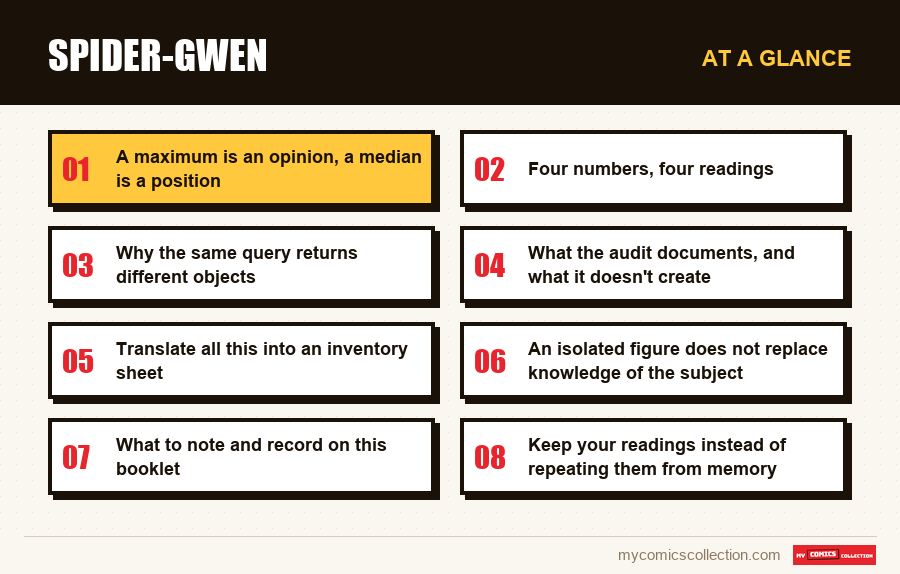
A maximum is an opinion, a median is a position
The difference between the two statistics is not a subtlety of method: it is of nature. A maximum is produced by a single person. It is enough for one seller in eighty to decide to try their luck very high for the top of the reading to shift by an order of magnitude, without anything having changed for the other seventy-nine. This value is therefore infinitely fragile: it depends on the mood of an individual whom you do not know, whose condition you do not know, and whom you will never know if he ended up selling. The median is a position in a ranking. It designates the point where half of the demands are lower and half higher. To move it, many sellers must move at the same time. She resists eccentrics, by construction.
This does not make the median a truth. It remains built on amounts claimed, and an amount claimed is not an amount obtained. It describes what sellers hope for, collectively, on any given day. This is already much more useful than an isolated cry, but it remains a measure on the supply side. A collector who writes $402.77 in front of his verified copy should know that he is noting the median expectation of a group of sellers as of August 30, 2026, and not the amount that a buyer would give him. This nuance seems theoretical until the day you are looking to sell.
Four numbers, four readings
$17,999.99: the verified high
This amount is issued by a single announcement among eighty. It involves no buyer, no negotiation, no consideration. Compared to the midpoint of the same segment, it represents approximately forty-five times this. This factor forty-five says nothing about the booklet: it says that within the same group of sellers, ambitions spread over nearly two orders of magnitude.
$402.77: the verified midpoint
Forty verified ads are below, forty above. It is the only mark on the survey that can be transported elsewhere without distorting it. It is always a request, never a transaction, and it bears a date: that of the statement. Out of this date, it loses its meaning as silently as a receipt forgotten in a pocket.
$39.95: the unverified midpoint
Out of 72 listings without verification, half of the sellers ask for less than this amount. The gap with the verified segment is considerable, but it cannot be explained solely by the verification: this segment contains, as we will see, objects which are not the booklet sought. A median is only reliable if the measured set is clean.
$30.00: the floor checked
The most informative figure in the statement. A verified copy ad requires less than half of unverified ads. The verification therefore notes a condition, it does not manufacture it: a tired copy remains a tired copy once documented, and the asking price is affected.
These four readings contradict each other if we take them as estimates, and they agree perfectly if we take them for what they are: descriptions of the way in which sellers position themselves. The summit describes the extremity of ambition. The midpoint describes the center of gravity of the request made. The floor describes cases where the seller's item, condition, or urgency pulls the listing down. None of these three things is a market price, but one of them, the midpoint, is at least reproducible from one reading to the next, which makes it comparable over time provided that one is done again.
A point of method which should accompany any reading of figures: the reading of August 30, 2026 is a photograph. It shows a state at a point in time, just as a photograph shows a room at a point in time. It shows no rise, no fall, no trend, for the basic reason that there is nothing to compare. Any sentence such as “this issue is progressing” or “the market is waking up” which is based on these numbers would be a pure invention: it would take at least two separate readings in time, carried out using the same method, to pronounce the word movement.
This is also why an inventory value must always be dated. A number without a date behaves like living information even though it is frozen, and it becomes false without ever warning. Writing “$402.77” in an index card is an error; writing “around $400, statement on August 30, 2026, advertisements verified, amounts requested” is information that can be used in a year, because we will know exactly what it is still worth.
Why the same query returns different objects
The lower part of the unverified segment is worth paying attention to, because it explains a good part of the difference between the two medians. Among the listings returned by the same search were a $1.00 copy titled “Edge Of Spider-verse #2 (2022 Marvel) Cover A,” another at $3.50, one at $3.99, a fourth at $4.25 marked “(2022) […] UNREAD,” and a fifth at $4.50 labeled “Edge of the Spider-Verse 2 2022.” These five announcements are not business deals: they are 2022 issues which bear the same title and number as the issue sought. The commercial search engine makes no difference between the two, because it compares character strings and not objects.
The statistical consequence is direct: each 2022 announcement that enters the set pulls the midpoint down. Out of 72 offers, it only takes a handful to visibly move the median. The $39.95 of the unverified segment is therefore not the median of the advertisements for the booklet sought: it is the median of a mixed set, containing two distinct objects. Before reading a number, you need to know what was counted: this question precedes all others, and it is almost always skipped.
Query does not sort objects
A merchant engine matches labels, not bibliographic references. Two booklets with the same title and the same number decades apart fall into the same bag. No warnings are displayed, and nothing in the list indicates coexistence.
The number only has meaning with its date
An amount recorded on August 30, 2026 describes that day. Copied without its date in a file, it becomes a timeless statement that no measure supports. The date is not a decoration: it is what makes the figure refutable, and therefore useful.
Asked is not obtained
All values in this statement are amounts claimed by sellers on current listings. None have been confirmed by a buyer. To confuse the two is to take the price displayed in the window for the amount written on the ticket.
Verified and unverified do not mix
Counting the 80 verified ads and the 72 unverified ads together would produce a median without a referent: it would describe an average object that does not exist anywhere. The two segments meet different expectations and must remain separate to any extent.
A low workforce concludes nothing
Here, 72 and 80 ads allow a median. On a handful of offers, the same statistic would become an accident: two eccentric announcements would be enough to move it. Under a dozen announcements, the only honest answer is that we don't know.
The top catches the eye and lies
Sorting by descending price systematically places the least representative ad at the top of the screen. The interface values the exception. Looking at the middle of the list first requires voluntary effort, and yet it is the only profitable move.
What the audit documents, and what it doesn't create
The overlap between the two segments is the most counterintuitive result of the survey. The verified copies are expected to form a block entirely above the unverified copies. This is false: the verified floor, at $30.00, is below the unverified median, at $39.95. That is, there is at least one verified copy ad that requests less than half of the non-verified adverts.
The explanation is simple and worth stating clearly, because it doesn't get across well. Passing by a verification body produces a documented condition report; it does not modify the object. A damaged copy that emerges from a verification procedure is a damaged copy whose wear is now recorded. It is sometimes more difficult to sell at a high price than an undocumented copy, precisely because the buyer can no longer hope that the flattering photograph hid a better reality. Verification removes uncertainty, in both directions.
This puts in its place a widespread idea according to which it is necessary to have it checked systematically. The statement doesn't help resolve this question (it only shows requests, not results) but it at least shows that verification is not an automatic multiplier. The distribution of verified ads starts lower than this belief would imply, and its spread, from $30.00 to nearly $18,000, is far too wide to attribute a single, predictable effect to it.
For a booklet as identified as this one, the gap between the two segments is therefore due to at least three things, impossible to disentangle with a single measurement: the real condition of the copies, the presence of foreign objects in the unverified set, and the difference in audience between the two segments. Attributing the entire discrepancy to verification alone would be a conclusion that the data does not support.
Collecting this series?
Track what you own, what you are missing and what your collection is worth. 7 day trial.
Start my trial →Translate all this into an inventory sheet
The practical question remains: what number to write in front of your copy? The answer is in one sentence: a median order of magnitude, dated, accompanied by the segment measured. Concretely, for a verified copy of this booklet, we will enter something like “order of magnitude $400, median of verified announcements noted on August 30, 2026, amounts requested”. This wording is longer than a bare number, and that is its whole point: it carries with it the three warnings which prevent it from being misinterpreted six months later.
The opposite reflex, writing down the best number seen, has a concrete and unpleasant consequence. A collection valued on its maximums displays a total which corresponds to nothing: neither to what we would obtain by selling, nor to what we would pay to reconstitute the whole, nor to what an insurer would agree to retain. This total is only for fun, and it costs a lot the day a real decision is based on it. The midpoint gives a defensible order of magnitude, the limits of which we know because we have written them next to it.
A final point is worth asking, because it concerns the entire monitoring work and not just this booklet. An inventory value is not an attribute of the object, it is an attribute of the measure. The object does not change: it is the same booklet in the same cover. What changes is the number of sellers, their expectations, and the composition of the group that the request brings back. Tracking a value therefore means redoing the measurement from time to time and keeping the previous measurements, not refreshing a field by overwriting the old one. Without history, the question “has this changed?” » literally has no answer. This logic applies in the same way to alternative covers, whose ad sets are often much smaller and therefore much less measurable.
An isolated figure does not replace knowledge of the subject
There is a basic reason why the collector who knows his subject is less trapped: he knows, before launching the request, which objects bear this title and this number. He immediately recognizes that a $4.50 ad and a $400 ad do not describe the same thing, and he excludes the former from his reasoning instead of taking it as a bargain. This knowledge does not come from numbers: it comes from editorial knowledge of the character and its successive publications.
This is the most useful reversal that can be drawn from this statement. Numbers don't explain comics; it’s comics that allow you to read the numbers. A set of 152 announcements divided into two segments only becomes intelligible if we know what should be there and what should not be there. Conversely, a reader who arrives without editorial guidance will see a distribution ranging from $1.00 to $17,999.99 and will conclude, either, that the market is crazy or that the booklet is worthless. Both conclusions are false, and they come from the same gap.
This reading naturally extends beyond an isolated number. The same precautions apply to all regular series dedicated to the character, where the profusion of announcements and the repetition of numbering from one relaunch to the next create exactly the same type of confusion as the 2022 duplicate observed here. A number 1 is never “the” number 1 in a bibliography which includes several.
What to note and record on this booklet
Note the median, not the vertex, and note which segment it comes from. For a verified copy of this booklet, the August 30, 2026 benchmark is approximately $400; for an unverified copy it is about $40, with the caveat that this set contains objects which are not the issue sought. Never copy $17,999.99 or $699.00: these two numbers did not produce any information about your copy.
Date the value on the day of the statement and keep the words “amounts requested”. These numbers come from current listings, not closed sales. A sheet that omits this precision transforms a seller's expectation into an observed price, and this shift occurs without anyone noticing. Three words in a comment field are enough to permanently prevent it.
Record the existence of the 2022 issue with the same title and number. This is the most profitable information in this entire survey, because it will prevent you from taking an ad for a few dollars for an opportunity in each future search. Write it down once, in the number card, and you will never make the mistake again: neither you nor anyone who consults your inventory.
Save the state of your item regardless of any value. The verified floor at $30.00, located below the unverified median, shows that the state commands the requested amount much more than the presence of a finding. Describe what you see (folds, corners, spines, whiteness) in a field that belongs to you. This description does not expire, unlike the figures.
Keep each reading instead of overwriting the previous one. A single measure says nothing about a movement, and two preserved measures say everything that the first could not say. If you do the exercise again in six months with the same method and the same division of segments, you will then have the right, and only then, to talk about evolution.
No, and this number says nothing about your copy. It corresponds to a single advertisement among eighty verified advertisements recorded on August 30, 2026. A seller freely sets the amount he claims; no one has accepted it, and there is no indication that they will. The actionable benchmark from the same statement is the midpoint, at $402.77, and this too is a request, not a transaction.
Because the whole measured is not homogeneous. The same request brings back 2022 issues with an identical title and number, offered between $1.00 and $4.50. Each of these ads pulls the midpoint down. The $39.95 therefore describes a mixture of two distinct objects, not the booklet sought alone.
Because verification documents a state without transforming it. A very used copy remains very used once its condition is recorded, and its seller takes this into account. This verified floor is also below half of the unverified announcements, which is enough to rule out the idea that a verification would mechanically increase the amount requested.
Neither, and no amount of treatment will make them say it. This is a single reading, taken on August 30, 2026. A measurement taken on a single date describes a state, never a movement: there is nothing to compare. To speak of an increase or decrease would require at least two measurements spaced over time and carried out using the same method.
No. Merging the 72 unverified listings and the 80 verified listings would produce a statistic describing an average item that does not exist. The two segments are aimed at different buyers, and one of them also contains foreign booklets for research. A median only makes sense on a set whose content can be named.
Keep your readings instead of repeating them from memory
A dated value, the measured segment, the actual condition of the item and the history of previous readings: these are four distinct pieces of information, and none fits into a single field. My Comics Collection keeps them for each issue, so the question “has this changed since last time?” » finally have an answer instead of an impression.