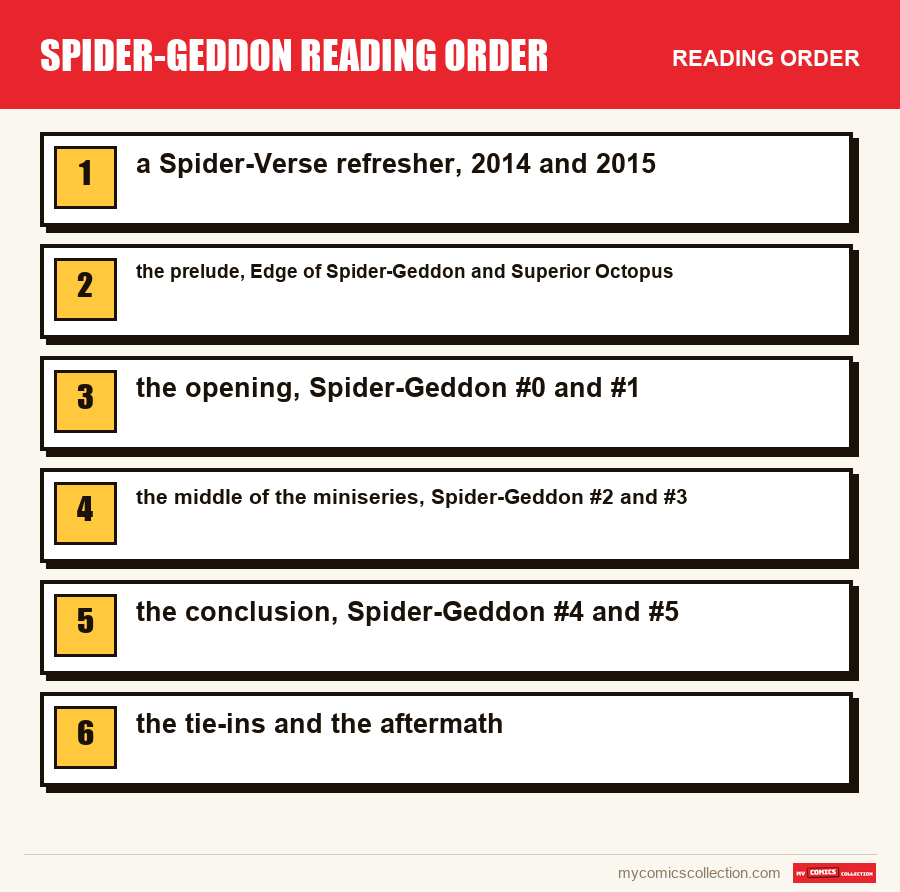
The Spider-Geddon reading order covers a six-issue miniseries (#0 to #5) published from October to December 2018, written by Christos Gage with Jorge Molina on art: the 2018 Spider-Verse event, and the sequel to Spider-Verse (2014). First read a refresher on Spider-Verse, then Edge of Spider-Geddon #1 to #4 and Superior Octopus #1, then Spider-Geddon #0 to #5 in order. The tie-ins come afterward, series by series.
Dozens of Spider-Men and Spider-Women from different realities, a family of predators sworn to revenge: Spider-Geddon takes the 2014 setup and replays it on a bigger scale. The event is dense with side titles, and the real question isn't what to read, but in what order and within what limits. Here is a reading method, from the backstory through to the aftermath.
As always in this guide, we only state verified information (creators, issue numbers, dates); the analysis is our own, with no reproduction of protected pages or dialogue.
What to read first
Spider-Geddon openly presents itself as the sequel to Spider-Verse, the 2014 crossover that brought together versions of the hero from many realities. Nothing says you have to have read everything, but two reference points matter: the identity of the antagonists, the family of Inheritors, and the idea of a multiverse populated by variants of the hero.
- Spider-Verse (2014): an event written by Dan Slott, with Olivier Coipel and Giuseppe Camuncoli on art, dated November 2014 to February 2015. Its core is The Amazing Spider-Man (vol. 3) #9 to #15. It comes with Spider-Verse (vol. 2) #1 and #2.
- Edge of Spider-Verse #1 to #5, which precedes the event as early as August 2014. For Spider-Gwen's first appearance in that series, see our page on Edge of Spider-Verse #2.
- The ending of Spider-Verse and the fate it hands the Inheritors: that's the starting point of Spider-Geddon, where this family returns seeking revenge.
If you're new to the universe, don't try to catch up on everything. A refresher on Spider-Verse and a read of the prelude are enough to get into the miniseries. To place 2018 in the larger timeline, the Spider-Man reading guide sorts the cycles by era.
Phase 1: a Spider-Verse refresher, 2014 and 2015
The first phase is optional, but it changes how you read. If you've never opened Spider-Verse, start with The Amazing Spider-Man (vol. 3) #9 to #15: that's the main thread, written by Dan Slott. There's also a prelude and parallel titles: Spider-Verse Team-Up #1 to #3, Spider-Woman (vol. 5) #1 to #4, Spider-Man 2099 (vol. 2) #5 to #8, issues #32 and #33 of Superior Spider-Man, and Scarlet Spiders #1 to #3.
A tip on method: don't try to read all these titles just to approach 2018. The core of Amazing Spider-Man and the two issues of Spider-Verse (vol. 2) give you the structure; the rest is for when you love a particular character, like Spider-Man 2099, whose dedicated page gathers the guides.
If you've already read the event, jump straight to the next phase. For the 2018 animated film, which draws on the idea of a multiverse of Spider-Men, our film vs. comics comparison sorts things out.
Phase 2: the prelude, Edge of Spider-Geddon and Superior Octopus
The prelude comes in two blocks:
- Edge of Spider-Geddon #1 to #4: an opening miniseries in four issues, to read before the event proper;
- Superior Octopus #1: the issue that launches the event's main theme and sits right before the miniseries.
These five issues were collected together in January 2019 in the Edge of Spider-Geddon volume: it's the simplest way to read them as one block. For the Superior Spider-Man line and its status, our Superior Spider-Man reading order gives the context you need.
Read the prelude in order: the four Edge issues first, Superior Octopus #1 next. This sequence leads smoothly into issue 0 of the miniseries.
Phase 3: the opening, Spider-Geddon #0 and #1
The main miniseries starts at issue 0, which is the first thing to remember: if you open #1, you'll have missed the setup. Spider-Geddon #0 has a standout feature: it brings the Peter Parker of the Spider-Man video game, released on console in 2018, into the comics, and sets up that game's sequel.
The miniseries is written by Christos Gage, with Jorge Molina on art. Read #0 and #1 in one go: they open the plot.
Spoiler warning: the event rests on the return of the Inheritors, already seen in Spider-Verse. If you read the refresher in phase 1, you'll have the key; if not, #0 and #1 hand it to you without difficulty.
Phase 4: the middle of the miniseries, Spider-Geddon #2 and #3
Issues #2 and #3 form the heart of the event. Keep in mind that the miniseries is short: six issues in all, and most of the journey plays out here.
If you're reading tie-ins, this is the right moment to slip one in, but not in the middle of an issue: read a full block of a side series (see the next phase), then return to the main miniseries. This method avoids breaking the rhythm and going back and forth too much.
Our advice: reread the end of Superior Octopus #1 before #2 if needed, to keep the event's starting point in mind.
Phase 5: the conclusion, Spider-Geddon #4 and #5
The last two issues wrap up the event. Read them in a single sitting, without interruption: #5 closes the miniseries. The complete miniseries was collected in February 2019 in the Spider-Geddon volume, which gathers issues #0 to #5 and the Vault of Spiders #1 and #2 miniseries.
After #5, stop: if you want to keep going, this is the time for the tie-ins and the aftermath, and you can read them in whatever order you like. The main line is wrapped up.
If you're looking for what changes once the event is over, look to the Spider-Gwen: Ghost Spider series, which extends the story in its issue #4, cited below.
Do you collect this series?
Track what you own, what you are missing and what your collection is worth. 7-day trial.
Start my trial →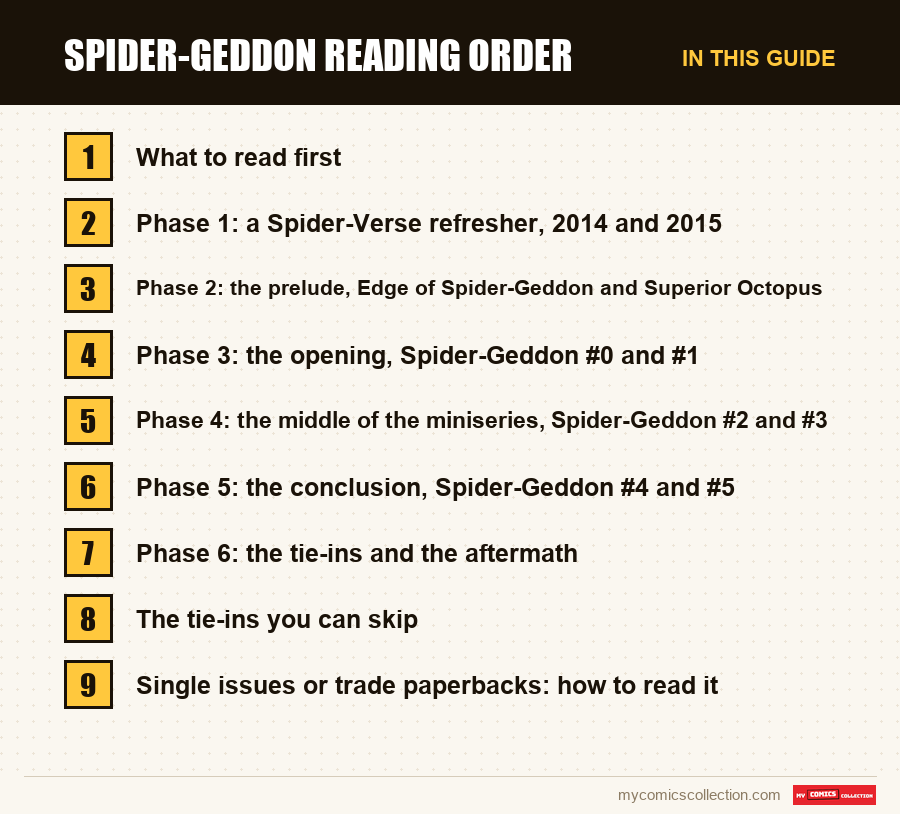
Phase 6: the tie-ins and the aftermath
Once the miniseries is finished, read the side titles series by series, since each one attaches to a single character:
- Vault of Spiders #1 and #2, collected with the main miniseries;
- Spider-Force #1 to #3 and Spider-Girls #1 to #3, brought together in February 2019 in the Spider-Geddon: Covert Ops volume;
- Peter Parker, The Spectacular Spider-Man #311 to #313;
- Superior Spider-Man (vol. 2) #1;
- Spider-Gwen: Ghost Spider #1 to #3, by Seanan McGuire and Rosi Kampe, then #4 which serves as the aftermath.
For Spider-Gwen readers, our Spider-Gwen reading guide places these issues within the wider series. For the character's historical background, the page devoted to Spider-Gwen gathers our guides.
The tie-ins you can skip
Almost all of them. The main miniseries and its prelude tell the story; the side titles broaden the scope, each through one character. If you have no attachment to Spider-Girls, Spider-Force or Peter Parker, The Spectacular Spider-Man, you can set them aside without losing the thread.
That doesn't mean they're without interest: Spider-Girls and Spider-Force have their own readers, and Peter Parker, The Spectacular Spider-Man #311 to #313 extends the event into the regular series. Still, none of them drives the ending. The simple rule: read them if you already follow the original series, or if a character stood out for you in the miniseries.
Once you've made your choice, the shortest line comes to eleven issues: Edge of Spider-Geddon #1 to #4, Superior Octopus #1, then Spider-Geddon #0 to #5, that's eleven issues, plus the 2014 refresher if you don't know it.
Single issues or trade paperbacks: how to read it
The event was collected in several volumes that you can combine:
- Edge of Spider-Geddon (January 2019): the four Edge issues and Superior Octopus #1;
- Spider-Geddon (February 2019): the miniseries #0 to #5 and Vault of Spiders #1 and #2;
- Spider-Geddon: Covert Ops (February 2019): Spider-Force and Spider-Girls;
- the Spider-Verse/Spider-Geddon Omnibus (September 2022), which gathers both events and many related titles, including Edge of Spider-Verse and Spider-Verse (2014) #1 and #2.
This list suggests a method: if you want to read the event with its context, the omnibus is the most complete object. If you'd rather read lighter, the two 2019 volumes (prelude, then miniseries) are enough. In single issues, count the issues one by one and don't lose sight of the fact that issue 0 exists: it's the one most often forgotten when completing a collection.
For help choosing between single issues and trade paperbacks according to your goals, our page on Spider-Man crossovers offers a framework.
The key issues to know
A recent event doesn't produce rare issues; it produces issues people look for because they open or close something. Here are the reference points, along with the method for judging them:
- Spider-Geddon #0: the video game Peter Parker's entry into the comics.
- Spider-Geddon #1: the opening issue of the miniseries proper, with a cover by Jorge Molina.
- Edge of Spider-Geddon #1: the start of the prelude, to hunt down along with the next three to complete the set.
- Spider-Gwen: Ghost Spider #1: the opening issue of the Seanan McGuire and Rosi Kampe series, to look for along with #4, which serves as the aftermath.
Method: always compare the same issue and the same cover across several sold listings, and check that the title carries the right number, because an issue 0 is easily mistaken for an issue 1 in a hastily written listing.
Recap: the complete order
- Optional refresher: The Amazing Spider-Man (vol. 3) #9 to #15 and Spider-Verse (vol. 2) #1 and #2 (2014 and 2015).
- Edge of Spider-Geddon #1 to #4.
- Superior Octopus #1.
- Spider-Geddon #0 and #1, Christos Gage and Jorge Molina (October 2018 onward).
- Spider-Geddon #2 and #3.
- Spider-Geddon #4 and #5 (through December 2018).
- Tie-ins of your choice: Vault of Spiders #1 and #2.
- Tie-ins of your choice: Spider-Force #1 to #3 and Spider-Girls #1 to #3.
- Tie-ins of your choice: Peter Parker, The Spectacular Spider-Man #311 to #313 and Superior Spider-Man (vol. 2) #1.
- Aftermath: Spider-Gwen: Ghost Spider #1 to #4.
Frequently asked questions
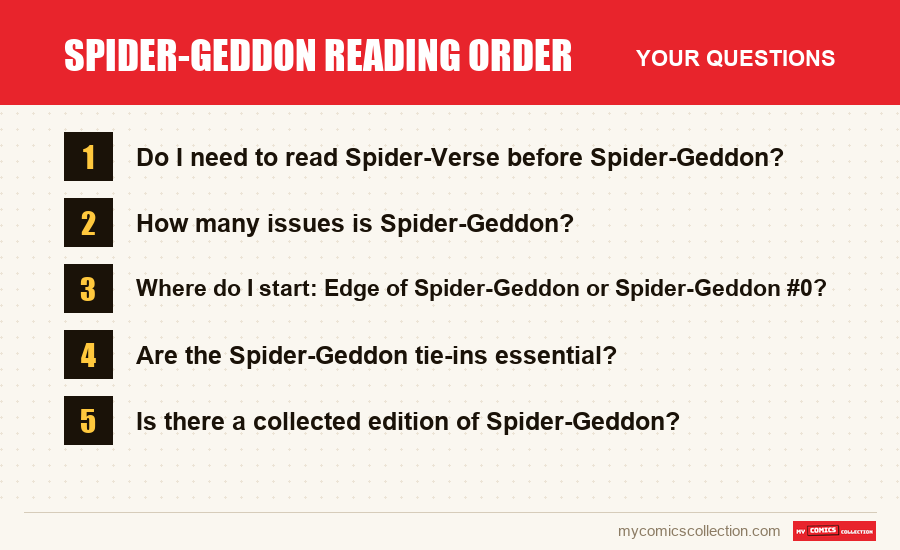
It isn't required, but it helps. Spider-Geddon is the sequel to Spider-Verse (2014) and reuses its antagonists, the Inheritors. A refresher on the core, The Amazing Spider-Man (vol. 3) #9 to #15, gives you the reference points you need to follow the 2018 story without losing the thread.
The miniseries runs six issues, #0 to #5, published from October to December 2018 and written by Christos Gage with Jorge Molina on art. The Edge of Spider-Geddon prelude adds four issues, and Superior Octopus #1 launches the main theme.
Start with Edge of Spider-Geddon #1 to #4, then Superior Octopus #1, before opening Spider-Geddon #0. The prelude sets up the characters and the threat. If you're in a hurry, open #0 directly: the miniseries stays readable, even if it loses a bit of depth.
No. The main line fits in the prelude and the six-issue miniseries. The side titles, like Spider-Force, Spider-Girls or Vault of Spiders, add points of view. Read them if you already follow one of the characters involved, otherwise save them for a second read.
Yes. The Spider-Geddon volume (February 2019) gathers issues #0 to #5 and Vault of Spiders #1 and #2. The prelude has its own volume, Edge of Spider-Geddon (January 2019). A September 2022 omnibus brings together Spider-Verse and Spider-Geddon with many related titles.
Your Spider-Geddon and Spider-Verse issues are worth identifying precisely, issue 0 included.
Estimate my comic