Six segments from the same author, and the result can be summed up in one sentence: everything is cheap except two issues. As of August 29, 2026, its series wonder between $6.99 and $15.99 of raw median: including its most cited event, at $10.00. Two references escape this flatness, and these are the first two appearances of characters who have become popular: $397.50 and $31.64 gross, $1,389.99 and $327.22 certified. The value is not distributed, it is punctual.
This setup is the clearest of the entire campaign to understand what a collectible market actually measures.
This article presents the six statements, draws their structure, explains the limits of the method, and says what a buyer can do with them.
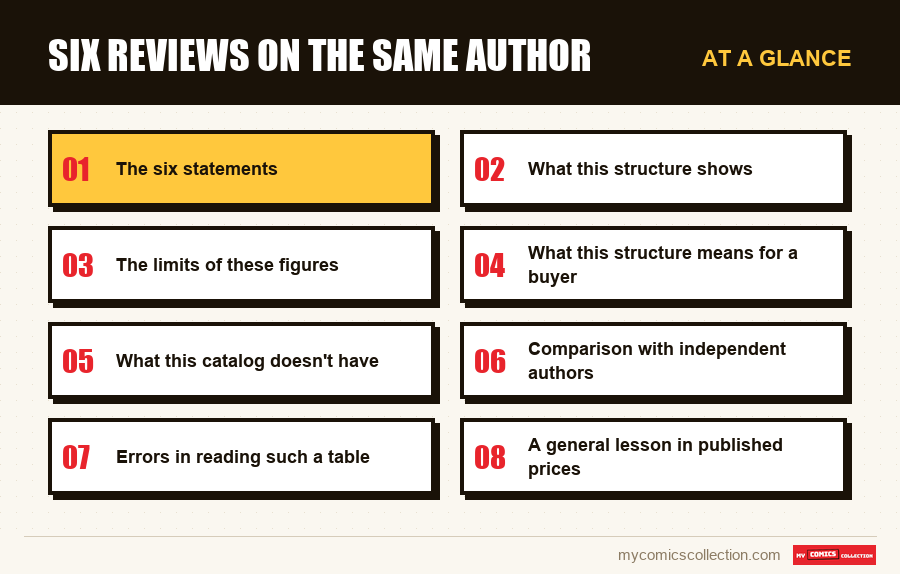
The six statements
Method: fixed price advertisements consulted on August 29, 2026, with a separate count depending on whether the copy is raw or under shell. The amounts are those displayed by sellers and do not correspond to any verified transaction.
1970s horror series
Gross: 169 ads, median $15.99. Certified: 19 listings, median $150.00.
The highest raw median of its current series.
1980s group series
Gross: 134 ads, median $10.00. Certified: 30 listings, median $199.95.
His greatest commercial success, and one of the least expensive.
1985 editorial event
Gross: 124 listings, $0.99 to $150.00, median $10.00. Certified: 31 listings, median $110.00.
The most cited work in the catalog, at one dollar per entry number.
Single-player antagonist series
Gross: 169 ads, median $6.99. Certified: 3 ads only.
The cheapest and least organized segment.
Added to this are the two references which escape this flatness. The first appearance of a horror character: 34 gross ads at $397.50 median, and 82 certified announcements at $1,389.99. The first appearance of an antagonist: 80 gross ads at $31.64, and 53 certified ads at $327.22.
What this structure shows
Three observations emerge, and they reinforce each other.
The notoriety of a work cannot be paid for. The 1985 event is by far the most cited in this catalog and it is at the same level as an ordinary series. Being important is not being rare.
Commercial success lowers prices. The two best-selling series in their time are among the cheapest today, because they were printed accordingly.
Value focuses on points of origin. The only two cherished references are first appearances: not notable stories, not conclusions, not issues deemed better.
These three observations say the same thing in a different way. The market measures neither quality nor influence: it measures material scarcity and a convention about what matters, which exclusively favors the first.
The limits of these figures
We must state frankly what these statements do not allow, otherwise we will make them say more than they contain.
These are requests, not sales. There is no obligation for a displayed price to match an accepted price, and a stagnant ad remains counted as long as it is online. The object measured is the available supply, not the actual exchange.
It's a snapshot. No temporal comparison is possible, therefore no statement on an evolution, an increase or a current effect.
The composition of the requests influences. A more or less precise search does not bring up the same advertisements, and I have noticed elsewhere differences of a factor of three on the same series depending on the wording.
Extreme values are excluded by construction. I use the median and I report the isolated maximums, but this methodological choice is in itself a decision which directs the result.
These four limits apply to all the readings of this campaign. What remains solid is the structure, the distribution between segments, much more than the amounts themselves.
A single digit in this table has no argument value. Taken out of context, it allows any statement to be made: one can say that this author “sells for $6.99” or “reaches $1,389.99” with the same apparent accuracy.
This is why these statements are presented together and with their numbers. A figure without its number of observations and without its neighbors is not data, it is a quote, and price quotes circulate much faster than the tables that make them readable.
What this structure means for a buyer
Four direct consequences, applicable immediately.
Reading costs very little. At a median of $6.99 and $15.99, with entries between $0.99 and $2.99, this entire catalog can be browsed for a modest budget. This is the most useful conclusion in the table.
The two expensive references are optional. These are piece purchases, unrelated to reading: the stories they contain are found everywhere else.
Raw does not compare to certified. On the two tight references, what remains in rough is mainly degraded, and a moderate price indicates another object rather than an opportunity.
No depletion is to be expected. The draws for the periods concerned prohibit any changes to the current numbers. Buying hoping for a valuation is baseless here.
These four points converge: it's a catalog to read, not to place, and saying so avoids the most common disappointment in this type of segment.
Why are the two high points there?
It's worth examining what sets the two cherished references apart from hundreds of others, because the answer is narrower than one might imagine.
These are not the best stories in the catalog, nor the most influential, nor the most talked about. These are the two issues where a character appears for the first time, and where that character went on to have a long career.
Both conditions are necessary and neither is sufficient. A catalog contains many first appearances of forgotten figures, who are worthless; it also contains very popular characters whose introduction is diffuse and therefore has no identifiable reference.
It is this rare conjunction that produces a high point, and it explains why there are so few of them. Out of hundreds of issues written by the same author, only two unite it.
For a buyer, the consequence is useful: looking for high points is like looking for conjunctions, not qualities: and a remarkable work without lasting characters will produce none, whatever its reputation.
What this catalog doesn't have
One absence is instructive and it distinguishes this author from several others examined in this campaign.
There are no original confidential pieces here: no convention anthologies, no fanzines, no limited editions outside the circuit. Everything he has written has been published by major houses, in national distribution, in substantial print runs.
This removes an entire category of rarity: the one which owes nothing to demand and everything to the weakness of the initial circulation. Authors who have gone through self-publishing or small circuits almost all have one, and it dominates their market.
Here, scarcity can only come from attrition, wear and tear over decades, and the conjunction described above. These are both slower and more predictable mechanisms.
The result is an exceptionally readable market: two identified high points, general flatness, and no possible surprises regarding confidential objects. This is more reassuring for a buyer than most of the catalogs studied here.
Collecting this series?
Track what you own, what you are missing and what your collection is worth. 7 day trial.
Start my trial →Comparison with independent authors
Situating this catalog in relation to those of self-published authors sheds light on both configurations.
Among the independent authors examined in this campaign, the structure is the opposite: very low medians everywhere, one or two three-digit confidential items, and often a problem of identification: circulation ranks, successive publishers, unreported anthologies.
For this author, the medians are slightly higher, the high points are more expensive, and identification poses almost no problem: the series are well referenced, the numbering stable, the editions documented.
This difference is due to the publication circuit and not to the works. A large house produces standardized objects, easy to identify and abundant; a small structure produces irregular, difficult to identify and rare objects.
For a collector, this guides the type of effort to be made. On the big houses, the effort is focused on choice; on small structures, it concerns the identification: two distinct skills, and it is better to know which one you are practicing.
Errors in reading such a table
The extracted figure
Taken out of the table, any of these amounts serves any argument about this author.
Raw compared to certified
Two different populations that no average should bring together, especially on tense references.
The snapshot taken for a trend
A single statement says nothing about an evolution, whatever the apparent precision of the amounts.
The median without its number
A median out of 3 advertisements and a median out of 169 do not have the same status, even if written the same.
A general lesson in published prices
The lesson is beyond this author, and that is probably the main point of the exercise.
Behind every published price there are decisions: where we looked, what references we retained, how we dealt with aberrant cases, what day. These decisions are rarely exposed and yet weigh as much on the number displayed as the reality it claims to describe.
The table above was constructed with explicit choices, and another set of choices would have produced other numbers without any being wrong. This is not a weakness of the process, it is its nature.
What a reader can take away from this is a simple requirement: ask the method before believing a number, and be wary of any rating delivered without date, without number, and without distinction between raw and certified.
These three clarifications cost a line to whoever publishes them. Their absence is generally a sign that they do not exist.
What to record
On a flat catalog with two high points, the sheet must adopt two levels of detail.
For common series: the number, the exact series and the state, nothing more. At these price levels, increasing the seizure costs discourages without adding anything, and a collection that is not seized is of no use.
For the two tense references: the edition, the country, the certification and its number, the price paid and its date. These are the only objects in this catalog whose identity can be disputed and whose resale requires proof.
This asymmetry is the most useful principle that an inventory can apply, and it is the opposite of what most tools do, which impose the same form everywhere.
The level of detail must follow the issue: on a catalog where the issue is concentrated on two references among hundreds of issues, applying the rigor they require everywhere guarantees that we will give up before having finished.
Frequently asked questions
That everything is cheap except two numbers. Series fetches between $6.99 and $15.99 median gross, including the catalog's most cited event at $10.00. Only two first appearances escape this flatness: the value is not distributed, it is punctual.
Because the market measures neither quality nor influence, but material scarcity and a convention that favors points of origin. A highly cited and widely sold event was printed accordingly: being big is not being rare, and commercial success drives prices down.
Not at all. These are requests and not sales, recorded on a single date, therefore without possible temporal comparison. I observe the state of supply on a given day: nothing authorizes to deduce an increase, a decrease or a news effect.
Better to avoid it. Extracted from the table, any one authorizes any assertion: we can say of this author that it “sells for $6.99” or that it “reaches $1,389.99” with the same apparent accuracy. A number without numbers or neighbors is a quote, not data.
Three things: the date of the statement, the number of advertisements it relates to, and the distinction between raw and certified. These details cost a line for whoever publishes them, and their absence is generally a sign that they do not exist.
Two levels of detail, not just one
The number and state are sufficient almost everywhere: only two references merit full entry.