The stories of a few pages are what this work has best, and they are those that we recommend the least. A creature appears, something happens, the story ends: often without resolution. This brief form is what allows the use of folklore material that itself has neither exposition nor conclusion. But she does not work as a front door: read before the long stories, it seems arbitrary, and it is the most frequent error of order in this work.
The contradiction between “the best” and “not that way” deserves to be explained rather than noted.
This article describes what the brief form allows, why it fails on first reading, how these stories relate to each other, and where to find them collected.
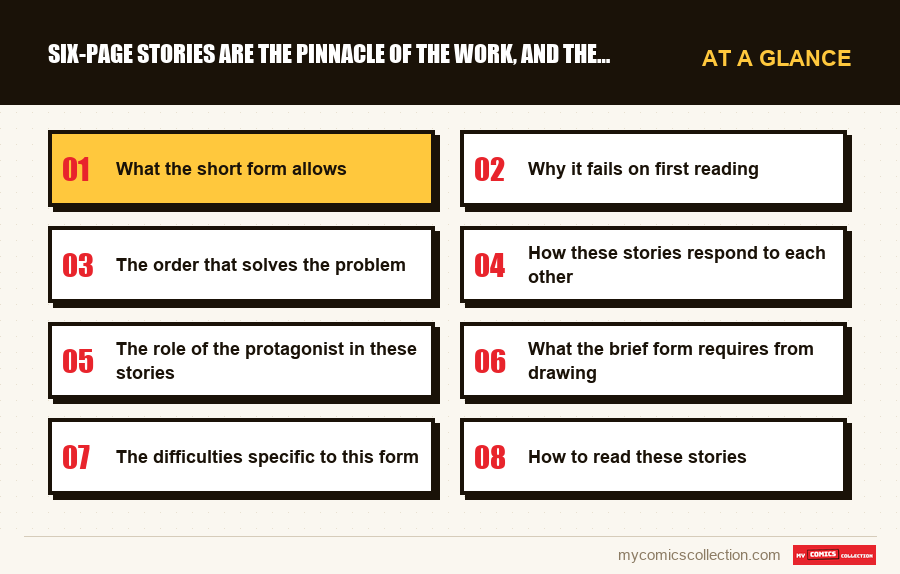
What the short form allows
Four things that a long story cannot achieve, and which explain why this form dominates the work.
L'absence de justification. On six pages, there is no time to explain where a creature comes from. Brevity makes the ellipse natural where it would seem intentional on a hundred pages.
The ending without resolution. A short story can dwell on an open-ended situation without frustrating, because the reader is not invested enough to demand a conclusion.
The variety of register. One story can be funny, the next funereal, the third purely contemplative: without the whole thing seeming incoherent, which a graphic novel would not tolerate.
Fidelity to the source. An oral tale lasts a few minutes. The short form is that of the material itself, and extending it would betray him more surely than any infidelity in detail.
Why it fails on first reading
The character is not installed
These stories assume that we already know who the protagonist is and what he is doing there. Six pages are not enough to establish it at the same time as to tell it.
This is the main reason, and it is purely structural.
The reasons don't resonate yet
The coherence of the whole is built by accumulation. The first story read has nothing to answer for.
The ellipse passes for a lack
Without prior trust in the author, what is not explained seems forgotten rather than remembered.
Brevity seems like lightness
Six pages seem like a minor piece to anyone who has not yet seen what the form allows.
The order that solves the problem
The solution is simple and it contradicts what we usually read.
A long story first. It establishes the character, his origin, his relationships and the general framework. One hundred pages are enough, and they require nothing prior.
Short stories then, in series. Once the character is acquired, each short story can devote itself entirely to what it tells, without spending pages introducing anyone.
Jamais en alternance aléatoire. Reading a short story between two long arcs, as the monthly publication required, breaks the effect of accumulation which gives value to the brief form.
This order completely transforms the experience. The same six pages, read at the right time, go from curious to remarkable: and the gap is due to nothing other than their position in the reading.
This is a rare case where the critical recommendation and the practical recommendation diverge. Critics are right to say that these stories are the pinnacle of the work; she is wrong to recommend them first.
Both propositions are true simultaneously, and confusing “the best” with “where to start” is a general error that we encounter well beyond this work.
How these stories respond to each other
This is the most difficult effect to perceive and the one that most rewards careful reading.
A creature seen in one story reappears thirty pages later in another context. A rule glimpsed without explanation is confirmed elsewhere. A place mentioned in passing becomes the setting for a later story.
None of these recalls are reported. There is no referral, no note, no character who says “like last time”. The reader recognizes or does not recognize.
This device constructs a coherence which is never stated. By the thirtieth story, we have the feeling of a world that exists independently of the stories that take place there-a feeling that no explanation would have produced.
This is also what makes rereading so productive: we recognize links that we had crossed without seeing them.
The role of the protagonist in these stories
One particularity deserves to be isolated, because it distinguishes these stories from most stories with recurring characters.
In an ordinary story, the protagonist is the driving force: he wants something, he acts, the story follows his efforts. Here, he is very often content to be present: he passes through a place, encounters what is there, and leaves.
He is less a hero than a moving witness. What is happening would have happened without him, or had already been happening for a long time; its function is to provide the reader with a point of view, not to resolve a situation.
This choice has a direct consequence on what these stories can tell. A protagonist who systematically resolves situations imposes endings; a passing protagonist allows for stories that don't.
It also produces a particular melancholy, never commented on. Crossing places where old things continue without you, and leaving without having changed them, is a fairly fair position, and it explains part of the attachment that these stories arouse.
What the brief form requires from drawing
The narrative constraint is coupled with a graphic constraint which is worth explaining.
On six pages, there is no room to gradually set up a scene. The location must be established in one box and then remain understandable, without being able to return to it.
This is precisely what a composition in large masses allows: an architectural silhouette, a mass of trees, a horizon line are enough to establish a place that the reader will recognize in each following box.
A detailed drawing would be a handicap here. It would require several boxes to establish the same location, and in a six-page story, these boxes do not exist.
The convergence between the short format, the folkloric material and the graphic method is therefore not a happy coincidence: the three condition each other, and changing one would make the other two impractical.
Collecting this series?
Track what you own, what you are missing and what your collection is worth. 7 day trial.
Start my trial →The difficulties specific to this form
A dispersion in volumes
The short stories are distributed differently depending on the collection line, which breaks the series effect.
Unreported recalls
There is no indication that an item has already appeared elsewhere. The link is lost if you don't spot it yourself.
Isolated one-off publications
Some stories appeared in special issues that were never published and were difficult to locate.
Reading too quickly
Six pages are covered in two minutes, which encourages you to continue and not remember anything.
Finally, a note on isolated publications. Some of these stories appeared in special issues, collective collections or promotional publications which were never reproduced in volume. They are therefore invisible to a reader who only follows the collections, and nothing indicates their existence: not even a discreet mention in the summaries of existing volumes. This is the only case where purchasing single issues remains truly essential in this vein.
How to read these stories
Three concrete recommendations, which arise from all of the above.
Two or three per session, not twenty. The format invites you to continue and that's exactly what you shouldn't do: each story needs a downtime after it to produce its effect.
Don't look for a fall. Many of these stories don't. Reading them while waiting for a final twist is to miss what they do.
Write down what you recognize. The resonances between stories are lost if we do not fix them, and they constitute the essential part of what sustained reading brings.
This last recommendation really transforms the experience. A reader who keeps track of these echoes reads a work; a reader who does not reads a succession of anecdotes: and they are the same pages.
What this form costs the author
We must name the price paid, because this bias is not free.
Less recognition. The short story is structurally undervalued. We quote graphic novels, we don't quote six-page stories, even excellent ones.
A difficulty of recommendation. Nothing is more difficult to recommend than a set whose value is born from accumulation. An extract demonstrates nothing.
Difficult commercial exploitation. These stories don’t lend themselves well to adaptations, which need arcs. They therefore stay away from the circuit that gives visibility to a work.
These three costs are real and the author has clearly accepted them. It is a choice of form maintained against its interest in notoriety, which is rare enough to be noted.
Ce qu'il faut enregistrer
In this vein, the sheet must record what no summary does: the links between stories.
The echoes you spot from one story to the next: creature revised, location reused, rule confirmed. These reminders are never mentioned in the stories, and this is precisely what has their effect. Noting them is the only way to reconstruct a coherence that the author has deliberately left implicit.
Without this trace, a rereading months later starts from scratch, and the recognition work has to be completely redone.
The length of each story, which seems anecdotal but is not: finding “the six-page story with the thing in the snow” is impossible in a work of several thousand pages without a reference of this kind.
These two fields serve a form that is quick to read and difficult to find: a combination that makes the inventory more useful here than on long, easily identifiable stories.
Questions fréquentes
Because “best” and “where to start” are two different questions. These stories assume that we already know who the protagonist is, and six pages are not enough to establish that at the same time as tell the story. Read before the long stories, they seem arbitrary.
Because the material they use doesn't have any either: a tale transmitted to be believed is organized neither in exposition nor in resolution. The brevity makes this absence natural: the reader has not invested enough to demand a conclusion, which would not be true in a hundred pages.
Only yourself: no referrals, no notes, no character says “like last time”. A creature reappears thirty pages later, a rule glimpsed is confirmed elsewhere. This is what builds a coherence never stated, and what makes rereading so productive.
Two or three per session, not twenty. The format invites you to continue and that is exactly the mistake: each story needs a downtime after it. And don't look for a punchline: many don't have one, and reading them while waiting for a reversal makes you miss out.
Commercially, yes, on three counts: the short story is structurally undervalued by critics, a whole whose value arises from accumulation is almost impossible to recommend, and these stories lend themselves poorly to adaptations that need arcs. It is a choice of form maintained against its interest in notoriety.
Where had this creature gone before?
There is no referral to indicate this, and the echo is lost if you do not note it.