Mignola's stories draw on real European folk traditions, and he never explains them. A creature appears, acts according to rules the reader does not know, and disappears without any character commenting. This refusal to explain is not gratuitous obscurity: this is what restores the position of a listener of yesteryear, for whom these figures were self-evident. The modern reader accepts that he does not understand everything, just as an original reader did not understand everything either.
This method explains both why these stories are confusing at first contact and why they read so well.
This article describes where this material comes from, how it is used, what the refusal to explain produces, and how to approach these stories without prior scholarship.
Where does this material come from?
We must first clarify the nature of the sources, because they are often confused with invention.
Evidenced popular traditions. Tales, local superstitions, regional figures from European folklore: material collected in the 19th century by folklorists and published in scholarly collections.
Fragmentary stories. These traditions do not form a coherent system. A creature has contradictory attributes depending on the region, rules that vary, sometimes several names.
Originally non-fictional material. These accounts were not stories: they were explanations of the world, passed down to be believed, or at least taken seriously.
This last property is decisive. A tale meant to be believed is not organized like fiction: it has no exposition, no resolution, no necessary moral, and that is exactly what these stories reproduce.
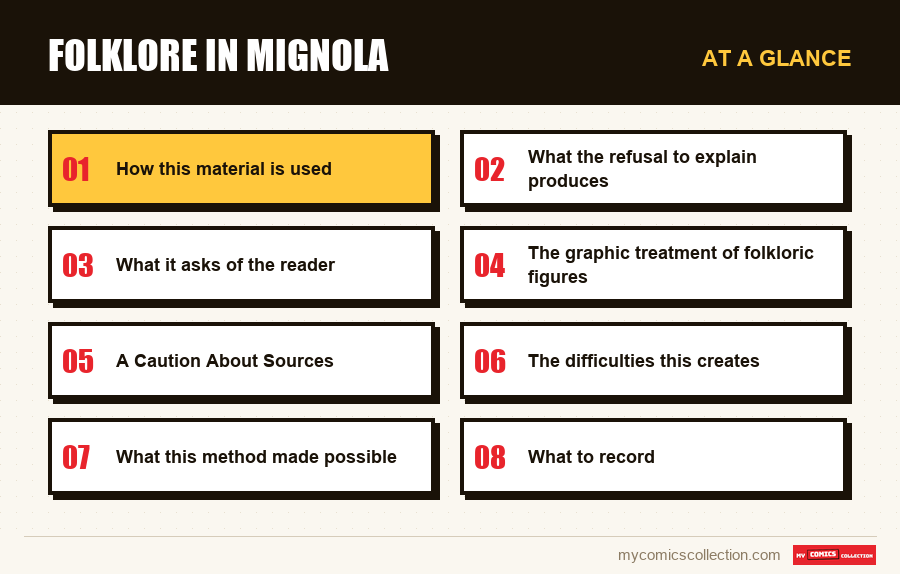
How this material is used
Without exposure
No character explains what the creature they encounter is. She appears, we treat her according to what we know about her, and the reader infers or not.
This is the most radical decision of the method.
With the contradictions preserved
When a tradition offers two incompatible versions, both can appear in the work without either being designated as the correct one.
Without hierarchy between sources
A neighboring village superstition with a major mythological figure, treated with the same seriousness and the same economy.
In very short stories
Most of these stories fit into a few pages, which is the length of an oral tale. The form follows the source.
What the refusal to explain produces
Three effects, two of which are sought and the third suffered.
A feeling of anteriority. A story that does not explain its rules seems older than it, as if it came from an established corpus of which we only see a fragment. This is the main effect and it is very effective.
A particular concern. What we don't understand can't be fixed. A creature whose rules are unknown can neither be fought methodically nor negotiated, which produces a threat of a different order than the ordinary adversary.
A share of lost readers. It must be said: some people dismiss these stories as arbitrary, and they are not wrong based on what they have read. The system requires a confidence that nothing encourages.
This third effect is the price of the first two. No attenuated version of the device would preserve them: Explaining a little would be enough to reduce these creatures to the rank of ordinary monsters.
The comparison that best illuminates this choice is that of the tale transmitted. Someone who heard these stories by a fire received no explanation either.
He already knew part of the context, ignored the rest, and lived very well with this partial understanding. What these stories reproduce is therefore not the content of folklore but the position of the listener: and it is a much rarer restitution than the first.
What it asks of the reader
A precise disposition, which it is better to adopt consciously than to endure.
Accept incompleteness. You won't always know what you just read, and that's not a reading failure. Systematically seeking to identify each reference transforms a story into a documentary exercise.
Read in series rather than in isolation. The motifs echo from one story to another: a creature seen somewhere reappears elsewhere, a rule glimpsed is confirmed thirty pages later. Coherence exists, it is built by accumulation.
Reread. It is the work of this campaign which gains the most on the second reading, because we then recognize what we had seen pass without understanding it.
These three provisions converge: these stories are not given, they are frequented. It’s demanding and that’s also what explains the loyalty of their readership.
The graphic treatment of folkloric figures
One aspect completes the narrative device and reinforces it: the way in which these creatures are drawn.
A story figure poses a problem of representation. Traditions describe it in vague and variable terms (tall, dark, with something animal-like) and any depiction cuts through what the text left open.
The solution chosen is not to decide. These creatures are rendered in black masses whose contours cannot be fixed: we perceive a silhouette, a posture, sometimes eyes, without ever being able to take inventory.
It is the same device as that of the story, transposed to drawing. The reader sees enough to understand the scene and not enough to draw the creature from memory.
This convergence between narrative method and graphic method explains the coherence of the whole. A more explicit drawing would have contradicted the refusal to explain, and a more talkative narrative would have rendered the black masses useless.
A Caution About Sources
A warning is in order about what can be said about an identified reference, because the exercise has its pitfalls.
Recognizing a figure does not guarantee that it is the source. Popular traditions are similar from one region to another, several can correspond to the same drawn creature, and the author sometimes combines elements from several.
An identification is therefore a hypothesis, not a discovery, and comments claiming exact matches usually go further than the material allows.
The right posture consists of noting the resemblance without hardening it. “Recall this figure” is a useful observation; “is such a figure” is an assertion that can almost never be substantiated.
This caution does not take away from the pleasure of the exercise. It only avoids transforming careful reading into approximate erudition, which is the main risk of this type of work.
Collecting this series?
Track what you own, what you are missing and what your collection is worth. 7 day trial.
Start my trial →The difficulties this creates
Unequally shared references
A reader from a given region will recognize figures that another completely ignores, without the text compensating.
Sources difficult to find
The traditions used are often obscure, and nothing in the stories explicitly names them.
A fragmented reading
The short stories are scattered across several volumes depending on the chosen line of collections, which breaks the resonance.
Un premier contact décourageant
A short story read in isolation, without the context of the others, often seems gratuitous.
Let us add that the inequality of recognition between readers is not a defect to be corrected but a property of the material. A Central European reader will recognize figures that a French reader ignores, and the reverse is just as true: just as two neighboring villages did not share the same beliefs. The text never compensates for this gap, and it would be wrong to do so.
Should we document ourselves at the same time?
The question arises naturally and deserves a nuanced answer.
Not while reading. Interrupting a six-page story to look for the origin of a creature destroys exactly the effect that the story is building-that of an accepted partial understanding.
Afterwards, eventually, and profitably. Finding the source of a story that we loved shows what the author kept, discarded and moved. It's informative about his method and costs nothing to read, which has already happened.
Never as a prerequisite. Approaching these stories by having first documented oneself amounts to knowing the rules before entering, which eliminates the position of the listener that the entire system seeks to restore.
In other words: the documentation is a pleasure to proofread, not a prerequisite. The stories are built to work without it, and they succeed.
What this method made possible
A long-term effect is worth noting, because it goes beyond each story taken in isolation.
By drawing on a real and immense corpus rather than on a personal invention, the author has equipped himself with a practically inexhaustible reserve of material. European popular traditions include thousands of figures, most of which have never been used in fiction.
This explains why a work can last for decades without repeating itself., where a universe based on an invented mythology is exhausted in a few years: the author then having to produce each new rule himself.
The process has a counterpart that must be named: these figures do not belong to it, and other authors can use them. This is the price of a common material, and it is modest compared to what it provides.
For a reader, the consequence is pleasant. The work does not give the feeling of exhaustion that threatens closed universes, because it draws from a reservoir that existed before it.
What to record
In this vein, the useful field is documentary and it is only used for rereading: a rare but real use of an inventory.
The creature or lore identified in each story, when you can name it. Nothing in the stories indicates it, no summary indexes it, and this identification is lost as soon as it is found if it is not noted. This is what allows, months later, to find the stories that respond to each other.
It is also what transforms an accumulation of short stories into a searchable corpus, the only way to perceive the coherence that the device constructs through accumulation.
The volume where each short story is found, the collection lines dispersing them differently: without this, finding a six-page story in a work of several thousand pages is a matter of chance.
These two fields serve a work that one does not read once, and that is precisely the case with this one.
Frequently asked questions
No, they come from documented European popular traditions, collected in the 19th century by folklorists. These are fragmentary and contradictory stories depending on the region, and the work preserves these contradictions instead of resolving them.
Because the device restores the position of the person who listened to these tales in the past: he knew part of the context, ignored the rest, and lived very well with this partial understanding. What is reproduced is not the content of folklore but the place of its listener.
Especially not: knowing the rules before entering removes exactly the desired effect. Documenting yourself while reading also destroys it, by transforming a six-page story into an exercise. After the fact, on the other hand, finding a source shows what the author kept and moved: it's a pleasure to reread.
Yes, and they are not wrong based on what they have read: a short story taken in isolation often seems gratuitous. The device requires a confidence that nothing encourages, and no attenuated version would preserve its effects: explaining a little would reduce these creatures to the rank of ordinary monsters.
Because it draws on a real and immense corpus (thousands of figures, most of which have never been used in fiction) rather than on an invented mythology that one would have to produce oneself. The counterpart is that these figures do not belong to him and that others can use them.
Which creature, in which story?
Nothing indexes it, and the identification is lost as soon as it is found.