In short
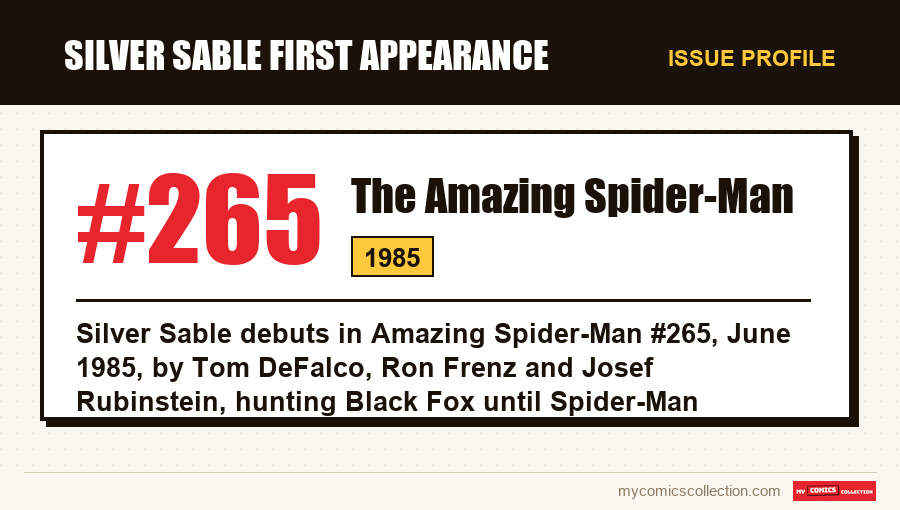
Silver Sable first appears in The Amazing Spider-Man #265, cover-dated June 1985. Tom DeFalco wrote the issue, Ron Frenz penciled it, and Josef Rubinstein inked it. Her entrance is a pursuit: she is after Black Fox and his stolen gems, and the hero blunders into her operation. She enters the series as a rival on a job, not as an ally, which is why the issue is a classic Copper Age key.
Most comics that collectors call keys announce themselves on the cover. The Amazing Spider-Man #265 does not work that way. It sits in the middle of the DeFalco and Frenz years, about a year after the black costume arrived in the title, and it introduces a character who spent her first decade mostly crossing other people's stories. That quiet entrance is exactly what makes the issue worth understanding before you hunt for a copy.
For this guide, the cover month, the credits box and every later issue number cited for Sable were confirmed against published references, and the cover credit is left blank because it could not be confirmed. Where the checkable record stops, for instance on who drew the cover, this guide stays silent rather than guess. Why the book deserves a place on a shelf is our judgment, not a reported fact.
Reading the cover month and the credits box
The Amazing Spider-Man #265 carries a June 1985 cover date. This is the 1963 series, volume one, so the bare number 265 can only mean the 1985 book, since the modern volumes count from their own first issues. If a listing says "Amazing Spider-Man 265" without a volume, the number alone already points to the 1985 issue, because the modern volumes have their own numbering and a very different look.
The credited team is Tom DeFalco as writer, Ron Frenz as penciler, and Josef Rubinstein as inker. The cover credit is the one line in the credits box that this guide leaves blank, because the checkable record for the cover of this particular issue is thinner than the record for the interior. When you see a seller attribute the cover to a named artist with great confidence, treat it as a claim to confirm against the printed indicia and the issue itself, not as settled fact.
How Silver Sable is introduced
The setup is a chase. Silver Sable is hunting Black Fox, an international criminal who has stolen valuable gems, and her goal is to recover them. Spider-Man, drawn into the same pursuit, interferes with her plan without intending to. In other words, the hero does not meet an ally here. He meets a professional whose work he has accidentally damaged, and the reader learns who she is by watching her deal with an obstacle.
That framing is a smart piece of character design. A new mercenary character could have been introduced through a fight with Spider-Man, a team-up, or an origin flashback. Instead the issue gives her a client-driven objective and lets the hero be the complication. She does not need to be stronger than Spider-Man, and she does not need to be his enemy. She only needs to be competent, mission-focused and slightly inconvenienced. Everything the character becomes later, from a rival with her own agenda to a partner of convenience, grows out of that first impression.
Who created her and in what editorial moment
Silver Sable is credited to Tom DeFalco and Ron Frenz. DeFalco has pointed to safari cards he bought as an inspiration for the character, a detail that fits her look and her field-operative style better than a comic-book precedent would. The same duo was in charge of the main Spider-Man title at the time: Frenz became the regular artist on the series in 1984, and issue #252, from May 1984, is where the black costume first appears in the flagship title.
That timing is useful context. The Frenz and DeFalco era was a period of fresh additions to Spider-Man's cast, and #265 is one of the better-known ones. The team did not stay forever: the editor at that time, Jim Owsley, removed them from the title in 1986.
Why #265 is a key issue
The case for the issue rests on three things that you can check without any value guide. The first reason is her later career: Sable headlined a title of her own, Silver Sable and the Wild Pack, which launched in June 1992 under Gregory Wright and Steven Butler and lasted 35 issues, through 1995. A character who later leads a title for three years has a debut that people go back for.
Second, she has stayed in circulation. Beyond her own series, she appears in Sable and Fortune, a limited series that began in 2006, in the "Ends of the Earth" story of 2012 in The Amazing Spider-Man, and in Venom War: Lethal Protectors #1 from September 2024, where she is tied to the Agony symbiote. A debut issue keeps drawing buyers when the character keeps coming back, in new formats and in new hands.
Third, the issue is a recognizable member of a well-known run. If you are building a set of DeFalco and Frenz Spider-Man, #252 is the black costume, #265 is Silver Sable, and the stretch between them gives you a coherent, affordable-to-understand shelf. The flagship Amazing Spider-Man key issues list helps you place #265 among the larger names, and the guide to #252 and the black costume covers the book that opens the era.
Do you collect this series?
Track what you own, what you are missing and what your collection is worth. 7-day trial.
Start my trial →
Reprints and issues that get confused with it
Because the character came back so often, several books share her name or her cover presence. The most common confusions are worth listing so that you check the number, not the character.
The first confusion is with her later appearances in the same series. The Amazing Spider-Man #279, from August 1986, shows her hired by a South African government to deal with Jack O'Lantern. It is a meaningful issue for her story, but it is a later appearance, not the debut. The second is the six-part storyline in #320 to #325, from 1989, in which she teams with Spider-Man, Paladin, Solo and Captain America to track down Sabretooth and the Red Skull. Again, a good story and a different book.
The third is the 1992 series. Silver Sable and the Wild Pack #1 is a number one with the character's name in the title, and that kind of cover invites the assumption that it is her origin. It is her series debut, not her first appearance. The fourth is the Web of Spider-Man #50 from May 1989, where she formed a group called the Outlaws. It is another milestone, again not the debut. If a listing mixes these up, or calls any of them "the first Silver Sable," the number in the title field is the thing to trust.
Inspection points for a 1985 Marvel before you pay
Condition drives the decision more than anything else, and a mid-1980s Marvel has predictable weak points. Start with the spine: a copy that has been read has stress lines running down the fold, and heavy ones can break the color. Look at the corners and at the bottom edge, where handling shows first. Check the staples for rust migration, which leaves a faint brown halo on the cover or the first page, and check whether the staples are original. Swapped staples count as restoration and belong in the description.
Next, look at the cover surface under angled light. Marvel covers from this era show scuffs as dull patches where ink has been abraded, and the dark areas of a cover reveal every flaw. Compare the color saturation with another copy if you can, because a cleaned or pressed book can look unusually bright and flat. Grading labels can flag pressing, cleaning and touch-up, so reading the label tells you what work a book has had. Our walkthrough of Spider-Man grading lists the notations each service uses.
The cover price and the indicia tell you which edition you hold. In 1985, Marvel shipped books through two channels, and the two versions look different in one spot on the cover: one carries a barcode, the other carries an illustrated box. Both are legitimate printings of the issue. Which one you want is a personal choice, and the point is to know what you have and to describe it correctly when you sell it. If you intend to sell a copy later, note the edition, the condition notes and the certification details in your records, so you can compare like with like instead of relying on memory.
The appearances that follow and are worth reading
If #265 makes you curious about the character, a short reading list gives you the shape of her career. Every entry below was verified for issue number and date.
The Amazing Spider-Man #279 (August 1986). She is hired by a South African government to neutralize Jack O'Lantern. The issue shows the contract-driven side of the character that #265 only sketches, and it is the natural next step for a reader who wants to see how she operates when the job is hers.
Web of Spider-Man #50 (May 1989). She forms the Outlaws. The issue belongs to a series that ran from 1985 to 1995, and it is a useful check on how the character was used outside the flagship title. The Web of Spider-Man key issues guide places it within the rest of the run.
The Amazing Spider-Man #320 to #325 (1989). David Michelinie wrote it and Todd McFarlane drew it, and she tracks down Sabretooth and the Red Skull alongside Spider-Man, Paladin, Solo and Captain America. This storyline moves her out of Spider-Man's neighborhood and into a wider espionage setting, a good complement to the small-scale debut.
Silver Sable and the Wild Pack #1 (June 1992). Her own series, by Gregory Wright and Steven Butler. If you collect characters through their solo books, this is the gateway, and the full run is 35 issues.
The Amazing Spider-Man #684, #687 and #690 (2012). The "Ends of the Earth" story pits her team against a Doctor Octopus scheme; after the Sinister Six defeat the Avengers, she recovers Spider-Man and Black Widow, which brings the character into the modern era of the flagship title.
For a ranked and annotated version of these reads, with advice on who each one suits, the companion piece best Silver Sable comics goes through the order of reading, while this guide stays focused on the debut book and the copy in your hands.
How to place #265 in a Spider-Man collection
Treat #265 as the hub of a small cluster of issues around it, not as a lone trophy. The anchor is #265. Around it sit #252 for the black costume, the DeFalco and Frenz run in general, and the mercenary's follow-up appearances. If your shelf is organized by character, #265 belongs in a Silver Sable section next to #279 and the 1989 storyline. If it is organized by creative team, it sits in the middle of DeFalco and Frenz. If it is organized strictly by number, it simply takes its place in the first volume. All three approaches are valid, and the useful thing is to choose one on purpose.
Frequently asked questions
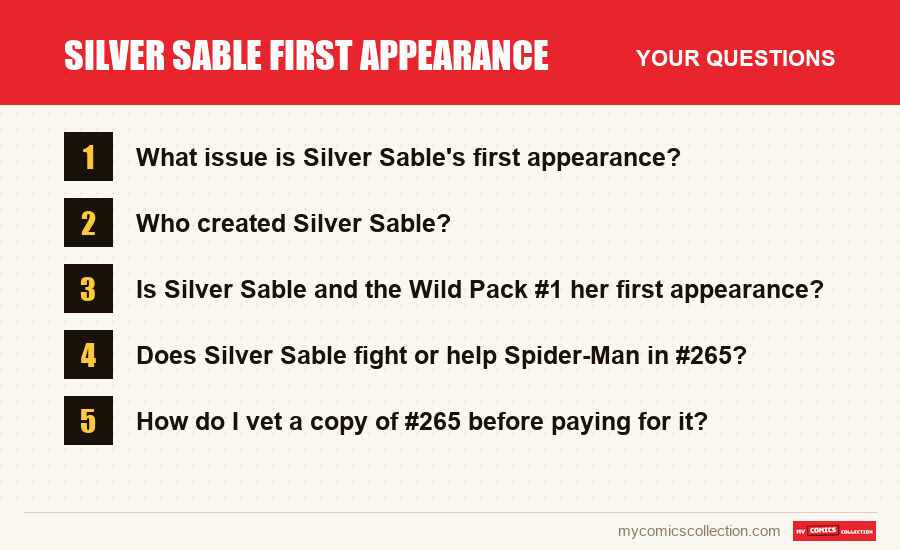
Silver Sable first appears in The Amazing Spider-Man #265, cover-dated June 1985. The issue was written by Tom DeFalco, penciled by Ron Frenz and inked by Josef Rubinstein. No volume tag is needed to pin it down, because the 1963 series was the one running at that time.
Tom DeFalco and Ron Frenz are credited with creating her. DeFalco has cited safari cards he bought as an inspiration. The two were handling the main Spider-Man title when she debuted, with Frenz the regular artist from 1984, and an editor removed them from it in 1986.
No. The 35-issue run that opened in June 1992 under Gregory Wright and Steven Butler is her own title debut, and it closed in 1995. It is her own series debut. Her first appearance in any comic is The Amazing Spider-Man #265 from June 1985, seven years earlier.
Neither, exactly. Her target is the thief Black Fox and his stolen gems; Spider-Man, by accident, wrecks her approach. She appears as a professional with her own objective who is inconvenienced by the hero, which sets the pattern for a long run of partnerships of convenience.
Start with the cover month, then study the spine fold, the staple condition and any scuffed or retouched areas on the front. On a slabbed copy, the label notes and the certification lookup tell you more than the numeric grade alone.
Holding a copy of The Amazing Spider-Man #265 and unsure how its condition compares? Get a free estimate.
Estimate my comic