In short
March 1967 is the cover date of The Amazing Spider-Man #46, where the Shocker debuts. The creators are Stan Lee, who wrote it, and John Romita Sr., who drew it. Herman Schultz is a safecracker in a quilted suit who builds vibrating gauntlets in prison, uses them to escape, beats Spider-Man in their first fight, and is stopped once his thumbs are webbed away from the triggers.
Among the villains of the Romita years, the Shocker is the one whose whole premise fits inside a single issue. Herman Schultz is a thief with a clever invention and a costume designed to protect him from his own machinery. The Amazing Spider-Man #46 is where that premise is laid out in full, and it is the copy collectors mean when they search for the character's debut.
Cover date, credits and the list of later Shocker stories were confirmed against published listings before writing. The comments on the supporting cast, the Rhino and Kingpin comparison and the buying checklist are our own opinion, and no panel or dialogue appears here.
What The Amazing Spider-Man #46 is on paper
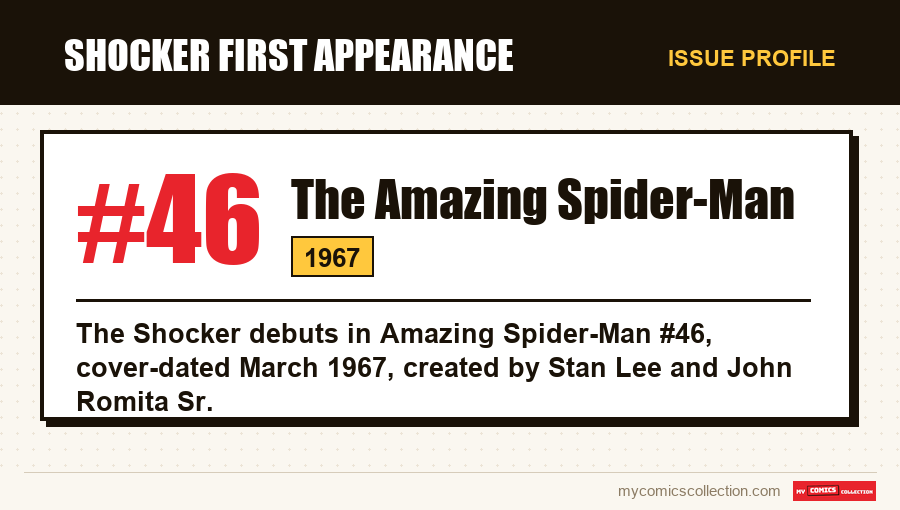
The Amazing Spider-Man #46 carries a March 1967 cover date. Stan Lee wrote the story and John Romita Sr. drew it, and Schultz is credited to both men as co-creators. When you read listings, look for that pairing: a dealer note that names Lee and Romita alongside the number and the March 1967 date is describing the right book, while a note that gives only a villain's name leaves the most important facts out.
The number sits in the middle of the first run of the title, in the stretch where John Romita Sr. had replaced Steve Ditko as the artist. Issue #41, which introduced the Rhino in October 1966, is one of the earliest Romita numbers to carry a new villain, and #46 follows a few issues later with another. A collector who reads #41 and #46 side by side sees two debuts built from the same instinct: one bulky silhouette that reads on a newsstand, and one costume with a clear visual idea behind it.
How the Shocker is introduced
The character arrives with a short, complete backstory. Herman Schultz is a New York burglar with a talent for inventing and engineering, and by his own later account he is the best safecracker in the world. Once he is jailed, he builds a pair of gauntlets that fire high-frequency vibrating air blasts, uses them to escape, and takes the name Shocker. The triggers sit under his thumbs, and that small design choice turns out to matter more than anything else about him.
The costume follows from that logic. It is a quilted suit, and it is easy to read the padding as a visual answer to the problem of a man who shakes things apart for a living. John Romita Sr. has described designing the costume around the ideas of a cushion and a quilt, reasoning that a character who vibrates buildings would need that kind of protection himself.
The gauntlets decide the first meeting, which happens during a robbery and ends with Spider-Man beaten. The reversal comes during a bank robbery, and it comes from observation rather than strength: Spider-Man pins Schultz's thumbs away from the triggers with webbing, knocks him out, and sends him back to prison. The whole arc, from invention to defeat, rests on a single mechanical weakness, which is why the character is so easy to explain to a new reader.
The rest of the issue: why Peter's life matters to this copy
A debut issue is rarely only a debut, and #46 belongs to a period when the supporting cast of the series was growing fast. Gwen Stacy and Harry Osborn had both arrived in #31, cover-dated December 1965. Mary Jane Watson, glimpsed with her face hidden in #25, made her first full appearance in #42, cover-dated November 1966, only four numbers before the Shocker. A reader who picks up #46 is reading the book just as that cast was settling into the shape fans remember.
That context changes how the copy feels on a shelf. The villain is the reason the number is sought, but the Romita pages of this stretch are also where Peter Parker's college life takes over from the high-school world of the Ditko years. Our view is that a collector who reads #42 to #46 in sequence gets a clearer picture of the series than one who reads the debut alone, and that the Shocker reads best as one new face among several.
Who created the Shocker, and in what editorial moment
Stan Lee and John Romita Sr. are credited as the creators of the Shocker. Lee wrote the story; Romita designed the character and drew him. The editorial moment is a handoff: Steve Ditko had defined the look of the series for its first thirty-eight issues, and Romita took over with a softer, more glamorous line. The Shocker arrives in the middle of that handoff, as one of the early Romita-era antagonists, and he was designed for the new visual language of the book.
The Kingpin's debut in #50 arrives only a few numbers later, and the stretch from #41 to #50 is one of the most productive runs of new villains in the title. Collectors who build this stretch in order tend to find that the Shocker sits comfortably between the Rhino and the Kingpin, as a mid-tier debut in a very strong neighborhood. Our guide to the Kingpin debut in #50 covers the number that followed.
Do you collect this series?
Track what you own, what you are missing and what your collection is worth. 7-day trial.
Start my trial →
Why #46 is a key issue
The case for #46 is clear and does not need inflating. Herman Schultz debuts here, and writers have kept bringing him back across several decades. Herman Schultz has been used as a hired fist, as a team member, and as a figure of comic desperation, and the version of him that fans know best is a long way from the confident thief of 1967. The debut is the root of all of it.
The later record is real. The Shocker is a regular in the Thunderbolts run, appearing in Thunderbolts #157 to #162 before leaving the team. He features in the Masters of Evil trial storyline in The Avengers #228 and #229, and he is hired to kill Dominic Fortune in Web of Spider-Man #10. Deadly Foes of Spider-Man #1 to #3 shows him escaping prison with help from Boomerang, terrified of the Scourge, and fleeing after a Scourge impostor steps in. Acts of Vengeance brings him to Fantastic Four #334, and The Amazing Spider-Man #642, #644 and #645 use him in Origin of the Species.
The Superior Foes of Spider-Man made Schultz a lead, and in #17 (2015) Silvermane names him the new crime boss of New York after he defeats the Punisher. For many newer readers that modern series is the first place they met the name. Later, he joins Wilson Fisk's Thunderbolts in Devil's Reign #1. A character with that range of appearances is a character worth collecting from the root.
A fair assessment places #46 below the top tier of Spider-Man keys, which are numbers that introduce characters central to the whole franchise. It sits in the layer of the market that belongs to the mid-tier villains, where the number is wanted by completists and by collectors building villain sets. That is a perfectly good place to be. It means the issue is the kind of copy you can choose by condition rather than by availability.
Reprints, collections and numbers that get confused
Several collected editions reprint the story, which means a reader can enjoy it without owning the single issue. Before buying a collected edition for the story alone, check the contents listing to confirm that #46 is inside, since the volumes in this period are organized by issue ranges and the boundaries differ between formats. A reader who only wants the Shocker's debut does not need the original comic at all.
The number that gets confused with #46 most often is #41, the Rhino debut from October 1966, because the two issues share an artist, a period and a new villain on the cover. The Kingpin's debut in #50 is the other neighbor. Searching a marketplace for "first appearance" in a 1967 range turns up all three, and a listing that gives the number is worth more than a listing that gives only a villain's name.
What to check before you buy, and where the copy sits on the shelf
A number from 1967 is a number with a long history of handling. Start with the spine. Look for stress lines, color breaks, a roll in the spine, and any sign that the staples have been moved or replaced. Check that the cover is attached firmly at both staples and that the centerfold has not separated. On a 1967 book, watch for a cover that was detached and glued back on: glue residue and a small offset along the spine fold give it away.
Next, look at the cover's printed color. Silver-age Marvel covers use flat, saturated inks that show scuffs and color breaks clearly. Tilt the book under a raking light and look for gloss changes, which can indicate that a color touch or a cleaning treatment has been used. A cover with a uniform gloss and a clean surface may simply be a well-kept copy, but it may also be a restored one, and the price should reflect the difference.
Check the edges. Trimmed copies are shorter than the standard size, and the cut leaves a crisp, uniform edge rather than the slightly irregular edge of an uncut book. Look at the corners for blunting or rounding, and at the top edge for the small tears that come from newsstand handling. Look at the back cover for writing, stamps, and coupon cuts, all of which were common in this period and all of which affect the grade.
A slabbed #46 deserves two readings, one of the comic and one of the holder's label, which may list restoration, page quality or a signature note. A restoration notation tells you that the book has been worked on, and the extent of the work should be read from the description rather than assumed. Study the full-resolution images of the slab, front and back, and compare them with what the label says.
Buying unslabbed, request sharp photos of spine, staples and corners, then ask the seller outright about pressing, cleaning and color touch. A reputable seller can answer in a sentence. The method is the same whatever the budget: compare several copies of the same number, and do not choose on the cover photograph alone.
Already holding a copy? Run it through the free comic valuation before you decide anything.
For a collector building the villain side of a Spider-Man shelf, the sequence matters more than any one issue. The Rhino in #41, the Shocker in #46 and the Kingpin in #50 form a three-number chain of debuts in a short window, all under the same writer and the same artist. A shelf that holds the three together tells the story of the Romita era better than any single book, and the condition of the three should be matched as far as the budget allows, so that the set looks like a set.
The surrounding debuts are mapped in the key issues of Amazing Spider-Man, and the Spider-Man hub gathers the rogues gallery.
Frequently asked questions
The Amazing Spider-Man #46, dated March 1967, introduces the Shocker. Stan Lee wrote the story, John Romita Sr. drew it, and both receive creator credit. Other Shocker books exist, but #46 alone carries the debut.
Stan Lee and John Romita Sr. created the Shocker. Lee wrote The Amazing Spider-Man #46, and Romita designed the quilted costume and drew the issue. Romita has said the design came from thinking about a cushion and a quilt, since a man who vibrates structures would need padding himself.
The Shocker wins their first fight, during a robbery, thanks to the vibrating gauntlets. During a later bank robbery, Spider-Man pins his thumbs away from the triggers with webbing, which stops the gauntlets from working, then knocks him out and returns him to prison.
Good next stops are Web of Spider-Man #10, Deadly Foes of Spider-Man #1 to #3, The Avengers #228 and #229, and Thunderbolts #157 to #162. Schultz became a headliner in The Superior Foes of Spider-Man, a book on its own list of recommended reads.
Check the spine for stress lines and color breaks, the staples and centerfold for replacement or separation, the edges for trimming, and the back cover for writing or coupon cuts. On a graded copy, read the label for a restoration notation, and on a raw copy ask whether it was pressed, cleaned or color touched.
Own a copy of The Amazing Spider-Man #46 or another Silver Age Spider-Man key? Get an estimate based on its condition.
Estimate my comic