In short
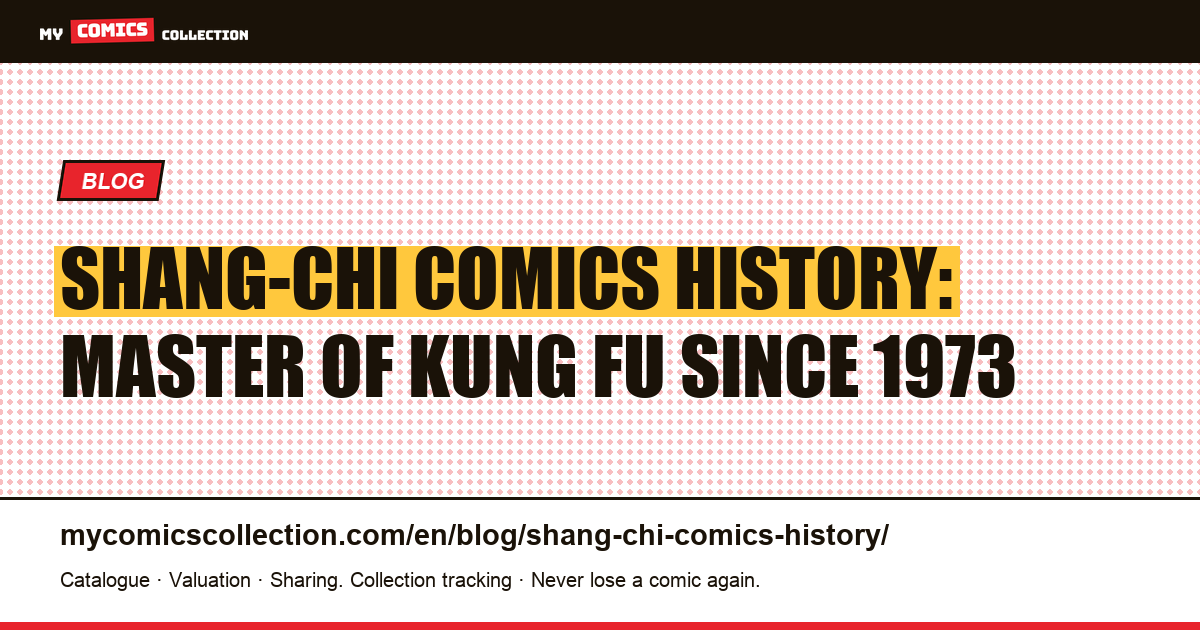
Shang-Chi arrives in Special Marvel Edition #15 (December 1973) as the son of Sax Rohmer's Fu Manchu, the work of writer Steve Englehart and artist Jim Starlin. The book became Master of Kung Fu and ran to #125 in 1983, defined by Doug Moench and Paul Gulacy. After decades of revivals, he joined the Avengers in 2012, and Gene Luen Yang's 2020 series rebuilt his world, with the Ten Rings at its center.
Shang-Chi is a hero whose publishing life divides into three unequal parts: a dense, famous run in the 1970s and early 1980s, a long stretch of one-shots, miniseries and guest roles, and a modern relaunch that rewrote what his father and his family mean. Following those parts in order explains why the character is a collector's favorite and why his bibliography is easy to misread.
The numbers, years and credits for Shang-Chi, from the 1973 debut to the Ten Rings relaunch, come from printed histories of the hero and of Master of Kung Fu, with a month given only when one was read. The commentary on what each turn did to Shang-Chi is interpretation, and no story page is reproduced.
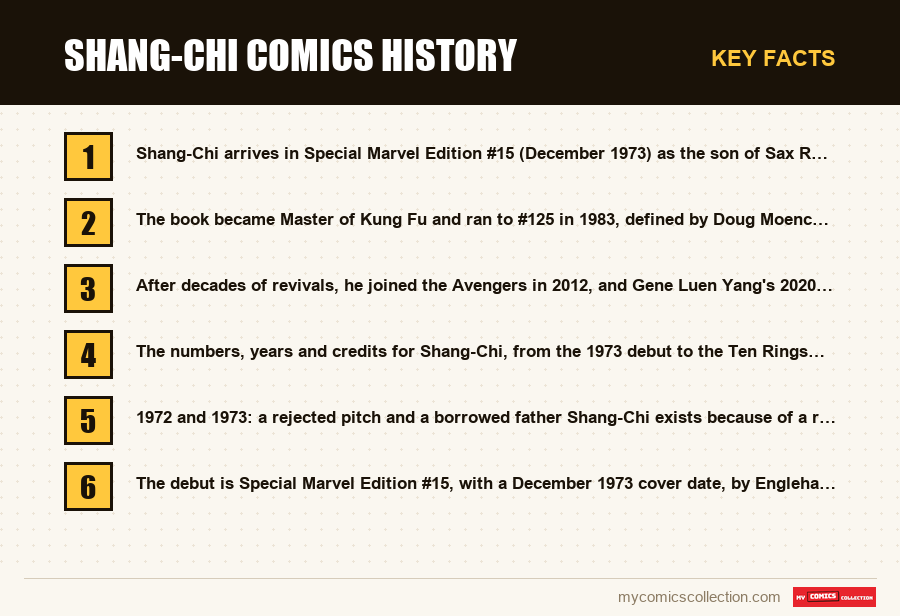
1972 and 1973: a rejected pitch and a borrowed father
Shang-Chi exists because of a refusal. Steve Englehart and Jim Starlin took a martial arts pitch built around the Kung Fu television series to DC, which declined it, and then brought it to Marvel. Roy Thomas, then editor in chief, agreed to it on one condition: that Sax Rohmer's Fu Manchu be part of it. Marvel had hoped to license the television series itself, but those rights were not available, while the company already held comic book rights to Fu Manchu.
That chain of events explains the character's entire shape. Shang-Chi is not a free-standing hero who happens to have a villain father; he is the previously unknown son of a literary villain whom a publisher already had the right to use. The debut is Special Marvel Edition #15, with a December 1973 cover date, by Englehart and Starlin, with Al Milgrom inking. Special Marvel Edition was a reprint title, and putting a new hero into it, rather than launching a number one, was a way to test a concept without committing to a new series.
The setup is plain. Introduced as the previously unknown son of Fu Manchu, Shang-Chi stands against his father. The rest of the character's history is a long argument with that decision. Our reading is that the borrowed father was both the engine of the launch and, much later, the thing the publisher had to write its way out of.
1974 to 1975: a new title and the arrival of Gulacy and Moench
With #17, cover-dated April 1974, the book was retitled The Hands of Shang-Chi, Master of Kung Fu, a title usually shortened to Master of Kung Fu, and it kept the Special Marvel Edition numbering. A new reader should note the consequence: there is no 1974 number one. The series begins at #17, and the original creative team did not stay long. Paul Gulacy's interior art begins at #18 (June 1974), and the writer Doug Moench took over after Englehart's departure. The Moench and Gulacy pairing worked together consistently from #22 (November 1974).
The handover matters for anyone reading the run in order. Englehart and Starlin built the premise, but the voice that most readers associate with the character belongs to the team that followed, and the early issues show the book finding that voice one number at a time.
By #29, The Crystal Connection (June 1975), the series had moved toward a James Bond influenced espionage format. In analysis, this is the moment the book finds its own identity: the martial arts premise remains, but the stories become spy fiction, with a supporting cast that includes Black Jack Tarr, Clive Reston, a younger and more vulnerable version of James Bond, the femme fatale Leiko Wu and Midnight, an assassin of the Si-Fan.
1976 to 1979: a six-voice storyline and a changing art team
An extended storyline, largely serialized in #45 to #50 (November 1976 to March 1977), is narrated from the viewpoints of six characters. Jim Craig replaced Paul Gulacy at #51, and Mike Zeck became the regular penciler later in the decade. The credits of the series therefore divide into two eras: the Gulacy years, which many readers regard as the peak of the run, and a more varied period in which the series kept its voice through Moench's scripts.
The introduction of new villains continued during this stretch. Kogar, created by Moench and Craig, debuts in #63, dated 1978. A collector who wants to mark the shift of the series from its early influence to its later, more continuity-heavy tone can use this stretch as a boundary.
The practical lesson of this period is that Master of Kung Fu is a series of long arcs. A single issue from the middle of the run often assumes that the reader knows the intelligence agency, the supporting cast and the father-and-son conflict, which is why collectors tend to read the run in sequence rather than by cherry-picking.
1979 to 1983: Gene Day, the end of the father storyline and cancellation
Gene Day joined the title in 1979 and became its penciler in the early 1980s. The father-and-son storyline concluded with #118, Moench left after #122, and the series ended with #125, cover-dated June 1983. Over its life, volume one counted 114 issues (#17 to #125), with four Giant-Size issues and one annual included in that run.
Shadow Slasher debuts in #98 (1981), which is one of the later additions to the rogues' gallery. In the years that follow, the series ends with a sense of closure that few Marvel books of the period received: the central conflict with Fu Manchu is resolved before the book is cancelled, which is part of why the run reads as a complete work.
For a collector, the ending creates the character's long afterlife. The run is finite, famous and historically hard to reprint, a fact that our first appearance and reading guide explains in detail. That scarcity of easy reprints is a large part of why the 1970s numbers acquired their reputation.
1988 to 2009: revivals, miniseries and a gap in the title
After cancellation, Shang-Chi returned in pieces. Marvel Comics Presents carried a Moench storyline with Tom Grindberg in its first eight issues (1988), followed by the one-shot Master of Kung Fu: Bleeding Black (1990). In 1997 he appeared in Journey into Mystery #514 to #516, in an arc meant to lead into a 1998 miniseries. A Master of Kung Fu miniseries under the MAX imprint (2002 to 2003) reunited Moench and Gulacy. He was a main character in Heroes for Hire in 2007, and a one-shot, Shang-Chi: Master of Kung Fu, with several writers and artists including Gulacy, appeared in 2009.
The pattern across those years is irregular: short stories, special projects and guest roles rather than a continuing monthly title. For a collector, this period is the most scattered part of the checklist, because the appearances are spread across anthologies, miniseries and other characters' books, so the practical method is to track Shang-Chi by appearance rather than by one series.
Do you collect this series?
Track what you own, what you are missing and what your collection is worth. 7-day trial.
Start my trial →
2010 to 2017: Zheng Zu, the Avengers and a numbering return
The Fu Manchu connection had by then been downplayed after Marvel's license to the Rohmer estate lapsed, and the father was eventually renamed Zheng Zu. That change was revealed in the Secret Avengers storyline of #6 to #10 (December 2010 to April 2011), in which Captain America recruited Shang-Chi into the team. In 2012 he joined the Avengers proper under Jonathan Hickman's run during Marvel NOW!.
This is the legal-and-editorial pivot of the character: a hero built on a licensed villain had to separate from him in order to keep appearing. The rename solved the rights problem without erasing the family history, and it opened a path for the next reinvention.
The title itself returned briefly. A four-issue Master of Kung Fu miniseries by Haden Blackman and Dalibor Talajić ran in the Secret Wars storyline in 2015, and in 2017 Master of Kung Fu #126, a Marvel Legacy one-shot by CM Punk and Talajić, picked the numbering up where the 1983 cancellation had stopped it.
2020 to 2023: Gene Luen Yang and the Ten Rings
The modern relaunch comes from writer Gene Luen Yang. A five-issue Shang-Chi miniseries in 2020, with art by Dike Ruan and Philip Tan, was delayed from June to September by the pandemic, and an ongoing Shang-Chi series followed in 2021, written by Yang with Ruan on art; Marcus To replaced Ruan starting at issue #9. In July 2022 the series became Shang-Chi and the Ten Rings, and the already-solicited issue #13 was retitled Shang-Chi and the Ten Rings #1. Yang's run of 24 issues concluded with the one-shot Shang-Chi: Master of the Ten Rings in January 2023, with Michael YG on art.
The 2021 film shaped the comic. Yang incorporated its concepts, including Jiang Li as Shang-Chi's real mother, the realm of Ta-Lo and the Ten Rings. Our article on the 2021 film against the comics compares the two. For a collector, this means that the Yang books are part of a two-way exchange, not simply an adaptation.
The key issues across Shang-Chi's history
- Special Marvel Edition #15 (1973): the debut, by Steve Englehart and Jim Starlin, inked by Al Milgrom.
- Special Marvel Edition #16: the continuation before the retitle.
- The Hands of Shang-Chi, Master of Kung Fu #17 (1974): the retitle, keeping the old numbering.
- Master of Kung Fu #29 (1975): "The Crystal Connection", the turn toward espionage.
- Master of Kung Fu #45 to #50 (1976 to 1977): the extended storyline told from six viewpoints, before Jim Craig replaces Gulacy at #51.
- Master of Kung Fu #125 (1983): the end of the original series.
- Secret Avengers #6 to #10 (2010 to 2011): the Zheng Zu storyline.
- Shang-Chi miniseries #1 (2020): Gene Luen Yang's relaunch.
How to follow Shang-Chi in a collection
The main trap is the numbering. The original series starts at #17 inside a numbering inherited from Special Marvel Edition, and the 2017 #126 continues that count, while Yang's 2020 and 2021 books use their own numbers. Logging each series with its year prevents the three from being confused in a list, and the four Giant-Size issues and the annual of the 1970s need entries of their own.
The second question is the format. Because the 1970s run was historically difficult to reprint, many readers meet it through collected editions, and buying period issues is a separate project. The scattered appearances of 1988 to 2009 are best tracked as individual entries. Our guide to comic ages explains how the 1973 debut sits in the Bronze Age, and the Avengers Bronze Age key issues page covers the neighboring team books.
A workable plan is to place one marker for each pivot: the 1973 debut, the 1974 retitle, the 1976 to 1977 arc, the 1983 end, the 2010 to 2011 rename of the father, and the 2020 relaunch. When you hold one of these books, a free valuation is the natural next step, and the blog has more guides.
Frequently asked questions
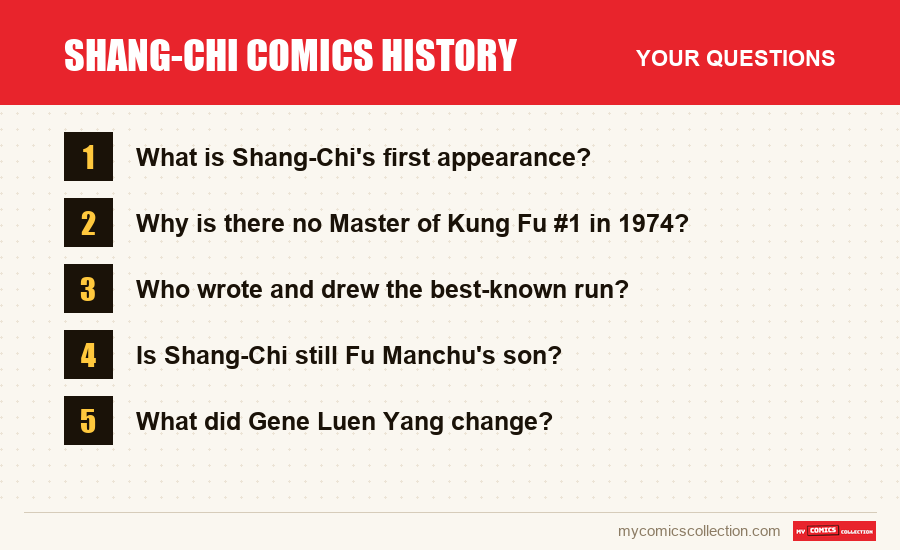
The debut sits in Special Marvel Edition #15 (cover date December 1973), where Al Milgrom inked the Englehart and Starlin pages. The book was a reprint title into which Marvel placed the new hero, and the story introduces him as the son of Fu Manchu.
The series kept the numbering of Special Marvel Edition. With #17, cover-dated April 1974, the book was retitled The Hands of Shang-Chi, Master of Kung Fu, so the title begins at #17 and runs to #125 in June 1983.
Doug Moench wrote and Paul Gulacy drew the stretch most often praised, working together consistently from #22 in November 1974. The extended storyline of #45 to #50 came shortly before Jim Craig replaced Gulacy at #51, and Mike Zeck later became the regular penciler.
The link was downplayed after Marvel's license to the Rohmer estate lapsed, and the father was renamed Zheng Zu in the Secret Avengers storyline of #6 to #10 (December 2010 to April 2011). The character's family story continues under that name.
Yang wrote a five-issue miniseries in 2020, an ongoing series in 2021 and the retitled Shang-Chi and the Ten Rings from July 2022, ending with a one-shot in January 2023. He folded in the 2021 film's Jiang Li as Shang-Chi's mother, the realm of Ta-Lo and the Ten Rings.
If a 1970s Master of Kung Fu issue or a Gene Luen Yang first printing is in your collection, a free valuation shows where that copy stands.
Estimate my comic