Shadowline is the editorial label that Jim Valentino runs within Image, and it's probably his most significant contribution: the one that's also the most invisible in the marketplace. As of August 29, 2026, only 19 ads mention this label in their title, $6.95 median asking, without any certified announcement. However, successful titles have come from it: sellers cite the series and the author, never the label. Editorial management leaves no trace in a collectible market.
This is the second profession of this author, and the one through which he will have touched the most readers without anyone knowing it.
This article explains what a label of this type actually does, what the record shows of its erasure, what this means for a collector, and how to spot these publications despite everything.
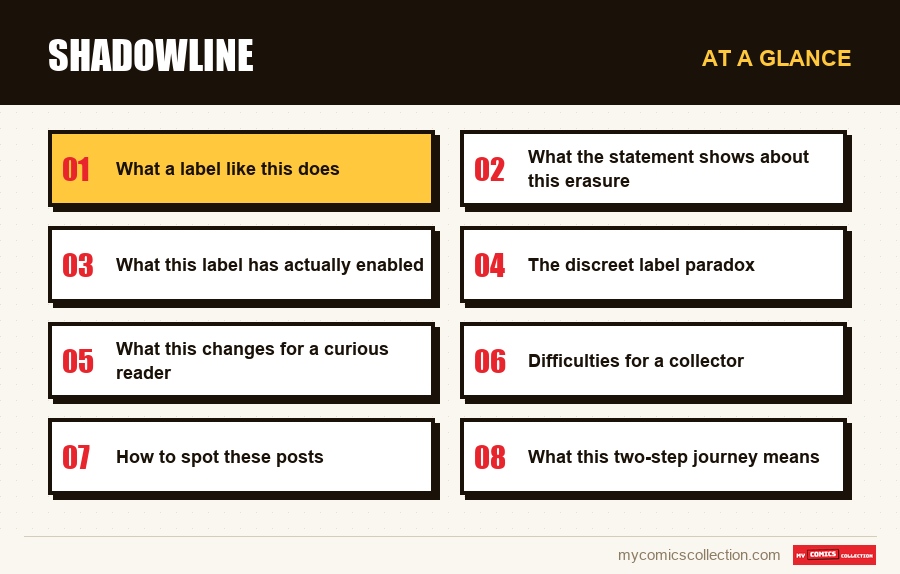
What a label like this does
The word covers a more concrete reality than we imagine, and it is worth detailing it.
He chooses. Projects arrive, most are refused, a few are retained. This selection is the fundamental editorial act and no one outside ever sees anything about it.
He accompanies. A beginning author needs to be told what doesn't work, before printing. This work is done on versions that the public will not see.
It structures. Calendars, publication commitments, coordination between designer, colorist and letterer: the least visible and most time-consuming part.
He protects. In a structure based on author ownership, someone must ensure that contracts respect this principle for newcomers, who do not have the negotiating power of the founders.
These four functions have one thing in common: none produces an object that bears the name of the person who uses it.
What the statement shows about this erasure
The figures below come from fixed price announcements taken on August 29, 2026, with raw and certified counted separately. They reflect what a seller hopes to achieve.
The mention of the label
19 ads only cite it in their title, $3.39 to $36.61 requested, median $6.95. No certified announcement.
Nineteen, for a label active for decades.
What these ads contain
Series published over three decades, including titles that found a wide audience. The label appears as an incidental mention, after the title and the author.
What is highlighted instead
The name of the series, that of the screenwriter, that of the designer, the year. The label comes last when it arrives.
A significant absence
Zero ad certified under this mention. No one certifies a copy for their editorial label: we certify for an author, a character, a rank.
Why is this figure the subject?
Nineteen ads do not measure the label's activity. They measure its inclusion in the language of the market, and it is very different.
Titles published under this label actually circulate in hundreds of advertisements, but indexed under their own name. The label is not a purchasing category: no one is looking for “a book of such a label” as one would look for an author or a character.
This is the direct translation of what was said above. A work of selection and support dissolves entirely in the works that it has made possible.
It must be said without dramatizing: this is the normal functioning of this profession, and every editor accepts it by choosing it. But this produces a real distortion in the way a catalog's story is told.
We attribute successes to the authors, which is fair, and we attribute nothing to those who selected them from among a hundred projects, which is less so.
Be careful not to overinterpret in the other direction. A label doesn't make the books: the authors make them, and a bad project doesn't become good because it was well supported.
What editorial management determines is which projects exist over others. It is a real power, but it is exercised upstream and negatively: on what has not been published as much as on what has been.
What this label has actually enabled
Without going into an inventory, a few features emerge from the publications noted.
A diversity of registers. The ads feature adventure, fantasy, humor and stories for a wide audience: a distribution that one would not expect from a catalog long identified with superheroes.
Early work. Several of the series noted are the debuts of authors who have gone on to have considerable careers elsewhere. This is the most useful function of a label of this type.
A long continuity. The announcements cover publications spanning several decades, which is rare for an editorial entity of this size.
These three features outline a policy. Taking risks on authors without reputation, in genres that the house did not practice: that is to say exactly what the original structure promised without any guarantee that it would be done.
The discreet label paradox
A question naturally arises: why not make the label more visible, since that would benefit everyone?
The answer lies in a trade-off that every publisher knows. Highlighting the brand requires giving it a strong identity (a genre, a tone, a promise) so that the reader knows what they are buying when they see it.
But this is exactly what a discovery label cannot do. Promising an editorial color would mean refraining from publishing what does not correspond to it, that is to say to renounce the freedom of selection which justifies the existence of the label.
The choice therefore fell on diversity to the detriment of recognition. The registers noted in the advertisements (adventure, fantasy, humor, broad audience) confirm this orientation, and at the same time explain why the name means nothing to anyone.
It is a defensible decision, and it has a measurable cost: nineteen advertisements cite the label, which means that no reader is looking for it and no published author gains additional visibility from it.
What this changes for a curious reader
A practical consequence follows from all of the above, and it is rather encouraging.
Since the label has no market label value, titles under it carry no premium. They sell at the price that their own notoriety justifies, no more and no less.
This means that a reader who methodically goes back through these publications (through the authors, as indicated above) would access a set of early works by authors who have become notable, without paying the premium that these same first works carry when they are identified as such.
The difficulty is entirely in the location, not in the price or in the availability. This is a rare situation, and it rewards documentation work rather than budget.
This is probably the best use a collector can make of this item: not looking for the label, but looking for the people he published before others published them.
Collecting this series?
Track what you own, what you are missing and what your collection is worth. 7 day trial.
Start my trial →Difficulties for a collector
A non-indexed label
Searching by the name of the label returns nineteen ads, a tiny fraction of what actually exists.
No accessible reference list
Nothing simply lists what appeared under this mention. The reconstitution is done title by title.
A discreet mention on the object
The label's logo is often small, sometimes only in the title, which makes it difficult to sort visually.
Unrelated prices
The titles published under this label each follow their own market. The label does not induce any price consistency.
How to spot these posts
Three methods, from the most reliable to the most convenient.
By the bear of the number. The mention appears systematically, which makes it the only sure check, but it requires having the copy in hand.
By the logo on the cover, when he is there. Its presence varies depending on the periods and series, and its absence proves nothing.
By overlapping authors. Authors published under this label return from one title to another. Identifying a name, then following its bibliography, brings up more publications than a search by label.
This last method is the most productive and it says something about the subject: we find editorial work by the people he put to work, never by his brand.
What this two-step journey means
One final point is worth asking, because it sheds light on this entire bibliography.
This author was first a designer, with the modest results that his price records show. He then became the one who decides what others will publish.
This shift is frequent and rarely chosen cheerfully: it often occurs when the creative career is running out of steam. But here it produces something coherent -an author who himself benefited from a fellow publisher in his beginnings finds himself occupying this place for others.
His first series was published by an author's small self-publishing house, a gesture of a colleague rather than a commercial act. Thirty years later, he did the same thing on another scale.
This is probably the fairest way to read this journey: not a career as a designer followed by a reconversion, but the same position held from two successive sides.
What to record
On this subject, the field to be kept concerns information that the object carries discreetly and that the market is entirely unaware of.
The original label, noted in the title rather than on the cover. This is the only way to reconstitute an editorial set that nothing indexes: neither advertisements, nor current catalogs, nor keyword searches. Nineteen advertisements mention it when hundreds of titles fall under it.
A collector who is interested in an editorial policy rather than a character has no other outlet than his own notes.
Authors discovered under this label, noted as such: this is the track which traces the most publications, since these authors return from one title to another and their bibliographies are correctly indexed.
These two fields are used to document a contribution which, by nature, does not leave a trace on the objects it produced.
Frequently asked questions
He chooses projects from those that arrive, supports authors on versions that the public will not see, structures schedules and technical coordination, and ensures that newcomers' contracts respect the principle of author ownership. None of these functions produces an object with its name.
Because this figure measures the inscription of the label in the language of the market, not its activity. The titles that fall under it circulate in hundreds of advertisements, but indexed under their own name: no one is looking for “a book of such a label” as one would look for an author or a character.
By the title of the number, where the mention systematically appears: this is the only sure check, but it requires having the copy in hand. The logo on the cover is of variable use and its absence proves nothing. The most productive method remains to follow the authors, who return from one title to another.
Not at all. The titles each follow their own market, without consistency induced by their editorial affiliation, and the statement does not show any certified advertisement under this mention. We certify for an author, a character or an appearance rank: never for a label.
It reached many more readers, without anyone knowing it. But we must not overinterpret: a label does not make the books, the authors make them. What editorial management determines is which projects exist rather than others: a real power that is exercised upstream, over what has not been published as much as over what has been.
What label, recorded where?
The mention is in the title, not on the cover, and the market does not index it anywhere.