Jim Valentino is the founder of Image whose most lasting contribution is not a series but a structural decision. He was part of the group of authors who left the big houses in the early 1990s to own what they created, then later took on an editorial leadership role. The paradox is measurable: at the reading of August 29, 2026, its own series wonders $4.96 to $7.55 median, when titles published under the structure he helped to shape reach levels beyond measure.
Understanding what happened in the early 1990s sheds light on an important part of what the independent comics market has become.
This article sets out the founding principle, what it concretely changed, what the survey shows about the paradox, and what you need to know to collect around this episode.
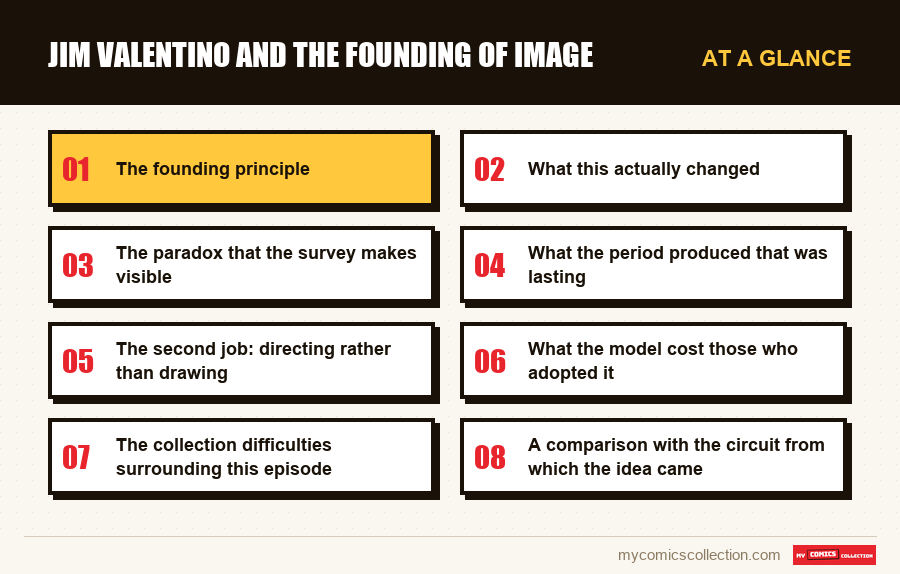
The founding principle
It fits in one sentence, and everything else flows from it: the author retains ownership of what he creates.
The dominant model until then worked differently. An author working for a large house created characters who belonged to this house, which could then exploit them indefinitely, on all media, without the creator having any share beyond his initial remuneration.
The structure founded in the early 1990s reverses this relationship. Each author publishes under his own label, keeps his rights, and in return bears the commercial risk of his choices.
It was not a new idea: the self-publishing circuit had been practicing it for a decade, on a confidential scale. What was new was to apply it with national distribution and authors already known to the general public.
What this actually changed
A displaced contractual standard
The possibility of publishing while retaining one's rights has become a real option rather than a marginal position. The big houses had to come to terms with this alternative.
This is the most lasting effect, and it is not seen in any particular series.
A catalog that has become heterogeneous
Each label following its own line, the structure ended up welcoming works that had no connection between them: action, intimate, humor, documentary.
A risk transferred to the authors
Maintaining your rights means assuming losses. Several series launched during this period stopped due to lack of profitability, without a net.
Management to learn
Authors became responsible for calendars, distribution and contracts, jobs that none of them had done.
The paradox that the survey makes visible
The figures mentioned below come from fixed price announcements recorded on August 29, 2026: asking prices, distinguished between raw copies and certified copies, which reflect what a seller hopes to obtain.
The personal series of this author wonder between $4.96 and $7.55 median in gross depending on the relaunch considered, with entries at $0.99 and a certified market which is counted in units.
The contrast with the reputation of the structure he helped to found is striking. Its recognition relates to an organizational decision, not to pages, and this type of contribution leaves no trace in a price statement.
There is nothing abnormal about this. A collector’s market values objects; a structural decision is not. But you need to know this before looking for a premium on your series that doesn't exist and has no reason to exist.
The consequence for a buyer is direct. Don't buy his comics thinking of acquiring a fragment of editorial history valued as such.
Buy them for what they are: readable series for a few dollars, whose documentary value is real but entirely intellectual. The statement shows no historical premium on any of the four series.
What the period produced that was lasting
It is worth separating what held from what did not, as the two are often confused.
What didn't hold up: aesthetics. The dominant style of the early years (exaggerated analyses, spectacular cutting, thin narratives) has aged poorly and still weighs on the reputation of everything dating from this period.
What held: the principle. Thirty years later, the structure publishes works that have nothing to do with those of its beginnings, in registers that its founders did not practice.
This discrepancy is the most interesting fact of the case. The model has outlived the aesthetic that made it possible, which is rare: most editorial movements disappear with the style that supported them.
This is probably because the principle did not depend on any content. A framework that only says “the author retains his rights” imposes nothing on what will be published.
The second job: directing rather than drawing
The least told part of this journey is perhaps the most defining, and it begins when the first one runs out of steam.
Going from author to editorial director implies a concrete renunciation: accepting that one's own work comes after that of others, and devoting the time one devoted to the boards to calendars, contracts and arbitrations.
Few authors take this step, and fewer still maintain it. The reason is simple:the publishing profession does not produce anything that has your name on the cover, and its success is measured by the success of the work of others.
This is exactly what the figures mentioned above reflect. A career devoted to bringing the work of others into existence leaves no trace on the market for its own books, and a considerable mark on the market for the books it has made possible.
There is no way to collect this contribution. On the other hand, we can recognize her, and that is reason enough to read her series with attention rather than with condescension.
What the model cost those who adopted it
A counterpart deserves to be exposed, because accounts of this period almost always omit it.
Maintaining your rights means bearing your losses. An author employed by a major house is paid whether his series works or not; an author who publishes under his own label commits his resources and loses if the title does not find its audience.
Several series launched with the enthusiasm of the first years ended abruptly, sometimes in the middle of the story, leaving unfinished stories that nothing has ever concluded. These interrupted series are a period-specific collecting trap: nothing on the numbers indicates that the sequence does not exist.
Added to this is the difficulty of scheduling. Publication delays were considerable, and readers waited months between two issues of the same arc: which explains part of the disaffection which followed the craze.
A buyer today escapes the problem of timing but not that of incompletion. Before committing to a series from this period, it's worth checking that it has ended.
Collecting this series?
Track what you own, what you are missing and what your collection is worth. 7 day trial.
Start my trial →The collection difficulties surrounding this episode
Considerable print runs
The production of these years was printed in quantities which are still dormant. Nothing is rare, almost everything is cheap.
Poorly identified labels
Each founder published under his own label. The name of the structure on a cover does not say who is responsible.
A collective reputation
The series from this period are judged as a whole, which disadvantages those which were better than average.
Moving credits
The authors intervened on each other's series. The cover does not provide reliable information.
A comparison with the circuit from which the idea came
It is enlightening to compare the two scales to which the same principle was applied, ten years apart.
In the self-publishing circuit of the 1980s, an author printed a few thousand copies, distributed them to a restricted network of stores, and lived frugally from a loyal readership. Control was total, the means paltry.
At the beginning of the 1990s, the same principles applied with national distribution, circulations numbering in the hundreds of thousands, and a readership who knew nothing of this debate. Control remains total, the means change by order of magnitude.
What the second experiment demonstrated was that the principle also worked on a large scale, which no one was sure of before. This is its historical contribution, regardless of the quality of the series produced.
What the first had demonstrated, on the other hand, and which the second painfully rediscovered: an author who owns his work also assumes its failures, and this responsibility does not become lighter with success.
How to approach this period today
Three recommendations, which arise from all of the above.
Buy out of documentary curiosity, not by calculation. The print runs prohibit any scarcity on current titles, and the statement confirms this series after series.
Look for the exceptions rather than the headliners. The most interesting series from this period are rarely those that sold best at the time, and they can be found at the same price today.
Read knowing what you are reading. These books were produced under considerable schedule pressure by authors who were simultaneously discovering the craft of publishing. You can hear it in the pages, and knowing this makes the reading fairer.
This last recommendation is worth more than the other two. A series from this period read as an ordinary production disappoints; read as a document about a transition, it is fascinating.
What to record
Over this period, the useful field concerns editorial affiliation, a distinction that the covers deliberately make vague.
The label under which the title appeared, distinct from the name of the structure. Each founder published under his own imprint, and two series bearing the same common logo are entirely separate editorial responsibilities. Without this field, a set built around the structure mixes lines that have nothing to do with each other.
This is also what makes it possible to follow an author's trajectory through the period, rather than accumulating titles linked by a logo.
Year of publication, since this period produced several renumbered homonymous series, including from the same author.
These two fields serve to reconstruct an organization that the objects themselves do not show: which is exactly the issue when you collect around an editorial episode rather than around a character.
Frequently asked questions
A structural decision rather than a work: to be part of the group of authors who leave the big houses to publish while retaining their rights, then to assume a role of editorial management. This type of contribution leaves no trace in a price statement, which explains the contrast with the modesty of its own medians.
No, the self-publishing circuit had been practicing it for a decade on a confidential scale. What was new was to apply it with national distribution and authors already known to the general public: the principle is the same, the means have no relation.
None, in any of the four series noted. Gross asking medians range from $4.96 to $7.55 with entries at $0.99, and the certified market is counted in units. A collectible market values objects, and an organizational decision is not one of them.
The principle, not the aesthetics. The dominant style of the early years has aged poorly and still weighs on the reputation of everything that dates from it. The model has survived: the structure today publishes works in registers that its founders did not practice.
Knowing that they were produced under considerable schedule pressure by authors who were simultaneously discovering the publishing profession. Read like an ordinary production, a series from this period disappoints; read as a document about a transition, it becomes fascinating.
What label, what year?
The same logo covers entirely separate editorial responsibilities.