Every comic collector eventually faces their duplicates. A convention buy without checking your list, a lot bought to snag a key issue, a series accidentally purchased twice because you forgot… duplicates are part of the collector's life. But they're more than a problem: handled well, they're a way to finance new acquisitions and lighten an overflowing collection.
Every comic collector eventually faces their duplicates. A convention buy without checking your list, a lot bought to snag a key issue, a series accidentally purchased twice because you forgot… duplicates are part of the collector's life. But they're more than a problem: handled well, they're a way to finance new acquisitions and lighten an overflowing collection.
This guide walks through every option available to US collectors in 2026: online platforms, conventions, buyback shops, and the best practices to maximize what you get for them.
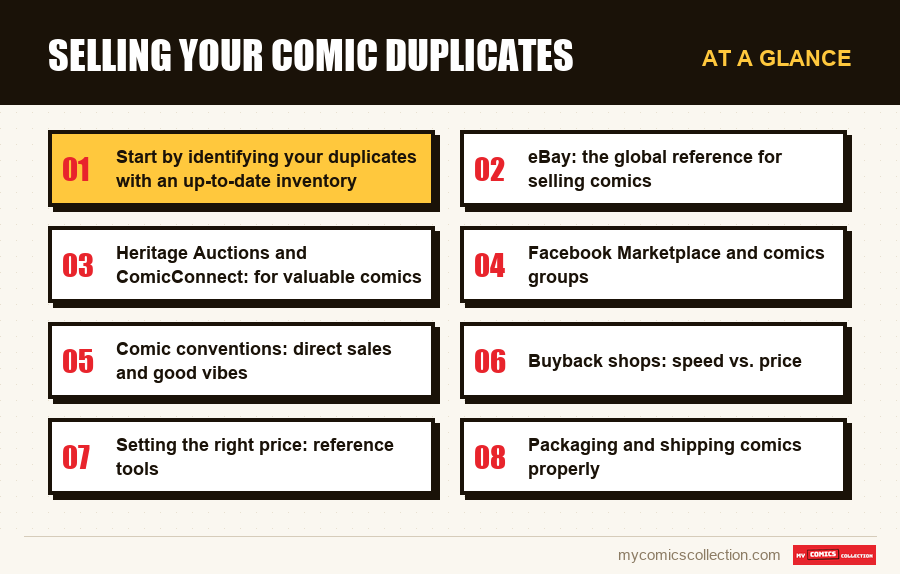
Start by identifying your duplicates with an up-to-date inventory
Before trying to sell, you need to know exactly what you have in duplicate. That's where a digital inventory becomes indispensable. Leafing through longboxes searching for duplicates is tedious and unreliable: you risk missing some, mixing them up, or worse, mistakenly selling an issue you only owned once.
With My Comics Collection, every issue you own in multiple copies is clearly flagged. The tool automatically generates your duplicate list, issue by issue, with condition and estimated value. You enter the selling phase with total visibility on what you have to offer.
Tip: Before listing, verify that the condition of each duplicate is properly entered in your inventory. It's the first question a serious buyer will ask, and it directly determines the price you can command.
eBay: the global reference for selling comics
eBay remains the go-to platform for selling American comics, whether you're in the US, Europe, or selling across borders. The buyer base is massive, comics are in high demand, and the auction-or-fixed-price format lets you choose your strategy.
Creating an effective eBay listing
A good listing title should include the series name, issue number, publisher, year, and condition. Example: "Amazing Spider-Man #300 Marvel 1988 VF/NM, 1st full Venom app". Photos are essential: front cover, back cover, and any visible defect (crease, stain, dinged corner). A buyer who purchases without seeing actual condition will be unhappy and leave negative feedback.
eBay fees and commission
eBay takes roughly 13-15% of the final sale price (selling fees + payment processing). Factor these fees into your pricing. For a comic sold at $55, you'll net about $46-$47. Add shipping if you charge separately, or build it into the price if you offer free shipping (which improves visibility).
Auction or fixed price?
The auction format works better for key issues: first issue, first appearance of a character, rare issue: where buyer competition can drive the price beyond your expectations. Fixed price is better suited to common comics for which you know the market value and want a fast, predictable sale.
Heritage Auctions and ComicConnect: for valuable comics
For valuable comics: CGC 9.8s, key issues, Golden Age, Silver Age:Heritage Auctions and ComicConnect are the specialized platforms. Unlike eBay, lots are validated by a specialist before going up, which reassures buyers and can justify higher prices.
These platforms are particularly suited to value comics: key issues, first issues, CGC-graded comics, Golden Age or Silver Age. For an Amazing Spider-Man #1 or a Batman #1, Heritage or ComicConnect will offer a better sale frame than eBay, with an audience of serious buyers willing to pay.
Seller fees run around 10-15% of hammer price. Auctions usually last 1-2 weeks. The submission process is more selective than eBay, not every comic is accepted, but that plays in your favor for quality pieces.
Facebook Marketplace and comics groups
To sell fast and without commission fees, Facebook is your ally. Two complementary approaches:
Facebook Marketplace
Ideal for ordinary comics sold as a lot to a local buyer. No fees, hand-off possible to avoid shipping issues. Less suited to rare comics you want to sell at best international price.
Facebook comics groups
Groups like "Comic Books for Sale" and specialty "Buy / Sell / Trade Comics" groups gather thousands of collectors. Transactions happen between enthusiasts, without platform fees, with good mutual understanding of comic values. Prioritize secure payments (PayPal Goods & Services) even between individuals.
Comic conventions: direct sales and good vibes
Comic conventions (SDCC, NYCC, C2E2, Wizard World, local shows) are an excellent direct sales venue. You can rent a dealer table or simply offer your duplicates to other collectors during the informal buy-sell portion many events organize.
The upsides are real: no platform fees, immediate payment, no shipping to handle. The downside: you're limited to the physical audience that day, and convention prices are sometimes lower than eBay. For lots of common comics you want to move quickly, it's perfect. For a rare key issue, eBay or Heritage give you better results.
Major US comic conventions to know
- San Diego Comic-Con (SDCC): July (San Diego, CA)
- New York Comic Con (NYCC): October (New York, NY)
- C2E2: March (Chicago, IL)
- Wizard World conventions: various dates, multiple US cities
- Emerald City Comic Con: March (Seattle, WA)
Collecting this series?
Track what you own, what you are missing and what your collection is worth. 7 day trial.
Start my trial →Buyback shops: speed vs. price
Comic shops and specialized retailers often offer buyback services. It's the fastest option: you bring your duplicates, the retailer evaluates and makes you an offer same-day.
The flip side: shops generally buy at 30-50% of market value, sometimes less for common comics. They need their margin to resell. You usually have a choice:
- Cash immediate: less financially attractive but practical if you want to liquidate fast
- Store credit: usually 10-20% more than cash, to use on future purchases in the shop
Store credit is an excellent deal if you buy regularly at that shop: you recycle your duplicate value directly into new comics.
Setting the right price: reference tools
Selling at the right price means knowing the actual market value. Three tools are essential:
eBay Sold Listings
Your primary reference. On eBay, filter by "Sold Items" to see the prices at which identical comics actually sold (not just listed). Compare copies in the same condition as yours. This is the most reliable and most current data.
GoCollect
GoCollect aggregates sales data from eBay and other platforms and displays price evolution charts by issue and CGC grade. Ideal for understanding whether a comic has recently appreciated and identifying the best moment to sell.
Overstreet Price Guide
The collector's bible for decades. Overstreet gives reference prices by grade for classic comics. Useful for estimating Golden Age or Silver Age value without recent eBay data. Caveat: Overstreet prices can lag the current market for modern comics.
Packaging and shipping comics properly
An online sale only succeeds if the comic arrives in perfect condition. A comic damaged in transit creates a dispute, a return, and a bad seller reputation. Here's the minimum:
- Bag: Mylar or polypropylene, sized to the comic (current, Silver Age, Golden Age)
- Board: slipped behind the comic in the bag for rigidity
- Cardboard sandwich: two pieces of rigid cardboard slightly larger than the comic, taped around the bag+board
- Bubble mailer or box: a bubble mailer works for a single comic, a box for a lot
- Tracking number: essential: without tracking, you can't defend yourself in a buyer dispute
Warning: Never ship a comic in a plain envelope. Bending during postal sorting can crease the cover, lowering condition, and buyer satisfaction. Rigid cardboard is non-negotiable.
FAQ: Selling comic duplicates
Identify your duplicates with My Comics Collection
Your inventory automatically generates your duplicate list with condition and estimated value. No more digging through longboxes: sell with method.
🚀 Free 7-day trial, no commitment