
Selling 50 comics at once in 2026 means balancing bulk sales (fast, 30-40% discount) against individual sales (slow, full value). Under $500 in total value, an eBay lot does the job. Between $500 and $5,000, go with ComicConnect or Whatnot. Above that, Heritage Auctions remains the gold standard for preserving value.
Finding yourself with 50 comics to sell all at once happens more often than you'd think: a move abroad that forces a ruthless cull, decluttering after a life change, an inheritance handed down by a collector relative, or simply a collection that's grown unmanageable because it fills two full shelves and half of it has never been reread. The question is no longer whether to sell, but how to sell 50 units without losing weeks scanning, photographing, grading, listing, and shipping each copy one by one.
The classic trap is applying the same method you'd use for 5 comics: photographing every back cover, writing 50 descriptions, managing 50 transactions, packing 50 parcels. At that pace, the job turns into an unpaid part-time gig for two months. At the other extreme, dumping the whole lot on a Sunday flea-market dealer for $200 cash sacrifices 60-70% of the real value. The 2026 strategy is to segment the lot into coherent sub-groups, identify the 3-5 individual pieces that deserve special handling, and liquidate the rest as themed lots on the platform best suited to the average ticket.
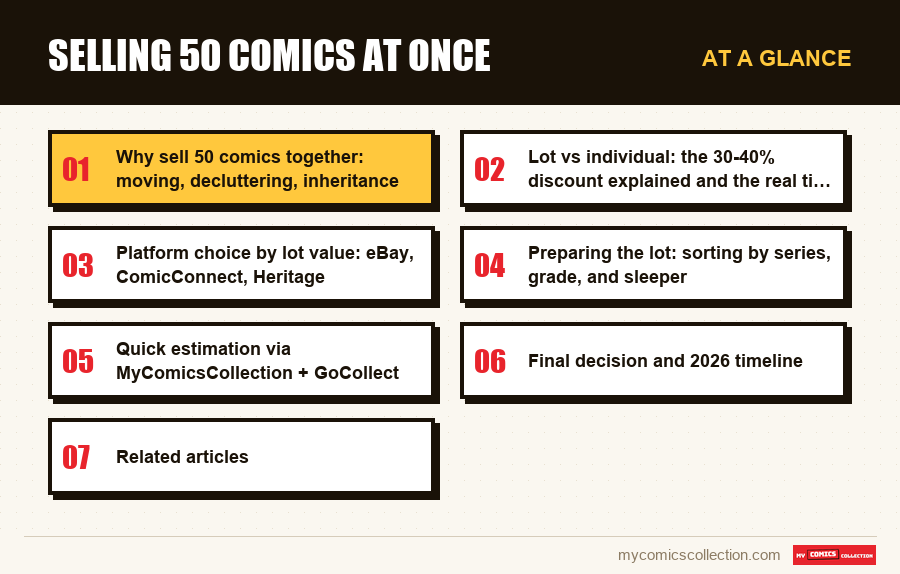
Why sell 50 comics together: moving, decluttering, inheritance
Selling 50 comics as a group rarely comes from a purely financial decision. Three contexts statistically dominate: geographic relocation, life reorganization, and estate transfer. Each imposes different timing and method constraints, and confusing these cases leads to costly strategic mistakes.
A move, especially an international one, sets an absolute deadline. An expat leaving for Canada or Asia has six to eight weeks to liquidate whatever won't fit into a 1,000-cubic-foot container. In this context, individual sales are off the table: you need a channel that can absorb 50 units in under 30 days, even if it means accepting a 25-35% discount off catalog value. eBay in themed lots of 10-15 copies (1990s Spider-Man, 2000s Batman, post-2010 X-Men) remains the fastest solution for this profile, possibly supplemented by a Whatnot live show for the mid-tier pieces.
Voluntary decluttering gives you more room to maneuver. A collector who decides after ten years that the collection has outgrown its storage capacity can spread the sale over three to six months, sell the 10 strong pieces individually, group the rest into two or three lots, and smooth the income across two tax years. This is the scenario that maximizes recovered value, provided you have the discipline to list regularly.
Inheritance presents a hybrid case. Inheriting 50 comics from a deceased relative often imposes an administrative delay (probate, splitting with siblings, valuation for a notary), but also an emotional weight that slows down decisions. The trap here: leaving the comics in a damp box for 18 months while the estate drags on. Humidity degrades raw copies, and White pages turn Off-white within six months of poor storage, which can cut the potential CGC value in half. Sorting a comic collection within an estate requires a methodical approach distinct from a simple resale.
Identifying your context lets you calibrate the speed/value trade-off. A move prioritizes speed, decluttering prioritizes value, and an inheritance first requires physically securing the books before any commercial decision.
Lot vs individual: the 30-40% discount explained and the real time savings
The central trade-off in any 50-comic resale: should you sell in a lot or individually? The answer depends on the time available, the average per-unit value, and your ability to handle the logistics. The 2026 figures confirm an average discount of 30 to 40% on bulk sales compared to the sum of separate unit values, but that discount masks wildly variable realities depending on the lot's composition.
A homogeneous themed lot (50 consecutive issues of Amazing Spider-Man between #500 and #550, for example) takes a smaller discount, around 20-25%, because it attracts a specific buyer: the collector completing a run. Conversely, a heterogeneous lot mixing eras, publishers, and genres (1990s Marvel, 2000s DC, recent Image) takes the maximum discount of 40-50%, because the buyer buys by the pound and resells piece by piece.
The time savings on a bulk sale are massive. Selling 50 comics individually represents between 25 and 40 hours of actual work: photographing each side, writing each description, replying to buyer messages, packing 50 parcels, handling any returns. Selling those same 50 comics as five lots of ten represents 4 to 6 hours total: five group photos, five descriptions, five shipments. The simple economic math: if the discount amounts to $200 and the time savings is 30 hours, you're paying yourself $6.66/hour. For most casual sellers, that hourly rate amply justifies selling pieces worth more than $50 each individually, but not below that.
The empirical rule of thumb, road-tested: sell individually any copy estimated at more than $50 apiece, group into lots anything worth between $5 and $50 apiece, and consider donating or going to a flea-market dealer for copies under $5 that wouldn't even find a taker in a lot. On a typical sample of 50 comics, this segmentation often yields 5-8 individual pieces, 35-40 pieces across two or three lots, and 2-5 copies on the way out.
The discount also varies by grading. Selling raw or graded in 2026 changes the math: an all-raw lot takes a bulk discount because the buyer can't verify condition piece by piece, whereas a lot mixing 3-5 CGC and 45 raw discounts less because the CGC copies serve as a visible value anchor.
Platform choice by lot value: eBay, ComicConnect, Heritage
The right platform depends strictly on the lot's total value and the average ticket per lot. Choosing Heritage Auctions for a $300 lot means paying fees that will exceed the profit. Choosing eBay for an $8,000 lot means giving away pieces that public auctions would have pushed higher. The 2026 segmentation by value band breaks down as follows.
Under $500 in total lot value: eBay remains the default solution. The fees (12-15% all in) are bearable, the international buyer base absorbs themed lots in 7-14 days via the auction format, and the shipping logistics stay simple. Whatnot complements eBay for live sessions that can move 30-40 raw comics in an hour in front of a captive audience. The Whatnot live auction strategy for comics in 2026 details the pacing and pricing techniques suited to this format.
Between $500 and $5,000 in lot value: ComicConnect becomes relevant. Their seller fees (10-15% depending on volume) stay comparable to eBay, but the audience curation directly targets serious buyers. ComicConnect runs monthly auctions with editorial catalogs that showcase coherent lots. Heritage starts to become interesting at the top end of this band, especially if the lot contains Bronze Age or Silver Age books. Specialized retailers also offer direct-buy programs for lots in this range, with immediate cash flow but purchase prices at 40-50% of catalog value, which only suits sellers who are above all in a hurry. Our comparison of bulk-buyer shops helps you choose between these direct buyers.
Above $5,000: Heritage Auctions remains the absolute benchmark, especially if the lot contains CGC-graded Key Issues. Their seller fees (10% above $1,000 per lot) are reasonable given the marketing firepower: physical catalogs, institutional audience, auctions across several sessions over six weeks. ComicLink complements Heritage for mid-tier sales, with a weekly format that can suit sub-lots of $8,000-15,000.
A point often overlooked: seller protection. eBay applies its Vendor Protection system, which can freeze payments in the event of a buyer dispute even an unjustified one. On lots of $3,000-5,000, this risk becomes significant, and switching to ComicConnect or Heritage, where payments are secured by escrow, is worth the fee discount. The eBay Vendor Protection guide for comic sellers details the protection techniques.
Preparing the lot: sorting by series, grade, and sleeper
Preparation determines 60% of the final price you get. A 50-comic lot dumped loose with no sorting will look like the bottom of a flea-market box and will attract offers to match. A sorted, sleeved, and professionally photographed lot can double the final sale price. The standardized 2026 method is organized into four sequential steps.
Step 1: sort by series and era. Spread the 50 comics across a table and create coherent piles. One 1990s Marvel pile, one 2000s DC pile, one recent Image pile, and so on. This initial segmentation takes 30-45 minutes but structures everything else in the process. In each pile, identify the potential Key Issues: first appearances, first issues, notable variants. These pieces will be pulled from the lot for individual sale.
Step 2: grade-by-grade assessment. Inspect each copy under direct light and sort into four simple categories: Near Mint (9.0+), Very Fine (7.5-8.5), Fine (5.5-7.0), below that. This visual inspection, even without professional grading, is enough to build coherent lots. A lot sold as NM/VF sells for 30-40% more than a "mixed condition" lot because it reassures the buyer. The CGC vs CBCS resale discount in 2026 helps you decide whether to push certain copies through professional grading before selling.
Step 3: sleeve and bag. Every raw copy bound for sale should be placed in a mylar or Mylite2 bag with an acid-free backing board. The material cost (about $0.80 per copy with bag + board, or $40 for 50 comics) pays for itself immediately: a bagged comic inspires confidence and sells for 15-25% more than a naked copy. For the high-end copies in the lot, investing in Mylite2 bags ($1.50 apiece) rather than standard polypropylene signals seriousness to the buyer.
Step 4: photograph and document. High-resolution front/back photos on a neutral background, diffuse lighting, no direct flash that creates reflections on the mylar. For lots, a fanned-out group photo + individual photos of the lot's strong pieces. Document the exact composition of each sub-lot in a spreadsheet with titles, issue numbers, years, and estimated conditions. This documentation will serve for the sales descriptions and for your tax filing.
A tool like the comic catalog explorer or a dedicated collection manager lets you centralize this inventory and reuse it for future sales. Many sellers lose their spreadsheet after the sale and have to start over if a new resale comes up two years later.
Collecting this series?
Track what you own, what you are missing and what your collection is worth. 7 day trial.
Start my trial →Quick estimation via MyComicsCollection + GoCollect
Estimating 50 comics by hand, looking up each reference in eBay sold listings, takes ten to fifteen hours. The 2026 tools cut this work down to two or three hours with an acceptable margin of error of plus or minus 15-20% on total value. The MyComicsCollection + GoCollect combo covers 90% of the estimation needs for a mixed lot.
MyComicsCollection serves as the structured inventory. Entering each comic via the barcode scanner or title/issue search builds a usable database. The app shows, for each copy, an estimate from current eBay listings. In 30 minutes for 50 comics, the full inventory is built with an estimated value for each copy.
GoCollect, as a complement, offers the historical depth of sales. For each potential Key Issue in the lot, checking the GoCollect price curve over 12-24 months tells you whether the market is stable, rising, or falling. A Spider-Man #300 (first appearance of Venom) that was worth $800 in 9.0 in 2022 is worth $450-550 in 2026 based on recent sales. Selling now or waiting for a rebound is decided from this data, not from a hunch.
The free estimate offered on the site lets you get a quick valuation for the lot's strong pieces, cross-validating the algorithmic estimates. For mid-tier copies ($5-50 apiece), the algorithmic estimate is enough. For pieces worth more than $100, a human check avoids underestimating mistagged Key Issues.
Once the inventory is priced, totaling by category gives you the strategic steering. If the estimated total individual value is $1,800, with 5 pieces over $50 accounting for $800 and 45 mid-tier pieces accounting for $1,000, the strategy becomes clear: sell the 5 pieces individually (expect roughly $800), group the 45 into three themed lots (expect $600-700 with a 30% discount), totaling $1,400-1,500 against $1,800 in theory, but in 6 hours of work instead of 30 hours.
The initial estimate also serves to set floor prices for auctions. For eBay, start a lot auction at 50% of the estimated value, with Buy It Now at 80%. For Heritage, set a reserve at 60-70% of the low estimate. These floors protect against an unlucky break where few bidders show up.
Final decision and 2026 timeline
Synthesizing all the preceding variables into a concrete action plan calls for one last step: the final decision by profile. Four scenarios cover 90% of real-world cases, and each calls for a distinct timeline over 30, 60, or 90 days.
Scenario A: seller in a hurry, mid-tier lot $500-1,500: 30-day timeline. Week 1, sorting and photos. Week 2, listing on eBay 7-day auction format, alongside a Whatnot session for the raw books. Week 3, finalizing sales and shipping. Week 4, handling any returns and closing out. Typical recovered value: 60-70% of catalog value, but cash in the bank by day 30.
Scenario B: methodical seller, lot $1,500-5,000: 60-day timeline. Weeks 1-2, full sorting, grading the 3-5 strong pieces (CGC fast pass 30 days or Comic Hall of Fame Express), inventory and photos. Weeks 3-4, listing the strong pieces individually on ComicConnect or eBay BIN. Weeks 5-6, themed lots on the ComicConnect monthly. Weeks 7-8, finalizing and shipping. Typical recovered value: 75-85% of catalog value.
Scenario C: patient seller, premium lot $5,000+: 90-day timeline minimum. Month 1, professional grading of the Key Issues (CGC standard 60 days), inventory and prep. Month 2, submission to Heritage Auctions for a catalog sale, negotiating fees by volume. Month 3, Heritage sale in session with dedicated marketing, finalizing. Typical recovered value: 85-95% of catalog value, with occasional significant overperformance on the rare pieces.
Scenario D: estate or absolute urgency: 14-21 day timeline. Direct contact with a specialized retailer for a bulk purchase offer. Acceptance at 40-50% of catalog value against payment within 7 days. A low-yield solution but one that closes the file quickly, relevant when the cost of time exceeds the cost of the discount.
The French tax dimension rounds out the decision. Selling comics and taxes in France for private individuals details the applicable regime: under €5,000 per sale, an exemption on movable goods; above that, a flat tax on capital gains on movable property at 19% plus social levies. Spreading a large sale over two tax years can optimize this charge if the total value exceeds €10,000.
No strategy is universal. Your personal profile (time available, financial urgency, emotional attachment to certain pieces, administrative tolerance) weighs as much as the lot's objective value. Taking 2-3 days to assess these criteria before posting the first listing avoids the regrets of a rushed sale that sacrifices 30-40% of value to save two weeks.
FAQ: Selling 50 comics
How long does it take to sell 50 comics at once?
Between 14 days (a bulk sale to a professional buyer like Mile High Comics) and 90 days (individual sale of the strong pieces + lots on ComicConnect or Heritage). The median range sits around 45-60 days for a mid-value lot ($1,000-3,000), combining individual sale of the Key Issues with themed lots for the rest.
What discount should I expect between individual and bulk sales?
30 to 40% on average for a heterogeneous lot, 20 to 25% for a coherent themed lot (a complete run of a series, for example). The discount shrinks if the lot contains 3-5 CGC-graded pieces that serve as a visible value anchor, and rises to 50% for mixed lots in average condition with no editorial coherence.
Should I grade the strong pieces before selling 50 comics together?
Only copies estimated at more than $200 raw, and only if the timing allows you to wait out the 30-60 days of CGC service. Below that threshold, the grading cost ($60-120 per piece with shipping fees) often exceeds the value gain. For a premium lot bound for Heritage Auctions, systematic grading of the Key Issues becomes worthwhile because it maximizes the bids.
Which platform should I choose to sell 50 mid-tier comics in 2026?
eBay remains the default solution for lots under $500 in value, with a Whatnot session as a complement for the mid-tier raw books. ComicConnect takes over between $500 and $5,000 thanks to its curated audience. Heritage Auctions takes the lead above $5,000, especially for Bronze and Silver Age. Mile High Comics offers direct buyouts for sellers in a hurry at 40-50% of catalog value.
How do I quickly estimate the value of 50 comics without looking everything up manually?
Combine MyComicsCollection for the structured inventory (barcode scanner or title/issue search) and GoCollect for the historical price curves of the Key Issues. Count on 2-3 hours for a 50-comic lot with a ±15-20% margin of error on total value. For pieces worth more than $100 apiece, a manual check of recent eBay sold listings refines the estimate.
Related articles
- Selling comics fast without losing money
- Whatnot vs eBay: where to sell your comics
- ComicConnect vs Heritage Auctions: comparison
- CGC vs CBCS: resale discount 2026
- Sorting a comic collection in an estate