Selling comics fast in 2026 means accepting a 15-25% discount off the patient maximum price. The effective method combines a high-liquidity platform (Whatnot live, eBay Buy It Now, Vinted), psychologically optimized pricing (-$1 below a round threshold), decent smartphone photos, and buyer replies within an hour. Cutting the discount below 15% is still possible on well-prepared themed lots.
Selling comics quickly and well is a delicate balance between speed and value. The natural reflex is to slash prices to close the deal, which sacrifices 30 to 40% of true value without necessarily saving time. Conversely, holding out for the maximum price locks up your inventory for six to twelve months with a real opportunity cost: cash tied up, storage space occupied, risk of raw copies degrading, and the psychological fatigue of juggling twenty open listings at all times.
The 2026 strategy documented by regular sellers comes down to a simple equation: accepting a controlled 15-25% discount lets you close a sale in 7 to 21 days instead of 60 to 180 days, while freeing up the mental energy to kick off other sales. This guide breaks down the six levers that make up this fast method, from choosing your platform to managing timing based on your selling context (urgent move, estate liquidation, simple decluttering).
Fast price vs patient maximum price: the 15-25% discount explained
Every fast sale rests on a quantifiable time trade-off. Selling a comic at its maximum price takes patience: posting a Buy It Now at 95% of the latest comparable sold listing on eBay, waiting for the exact buyer hunting for that specific piece, and tolerating 30 to 180 days of waiting with no guarantee. Selling fast means setting a price that triggers an impulse buy or an aggressive bid within 72 hours, usually between 75 and 85% of the maximum price.
The 15-25% discount doesn't come out of nowhere: it corresponds to the liquidity premium the buyer demands in exchange for deciding quickly. A buyer who sees an Amazing Spider-Man #361 (first Carnage) at $180 when the recent sold listing shows $220 immediately understands they're getting a good deal. They buy within the hour rather than waiting for a better offer that might never come. Conversely, the same comic posted at $220 sits for two months before a buyer pays full price.
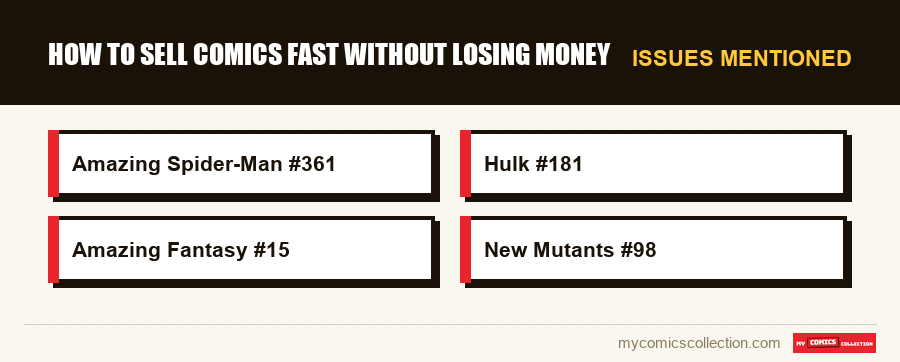
Three variables modulate this discount. The type of comic first: a highly sought-after Key Issue (Hulk #181, Amazing Fantasy #15, New Mutants #98) takes a smaller fast discount, 10 to 15%, because latent demand absorbs the supply almost instantly. A second-tier comic (an average issue from a popular run but with no first appearance) takes a steeper fast discount, 25 to 35%, because latent demand is low and you need a genuinely attractive price to trigger the purchase. Condition next: a CGC 9.8 sells fast at 90% of market price, a raw VF gets dumped at 70-75%. Seasonal timing last: December and January see demand climb with end-of-year checks and bonuses, while July and August remain the slowest months.
Concretely, on a basket of ten comics estimated at $1,000 in patient maximum value, aiming for a fast sale brings in $750 to $850 cashed in within two to three weeks instead of $950-1,000 cashed in over four to six months. The $150-200 differential corresponds to the value of the time freed up, and most casual sellers find this rate reasonable. For professional sellers who rotate inventory, this controlled discount fuels a continuous cycle: cash in, rebuy, resell, rather than locking capital into unsold stock.
One point too often overlooked: a well-managed fast discount avoids the discount you're forced into. A comic listed at full price for six months often ends up dumped in desperation at 50% of the initial price, which amounts to waiting six months only to lose more than you would have with a fast sale embraced from the start. Understanding comic values and the grade-to-price relationship in 2026 sharpens this analysis by showing how price curves evolve by segment.
Fast platform: Whatnot live, eBay Buy It Now, Vinted compared
Your platform choice determines 60% of selling speed. Three channels dominate in 2026 for fast sales, each with its own buyer profile and average ticket. Combining them well lets you clear varied inventory in two to three weeks.
Whatnot in live format remains the fastest platform in absolute terms. A 60- to 90-minute session can move 20 to 40 comics to a captive audience bidding in real time. The format encourages quick decisions: the buyer has 30 seconds to click before the seller moves to the next lot. For average raw comics ($5-50 each), Whatnot is unbeatable on liquidity. Seller fees (8% + Stripe payment processing) stay competitive, and payouts arrive within 7 days of shipping. The Whatnot live auction strategy for comics in 2026 details the hosting mechanics and pricing optimized for this format. The catch: Whatnot requires a live seller presence, which doesn't suit those who want to automate.
eBay in Buy It Now at a discounted price remains the standard for asynchronous sales. Posting a comic at 80% of the latest sold listing with the "Best Offer" option generally triggers a purchase within 48 to 96 hours. The BIN format avoids the seven-day wait of an auction and captures the impulse buyer. eBay fees (12.9% + payment fees) stay acceptable for tickets of $30 to $500. The massive advantage: the international buyer base ensures near-constant latent demand for Key Issues and popular runs. The trap to avoid: the Vendor Protection system can hold a payment for several weeks in case of a dispute, a point covered in the eBay Vendor Protection guide for comic sellers.
Vinted complements eBay for modern comics and inexpensive lots. A mainstream platform with no seller fees (the buyer pays for protection), Vinted attracts a less expert audience, which simplifies transactions: fewer technical questions, fewer returns over minor defects, less haggling. The average ticket stays low ($15-40), but turnover is fast for modern comics like Image, Boom Studios, or recent Marvel runs. For 20 modern comics at $10 apiece, Vinted typically clears the stock in 10 to 21 days with no marketing effort.
The winning 2026 combination: Whatnot for weekly sessions that move 30 raw comics at a time, eBay BIN for Key Issues and CGC in parallel, Vinted for the remaining moderns. This split covers 90% of inventory types and keeps cash flowing steadily. For premium pieces above $500, the ComicConnect vs Heritage Auctions comparison remains more relevant despite longer turnaround times.
Price optimization: -$1 psychology, lots, bundles, comparative anchor
Fast pricing follows psychological rules documented by behavioral research applied to retail. Four techniques significantly increase closing speed without eroding perceived value.
The round-threshold-minus-one technique: posting at $49 rather than $50, at $99 rather than $100, at $199 rather than $200. This visual rule triggers a psychological anchoring effect to the lower tier. A buyer who sees $49 mentally processes the price as "forty-something," whereas $50 reads as "a full fifty dollars." The one-dollar gap reduces the psychological barrier disproportionately compared to the actual economic difference. Seller tests: a comic listed at $99 sells 2 to 3 times faster than at $100, and even slightly faster than at $95, which seems cheaper yet performs worse.
The bundle lot technique: grouping 3 to 5 comics from a related series at a discounted effective unit price. Rather than selling five Spider-Man issues at $20 each ($100 total), offer a "Lot of 5 Amazing Spider-Man 2000s" at $79. The buyer perceives a $21 saving (21% off), the seller cashes in $79 in a single transaction instead of five transactions spread over three weeks. The net gain for the seller: logistics time divided by five, shipping costs pooled, dispute risk concentrated on a single package. The bundle lot works especially well on Whatnot, where the live hosting puts the lot in the spotlight.
The comparative anchor technique: displaying a higher sold price reference in the description. Example: "Latest eBay sold $65: offered here at $49." This anchor makes the fast discount visible and quantified, turning the discounted price into an advertised bargain rather than a fire sale. The buyer is no longer buying at $49: they're saving $16 against a recent comparable. This technique requires actually having the $65 sold in the history (a screenshot reassures), but it converts strongly.
The structured tiered-pricing technique: for sellers who accept the Best Offer format, mentally map out a response grid. Listed price $99, offer automatically accepted at $85, offer declined below $75, counter-offer at $90 for offers between $75 and $85. This structure avoids the hesitation that costs time and lets you respond to each offer in under 5 minutes, which keeps the buyer engaged. A buyer who waits 24 hours for a reply moves on to another listing 30% of the time.
The classic mistake to avoid: overvaluing personal sentimental attachment. A comic you paid $80 for five years ago that's worth $60 on today's market should be offered at $49 for a fast sale, not $75 to "recoup your investment." This emotional detachment conditions how fast you sell. Taking screenshots of your comic collection to prepare for sales helps you objectify this reference value before posting.
Fast smartphone photos: a 5-minute-per-comic method
Photos determine 40% of the conversion rate. A poorly photographed comic, even listed at an attractive price, sells two to three times slower than a well-shot one. The good news: producing decent photos doesn't require pro equipment, just a repeatable method that takes 5 minutes per comic with a standard smartphone.
Minimal gear setup: a neutral background (a white sheet stretched over a table, or matte light-gray cardboard), a north-facing window or a bright spot without direct sunlight, the smartphone held 12-16 inches above the comic. No flash, no filter. Diffuse natural light reveals the colors without saturating them or creating glare on the mylar. Ideally, shoot in the middle of the day between 10 a.m. and 3 p.m. for the most stable light. Avoid the yellow light of tungsten bulbs, which distorts how whites are perceived and makes comics look yellowed.
5-minute-per-comic sequence: photo 1, full front flat, framing that includes the edges with a 1-inch margin; photo 2, full back flat, same framing; photo 3, spine viewed at an angle showing the back's condition (a critical point for graded comics and raw NM); photo 4, zoomed detail of the top right corner revealing corner condition; photo 5, detail of the cover center showing the colors and the absence of a center crease. These five photos cover 95% of buyer questions and defuse requests for "additional photos" that delay the sale.
Speed tip: shoot in batches of 10 to 15 comics in a row on the same setup. The pace climbs to 3 minutes per comic once you're in rhythm, meaning 50 comics shot in 2.5 hours. Renaming the photos immediately with a code (Spidey_300_front, Spidey_300_back, etc.) saves hours of sorting later. A free app like "Adobe Lightroom Mobile" or simply the native iPhone/Android editor handles brightness adjustment and final cropping in 30 seconds per comic.
For CGC and CBCS, the photo of the slab tilted 15° reveals the grade and certification number without glare on the acrylic case. This photo should always come first, because the grade is the primary piece of information that triggers the purchase. For raw comics destined for a fast sale, don't chase perfection: a decent photo beats a perfect photo shot next week. The choice between raw and graded for investment in 2026 also influences your photo strategy depending on the target buyer profile.
Common mistake: photographing the comic in its bag with the board behind it, which creates glare and hides details. For photos, temporarily take it out of the bag, shoot, put it back. The extra time (30 seconds) is offset by a visual quality that raises the conversion rate by 20 to 30%. Cross-referencing with the comics catalog explorer lets you quickly verify editions and variants before posting, which prevents title errors that scare off expert buyers.
Collecting this series?
Track what you own, what you are missing and what your collection is worth. 7 day trial.
Start my trial →Fast buyer replies: the one-hour rule that boosts sales
How fast you reply to buyer messages directly conditions the conversion rate. The 2026 platform data converges: a seller who replies within an hour closes 60 to 70% of conversations, versus 25 to 35% for a seller who replies within 24 hours. This 2x factor comes down to the psychology of impulse buying and the volatility of intent.
A buyer who asks a question about a comic is in a short engagement window of 60 to 180 minutes. They've seen the listing, calculated their budget, compared it against two or three alternatives, and sent a message to clarify a detail (exact condition, shipping cost, the option to combine with another lot). If the reply arrives within that window, the purchase follows 65% of the time. If the reply comes the next day, the buyer has often bought elsewhere, or their buying mood has cooled. The psychological cost of restarting the mental buying process demotivates them.
Practical method: turn on push notifications for the platforms (Whatnot, eBay, Vinted) and block three daily 15-minute slots to handle messages (8 a.m., 1 p.m., 7 p.m., for example). This discipline guarantees no message goes more than 5 hours without a reply. For sellers who can't reply during the day, set up pre-written template responses: "Hi, condition shown in the front/back photos. Shipping within France €4 Mondial Relay, €6 Colissimo. Available immediately, payment through the platform. Best regards." This reply covers 80% of standard questions and copy-pastes in 30 seconds.
For negotiations like "Would you take $40 instead of $49?", replying quickly with a compromise avoids endless back-and-forth. Rather than flatly refusing $40 and losing the buyer, counter at $45 with a justification: "At $45 I can close today, payment through the platform. At $40 it would be below my cost-coverage threshold." This reply sets a frame, proposes a way out, and invites a decision. The closing rate on these fast counter-offers exceeds 70%.
Special case of late-night messages: for a message received after 10 p.m. or before 7 a.m., reply as soon as you wake up without lengthy apologies. A reply at 7:30 a.m. to an 11 p.m. message stays within the buyer's engagement window; they see the reply when getting up and finalize their purchase that morning. The self-flagellating "sorry for the delay" that some sellers add out of politeness weakens the perception of professionalism and adds nothing.
Post-sale follow-up benefits from the same rule. Confirm shipping within 24 hours, send the tracking number within 48 hours, answer delivery questions within an hour. These quick gestures earn 5-star reviews that fuel the virtuous cycle: better review rating, better platform ranking, more visibility, more fast sales. For the tax side of these sales, selling comics and taxes in France for individuals details the legal framework.
Use cases: urgent move vs estate liquidation
The fast method doesn't apply identically across contexts. Two scenarios statistically dominate urgent sales: the international move that imposes an absolute deadline, and the estate liquidation that mixes administrative constraints with emotional weight. Each calls for a specific calibration.
Urgent move: 21 to 30 day timeline: the priority is immediate cash and freeing physical space. An expat leaving for Canada in early July must clear their collection before mid-June to pack the boxes. Recommended strategy: an intensive Whatnot combination (two 90-minute sessions over two weeks) for average raw comics, deeply discounted eBay BIN (-25%) for Key Issues, and Vinted for moderns. Accept an average 25 to 30% discount to wrap up in 21 days. Logistics planning matters as much as pricing strategy: preparing shipments in batches over two dedicated days rather than piecemeal avoids logistical burnout. On 60 comics worth $1,500 in catalog value, aim for $1,050-1,150 cashed in within 21 days.
Estate liquidation: variable timeline: this case mixes administrative constraints (succession, division among co-heirs, valuation for the notary) with emotional timelines. First rule: physically secure the comics as soon as you take charge. Store them in Mylite2 mylars with backing boards, in a dry place with controlled 40-50% humidity, away from sunlight. This safekeeping preserves value while the estate arbitration is settled. Second rule: get a professional appraisal before any sale, especially if several heirs are involved. The free appraisal offered on the site gives an objective baseline that defuses family suspicions. Once these points are settled, the sale can follow the standard fast method, favoring traceable platforms (eBay, ComicConnect) that produce invoices for the estate declaration.
Special case of a large estate (200+ comics): selling individually and fast becomes unrealistic. The pragmatic strategy is to segment the inventory into three groups: strong individual pieces (10-20 Key Issues to sell via discounted BIN), coherent runs (themed lots of 20-30 issues to offer on Whatnot or eBay), and the rest (a bulk lot to offer for direct buyout to a specialized retailer for immediate cash flow at 40-50% of value). This segmentation clears 70 to 80% of the inventory in 30 days and concentrates effort on the 20% that deserves a careful individual sale. Comparing specialized bulk buyers helps you choose the right one.
Move with an interim storage unit: a less urgent variant where the inventory goes into a climate-controlled storage unit for 3-6 months before sale. It allows a less discounted approach (15-20% instead of 25-30%) while freeing up living space. The storage cost ($60-120/month depending on volume) is offset by the discount saved if the inventory's value exceeds $2,000. Below that, a fast two-week sale remains more profitable.
Simple liquidation out of weariness: a hybrid profile with neither an absolute deadline nor an estate constraint, but who simply wants to close the file. The standard fast method applies with a moderate 15 to 20% discount, spread over 30 to 45 days. This case allows more pricing discipline and lets you recover 80 to 85% of catalog value while keeping a brisk pace.
Whatever the scenario, steering by a simple dashboard (Excel or a dedicated tool) tracks progress: how many comics sold, how much cashed in, how many remain, cumulative timeline. This tracking avoids the feeling of treading water and lets you adjust prices downward for items unsold after 14 days with no views, or kick off another Whatnot session to land the stragglers.
FAQ: Selling comics fast
What discount should I expect to sell comics fast without losing too much money?
Between 15 and 25% off the patient maximum price for a sale in 7 to 21 days, versus 30 to 40% for a fire sale in 48 hours. The discount varies by comic type: 10 to 15% for highly sought-after Key Issues, 25 to 35% for second-tier issues. A methodical seller recovers 75 to 85% of catalog value in three weeks, which balances speed and value recovered.
Which platform should I choose to sell comics the fastest in 2026?
Whatnot in live format remains the fastest in absolute terms for average raw comics (20 to 40 comics moved in 90 minutes). eBay Buy It Now at a 15-20% discount typically closes within 48 to 96 hours for Key Issues. Vinted rounds out the setup for inexpensive modern comics. Combining all three channels clears varied inventory in two to three weeks.
How long does it really take to sell 30 comics fast?
Between 14 and 21 days with the method described: one Whatnot session for 15 average raw comics, 10 discounted eBay BIN listings for Key Issues, and 5 Vinted lots for moderns. Budget 2 to 3 hours of prep (sorting, batch photos, template descriptions), then 30 minutes a day to handle messages and shipping. The conversion rate reaches 80 to 90% of listed inventory over this window.
Is it better to sell raw fast or wait for CGC grading?
For comics estimated under $200 raw, selling directly and fast is more profitable: the CGC grading cost ($60-120 per piece with shipping and insurance) plus the 30 to 60 days of waiting often outweigh the value gained. Above $200 raw with CGC 9.6+ potential, grading can multiply value by 1.5 to 3 but locks up the sale for 30 to 60 days. For a truly fast sale, sell raw and accept the fast discount.
How do I respond to buyers who negotiate aggressively on price?
Define a clear mental grid before listing: listed price 100, counter-offer accepted at 85, refusal below 75, counter-offer at 90 between 75 and 85. This structure lets you reply in under 5 minutes without hesitation. Justifying the counter-offer with "at this price I can close today" sets an engaging frame. The closing rate on fast counter-offers exceeds 70%, versus 40% for negotiations that drag on over several days.