Your father was passionate about comics. Or your uncle, your grandmother, your older brother. And today, in the context of an estate, a forced move, or a house clearance, you're facing their collection. Maybe a few dozen copies, maybe several thousand.
Your father was passionate about comics. Or your uncle, your grandmother, your older brother. And today, in the context of an estate, a forced move, or a house clearance, you're facing their collection. Maybe a few dozen copies, maybe several thousand. Numbered boxes, carefully classified series, or on the contrary chaos of cartons no one has touched in years.
This situation is both practical and emotional. Practical, because you need to decide fast: what to keep, what to sell, what to throw out? Emotional, because every comic is a piece of a loved one's life. This guide is designed to help you navigate both dimensions: without mistakes, and without getting taken.
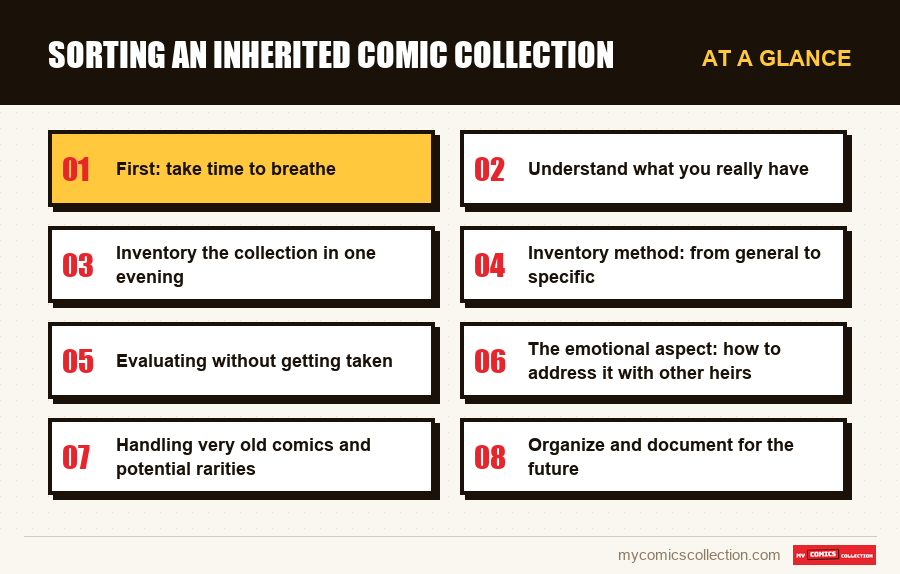
First: take time to breathe
In the whirlwind of an estate or forced move, everything feels urgent. The home must be emptied, belongings sorted, decisions made. But haste is the enemy of good decision-making when it comes to comics. A collection sold in bulk in haste is almost always sold at 30% of its real value: or less.
If the timeline permits, and it often does more than you'd think, start by securing the comics rather than evaluating immediately. Transport them to a clean, dry, temperature-stable location. A few extra weeks don't make a difference to value, but they make a huge difference to decision quality.
Important: If the collection is large (over 500 copies), don't give in to the temptation to sell it in one lot to a dealer or at a garage sale. Even apparently ordinary collections often contain some significantly valuable pieces hidden in the middle. Identify first, sell later.
Understand what you really have
Before any decision, you need to know what's in the collection. Not a vague estimate: a real inventory. It's the foundation of everything else: evaluation, division among heirs, sale, preservation.
Recognize if the collection was organized
The first thing to observe is the original collection's organization level. A passionate collector probably organized comics in ways that give you valuable clues:
- Comics in plastic sleeves with backing boards: sign of a serious collector who took care of copies. Higher likelihood of finding valuable pieces.
- Numbered or labeled boxes: the previous owner may have had their own inventory list. Look for notebooks, printed spreadsheets, or digital documents.
- Classification by title or publisher: greatly facilitates your own inventory work.
- Unorganized mix: doesn't mean the collection is worthless: sometimes the best discoveries hide in apparent disorder.
Spot signals of a potentially valuable collection
Some elements put you on the trail of a collection deserving a thorough inventory:
- Visibly old comics, yellowed paper, no barcode, prices in US cents
- Very low issue numbers in a series (issues 1, 2, 3...)
- Prestige publishers: Marvel, DC, EC Comics
- Conservation bags and boards: sign someone was aware of value
- Comics in sealed metal boxes
Inventory the collection in one evening
My Comics Collection lets you catalog hundreds of comics in a few hours thanks to barcode scanning, search by series and issue number, and a catalog of about 2.6 million issues. No more nights searching scattered sites.
Start inventory for free →7 days free
Inventory method: from general to specific
Inventorying an inherited collection happens in progressive passes. Trying to do everything at once is exhausting and leads to mistakes. Here's the recommended method.
First visual sort: 2 hours for 500 comics
Separate comics by publisher and approximate era, without trying to identify each copy. Create piles: Marvel Silver Age, DC Bronze Age, modern comics, unknown publishers, foreign-language comics. The goal is to have an overview.
Identification of potential "key issues"
First focus on very low issue numbers (1, 2, 3) and very old comics. They carry the most potential value. Photograph each: cover and back cover.
Systematic inventory with an app
Use My Comics Collection to scan or identify each copy. The system adds them to your inventory with title, issue, date, estimated condition, and market value. This is when you'll understand what the collection is really worth.
Condition notation for important pieces
For comics estimated above $55, take time to precisely evaluate condition on the standard scale (Poor to Near Mint). Condition directly impacts sale price.
Evaluating without getting taken
Evaluating an inherited collection is when the traps are most numerous. Here are the situations you'll encounter and how to handle them.
The dealer offering a global price
The most common and riskiest situation. A passionate collector or comic shop offers to buy the entire collection for a lump sum. That price will almost always be well below actual value. Why? Because the dealer must account for their own risk, sorting time, and margin.
That doesn't mean this option is always bad: if you need to empty an apartment fast and the collection is mostly modern comics without particular value, bulk sale can make sense. But do it after pulling out the valuable pieces, not before.
Expert evaluation
For large or potentially very valuable collections, professional evaluation is relevant. Certified experts can travel to estimate a significant collection. Major auction houses (Heritage Auctions, ComicLink) also offer free evaluations for pieces they might put up for sale.
Beware "free" evaluations offered by dealers who then want to buy: their interest is in low-balling. A neutral evaluation costs something but protects you.
Using market prices
Price databases like those integrated in My Comics Collection give you reference values based on current eBay listings. These prices are your compass to not be impressed by an offered price that seems high but remains below market.
Collecting this series?
Track what you own, what you are missing and what your collection is worth. 7 day trial.
Start my trial →The emotional aspect: how to address it with other heirs
In an estate, the comic collection often doesn't belong to one person. Siblings, children, family members: multiple heirs may have rights to all or part of the assets. And each may have a different emotional relationship with the collection.
Documenting for equitable sharing
Digital inventory is your best ally here. When each comic is documented with estimated value, discussions between heirs become factual rather than emotional. Sharing can be by equivalent total value rather than by number of copies.
Some heirs will want to keep comics that held particular meaning for the deceased: autographed issues, first editions of a favorite series. Others will prefer their market-value equivalent. The inventory makes these exchanges possible transparently.
Preserving the collection's memory
Beyond market value, a comic collection is an archive of a person's life. The titles they chose, publication years, any signatures: all of it tells a story. Even if you decide to sell most of the collection, photograph each copy before parting with it. These photos will let you reconstruct the collection's history, for you and for future generations.
Some families choose to keep a few symbolic copies rather than selling everything: the deceased's favorites, the issues they talked about, the ones they had doubles of for lending. It's a decision that belongs to each family.
What to keep, sell, donate?
Once the inventory is done and values known, the decision clarifies naturally. Here's a practical decision framework.
Decision framework for each copy
- Strong sentimental value + significant market value: think carefully. Keep if you can, or sell knowing what you're giving up.
- Strong sentimental value + low market value: keep without hesitation. Storage cost for a comic is minimal.
- Low sentimental value + significant market value: sell intelligently: on eBay, at auction, or at conventions. Not to a dealer.
- Low sentimental value + low market value: donate to associations, libraries, or let it go in bulk at an estate sale.
How to sell intelligently
If you decide to sell part or all of the collection, here are the channels in decreasing profitability order:
- Specialized auctions (Heritage Auctions, ComicLink) for high-value pieces: 15-25% commission but guaranteed market pricing
- eBay for intermediate-value comics ($55-$550): global audience, good prices if you take time to write careful listings
- Conventions and shows for direct sales, no commission, direct contact with passionate buyers
- Facebook groups and specialty forums for thematic lots
- Local comic shops as last resort for lots with no particular value
Handling very old comics and potential rarities
If the inventory reveals 1950s-1960s or earlier comics, special attention is needed. These copies can be worth significant sums, and errors in this area are the costliest.
For any comic you suspect is valuable (issue 1 of a major Marvel or DC series, Golden Age, Silver Age in good condition), consider:
- Submission to CGC or CBCS grading: cost is $33 to $110 per copy but the certificate of authenticity can multiply sale value
- Consultation with an independent expert
- Research on recent sales databases for comparable copies
Concrete example: An Amazing Spider-Man #1 (1963) in Very Good condition is worth around $8,800-$13,200. The same copy CGC-certified at 4.0 can trade for $16,500 or more. The grading cost (about $88) is largely amortized.
Organize and document for the future
Whether you keep everything, part, or sell all, the digital inventory stays useful long-term. For insurance in case of disaster, to prove a copy's provenance, for future resale: a well-kept inventory has value beyond the present moment.
If you keep comics, properly handle storage questions: non-PVC sleeves, backing boards, longboxes away from humidity and direct light. A well-preserved inheritance retains its value and can continue to appreciate.
FAQ
Turn an inheritance into an organized collection
My Comics Collection gives you every tool to inventory, evaluate prices, and organize an inherited collection: in hours rather than weeks.
Start inventory for free →7 days free, no commitment