Self-publishing American comics does not consist of printing your book: it consists of becoming your own publisher, distributor and sales department. Terry Moore has held this role for over thirty years. Concretely, this means that it advance printing cost, decides alone what he withdraws, stores his unsold items and sells part of his production directly. Each of these constraints leaves a visible mark on the objects we buy today.
There's a lot of talk about the artistic independence this model provides, and it's deserved. We talk much more rarely about what it requires on a daily basis (cash flow, logistics, stock) and yet it is this aspect which explains most of the particularities that a buyer encounters in his bibliography.
This article describes the model in detail, what it actually allows, what it costs in practice, and why almost no one manages to maintain it for such a long time.
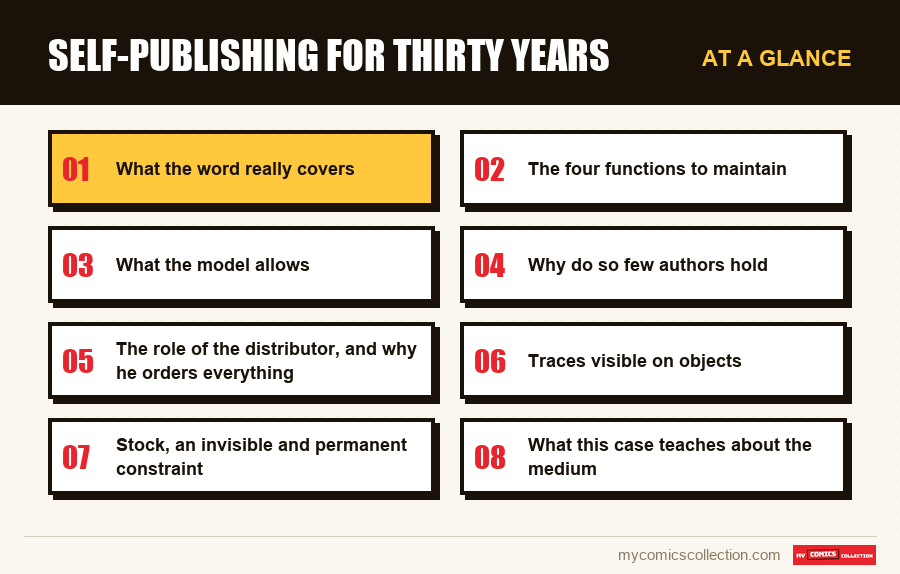
What the word really covers
In common usage, “self-publishing” refers to an author who publishes his book without going through a publisher. This is correct but very incomplete in this medium.
A comics editor doesn't just choose manuscripts. He advance printing costs, negotiates with the distributor, manages the relationship with booksellers, stores, ships, collects and monitors unpaid debts. An author who publishes himself takes over all of these functions.
He also assumes the risk. A print paid in advance and poorly sold turns into boxes in a garage, and the money tied up is no longer available for the next print. Cash flow becomes an artistic constraint: we publish at the rate of what we can finance.
The four functions to maintain
Finance printing
The first draw is paid for before anything is sold. This explains the cautious initial print runs, and therefore the relative rarity of the first issues of successful series.
Go through distribution
Reaching specialized bookstores requires appearing in the distributor's catalog, with deadlines and firm orders which decide the print run several months in advance.
Decide on reprints
No one else will. This is what produces the successive reprints of titles that work, and the prolonged unavailability of those that work less.
Sell directly
Conventions, correspondence, online store. Part of the production is hand-to-hand, which explains the number of signed copies in circulation.
What the model allows
Three freedoms, and they are not symbolic.
Finish what we started. A publisher's series ends when sales decide so, and its author does not have the last word. Here, each story was brought to fruition because no one else could decide it.
Not to be replaced. A character belonging to a publisher passes from hand to hand. A character you own will never be written by someone else, nor revived after you leave.
Change registry without permission. Going from relationship drama to horror then to comedy requires, in a publishing house, to convince each time. Here the decision is made alone, and the readership follows or not.
The counterpart, rarely said. These freedoms are paid for in audience. No one pays an advertising insert for a book that does not have a marketing department: it circulates from reader to reader, at the speed of word of mouth, and peaks well below what its level would justify.
The collector gains what the creator loses: suppressed demand leaves prices low on almost the entire catalog.
Why do so few authors hold
The risk is personal
A poorly sold print is paid for with one's own funds. Two bad years are enough to end the experience, regardless of talent.
Le temps passé ailleurs
Managing orders, shipping and accounting takes hours that aren't spent drawing. This is an invisible and considerable cost.
The pace to keep alone
Writing, drawing, inking and lettering each chapter without an assistant imposes a pace that no team can support in the event of a setback.
A publisher's offer is tempting
An advance, a distribution, a promotion: most successful independent authors end up accepting. Refusing for thirty years is truly rare.
The role of the distributor, and why he orders everything
One link actually decides almost everything, and it is invisible to the reader: the distributor who supplies specialized bookstores.
The operation is as follows. A title appears in the catalog several months before its publication; booksellers place orders fermes from this catalog; and it is this total which determines the draw. The author therefore prints what is already ordered, plus a margin for direct sales.
This has three immediate consequences. The print run of a first issue reflects the anticipation of booksellers, not the quality of the book: an unknown title is ordered cautiously whatever its worth. The decision is made months in advance, therefore without any feedback from readers. And a series that takes off after six issues cannot catch up with its first prints, which have been printed and sold for a long time.
It is this mechanism, and it alone, which creates the rarity of first issues in this segment. It comes neither from an artistic decision nor from a strategy of scarcity: it comes from orders placed by cautious booksellers faced with a title that no one knew anything about.
Traces visible on objects
This is the point that directly interests a buyer: each of the constraints described leaves an identifiable mark.
Cautious initial draws. The first issues of the series that ended up working are rare in the first printing, because no one could have known that they would work and the money was not there.
Numerous reprints. Conversely, the most popular title has been withdrawn several times: which explains why it is today the cheapest of its production on average, the mass of reprints overwhelming the value of the first prints.
Collections with inconsistent divisions. A publishing house stops its collection before the first volume; an isolated author groups his chapters piecemeal, according to what his treasury tolerates on the day he begins.
Many signed copies. As part of the production is sold in person, signed copies circulate in large numbers, and here they have a special status, the author having done everything himself.
Collecting this series?
Track what you own, what you are missing and what your collection is worth. 7 day trial.
Start my trial →Stock, an invisible and permanent constraint
One aspect of the model never appears in discussions about independence, and yet it is the one that weighs the most on a daily basis: you have to put the books away somewhere.
A print represents pallets. They occupy premises, they must remain dry, and they constitute tied up money until they are sold. An author who publishes himself is therefore also, materially, a warehouse manager.
This constraint explains several behaviors that we observe without understanding them. THE modest reprints rather than a large economic draw: we prefer to pay more per unit than to tie up our cash flow. THE temporary breaks on titles that sell: we wait to have enough to restart printing. And the direct sales in conventions, which sell from stock without going through the distributor's delivery.
For a buyer, this provides a useful reading grid: prolonged unavailability for a self-published author provides information on their current cash flow, not on the rarity of the title. The same volume will reappear, at the same price, as soon as printing is launched.
What this case teaches about the medium
A broader remark, which goes beyond this author.
Self-publishing has long been, in this medium, a transition: we started alone for lack of anything better, we joined a house as soon as possible. The model was seen as a step, never a destination.
A few trajectories reversed this perception from the 1980s and 1990s, by demonstrating that a long and ambitious work could be deployed in its entirety. Economic constraint has become a demanded choice, and this movement made possible careers that would not have existed otherwise.
What has changed since then are the tools: crowdfunding, direct online sales, printing on demand. An author who starts out today has resources that did not exist thirty years ago. What hasn't changed is what needs to be done: cash flow, logistics and pace remain exactly the same constraints.
What to remember before buying
Three reflexes arise directly from the model, and they do not apply to titles from major publishers.
Ask for the print rather than the cover. In this segment, there are practically no variations; on the other hand, reprints abound, and they are visually identical.
Do not confuse unavailability with scarcity. An out-of-print volume from the author can remain so for months without creating the slightest value, due to lack of a demand that justifies it.
Consider the signature as data. A copy autographed by someone who wrote, drew, inked and lettered the book does not have the status of a dedication on a collective work: it is the entire object that comes from the same hand.
These three reflexes are enough to navigate this bibliography, and they are transposed to any author practicing the same model.
A fourth is added for those who buy in bookstores rather than second-hand: buy early when a stock appears. For a self-published author, there is no automatic restocking: the stock available is that which has been printed, and its replenishment depends on an individual decision which can take months. This is not an incitement to speculative haste, simply a logistical fact: the book that is postponed may not be available until after a deadline that no one announces.
Frequently asked questions
No, it means taking over all of the functions of a publisher: advance printing costs, negotiate with the distributor, manage the relationship with booksellers, store, ship and collect. Printing is the most visible part and by far the least restrictive.
Because they are paid before having sold anything, from the author's own funds. An ambitious print run that doesn't sell ties up the money needed for the next issue, which mechanically encourages caution, and makes the first issues of successful series rare, after the fact.
The audience. A book without a promotional budget only reaches readers that another reader sends it, keeping it far below its potential audience. The collector benefits, prices remain low due to lack of demand, but that is exactly what the creator loses.
Because the risk is personal and two bad years put an end to it whatever the talent, but above all because the offer of a publisher (an advance, a distribution, a promotion) becomes very tempting as soon as one meets success. Refusing for thirty years is rare, not starting alone.
They facilitate financing and direct sales, which did not exist thirty years ago. But the basic constraints remain the same: we must always advance printing, maintain logistics and maintain a pace without a team to take over in the event of a setback.
On this model, the signature is data
Part of the production is hand-to-hand, and the author did everything himself.