Self-publishing a series for thirteen years is not an artistic gesture, it's a business, and that's where almost everyone fails. You have to advance printing, obtain distribution, collect late, decide on reprints without knowing demand, and keep a calendar while drawing. The success of this work is as much due to the management of these constraints as to its quality, and This is the part that success stories systematically leave out.
This dimension also explains market facts observable today, notably the abundance of successive print runs.
This article describes the real constraints of this mode of publication, what they produced visible on the objects, why the model held here, and what this implies for a buyer.
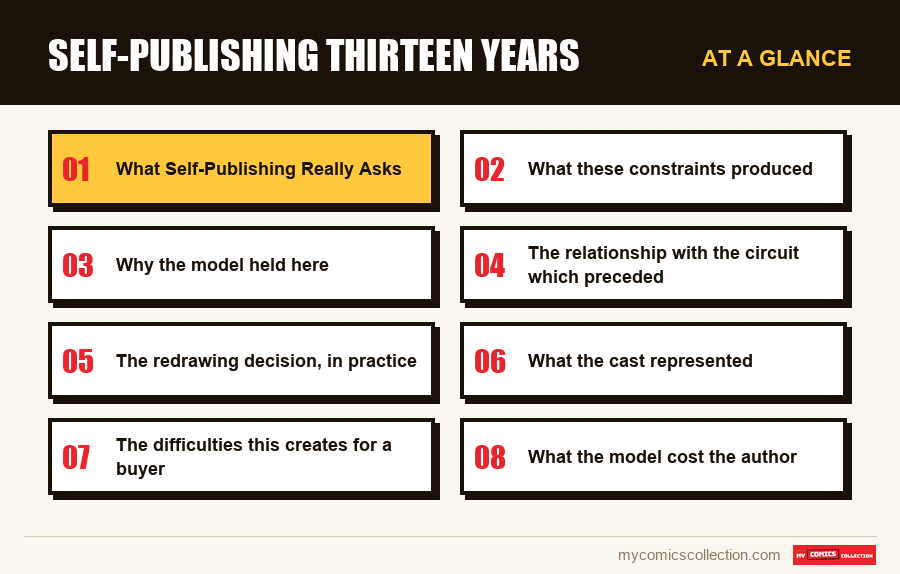
What Self-Publishing Really Asks
Four obligations, none of which relate to creation, and which are sufficient to explain the failure rate of this method of publication.
Advance the money. Printing is paid for before the sale. A self-published author finances each issue from his own cash flow, and a poorly calibrated print run ties up sums that he will not recover for months.
Get a distribution. Without access to the network that supplies stores, a book does not exist commercially, regardless of its quality. This is the first and most insurmountable obstacle.
Encaisser à retardement. Payments arrive after the sale, sometimes long after. An author can be successful and run out of cash at the same time.
Keep a calendar while drawing. Both activities compete for the same time, and management cannot wait: a late billing or order has immediate consequences.
These four obligations explain why so many self-published series stop after a few issues. They almost never stop for lack of readers, but due to lack of cash or time.
What these constraints produced
First confidential prints
An author who finances himself prints as cheaply as possible. The first issues were therefore printed in few copies: hence their current rarity.
It is a cash flow decision that has become, thirty years later, a market fact.
Many reprints
As demand grew, the first issues were reprinted several times. Advertisements commonly mention third and sixth printings.
A lasting identification problem
These prints are materially very close. This explains the unusual scale of the certified market for this series.
A series brought to an end
Full control made it possible to conclude at the chosen time, without external editorial arbitration.
Why the model held here
It is necessary to be precise, because the success of this particular case is regularly presented as reproducible even though it is based on a rare conjunction.
A work accessible without prerequisites. No external continuity, no genre codes to know, no pre-existing character. It could be recommended to anyone, which broadened the audience well beyond the specialist circuit.
Separate management of creation. The editorial structure was organized as a company with its own skills, and not as an additional activity carried out between two boards.
A format that lent itself to collection. A continuing epic naturally comes together in volumes, which opened up the general bookstore: an outlet that episodic series hardly achieve.
Sufficient duration to establish a habit. Thirteen years of regular publication have created a loyal readership, something a two-year series never achieves.
These four factors are inseparable. Remove one and the model no longer fits, which explains why so many authors having applied the same method have obtained incommensurable results.
A precision that restores scale. This case is cited as demonstration that self-publishing works, which amounts to concluding from the success of a small number that the path is practicable.
The same period saw hundreds of self-published series disappear, often after a few issues and for cash flow reasons. The model makes success possible; it does not make it probable, and confusing the two does a disservice to the authors we encourage.
The relationship with the circuit which preceded
This enterprise is part of a continuity that is worth remembering, because it is visible in the objects themselves.
In the 1980s, a small number of authors were already publishing themselves, using artisanal means and print runs of a few thousand copies. Some even welcomed the work of colleagues: a practice observed elsewhere in this campaign, where the series of one author appeared under the label of another self-published.
This circuit provided the proof of principle: an author could own his work and distribute it, provided he accepted a reduced scale.
What changes here is the scale, not the method. The same decision structure applied with national distribution and a mainstream work produces results of a different order.
This is also what makes these two moments comparable and distinct. One proved that it was possible, the other that it could become considerable.
The redrawing decision, in practice
This is the most delicate decision in this profession and it deserves to be detailed, because it explains a good part of what we observe on the market.
Reprinting requires gambling. Too little, and we miss sales by leaving stores without stock. Too much, and we tie up cash that we will need for the next issue.
The challenge is all the more difficult as the available signals are bad: Distributor orders reflect what stores anticipate, not what readers demand, and the gap between the two can be considerable on a growing series.
A self-published author therefore makes this decision several times a year, without a research department, arbitrating against production needs. The successive draws that we note today are the trace of this series of bets.
It changes the way you look at a third or sixth draw. This is not a by-product: it is a sign that a reprint decision was made, so that at that moment demand exceeded stock. Each reprint documents a moment of success, even if it is worth nothing today.
What the cast represented
The second obstacle deserves to be developed, because it is less visible than money and often more decisive.
Accessing the network that supplies stores requires being referenced in order catalogs, where retailers choose what they will take. Without this presence, a book does not reach any point of sale, whatever its qualities.
For a one-person structure, obtaining and then maintaining this referencing represents continuous administrative work: deadlines, quantities, invoicing, reminders. This is the part of the job that no reader ever hears about and yet who decides everything.
This is also what explains the fragility of self-published series in the face of an incident: a delay in publication which causes a place in the catalog to be missed can be enough to interrupt the chain, regardless of the number of readers acquired.
Maintaining this constraint for thirteen years, without missing an appointment, is in itself a result that the quality of the drawing does not explain.
Collecting this series?
Track what you own, what you are missing and what your collection is worth. 7 day trial.
Start my trial →The difficulties this creates for a buyer
Multiple indistinct prints
Direct consequence of progressive financing: the same number exists in several almost identical states.
An unequal offer depending on the numbers
Print runs have increased with demand, so that late issues are much more plentiful than early ones.
Not very standardized mentions
A small structure does not apply the draw indication conventions of large houses.
A little-known filter editor
The name of the structure does not always work as a search criterion, unlike large houses.
What the model cost the author
A rarely mentioned aspect deserves to be asked, because it nuances the success story.
Taking charge means not drawing during this time. Over thirteen years, this represents a quantity of unrealized creative work that no balance sheet measures.
It also means bearing the risk alone. A salaried author of a house is paid whether the series works or not; an author who finances his printing loses if the calibration is bad, and no one compensates.
Added to this is a permanent exhibition: commercial decisions (prices, reprints, distribution choices) are visible to readers and are directly attributed to them, which is not the case for a published author.
The benefit is real and it is twofold: ownership of the work, and the freedom to conclude it. These two benefits are probably worth the cost, but you need to know the cost to judge the exchange.
What this changes for a reader
Three practical consequences, directly observable on objects.
First issues are rare for a specific reason. Not because they were in demand at the time, but because a single author could not afford to print them in numbers.
Late prints are plentiful and cheap. They date from the time when demand was established and financing was no longer a problem.
The series is complete. It ends, which was guaranteed by no one, and which distinguishes this set from the countless interrupted self-published series.
This last property is the one that we notice the least and which matters the most. Buying a complete self-published series is the exception; the rule, on this circuit, is to come across unsuccessful starts.
What to record
On a series from a small structure, the file must compensate for the lack of editorial standardization.
The exact statement appearing on the copy, copied as is rather than interpreted. A small structure does not apply the conventions of large houses: the circulation indications vary in wording, change place, and sometimes disappear. Literally copying what is printed allows you to decide later, even when the wording is unlike any other.
Interpreting at the time of purchase, “it’s probably a first print”, produces a false record from which we will never be able to escape.
The absence of a mention, explicitly noted as such: this is information in itself on this type of publisher, and a blank sheet does not allow us to distinguish an uninformed copy from an unverified copy.
These two reflexes deal with the difficulty specific to small structures, documentary irregularity, which collections from large houses never encounter.
Frequently asked questions
Almost never for lack of readers, but for lack of cash or time. Printing is paid for before the sale, receipts arrive long after, and management competes for the same time as the design. An author can be successful and run out of cash at the same time.
Because an author who finances himself prints as cheaply as possible. This is not a rarity due to demand at the time but a cash flow decision, which thirty years later became a market fact, and this is what also explains the long series of reprints which followed.
It is based on a rare conjunction: work accessible without prerequisites, management organized separately from creation, format suitable for collection and therefore for general bookstores, and sufficient duration to establish a habit. Remove one and the model no longer holds. The same period saw hundreds of series disappear.
Unrealized creative time over thirteen years, the financial risk carried alone, and a permanent exhibition: the price or reprint decisions are visible and directly attributed to the author, which does not happen to a published author. In exchange: ownership of the work and the freedom to conclude it.
The printed notice copied as is, never interpreted. A small structure does not standardize its circulation indications: they change wording, place, and sometimes disappear. Also note explicitly the absence of mention: it is information, and a silent form does not distinguish the non-informed from the non-verified.
What exactly does the copy say?
Copy the statement rather than interpret it: a small structure does not follow any convention.