The first issue of the series launched in 1991 was released enclosed in a sealed blister, with a collectible card slipped inside. This packaging creates a paradoxical object: as long as the bag is closed, the card is guaranteed to be present but the booklet remains invisible; as soon as you open it, you can examine everything but the original object no longer exists. On August 29, 2026, a listing report showed 159 unverified offers requested between $0.99 and $85.00, with a mid-range at $7.00, and 16 verified copy offers requested between $29.99 and $250.00, mid-range at $64.00. The floor, at less than a dollar, corresponded precisely to a copy described as unsealed and deprived of its card.
There are few situations in collecting fascicles where the very act of checking destroys what we were trying to check. The sealed blister is one of them. The publisher delivered a closed object to the points of sale: a heat-sealed plastic pouch containing the booklet and a printed card, unsaleable separately, inaccessible without scissors. The 1991 buyer had the choice between reading and keeping, and this choice was irreversible. Thirty-five years later, this same choice is replayed with each transaction, except that it now concerns sums and a notion of state that no one, in 1991, had anticipated.
The difficulty is not theoretical. A booklet is assessed by its condition: the sharpness of the corners, the fit of the spine, the whiteness of the edges, the absence of reading folds, the quality of the stapling. None of these criteria is observable through opaque plastic or even through transparent plastic which only exposes one side of the cover. The buyer of a sealed copy therefore buys a promise of completeness (the map is there, obviously) in exchange for total ignorance about what normally determines the price. It's a barter, and you have to face it before taking out your bank card.
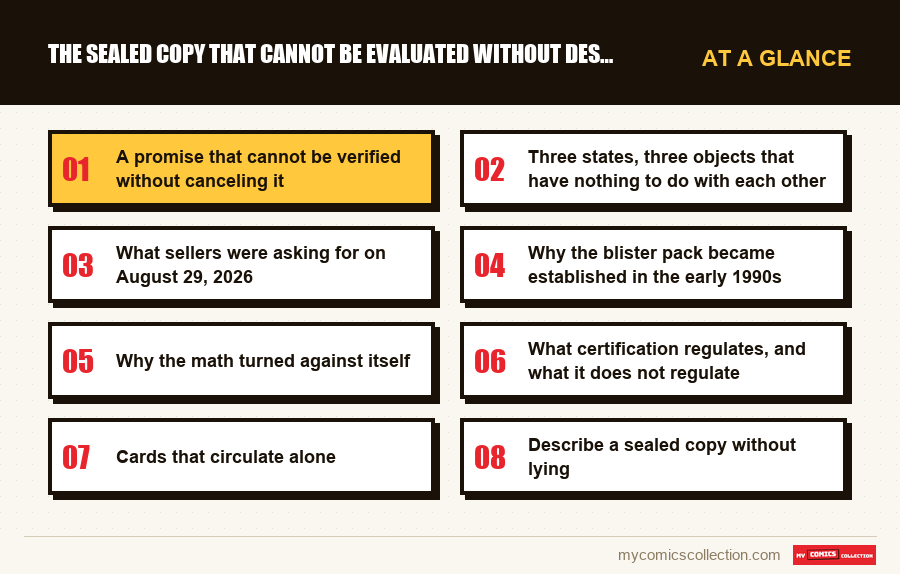
A promise that cannot be verified without canceling it
The sealed blister functions like a notarized seal: it certifies that the contents have not been tampered with. This certificate has real value, because it solves at once the most banal problem of this type of exit: the missing card. Tens of thousands of copies were opened in the days following their purchase, the map found its way into a binder, a shoebox, a pocket, and the booklet continued its life alone. Reconstructing the whole a posteriori is possible materially but proves nothing: nothing distinguishes a card put back in an open bag from a card which has never been taken out.
Except that this seal only attests to that. He says nothing about the booklet. A copy can have spent three decades standing in a cardboard box placed against a damp wall, its lower edge slightly warped, its cover marked by pressure from neighbors, and remain perfectly sealed. Plastic protects against dust and handling; it does not protect against humidity, heat, weight or time. Worse: a thin plastic, heat-sealed without special precautions, ages itself. It yellows, it stiffens, it cracks at the corners, and on some copies it sticks slightly to the cover. The packaging supposed to guarantee the object becomes an additional factor of degradation.
The collector therefore finds himself faced with an equation with a single known variable and several unknowns. He knows the card is in there. It ignores the condition of the paper, the alignment of the stapling, the possible presence of an original fold due to packaging, and sometimes even the exact identity of the card if the seller has not photographed it through the plastic. Buying is betting. Opening to remove doubt means transforming the object into something else and depriving yourself of what you paid extra for.
Three states, three objects that have nothing to do with each other
Sealed, contents unknown
The bag is intact. The card is necessarily present. The booklet is unverifiable: neither the corners, nor the interior edge, nor the pages can be inspected. We buy a guarantee of completeness against state ignorance. It is the most requested item and the most difficult to honestly evaluate.
Open, with the card
The bag has been cut, the booklet can be examined, the card is there. We can see everything, but the proof of origin has disappeared. Nothing shows that this map accompanied this booklet. The set sells as a cohesive lot, not a sealed item, and the difference in value is entirely due to this nuance.
Open, without the card
This is the case of the floor raised on August 29, 2026: an ad at $0.99 explicitly specifying that the copy is unsealed and without its card. At this stage, only one issue of a large print run remains, sold at the price of one issue of a large print run. The particularity has been consumed.
Verified by a third party
Certification resolves the ambiguity by opening, noting, then enclosing the whole thing in a box sealed by the organization. As of August 29, 2026, 16 such listings were asking $29.99 to $250.00, with a mid-range at $64.00, compared to $7.00 for the 159 unverified listings.
These four situations cannot be compared to each other like degrees of the same scale. These are four distinct goods which bear the same name in the advertisement titles, which explains the dizzying amplitude of the reading: from $0.99 to $85.00 among the unverified, or a ratio of one to eighty on a theoretically identical object. Such a dispersion does not reflect a disagreement on value; it reflects the fact that they do not sell the same thing there.
The mid-range of the unverified announcements, at $7.00 on August 29, 2026, is the most useful information in the statement. It indicates where the mass of offers is located, very far from the maximum displayed at $85.00. An isolated maximum expresses the hope of a seller, not an established amount: no one has paid this price simply because it is asked.
Reminder of method: all the amounts cited here are sums claimed in published announcements, noted on a specific date. These are not completed transactions, and no conclusions about a value trajectory can be drawn from them.
What sellers were asking for on August 29, 2026
159 unverified listings
This is the volume observed for this single number, on a given day. Such an abundant supply, several decades after the release, already says something: the object is not difficult to find, it is difficult to qualify.
From $0.99 to $85.00
The difference between the floor and the ceiling of the reading reaches a ratio of one to eighty. Both ends describe the same number, but not the same state of packaging or the same commercial ambition.
Mid-range at $7.00
Half of the unverified listings were below this amount. This is the benchmark to remember when trying to find out what the ordinary copy is really worth, as opposed to the showcase of the most expensive offers.
The floor, unsealed and without a card
The $0.99 ad said it in its title: bag open, card missing. The lowest price on the list corresponds exactly to the copy which has lost the two elements which make it special.
16 verified ads only
Faced with 159 raw offers, certification remains marginal in number. However, it concentrates the highest amounts requested in the statement, from $29.99 to $250.00, mid-range at $64.00.
Two markets that coexist
Between $7.00 and $64.00 mid-range, the spread does not measure intrinsic quality: it measures what sellers ask for in exchange for uncertainty removed by a third party. This is the stated price of certainty, not that of paper.
Why the blister pack became established in the early 1990s
The editorial logic of the time is clear, and there is nothing shameful about it: it was a question of transforming a periodical into a collector's item from the moment it was put on sale. An ordinary booklet becomes collectible by accident, over time, because a story gains importance or because copies disappear. The blister bypasses this slowness. It proclaims, from the display, that the object is special, that it contains something more, and that it must be treated with care. The message is written in the material: this plastic exists to be preserved.
The second desired effect is even more direct: multiple purchases. A reader who wants to read must open. A reader who wants to keep should not open. A reader who wants both buys two copies. The packaging mechanically creates a reason to buy twice, without changing anything in the content or the unit price. Add the map, which is part of another very active collecting practice during this period, and you have a third motive: certain buyers wanted the map more than the story, and acquired the object for its insert.
This mechanism was part of a general climate. The period saw a proliferation of material devices intended to distinguish an issue from the current flow: treated covers, special inks, parallel editions, detachable inserts. The blister has the advantage of being inexpensive, very visible and perfectly readable for the uninitiated buyer. It does not require any knowledge of the series to understand that something is being presented as exceptional.
We must also recognize what the process actually provides when it works. An item delivered closed arrives intact at the retailer, protected from shelf leafing, greasy fingers and covers dogged by handling. On a booklet that many buyers intended for conservation, this upstream protection has a measurable effect: the proportion of copies in good condition left the sales circuit was, by construction, greater than that of a booklet sold bare.
Why the math turned against itself
The problem is arithmetic, not moral. An item becomes rare when the available quantity decreases. But the blister produced exactly the opposite. It was applied to a title launched with a strong commercial ambition, therefore printed extensively, and it was purchased by a very large number of people who all shared the same intention: do not open, keep, wait. When hundreds of thousands of buyers simultaneously make the decision to preserve an identical item, they don't create scarcity: they create inventory.
This is the central paradox of the period, and it can be read directly in the statement of August 29, 2026: the floor of advertisements is under a dollar for an issue which was one of the most widely distributed of its time. We can formulate it cautiously, without giving any circulation figures: an object produced in very large numbers and carefully preserved by a multitude of people cannot become rare, whatever the quality of its conservation. Collective conservation cancels the effect it sought to produce.
This reality does not devalue the object, it replaces it. A sealed copy remains interesting for what it is: a material witness to a dated editorial practice, a medium which documents how a publisher attempted to create value through packaging. It is a piece of history of the fascicle trade. What it is not is an investment, and the 159 advertisements available on an ordinary day are enough to demonstrate this without the need to invoke anything else.
We must also measure the opposite, more discreet effect. Because many copies were opened to extract the card, and because others were opened simply to be read, the population of copies actually sealed is smaller than the total population. But “smaller” does not mean “small”. A fraction of a very large number remains a large number, and this is precisely what the abundance of offers noted shows.
Collecting this series?
Track what you own, what you are missing and what your collection is worth. 7 day trial.
Start my trial →What certification regulates, and what it does not regulate
Faced with an unverifiable object, certification offers a logical outcome: a third party opens, examines, notes, then closes it in a box that he seals himself. The uncertainty disappears, replaced by a legible note. It's effective, and the difference in requested amounts on August 29, 2026: mid-range $64.00 versus $7.00: measures precisely what sellers think they can charge for this relief of doubt.
But the operation has a conceptual cost. The certified box is no longer the object of 1991: it is an object of 1991 transformed into a documented part. The original bag, when it is preserved, is as an attached element and no longer as a functional envelope. The guarantee chain has changed in nature: it is no longer based on the integrity of a factory heat seal but on the word of an organization. For many buyers, this is clear progress. For those who were looking for the item as it came off the line, this is a loss.
It should also be noted that 16 verified advertisements compared to 159 raw advertisements indicate a market where certification remains in the minority. The majority of transactions therefore continue to be done blindly, on the basis of a description and photographs taken through plastic. This is where the collector's real training ground lies, and this is where the rigor of description makes the difference between a thoughtful purchase and a disappointment.
Cards that circulate alone
The last part of the problem is the most definitive. Once the bag is opened, the card becomes an independent object. It is small, flat, easy to store, easy to exchange, easy to resell separately. It joins collections of maps, not collections of fascicles. And from that moment on, there is no way to connect it to the copy that accompanied it.
This point deserves to be understood in its full scope. The booklet bears no mark of its insert. The map bears no reference to the specific copy to which it was attached. The two objects are mass-produced, interchangeable within their respective series, and their original association only existed in the form of a plastic weld now cut out. Recomposing a set therefore amounts to bringing two compatible objects together, never to restoring an original pair. The distinction seems subtle; it is exactly what the blister was intended to guarantee.
Practical consequence: a seller who offers an open copy “with his card” states something verifiable, the card is physically there, and something unverifiable: that it is his card. The buyer must read this announcement for what it is: the sale of a coherent lot, at a price which cannot be that of a sealed copy, since the proof which justified this price was destroyed at the time of opening.
Symmetrical practical consequence for personal inventory: if you open a copy, write it down. The day of opening, the observed condition of the booklet at that time, the presence or absence of the card, and the fate of the bag. This information will never exist anywhere other than in your notes, and it is the only residual trace of an association that the plastic certified in your place.
Describe a sealed copy without lying
Since the object is unverifiable, descriptive honesty becomes the only reliable currency. A serious seller explicitly distinguishes between what he observes and what he assumes. The bag is intact: observation. The booklet is in good condition: assumption, unless the transparent plastic shows enough to confirm this. This border, drawn in black and white in an announcement, is better than a stated state grid without a basis.
On the buyer's side, a few simple questions eliminate most of the unpleasant surprises. Is the bag original or was the copy put back in plastic by an intermediary? Do the photographs show the four corners of the bag, its welds, and the edge of the booklet through the film? Does the plastic show any yellowing, stiffening, visible adhesion to the cover? Is the map identifiable through the film, or only assumed to be present? None of these questions replaces a direct examination, but each reduces the betting element.
Finally, we must accept an unpleasant fact: on a sealed object, the condition note only becomes certain the day someone agrees to make it certain, that is to say, to open it. Any other statement is an estimate. A buyer who understands this will pay the price of a bet, and not that of a certainty: which, on an item whose mid-advertising range stood at $7.00 on August 29, 2026, remains a perfectly reasonable expense.
Ce qu'il faut noter
The state of the packaging must be separate data from the state of the fascicle. On this specific number, the two do not coincide and cannot coincide as long as the bag is closed. An inventory that only has one "state" box will force you to overwrite one of two pieces of information, and it will always be the one you need later. Provide two mentions: sealed or open on the one hand, observed state or assumed state on the other hand.
The presence of the card is binary information that changes the nature of the object. The $0.99 advert noted on August 29, 2026 proves this absurdly: unsealed and without a card, the copy costs the price of an ordinary booklet. So note the map as an element in its own right, never as a detail of description, and distinguish « carte présente dans le sachet fermé » from « carte présente à côté du fascicule ouvert ».
An opening is a dated event, not a simple change of state. The day you cut a bag, the object definitively ceases to be what it was and no further handling will restore it. Recording the date, reason and condition noted when opened is the only way to keep a record of what the plastic showed before you. It's documentation, not paperwork.
Amounts raised must be recorded as dated claims. 159 unverified listings from $0.99 to $85.00 with a midpoint of $7.00, and 16 verified listings from $29.99 to $250.00 with a midpoint of $64.00: These numbers describe the state of a listing catalog on August 29, 2026, nothing more. Without the date and without the mention « demandé », they will be transformed in your memory into the supposed value of your copy.
The extremes of a survey are not used to estimate, they are used to understand dispersion. The maximum displayed reflects the hope of a single seller; the floor translates the object stripped of its attributes. Between the two, only the middle of the range provides information on the position of the mass of offers. Keep all three values together, never just one: isolated, each tells a false story.
It entirely depends on what you want to do with it. If your goal is to read, open: the story is identical in any copy, and there are many at very low prices, including a $0.99 release on August 29, 2026. If your goal is to keep a witness to the original packaging, do not open, and accept never knowing the exact condition of the booklet. The only mistake is to open hoping to keep the advantages of both situations: it is impossible, the operation is definitive.
No, and that's the whole problem. The bag protects against handling and dust, but not against humidity, heat, the pressure of a poorly stored cardboard box or the aging of the paper. A poorly stored sealed copy may be in worse condition than an opened copy stored flat in good conditions. The difference is that we can see it on the second and not on the first. Sealed means untouched, never flawless.
Because the ads do not relate to the same subject, despite similar titles. On August 29, 2026, the 159 unverified offers ranged from $0.99 to $85.00 with a midpoint at $7.00: the bottom corresponded to an unsealed copy deprived of its card, that is to say an ordinary booklet, while the top of the range brought together sealed copies and sellers' hopes. An isolated maximum indicates what we ask for, never what we obtain.
A separate card becomes an independent collector's item, evaluated according to the criteria of its own market and not according to those of the booklet. What disappears irremediably is the link with the copy that accompanied it: neither the booklet nor the card bear any mark allowing them to be reconciled. Once separated, the two objects circulate independently and no subsequent recomposition can claim to restore an original whole.
On August 29, 2026, the 16 listings for verified copies ranged from $29.99 to $250.00 with a midpoint at $64.00, compared to $7.00 for unverified listings. This gap measures what sellers charge for uncertainty resolved by a third party, not guaranteed premium quality. Certification has a real interest on an unverifiable object, since it is the only way to know the state without destroying the packaging yourself. On the other hand, it transforms the object into a documented piece, which is not what all collectors are looking for.
Keep Track of What Plastic Won't Tell
Sealed or opened, card present or absent, state observed or assumed state, date opened: this information only exists if you record it, and it becomes impossible to find as soon as a bag is cut. My Comics Collection allows you to follow each copy with its packaging, its particularities and your own dated statements of amounts, without ever confusing a displayed request with an established value.