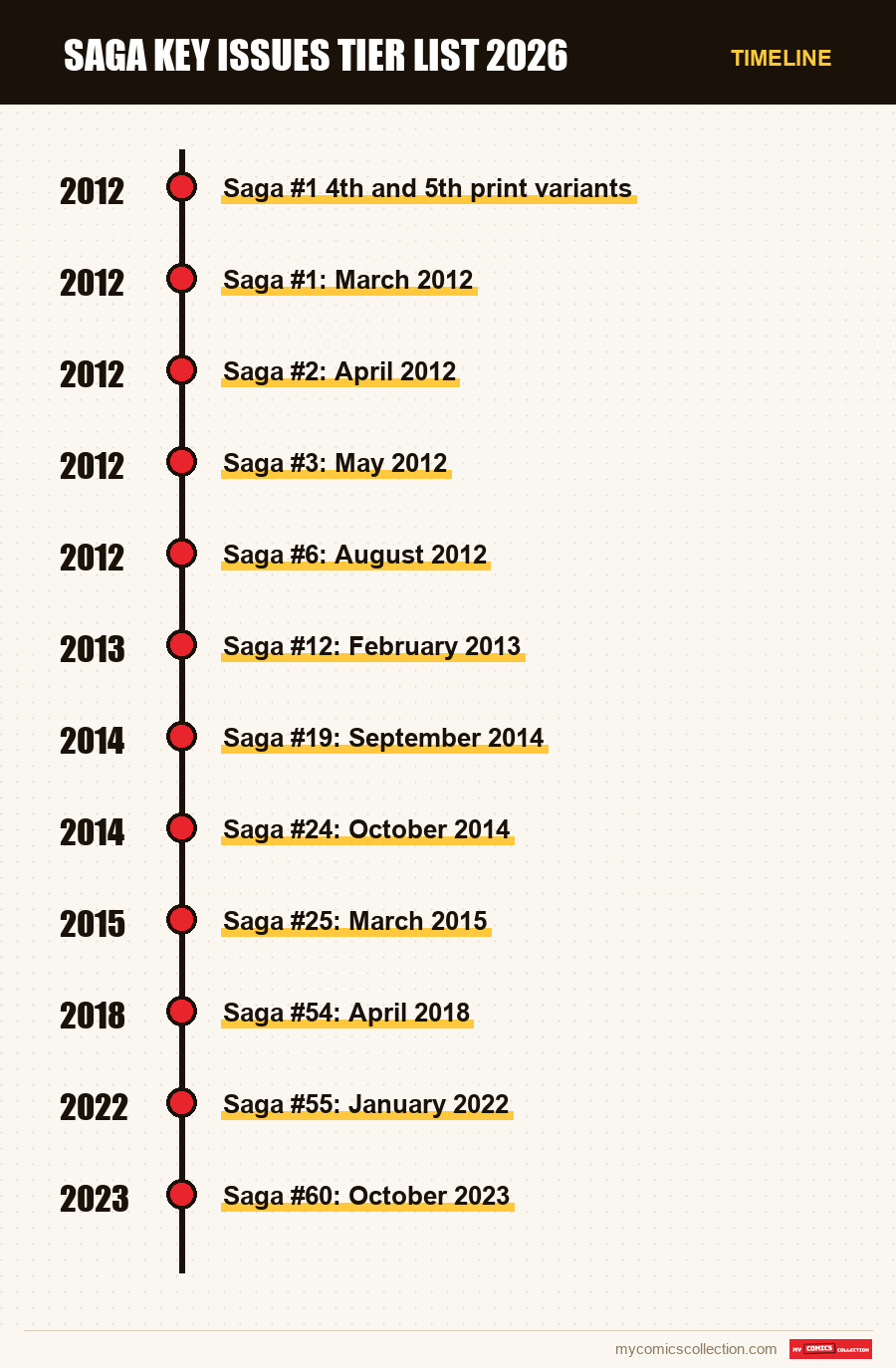
The 2026 tier list of key Saga issues ranks Image Comics issues by value potential and narrative importance: Tier S blue-chip (Saga #1 March 2012 Brian K. Vaughan/Fiona Staples, Saga #2 April 2012 first full appearance of Will, The Stalk and Brand, Saga #3 May 2012 solo debut of The Will, Saga #19 September 2014 cliffhanger announcing the hiatus): central assets at €80-700 depending on grade. Tier A (Saga #6 August 2012 limited distribution newsstand-like, Saga #12 February 2013 cliffhanger Hazel, Saga #24 October 2014 finale volume 4, Saga #54 April 2018 last issue before three-year hiatus). Tier B solid sleepers (Saga #1 4th-5th print variants, Saga #25 March 2015 dense reprint, Saga #55 January 2022 return Vaughan, Saga #60 October 2023 launch volume 10). Tier C speculative bets 2026-2027 (FX TV adaptation in development, Vaughan return announced in 2026).
Building a coherent Saga collection in 2026 requires particular methodological discipline. Saga is one of the very few modern Image Comics titles to have gone through a full decade without losing critical relevance, and its narrative hiatus (April 2018: January 2022) has created an atypical market dynamic that many French-speaking collectors have not properly decoded. Without clear prioritization, the budget is dispersed on abundant reprints while the real blue-chips continue to appreciate out of reach.
Ce guide tier list Saga 2026 classifies the major key issues into four tiers (S, A, B, C) according to three weighted criteria: narrative historical importance in the Vaughan/Staples universe, market performance over five rolling years (2021-2026), and probability of an audiovisual catalyst in the 2026-2030 window. Each issue is documented with exact publication date, creative team and price range by CGC grade. Objective: to allow the French-speaking collector to build a budgeted purchasing strategy, without wasting a euro on the classic pitfalls of the Saga catalog (confusion between multiple prints, premium on variant covers, false volume 1 rarities).
Saga 2026 tier list methodology
A useful tier list does not simply align numbers in chronological order: it prioritizes according to a coherent investment and collection thesis. For Saga in 2026, three methodological axes structure the ranking. The title published by Image Comics since March 2012 under the pen of Brian K. Vaughan and the pencil of Fiona Staples constitutes a particular case study in the modern independent landscape, halfway between the critical legitimacy of Y: The Last Man and the gradually increasing scarcity of circulation of everything that comes out of the major traditional publishers.
Tier S/A/B/C classification criteria
- Narrative historical significance (40%): first appearances of structuring characters (Alana, Marko, Hazel, The Will, The Stalk, Prince Robot IV, Lying Cat), founding events (birth of Hazel, death of Marko, narrative hiatus), canonical arcs cited by critics. Saga having won the Eisner Award for best new title in 2013 then the Hugo Award Best Graphic Story in 2013, 2014 and 2015, the cultural legitimacy is beyond doubt.
- Market performance 5 years (35%): CGC price trend documented on GoCollect, Heritage Auctions, ComicConnect between 2021 and 2026. An issue that has doubled and then plateaued is not equivalent to an issue that progresses linearly. Saga presents an atypical profile: regular rise 2012-2018, plateau during the hiatus, restart in January 2022, then second phase of appreciation post-2023.
- Probability of audiovisual catalyst 2026-2030 (25%): proximity to the TV adaptation in development at FX (under the aegis of Vaughan himself as announced showrunner), presence on the Hollywood Reporter and Variety radars, estimated production schedule.
Definition of third parties
- Tier S: blue-chip: central numbers, value recognized worldwide by the collector community, no risk of historical downgrading. These are the defensive assets of a serious Saga collection. If you could only have four numbers, these would be them.
- Tier A: fundamentals: historically critical issues with solid performance but without the absolute status of Tier S. Make up the backbone of a reasoned collection and offer a balanced exposure to the different volumes of the series.
- Tier B: sleepers with conviction: numbers undervalued in view of their narrative significance, with catalyst identified at 12-36 months. Moderate risk, documented re-rating potential. The multiple prints of Saga #1 feature prominently because the market is just beginning to take into account their relative rarity.
- Tier C: speculative bets: issues with a strong thesis but dependent on uncertain future events (notably the confirmation of the schedule of the FX adaptation). Limited budget allocation recommended, typically 10-20% of the total Saga budget.
Voluntary out-of-scope
This tier list does not classify convention variant covers (San Diego Comic-Con, ECCC, NYCC) except in exceptional cases, nor deluxe hardcover editions (Image Deluxe HC volumes 1 to 4) which fall under a separate collector's market. The classic TPB (trade paperbacks) in first printing are deliberately excluded: their rating remains anecdotal apart from original Vaughan or Staples signatures. To understand how Saga fits into the modern publishing ecosystem, check out the history guide Image Comics 30 years which places the series in the context of the major North American independent cycles.
Tier S: the central Saga blue-chips
Four issues absolutely dominate the Saga catalog and constitute the defensive hard core of any serious collection. They combine relative rarity in high grade CGC, indisputable historical importance in the Vaughan/Staples mythology, and maximum liquidity on major auction markets (Heritage Auctions, ComicConnect, institutional eBay). To situate these issues in the Image Comics editorial chronology, the Image Comics and Independents calendar details the 2012-2026 release windows.
Saga #1: March 2012 (Brian K. Vaughan / Fiona Staples)
The absolute founding number. Published by Image Comics in March 2012 under the aegis of Brian K. Vaughan for the script and Fiona Staples for the drawings (colors and lettering included), Saga #1 introduces the complete narrative universe of the series: the cosmic war between Landfall and Wreath, the couple Alana (Landfall soldier) and Marko (Wreath deserter), and the birth of their daughter Hazel, retrospective narrator of the entire saga. The issue has become the most collected modern Image Comics cornerstone, even surpassing some Walking Dead issues in the critical imagination.
- CGC 9.8 1st print: public sales 2024-2026 between €500 and €700. Census CGC 9.8 exceeding 4,000 copies but structurally strong demand.
- CGC 9.6 1st print: €220 to €320. The most accessible median grade for a defensive investment.
- CGC 9.4 1st print: €130 to €190. Reasonable entry point.
- CGC 9.2 1st print: €75 to €110. The grade of serious collectors with a capped budget.
- Raw NM 1st print: €40 to €70. The minimum acceptable, to be checked visually to distinguish from the 2nd print.
5-year trend: +210% between 2021 and 2026 in CGC 9.8 1st print, with a clear acceleration following the announcement of Vaughan's return in November 2021 and the reboot of the series in January 2022. No documented market correction greater than 15% on 36-month rolling windows since 2014. The number is cited as a Modern Age cornerstone in most analyzes published by modern comics guides investing 2020-2026.
Saga #2: April 2012 (Brian K. Vaughan / Fiona Staples)
First full appearance of Will, The Stalk and Brand. Published April 2012, Saga #2 introduces the trio of cosmic freelancers hired to capture Alana and Marko: The Will (lead mercenary), The Stalk (her silent eight-legged arachnid partner), and Brand (the sister never seen at this point but mentioned and providing structure for later arcs). These characters become central to the complete mythology and give the issue a narrative weight that goes well beyond its status as a second issue.
- CGC 9.8 1st print: €180 to €260. Census CGC 9.8 significantly lower than #1 (more modest initial impressions).
- CGC 9.6 1st print: €75 to €115.
- CGC 9.4 1st print: €45 to €70.
- CGC 9.2 1st print: €28 to €45.
- Raw NM 1st print: €20 to €35.
5-year trend: +160% in CGC 9.8 between 2021 and 2026. The narrative importance / acquisition price ratio remains one of the best in the Saga catalog, making it one of the favorite issues of informed collectors looking for a Tier S exhibition at a moderate price. The rating also benefits from speculation about an FX adaptation that would necessarily make The Will one of the three or four main roles in the first season.
Saga #3: May 2012 (Brian K. Vaughan / Fiona Staples)
First solo appearance of The Will with his own narrative framework. Published May 2012, Saga #3 develops the character of The Will, a freelance mercenary, and introduces Lying Cat, his feline companion with the ability to detect lies. Lying Cat has become one of the most emblematic secondary characters of the franchise and a real merchandising phenomenon (soft toys, statuettes, t-shirts sold at Skybound and direct image).
- CGC 9.8 1st print: €220 to €320. Premium Lying Cat documented.
- CGC 9.6 1st print: €90 to €135.
- CGC 9.4 1st print: €55 to €85.
- CGC 9.2 1st print: €32 to €50.
- Raw NM 1st print: €22 to €38.
5-year trend: +185% in CGC 9.8 between 2021 and 2026. The curve accelerated significantly from 2023 when announcements of FX adaptations began to filter through the specialized press. Lying Cat remains the most profitable merchandising spring post-potential adaptation, which justifies the premium Saga #3 over Saga #2 despite a formally comparable narrative importance.
Saga #19: September 2014 (Brian K. Vaughan / Fiona Staples)
Cliffhanger Alana pregnant and first narrative hiatus. Published September 2014, Saga #19 closes the volume 3 arc with the revelation that Alana is pregnant with their second child. The issue also marks the series' first narrative hiatus (Vaughan and Staples taking a three-month break before the reboot), creating a structuring editorial event. The cover captures the turning point in the story, making it one of the most visually identifiable issues for collectors.
- CGC 9.8 1st print: €95 to €145. Census CGC 9.8 limited, growing demand.
- CGC 9.6 1st print: €42 to €65.
- CGC 9.4 1st print: €25 to €40.
- Raw NM 1st print: €15 to €25.
5-year trend: +140% in CGC 9.8. Number undercovered by the speculative retail market but recognized as a cornerstone by experienced Saga collectors. The current window remains favorable for entering CGC 9.6, with 9.8 having already captured most of the available re-rating.
Tier A: solid Saga fundamentals
Tier A brings together the issues that constitute the backbone of a serious Saga collection. They combine documented narrative importance and continued market performance, without achieving absolute Tier S monument status. The budget weighting rule suggests that they represent 35-45% of the independent Modern Age oriented collector's total allocation. For the overall context of modern comics Image and the initial selection, the Image Comics guide to getting started offers a complementary reading grid.
Saga #6: August 2012 (Brian K. Vaughan / Fiona Staples)
Limited newsstand-like distribution and first structural sell-out. Published August 2012, Saga #6 marks the point where Image Comics and Diamond Distribution underestimated demand, creating an unusual structural scarcity for an independent title. The direct market copies available were already sold out in a few days in large retailers, which created a mini-scarcity premium that continues today.
- CGC 9.8 1st print: €140 to €210.
- CGC 9.6 1st print: €60 to €90.
- CGC 9.4 1st print: €32 to €50.
- Raw NM 1st print: €18 to €30.
5-year trend: +120% in CGC 9.8. Number frequently cited in sleeper analyses, particularly in the context of modern strategies described by modern comics guides investing 2020-2026.
Saga #12: February 2013 (Brian K. Vaughan / Fiona Staples)
Cliffhanger Hazel and finale volume 2. Published February 2013, Saga #12 ends the second volume of the series on a cliffhanger which puts Hazel's safety at stake against Prince Robot IV. The issue is one of the most recognizable covers of the series and represents a moment of major dramatic shift between the "romantic elopement" phase and the "continuing threat" phase of the narrative.
- CGC 9.8 1st print: €110 to €165.
- CGC 9.6 1st print: €48 to €72.
- CGC 9.4 1st print: €28 to €42.
- Raw NM 1st print: €16 to €26.
Buying Saga #12 in grade matching with Saga #19 and Saga #24 maximizes collector consistency and liquidity for future resale in batches. 5-year trend: +135% in CGC 9.8.
Saga #24: October 2014 (Brian K. Vaughan / Fiona Staples)
Finale volume 4 and major narrative turning point. Published October 2014, Saga #24 closes the volume 4 arc with a structuring narrative event (without revealing the full spoiler, it is a definitive tipping point for one of the main characters). The issue remains one of the most discussed in the series by the critical community and enjoys enduring demand among complete collectors of the Vaughan/Staples run.
- CGC 9.8 1st print: €95 to €145.
- CGC 9.6 1st print: €42 to €65.
- CGC 9.4 1st print: €24 to €38.
- Raw NM 1st print: €14 to €24.
5-year trend: +115% in CGC 9.8. The issue is central to understanding the emotional arc of the series and remains undercovered by the market despite its narrative weight. See also our analysis comics female collector 2026 where Saga regularly appears among the titles recommended for a genre-conscious approach to the collection.
Saga #54: April 2018 (Brian K. Vaughan / Fiona Staples)
Last issue before the three-year hiatus. Published April 2018, Saga #54 marks the entry into hiatus announced by Vaughan and Staples after a decade of almost uninterrupted monthly publication. The issue contains a dramatic cliffhanger (death of one of the main characters) and was followed by complete editorial silence until the return in January 2022. This issue has become legendary for the Saga community and concentrates a strong emotional demand.
- CGC 9.8 1st print: €130 to €195.
- CGC 9.6 1st print: €55 to €85.
- CGC 9.4 1st print: €32 to €50.
- Raw NM 1st print: €18 to €30.
5-year trend: +175% in CGC 9.8 between 2021 and 2026. The curve experienced two phases: appreciation during the hiatus (increased perceived rarity), then a new increase after confirmation of the return in November 2021. The number is now one of the modern cornerstones in the series and its grade 9.8 remains structurally under-represented in the CGC census.
Tier B: the sleepers Saga to conviction
Tier B is the favorite playground of informed collectors. The numbers are accessible there, their assessment thesis documented, and the potential/risk ratio favorable. They typically represent 25-35% of a diversified Saga allocation. Several multi-print issues deserve special attention because the market only began to recognize their relative rarity from 2024 onwards.
Saga #1 4th and 5th print variants (2012-2013)
Multiple prints Saga #1 underrated. Saga #1 saw five successive printings between March 2012 and early 2013, testifying to the explosive demand phenomenon surrounding the title. The 4th print (orange cover) and the 5th print (purple cover) are significantly rarer than the 1st and 2nd prints, but their price remains much lower than the 1st print. This market anomaly is one of the clearest sleeper opportunities in the Saga catalog.
- Saga #1 4th print CGC 9.8: €85 to €130.
- Saga #1 4th print CGC 9.6: €38 to €60.
- Saga #1 5th print CGC 9.8: €110 to €170. Rarer than the 4th print.
- Saga #1 5th print CGC 9.6: €48 to €75.
- Saga #1 4th print Raw NM: €18 to €30.
5-year trend: +95% in CGC 9.8 for the 4th print, +130% for the 5th print. The progression is less explosive than on the 1st print but more regular, with a significantly lower risk of fakery (multiple prints are rarely falsified due to the lack of an organized counterfeiting market). To distinguish the prints, the guide pillar Image Comics details critical visual indicators (color cover, indica, barcode).
Saga #25: March 2015 (Brian K. Vaughan / Fiona Staples)
Dense reprint and founding issue volume 5. Published March 2015, Saga #25 opens the fifth volume with a significant time jump and several secondary first appearances (notably Petrichor, a trans character who joins the main cast). The issue has benefited from recent critical coverage of LGBTQ+ representation in independent comics, creating stable category demand.
- CGC 9.8 1st print: €75 to €115.
- CGC 9.6 1st print: €32 to €50.
- CGC 9.4 1st print: €18 to €28.
- Raw NM 1st print: €11 to €18.
5-year trend: +105% in CGC 9.8. The issue remains accessible to French-speaking collectors with a modest monthly budget and offers exposure to the modern themes of the franchise.
Saga #55: January 2022 (Brian K. Vaughan / Fiona Staples)
Official return after a hiatus of three years and nine months. Published January 2022 by Image Comics after the official announcement in November 2021, Saga #55 marks the reboot of the series after the longest hiatus in its history. The issue saw explosive pre-order demand, with additional prints needed within the first week. It's one of the de facto "anniversary issues" of the title, and its unique historical status warrants a robust Tier B presence.
- CGC 9.8 1st print: €85 to €130.
- CGC 9.6 1st print: €38 to €60.
- CGC 9.4 1st print: €22 to €35.
- Raw NM 1st print: €13 to €22.
4-year trend: +180% in CGC 9.8 between January 2022 and the end of 2025. The appreciation curve was particularly marked at the end of 2024 when rumors of an FX adaptation intensified in Variety and The Hollywood Reporter.
Saga #60: October 2023 (Brian K. Vaughan / Fiona Staples)
Launch of volume 10 and new narrative cycle. Published October 2023, Saga #60 marks the start of volume 10 and a new structuring narrative arc for the end of the 2020 decade. The issue contains several secondary first appearances and initiates a narrative dynamic which obviously extends until 2027-2028. For collectors looking for a recent Modern Age entry point at a low acquisition cost, this is one of the best options in the Saga catalog.
- CGC 9.8 1st print: €55 to €85.
- CGC 9.6 1st print: €24 to €38.
- Raw NM 1st print: €9 to €16.
2-year trend: +85% in CGC 9.8 since October 2023. The entry window remains favorable compared to pre-hiatus numbers, but caution is required: the rating largely depends on the editorial continuity of the series until 2028 and the evolution of the FX adaptation.
Collecting this series?
Track what you own, what you are missing and what your collection is worth. 7 day trial.
Start my trial →Tier C: speculative bets Saga 2026-2027
Tier C concentrates bets with a strong thesis but high uncertainty. Recommended budget allocation: 10-20% of the total Saga budget. Buying several copies of the same issue is sometimes relevant here if the conviction is high and the entry price low. The catalysts identified for 2026-2027 are essentially based on the TV adaptation and the announced schedule of the regular series.
Saga TV adaptation at FX (in development)
The Saga adaptation by the FX network (Disney group) has been announced several times since 2018, with reinforced confirmation in 2023-2024 that Brian K. Vaughan would remain closely involved as executive producer and co-creator. With the Saga series having a reputation for being "unadaptable" for years (due to nude art, violence, and visual complexity), the FX confirmation represents a major catalyst if the series reaches actual production.
- Saga #1 1st print CGC 9.8: main exhibition, already partially integrated into the price but with an additional margin if filming confirmed in 2026-2027.
- Saga #2 1st print CGC 9.8: The Will will necessarily be a main role, currently underexposed.
- Saga #3 1st print CGC 9.8: Lying Cat = potential merchandising phenomenon x10.
- Saga #5 1st print Raw NM: first Prince Robot IV, sleeper if the character becomes the central antagonist of season 1.
Potential catalyst: official FX announcement of pre-filming production could propel Tier S ratings +30% in 6 months and pull Tier B through halo effect. The 2026-2027 window is statistically the most likely according to analyzes published on the spec keys 2027 Marvel/DC films and series.
Announcement Vaughan return in 2026 and estimated final arc
Brian K. Vaughan has publicly indicated that Saga will reach a structuring final arc around volume 12 or 13, that is to say roughly 2027-2028. The issues marking this absolute cliffhanger (probably Saga #72 or #84 depending on the current pace) will benefit from similar structural demand to Saga #54 during the previous hiatus. Anticipating these numbers in pre-order is a speculative strategy with an extremely low entry cost (€5 retail) with potential upside x10 to x20 on grade CGC 9.8 over 5 years.
Secondary sleeper numbers to monitor
- Saga #4 (June 2012): first iconic Staples double-page spread, underpriced.
- Saga #7 (September 2012): first appearance The Brand developed, sleeper if the FX adaptation exploits the Brand arc.
- Saga #18 (August 2014): Apple App Store / censorship controversy (structuring media episode for the editorial history of the title).
- Saga #36 (March 2016): final volume 6, under-followed by the market.
For technical purchasing arbitrations, the investment strategy analysis 2027 offers detailed and useful budget weighting grids for calibrating Tier C exposure.
Allocation strategy by collector budget
A tier list only has value when operationalized by a concrete budgetary strategy. Here are three typical profiles adjusted to the Saga 2026 market, with detailed breakdown by tier and by grade.
Budget €1,500: the Modern Age heart collection accessible
- Saga #1 CGC 9.6 1st print (€260): defensive cornerstone.
- Saga #2 CGC 9.6 1st print (€95): Will/Stalk/Brand, Tier S anchor.
- Saga #3 CGC 9.6 1st print (€110): Lying Cat solo, Tier S.
- Saga #19 CGC 9.6 1st print (€55): cliffhanger Alana pregnant.
- Saga #54 CGC 9.6 1st print (€70): hiatus.
- Saga #6 Raw NM 1st print (€25): sleeper limited distribution.
- Saga #12 Raw NM 1st print (€22): final volume 2.
- Saga #24 Raw NM 1st print (€20): final volume 4.
- Saga #55 Raw NM 1st print (€18): post-hiatus return.
- Saga #1 4th print Raw NM (€25): sleeper variant.
- Reserve €800: window opportunities + targeted Tier C.
This allocation builds a base representative of the entire Saga chronology (volumes 1, 2, 3, 4, 9, 10) while keeping a tactical reserve for FX announcements and possible new key issues 2026-2027.
Budget €5,000: the Saga institutional collection
Suggested allocation: 55% Tier S, 25% Tier A, 12% Tier B, 8% Tier C.
- Saga #1 CGC 9.8 1st print (€600): ultimate grade cornerstone.
- Saga #2 CGC 9.8 1st print (€220): Tier S complete.
- Saga #3 CGC 9.8 1st print (€270): Lying Cat ultimate grade.
- Saga #19 CGC 9.8 1st print (€120): cliffhanger volume 3.
- Saga #6 CGC 9.8 1st print (€175): limited distribution.
- Saga #12 CGC 9.8 1st print (€140): Tier A.
- Saga #24 CGC 9.8 1st print (€120): Tier A.
- Saga #54 CGC 9.8 1st print (€165): definitive hiatus.
- Saga #25 CGC 9.8 1st print (€95): Petrichor first.
- Saga #55 CGC 9.8 1st print (€110): post-hiatus return.
- Saga #60 CGC 9.8 1st print (70 €): volume 10 opening.
- Saga #1 4th print CGC 9.8 (€110): sleeper variant.
- Saga #1 5th print CGC 9.8 (€140): rare sleeper.
- Reserve €2,665: Tier C, secondary sleeper opportunities, FX-catalyst allocation.
Budget €15,000+: the Modern Age blue-chip wallet
At this level, the top priority is the quality of the grade and the completeness of the Tier S/A run. Buying three Saga #1 CGC 9.8 1st print (€1,800 in total) in multiple copies rather than a single copy offers a differentiated resale option depending on the FX windows. Completed with a cover signed Vaughan (€1,200-1,800 depending on agreement) and a cover signed Staples (€1,500-2,200) adds a prestige dimension rarely available on the secondary market.
At this budget level, diversification towards other Modern Age Image titles (Walking Dead, Invincible) becomes relevant. See respectively the guide tier list Walking Dead 2026 and the guide tier list Invincible 2026 for portfolio correlations. For continued arbitration, also see the guide pillar Image Comics which details the main strengths of the independent catalog.
Classic pitfalls to avoid in the Saga franchise
The Saga collection has specific pitfalls that can erode a well-planned budget. Three families of risks dominate and deserve particular attention, in particular for French-speaking collectors who often buy without direct access to the Heritage and ComicConnect markets.
Identification of multiple prints Saga #1
Saga #1 had five successive printings between March 2012 and early 2013. Confusion between prints is the most frequent error on the secondary market. Critical indicators to distinguish prints:
- 1st print: dominant red-orange cover, indica March 2012, original barcode Image.
- 2nd printing: cover blue-violet variant, indica May 2012, mention "Second Printing" on the cover.
- 3rd print: cover yellow-green, indica summer 2012.
- 4th print: dominant orange cover, end of 2012.
- 5th print: purple cover, early 2013, most limited edition.
The price difference between Saga #1 1st print CGC 9.8 (€500-700) and a 4th print CGC 9.8 (€85-130) creates a strong incentive for false descriptions on eBay. Buy exclusively from CGC slabbed for any transaction over €80, or via trusted sellers with specified reprint guarantee. THE Image Comics guide to getting started details critical visual indicators.
Staples signed variants: authentication required
Fiona Staples regularly signs at conventions (San Diego, Emerald City, NYCC) but the "signed Staples" market includes a high proportion of false signatures, particularly on the pre-2018 ECCC and SDCC variants. Buy exclusively CGC Signature Series copies (CGC witness present during signing) or JSA / PSA authenticated for non-witnessed signatures. Non-witnessed raw signatures are worth at best 30% of the price of an authenticated signature.
Surcharge of modern convention variants
Post-2015 convention variant covers (notably ECCC, SDCC, NYCC variants ratio 1:25 and 1:50) have massively lost their speculative premium between 2022 and 2025. Many variants purchased for €150-300 in 2021 are now selling for €30-80. Avoid variant ratios as a primary strategy and favor 1st print regular covers for their documented authentic rarity and superior liquidity.
Fake “first print” Saga #1 on eBay
The eBay market includes a significant proportion of "Saga #1 first print" ads which actually correspond to 2nd, 3rd or 4th prints. The absolute rule: always require a photo of the complete indica (generally page 2) where the words "First Printing" must appear explicitly. In the absence of this mention, the number is by default a 2nd print or later.
Saga portfolio monitoring 2026-2030
A tier list is not static. Audiovisual catalysts, editorial announcements at Image Comics, and macro-economic cycles in the collecting market cause the ranking to evolve year after year. This is the recommended review method for an ambitious Saga portfolio.
Quarterly review cycle
- Q1: previous year report: Heritage Auctions and ComicConnect sales, calculation of progression by issue and by grade. Recalibration of the annual budgetary weighting.
- Q2: analysis of spring convention announcements (ECCC, C2E2, MegaCon). Surveillance of Staples / Vaughan signed variant prints.
- Q3: monitoring FX adaptation summer announcements (Upfronts, TCA). Price impact observed D+30, D+90, D+180 if official production announcement.
- Q4: end-of-year tax arbitrages, opportunistic sales of positions having achieved their objectives +100% and more.
Re-classification indicators
Three signals can justify moving a Tier C number to Tier B, or Tier B to Tier A:
- Official FX Saga pre-filming announcement with confirmed schedule.
- Reduction of the CGC 9.8 census below a structural threshold (typically 200 copies in public circulation for pre-hiatus issues).
- Price progression greater than 80% over 18 rolling months with maintenance over 24 months and confirmation by three documented Heritage / ComicConnect sales.
Operational monitoring tools
To manage a Saga portfolio diversified over 30 to 60 issues (the complete run 2012-2026 totals more than 65 issues), manual tools (Excel, Google Sheets) quickly reach their limits, particularly for tracking multiple prints. Dedicated applications like Comics Manager keep daily-updated eBay estimates in one place, to read alongside the CGC census and the FX announcement calendar. See the complete guide Comics Manager for initial setup and free estimate for individual arbitrations.
Horizon 2027-2030: areas to monitor
Four major theses will probably structure the following decade on the Saga franchise:
- FX adaptation production 2027-2028: reset of all media attention on the series, opportunity to re-rate Tier S +50-100% if the production reaches broadcast.
- Vaughan/Staples Final Arc 2028-2029: announced narrative closure, dynamic comparable to the 2018-2022 hiatus but amplified by the “official end” effect.
- Increasing print run Tier S 1st print: risk that the market gradually absorbs the available CGC 9.8 census, creating progressive scarcity.
- Modern independent saturation: risk of market fatigue if the Image Comics 2026-2028 offering overloads collector attention to the detriment of the 2012-2018 classics.
For collectors wishing to actively track the global Image Comics and independent market, the overview of referenced comics and the index of key issues comics provide a systematic entry point. For the Saga franchise specifically, the sheetAlana Character Sagacentralizes complementary narrative resources.
Saga 2026 tier list FAQ
Saga #1 (March 2012, Brian K. Vaughan / Fiona Staples, Image Comics) remains the absolute foundational issue. If the budget only allows one Tier S acquisition, this is it, ideally in CGC 9.6 minimum to preserve blue-chip status and resale liquidity. Saga #2 (April 2012, first full appearance of Will, The Stalk and Brand) is the second central choice if the budget allows it, with a better importance / acquisition price ratio.
Saga #1 1st print CGC 9.6 (€220-320) remains the optimal defensive investment. For a first purchase on a budget, Saga #1 4th print CGC 9.8 (€85-130) or 5th print CGC 9.8 (€110-170) offer indirect Tier S exposure with real structural rarity and a significantly lower risk of counterfeiting. Avoid Saga #1 "first print" raw sold for under €40 on eBay: the probability of being a 2nd or 3rd print is high.
The FX announcement has already been partially integrated into the price of Tier S (Saga #1, #2, #3) which have increased +160-210% over 5 years. Full re-rating will only occur after official confirmation of production with release schedule. To take advantage of the catalyst, favor Tier A (Saga #6, #12, #24, #54) which has not yet completely absorbed the FX anticipation. Tier C: monitor Saga #5 (first Prince Robot IV) and Saga #7 (developed Brand).
Three strict rules: require the photo of the full indica where "First Printing" must appear explicitly (page 2 usually), buy exclusively CGC slabbed copies for transactions over €80, refuse any "raw first print" purchases over €50 without full photographic authentication. Confusions between 1st print and 2nd print are the most common fraud, particularly among occasional non-specialized Image Comics sellers.
For Saga #1, #2, #3: CGC 9.6 minimum is the institutional liquidity threshold, with CGC 9.8 offering the maximum potential appreciation but with a high entry point. For Saga #19, #24, #54: CGC 9.6-9.8 are the sweet spots, with grade 9.4 retaining a negotiable discount. For multiple prints (4th, 5th): CGC 9.8 mandatory because the rarity justifies the premium grade. NM raws are acceptable for Tier B sleepers and Tier C speculative.
Related articles
- Key Saga numbers: complete guide in order of importance
- Complete history of Saga in comics 2012-2026
- Tier list Walking Dead key issues 2026
- Tier list Invincible key issues 2026
- Guide pillar comics Image Comics complete universe
Do you own Saga comics? Estimate the value of your collection for free to know their current rating.