On the August 30, 2026 statement, the query “Sabretooth Sabretooth 1 1993” brings up 161 unverified ads: one dollar at the bottom, six dollars fifty in the middle, two hundred and twenty-five dollars at the top. But two of the five cheapest listings advertise a five-dollar minimum purchase requirement in their own headlines. The booklet displayed at $1.00 cannot therefore be purchased for $1.00: you must make a basket of at least five dollars to be entitled to it. These amounts are amounts claimed by sellers on a given date, not completed transactions, and shipping does not appear anywhere. The only price worth recording in a collection is the one you actually paid, including shipping.
There is a difference, rarely stated, between a readable amount and a payable amount. Reading a market statement gives the illusion of equivalence: here is a copy, here is its price, the deal is done. But the ad is not a shelf label. It is a proposed contract, and this contract may contain clauses which completely change the nature of the figure displayed. The case of Sabretooth, noted on August 30, 2026 on a general auction platform in the American market, provides a clear demonstration of this because the sellers wrote their conditions in the very title of their advertisements.
The report gives this: on the query "Sabretooth Sabretooth 1 1993", 161 unverified ads, minimum of $1.00, median of $6.50, maximum of $225.00. The copies passed by a verification body are counted separately and are only eleven, between $44.95 and $400.00, with a central value at $94.00. These are amounts that sellers claimed that day, not amounts that buyers paid. None of these lines prove that a transaction took place. And two of them, among the lowest, aren't even standalone deals.
What exactly the statement says, and what it doesn't say
Let's start with the most important limitation: this reading was taken only once, on August 30, 2026. A single measurement does not describe a trajectory. It does not allow us to assert that a price is rising, nor to assert that it is falling, nor even to say whether it is stable, since there is no second point of comparison. All it establishes is the state of a display at a specific time. Anyone who draws a trend from it adds information that does not exist in the data.
Second limit: the separation between the two populations counted. The 161 unverified advertisements form a sufficiently large set for us to observe its structure. The eleven verified ads, no. Eleven is a squad from which no solid conclusion can be drawn on a price level. Two announcements disappear, two appear, and the central value moves without anything in the market having changed. The figure of $94.00 should therefore be read as a descriptive curiosity and nothing else. It does not establish what a verified copy is “worth”.
Third limit, the most classic: the maximum. One ad at $225.00 on the unverified side, another at $400.00 on the verified side. These two amounts only tell the story of the wait of two sellers. A seller can ask for whatever he wants, for as long as he wants, without anyone ever agreeing. The top of an announcement list measures optimism, not value. It is only of interest to indicate the amplitude of the display, and this amplitude is considerable here: from simple to two hundred and twenty-fifth on the same query.
There remains the fourth limit, the one which is the subject of this article, and which is more rarely formulated: the lower limit is not always a limit. It can be the entry threshold for a shopping cart.
The minimum purchase: when the unit price becomes an entry price
Two out of five ads carry a condition
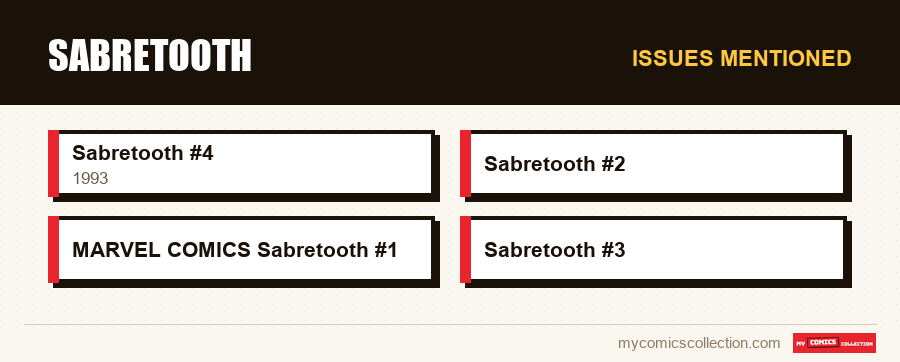
Among the five cheapest ads in the survey, two include the constraint in their very title: “Sabretooth #4 (Marvel 1993) $5 minimum purchase required” at $1.00, and “Sabretooth 2 1993 $5 minimum purchase required” at $1.25. The condition is not hidden in a legal notice: it is in the title, therefore in what the statement reads.
One dollar displayed, five dollars committed
To get the $1.00 copy, one must reach a five dollar order from this seller. The real minimum spend is therefore not one dollar but five. The figure read and the figure disbursed differ by a factor of five, and no line in the statement indicates this to anyone who does not read the titles.
Unconditional low announcements also exist
Three of the five cheapest listings carry no such mention: “Sabretooth #2 1993 [...] Larry Hama Mark Texeira Cover” at $1.00, “MARVEL COMICS Sabretooth #1” at $1.50 and “Sabretooth #3 [...] (VF)” at $1.50. The mechanism is therefore not systematic: it is simply frequent enough to distort the reading of the bottom of the range.
An invisible constraint for automatic calculation
A process that retains only the numerical amount of each line will record $1.00 and $1.25 as copy prices. It will place at the same level an independent offer and a fraction of a grouped order. The two figures look similar; the two commitments have nothing to do with each other.
The effect is mechanical and it pulls in only one direction. A seller who imposes an order floor can afford to display very low unit prices, since he will never sell a single part anyway. Its interest is even to display low: this is what catches the eye in a list sorted by increasing price. The least expensive ads in a survey are therefore structurally those where the probability of meeting a basket condition is the highest. The lower bound is not biased randomly: it is biased downward, systematically.
An amount with a minimum purchase is not comparable to an amount without conditions. The first describes an order share, the second describes a complete transaction. Adding them in the same calculation amounts to mixing two different units of measurement in the hope that the average makes sense.
The question to ask when faced with any lower limit is not “is this price credible?” » but “is this price achievable alone? ". On this statement, for two of the five lowest offers, the answer is no.
What the display systematically leaves out
Shipping does not appear anywhere
None of the labels noted mention shipping costs, neither for low advertisements nor for others. The statement therefore contains absolutely no shipping data. We cannot quantify its weight; we can only note that it is added to the amount displayed and that it is absent from all the numbers cited here.
A single photograph, no movement
August 30, 2026 is the only measurement date. There are no previous values in this reading, so no comparison possible. Any sentence like “the price has changed” would be a pure extrapolation, without support in the data presented.
Complaints, not sales
The 161 ads are current offers. They say what sellers hope to get. They say nothing about what buyers agreed to pay, since no transaction conclusion is recorded in this dataset.
A lot disguised as a unit
An ad conditional on a basket is in reality a lot offer whose composition remains to be defined by the buyer. It is presented line by line, which makes it impossible to distinguish from a unit sale if you only read the numbered columns.
Different numbers in the same query
The low advertisements cited relate to numbers 1, 2, 3 and 4. The request aggregates several distinct sections. A minimum, a median and a maximum calculated on this set describe a family of objects, not a precise object, and this is worth keeping in mind before any detailed reading.
The declared state, without an arbiter
A condition stated in a title is a representation by the seller. The eleven announcements made by a verification body are counted separately for this precise reason, but their number is too small for a reference price level to be drawn from them.
Why, at these amounts, the purchasing logic becomes that of the lot
When a number claims to be a dollar fifty, the difference between two copies is no longer the determining factor in the expense. Fifty cents difference on a piece is a variation that disappears in any shipping cost. This is not an opinion on the market, it is an arithmetic consequence: as soon as the fixed cost of sending exceeds the difference between two offers, comparing these two offers individually loses its practical interest. The statement does not provide any shipping figures, so we cannot say at what threshold exactly this occurs; we can say that in a series where several numbers cost between one and two dollars, the room for maneuver is slim.
This explains the rationality of the seller who imposes a five dollar order. At these levels, shipping a single part doesn't make economic sense for him either. The minimum purchase is not a trap: it is the explicit admission that the relevant unit of transaction is not the copy but the package. The seller says it in his title, which is more honest than many configurations where the constraint only appears when confirming the order.
For the buyer, the consequence is twofold. On the one hand, five copies of a series that costs a dollar each is not a bad operation: it is often even the least expensive way to move forward on an entire series. On the other hand, it's not the decision we thought we'd make. We thought we were buying a missing number; we actually buy a block of which four out of five pieces were not in the program. The difference is not financial, it is methodological: it changes what we look for, and therefore what we find.
This switch to batching has a secondary effect on bookkeeping. A bulk order arrives with a global amount and a single shipping cost. Then assigning a price to each piece requires a convention, and this convention must be the same from one purchase to another, otherwise the lines of the collection become incomparable with each other. It's a problem of method, and it arises exactly at the moment when you think you've got a good deal.
The same reasoning applies to other series in the same editorial environment, where abundant issues rub shoulders with a few much more requested issues. The reader who wants to situate Sabretooth within the larger picture will find useful context in Wolverine's story in comics, while locating the issues actually sought in this family of titles is another exercise, detailed on the side of the numéros clés de Wolverine.
Collecting this series?
Track what you own, what you are missing and what your collection is worth. 7 day trial.
Start my trial →Read a fork without getting trapped by its ends
A price range has three notable points and two of them are unreliable. The maximum reflects individual hope. The minimum, as we have just seen, can reflect a basket condition rather than a price. There remains the central value, here $6.50 on 161 unverified listings, which has the advantage of being insensitive at both ends: whether a seller displays $225.00 or $2,250.00 does not move it by a cent, and the same goes for the one-dollar line matching its condition.
This does not make the median a truth. It remains a median of complaints, not sales. It remains calculated on a query that mixes several numbers. It remains dated only August 30, 2026. But it is the least distorted point of the three, and it is the only one of which we can say that it reasonably summarizes the observed display rather than its accidents.
On the verified side, none of these precautions are enough. Eleven announcements are not a sample, they are a handful of observations. The fact that the central value is established at $94.00 describes these eleven lines and nothing more. It would be imprudent to deduce a price level for verified copies in general, and this imprudence would be invisible: the figure looks like a result, it only has the solidity of its strength.
The most honest reading of this statement therefore takes place in three sentences. There is, at this date, an abundant and cheap supply of these booklets, part of which is only accessible by putting together a basket. There is a much more expensive verified offer, but too few to characterize. And there is nothing in this dataset to tell which way anything is moving.
What to save in your collection after a purchase of this type
The price to be recorded is that actually paid, including shipping. Neither the amount of the announcement, nor the median of the statement, nor the central value of the verified copies. If the seller imposed a five-dollar order, the total paid includes this constraint; if shipping has been invoiced, it is part of the acquisition cost in the same way as the part. A collection line that notes $1.00 for a copy obtained after an order of five dollars plus fees records false information, and the falsehood will never be seen since the figure corresponds to something that was displayed.
A group purchase is distributed according to a rule written once and for all. Five copies for a single total raise a question of breakdown: in equal parts, or in proportion to the unit amounts announced, shipping costs distributed in both cases. It doesn't matter which convention is chosen, as long as it is always the same. Changing method between two orders makes the collection incomparable with itself, and this defect can only be repaired by resuming all the purchases concerned one by one.
The date of the purchase matters as much as the amount. A price without a date is orphan data. As this statement shows, an isolated measurement does not allow any reading of evolution; it is the accumulation of dated points, those of your own acquisitions, which ends up producing one. Each time-stamped line today is a point of comparison available later, and this is where keeping a collection takes on an interest that goes beyond inventory.
The nature of the offer is worth noting alongside the price. Single purchase, purchase under basket conditions, batch composed by the seller: these three situations produce unit costs which cannot be compared. A short mention at the time of entry, a few words are enough, saves an impossible reconstitution six months later, when all that will remain of the context is the number.
The retained statement must distinguish what has been declared from what has been verified. The statement counts apart from the eleven announcements made by a verification body, precisely because a state attested by a third party and a state announced by a seller are not of the same nature. The same distinction applies in a collection: recording the origin of the appreciation avoids later treating a commercial declaration as an established observation.
In the statement of August 30, 2026, the condition appears directly in the title of the announcement, in the form of an explicit mention of the minimum order amount. This is the most favorable case: the constraint is readable even before opening the page. There is no guarantee that it will always be displayed so visibly, and the three other low advertisements in the survey bear no trace of it. The useful reflex therefore consists of reading the full title rather than just the price column, and checking the offer page when an amount seems abnormally low compared to the rest of the list.
It corresponds to the central point of the 161 unverified advertisements noted that day, which is not the same thing. These announcements are requests from sellers, not completed sales, and the request aggregates several issues of the series rather than a single issue. The median nevertheless has the advantage of not moving when a seller displays $225.00 nor when a one dollar line hides a basket condition. This is the least distorted benchmark in the statement, provided you read it as a display summary and not as a market price.
It is based on eleven announcements, which is too few to establish a price level. With such a small workforce, the arrival or departure of two offers shifts the central value without any market reality having changed. The announced range, from $44.95 to $400.00, also shows a very wide dispersion on this small number of lines. The reasonable conclusion is that nothing can be concluded about this segment from this statement, and it is better to say it than to produce a reassuring-looking figure.
The statement doesn't say that. None of the wordings cited mention shipping costs, and therefore there is no numerical basis for responding. What we can say without inventing anything is that this cost exists, that it is added to the amount displayed, and that it is absent from all the numbers presented here: minimum, median and maximum included. On issues priced between one and two dollars, even a modest delivery cost weighs proportionately heavy, which is enough to explain why these purchases are naturally made in packages.
Neither, and the question is not answered in this data. The reading was taken only once, on August 30, 2026; there is no second measurement point to compare it to. A single observation describes a state, never a movement. It would take at least a second statement, built on the same query and using the same method, to start talking about direction, and even then it would be about display directions, since these are requests from sellers and not completed transactions.
Record what you paid, not what was displayed
A group purchase, shared shipping costs, a basket condition forgotten three months later: without a written record, the real cost of your collection becomes irrecoverable. My Comics Collection allows you to record each acquisition with its actual amount, date and context, issue by issue, so that your own figures remain comparable with each other.