French publishers in the 1980s and 1990s didn't just translate the bubbles: they renamed the characters. The same hero therefore circulated among us under a label which in no way resembles his original name, and second-hand advertisements today use one, the other, or both. The statement made on August 30, 2026 on the market French, in euros: and not on the American market like most of the statements published here: concerns the query « Semic Wolverine version integrale »: 77 online advertisements, a floor at €2.00, a median at €4.00, a ceiling at €22.00, and zero copies verified by an independent organization. The five cheapest ads all have a French name attached to the American name, from « Serval Wolverine Version Intégrale (1989) n° 5 SEMIC » at €2.00 to numbers 35 and 36 at €3.00. These amounts are prices claimed to this date, no transactions concluded, and a single measurement says nothing of an evolution.
The question seems trivial and yet it decides what you see of the market. When a French-speaking collector types the American name of a character into an ad search engine, he obtains lots whose seller took the trouble to write that name. All the others: those who describe their booklet with the name under which it was published in France, the one which appears on the cover, the one they have known since adolescence: remain out of the field. The collector does not notice anything abnormal: his search returns results, they seem plausible to him, he draws conclusions about availability and prices. He simply ignores that he is looking at a fraction of the market that concerns him.
The August 30, 2026 statement allows us to put a figure on this mechanism without overinterpreting it. Of the 77 ads responding to the query, the five least expensive: from €2.00 to €3.00: all have a title where the French name precedes or follows the American name, separated by a space or an oblique slash: “Serval Wolverine”, “SERVAL / WOLVERINE”. These sellers have made, consciously or not, the gesture which makes them visible on both sides of the lexical border. There is no indication that the entire market does this. Five titles are not a sample, and I am careful not to draw a rule from them: what they show is that a practice exists, not that it dominates.
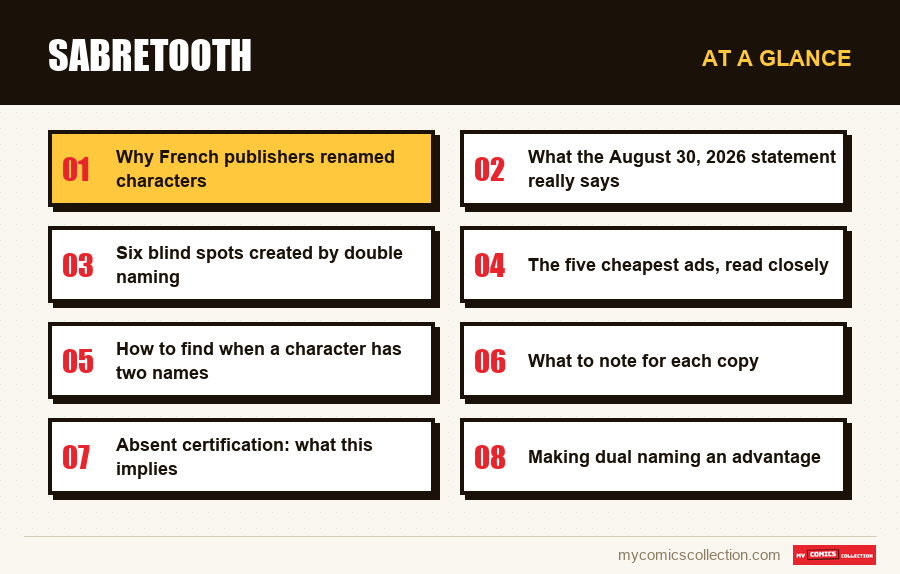
Why French publishers renamed characters
The translation of proper names was not an isolated fantasy: it was an editorial convention. An American hero's name is often based on an animal, a metal, a moral quality or a play on words that only works in English. Leaving it as is, in a magazine intended for a young readership who had not yet learned English in primary school, amounted to depriving the cover of its power to attract attention. The editors were therefore looking for an equivalent that evoked the same thing in our language: sometimes by meaning, sometimes by sound, sometimes by an association of ideas which only depends on the culture of the translator.
The result is a name that bears no phonetic relationship to the original. It is not a transcription, a spelling adaptation or a diminutive: it is another word. No fuzzy matching algorithm, no tolerance for typos in a search engine will bring the two strings together. For the machine, these are two unrelated objects. Only an informed human knows that they refer to the same creature.
This convention lasted long enough to leave decades of publications behind it, then was abandoned when the globalization of franchises made the original name more recognizable than its local version. We therefore find ourselves with two layers of publishing superimposed on the same second-hand market: old booklets, printed with the French name on the cover, and more recent reissues bearing the American name. The seller describes what he sees. The buyer looks for what he has in mind. The two only meet by accident.
We need to measure what this actually changes. A search is a filter, and a poorly set filter does not return an error: it returns fewer results, without reporting it. This is the most discreet form of blind spot. You think you have explored a segment when you have only consulted part of it, and you conclude that this number is rare or that this price is the market price.
What the August 30, 2026 statement really says
77 ads, a floor at €2.00
The query “Semic Wolverine full version” returns 77 active proposals on August 30, 2026 on a French general auction site. The lowest amount requested is €2.00. This is a price displayed by a seller, not the price at which a copy changed hands: the distinction is crucial and applies to all the figures on this page.
A median of €4.00
The median value of the amounts claimed is €4.00. In other words, half of the ads ask for less than that. In this segment, the barrier to entry is that of a new magazine on newsstands, which makes it the least expensive gateway to this character for a French-speaking reader.
A maximum of €22.00, isolated
The highest amount on the statement reaches €22.00. A single ceiling is not a price level: it reflects the hope of a seller at a given moment, on a lot whose content, condition or number of issues escapes us. I don't give it any reference value and neither should you.
Zero copies verified
None of the 77 advertisements offer a copy passed by an independent verification body. Certification is simply absent from this segment. The condition is therefore assessed solely on the description written in French by the seller, without a standardized scale behind the words used.
These four findings form a coherent portrait: an abundant, cheap, uncertified market, and described in a language whose state vocabulary is not standardized. Each of these features arises from the same editorial fact: these are local periodicals, printed in numbers, intended for reading and not for conservation, and never entered the circuit which gave rise to American-style certification. This is neither a fault nor a boon: it is a different market regime, which requires different reflexes.
Method reminder: the 77 announcements were observed on a single date, August 30, 2026. A snapshot shows no movement. There is nothing here to support the assertion that these amounts are rising, falling or stagnating, and any sentence you read elsewhere to this effect based on a single statement would be an extrapolation.
Second reminder: the statement relates to the French market and the amounts are in euros. The orders of magnitude published here for American markets, in dollars, are not comparable: neither the network of sellers, nor the description practices, nor the presence of certification are similar from one country to another.
Six blind spots created by double naming
Unilateral research
Questioning the market with the American name alone automatically rules out any ad written with the French publication name, and the opposite is just as true. The remedy is mechanical: systematically launch the two requests, one after the other, and consider that until you have done both you are not finished.
The year missing from the title
An ad like “Serval Wolverine Complete Version (1989) No. 5 SEMIC” bears its vintage, another does not. On a publication which extends over several years: the survey contains issues dated 1989 and 1991 - the absence of a year prevents the issue from being placed in the series and makes the identification incomplete.
The name of the character confused with the title
Here, the name of the hero and the title of the publication coincide, which hides a general pitfall: there is no guarantee that a magazine bears the name of its main character. When they differ, searching for the character does not find the title, and searching for the title does not find the character.
The state described in free French
Zero copies checked out of 77 listings means condition qualification is based entirely on the seller's words. No common scale connects these words to a recognized rating, and two sellers can use the same adjective for two very different realities.
Local numbering
The number printed on a French periodical is that of this publication. It does not correspond to the original series number, since the cutting of the content belongs to the local publisher. Confusing the two numberings produces inventory sheets which do not designate any real object.
The format statement
The formula “full version” appears in all the advertisements noted. It is an editorial characteristic, therefore a search criterion in its own right: omitting it unnecessarily broadens the results, misspelling it or accentuating it differently from the seller's entry reduces them just as much.
The five cheapest ads, read closely
Looking at exact titles is better than reasoning on averages. The floor of the statement, at €2.00, corresponds to “Serval Wolverine Version Intégrale (1989) n° 5 SEMIC”. Then come four proposals at €3.00: two consecutive issues from 1991, 10 and 11, written “SERVAL / WOLVERINE N 10 ÉDITIONS SEMIC 1991 [...] VERSION INTEGRAL ".
Three lessons emerge from these five lines. First, the double name: each associates the French name with the American name, which makes them accessible whatever the query used by the buyer. Then, the irregularity of the form: slash or space, capital letters or mixed case, “N 10” or “N°35”, parentheses or not, year present or absent. No standards are imposed on sellers, and this heterogeneity is itself an obstacle to research. Finally, the proximity of the numbers: two consecutive pairs appear at the bottom of the ranking, which suggests lots from the same collections dispersed at retail, without my being able to demonstrate this based on five observations.
I repeat the warning because it is easy to forget: five announcements do not prove a market practice. They establish that a use exists and that it is adopted by the cheapest sellers in the statement on that date. Nothing more. A collector who concludes that "sellers always put both names" would deprive himself of precisely the advertisements which do not do so: that is to say, those which this reasoning was supposed to allow him to find.
The fact remains that these amounts are insignificant compared to the rest of the hobby. Two to three euros, postage not included, gives access to full numbers. For a French-speaking reader who wants to discover a character before investing in more expensive editions, this is the cheapest entry route that exists on this name. This observation is valid for reading, not for speculation: nothing in a single statement allows us to anticipate anything about the future of these amounts.
Collecting this series?
Track what you own, what you are missing and what your collection is worth. 7 day trial.
Start my trial →How to find when a character has two names
The central gesture can be summed up in one sentence: never launch a single request. For any character that you know or suspect has been published in France under another name, the minimum search includes two passes, one by name, to which is added a third combining the two, since savvy sellers put them together. The three do not return the same results and the union of the three only approaches the real market.
Add to this the writing variations. The titles noted show accents sometimes present, sometimes absent: the request itself, “Semic Wolverine full version”, does not have an accent while the advertisements do. Number abbreviations vary. Case varies. A general ad engine tolerates some of these differences, not all, and there's no telling you which ones. Multiplying the formulations costs a few minutes and reveals batches that a single query would never have shown.
The name of the French publisher constitutes the third pivot. It appears in the five cheapest ads and it acts as an effective filter: it eliminates foreign reissues and focuses the results on the local publication you are interested in. Combine it with the mention of format when it exists, such as “full version” here, and you obtain a query that is both narrow and reliable.
Finally, keep in mind that this double research work applies to other characters in the same universe. If you build a collection around a hero whose allies and adversaries have also been renamed at the time, each affected name opens its own pair of queries. OUR Sabretooth reading guide helps you establish the list of series to cover before embarking on this research, and the identification of Wolverine key numbers tells you which ones deserve the most attention.
What to note for each copy
The French publication name AND the reference name. A card that only bears one of the two becomes unusable in half of the situations. Write the name printed on the cover of your copy, the one under which it actually appeared, and, in a separate field, the character's original name. The first allows you to recognize the physical object when you have it in hand; the second allows you to link it to the rest of your collection and find it in a catalog.
The exact title of the French publication. Copy it as it appears on the booklet, including format notes. “Full version” is not a comment added by the sellers, it is an element of identification of the publication, and it appears in all the advertisements noted. An approximate title in your inventory will force you to reopen the box to remove doubt.
The number and year of this issue. The statement mixes issues from 1989 and 1991, a No. 5 and Nos. 35 and 36: the same publication spans several years and its numbering is its own. Note the printed number and the year of printing together, never one without the other, and never confuse them with the numbering of the original series, which follows a different logic.
L'éditeur français. It was he who decided on the name of the character, the division of content and the format. Without his name in your file, two issues bearing the same number and published by different houses become indistinguishable on paper. It is also the most discriminating search key when you want to complete the series.
The price paid, shipping included. In a segment where the median is €4.00 in claimed amounts, shipping costs often weigh as much as the item. Recording the price excluding shipping gives a false picture of what your collection cost you. Note the amount actually debited, in euros, with the date: this is the only data you will have and which corresponds to a concluded transaction rather than a request from the seller.
Absent certification: what this implies
Zero copies checked out of 77 ads is not a statistical coincidence, it is the description of a segment. The cost of an independent verification would far exceed the value of the objects concerned: no one certifies a booklet displayed for two euros. The practical consequence is that no third party will intervene between the seller's description and your judgment.
You must therefore read the descriptions differently. The French words used to qualify the state do not have a shared definition and do not convert into a note. The same formula can cover a flexible but complete copy in one, and a copy barely holding together in another. What matters more are the verifiable elements: the number of photographs, their clarity, the presence of the back and the edges on the photos, the explicit mention of the defects. A seller who accurately describes a defect is more reliable than a seller who does not mention any.
The absence of certification also has an effect on price formation. Without a recognized rating, nothing objectively prioritizes two copies of the same number, and the difference between the floor at €2.00 and the ceiling at €22.00 cannot be explained by quality alone. It may reflect a multiple lot, an exceptional condition, a simple error of judgment by the seller, or the tenacious hope of someone who has time. On an isolated observation, I have no way of deciding and I do not claim to do so.
This configuration is not unique to this character. It characterizes the French periodical publishing of an entire era, and is found as soon as we look at local publications resulting from the great mutant narrative. The context of the original series, traced in our history of the X-Men in comics, sheds light on what these fascicles covered and in what order they proposed it to the French public.
Making dual naming an advantage
An obstacle known only to you becomes an advantage. Most buyers query the market with the name they saw in the movies or on a recent cover. Advertisements written only with the French publication name therefore receive fewer visits, and the items they offer stay online longer. There is no guarantee that they are less expensive though, that would be an inference that my data does not support, but they are, at the very least, less competitive.
Symmetrically, if you one day sell part of your collection, the lesson of the five announcements noted is directly applicable: writing the two names in the title makes your lot visible to both audiences. It costs nothing and doubles the search surface on which it appears. Add the publisher, year, issue, and format statement, and you will have written a title that answers almost every query an informed buyer can make.
Finally, draw a sustainable inventory rule from this. Each time you discover that a character has circulated under two names, it is not an anecdote to remember mentally: it is information to record in your database, next to the character file, so that your future research starts immediately on both tracks. Memory erodes, a field filled in does not. For entry-level purchases, our overview of ways to buy Wolverine without breaking the bank completes this approach with price.
Frequently asked questions
The following answers the points that come up most often when a collector discovers that the same character has two names depending on the country of publication, and that his searches for advertisements until then only showed him part of the available market.
Because it was not a question of transcribing a sound but of finding an idea. The translators were looking for a French word that evokes something to the reader, even if it means completely abandoning the original sound. The two strings having no significant common letter, no search engine will bring them together: only a human who knows the equivalence can make the link.
The statement of August 30, 2026 on the French market gives, for 77 advertisements, a minimum of €2.00, a median of €4.00 and a maximum of €22.00. These are amounts requested by sellers on this specific date, not sales concluded. A single measurement says nothing about a trend, and the isolated maximum reflects a seller's expectation rather than a market level.
Both, separately, then both together. The five least expensive listings in the survey have the two names next to each other, which makes them visible whatever the query, but there is no proof that all sellers do this. An advertisement written with a single name escapes anyone looking for the other: only the combination of queries approaches the real market.
None out of the 77 advertisements noted. Verification by an independent body is absent from this market, which can be explained by the relationship between its cost and the value of the objects. The condition is therefore judged on the seller's free description, written in French without a standardized scale, and on the quality of the photographs provided.
The name under which the copy appeared and the reference name of the character, in two separate fields; the exact title of the French publication with its format notices; the number and year of this issue; the French publisher; and the price paid including shipping. Without the publication name, your file no longer corresponds to the object you are holding; without the reference name, it stands out from the rest of your collection.
Keep both names in the same file
An inventory that distinguishes the publication name from the reference name saves you from searching twice for the same issue and repurchasing an issue that you already have under another label. My Comics Collection allows you to record title, number, year, publisher and price paid for each copy, in French and English.