Royal City has 14 issues published by Image between 2017 and 2018, written and drawn by Jeff Lemire. A family reunites in a declining industrial town, and each member is haunted by the same dead brother, but at a different age. This is the book where Lemire returns to the register of Essex County after ten years of genre series, in color this time, and with a more ambitious construction.
Royal City has 14 issues published by Image between 2017 and 2018, written and drawn by Jeff Lemire.
It is the least read title in his recent bibliography, and probably the most unjustly neglected. Stuck between Descender et Black Hammer, released without a television adaptation or extended universe, it was overshadowed by more spectacular series. This article explains what it contains, why its construction is remarkable, and who to recommend it to.
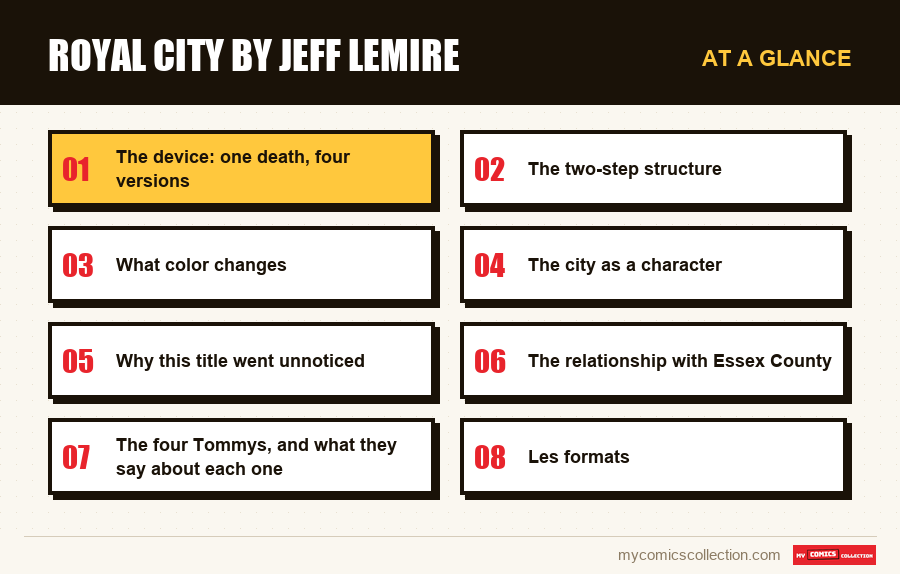
The device: one death, four versions
The Pike family lives, or has lived, in Royal City, a town of closing factories. The father has a stroke, which brings his scattered children together. Patrick is a successful novelist and no longer writes anything good; Tara works for the factory and negotiates its closure; Richie sinks into addiction.
Each of them sees Tommy, the youngest brother, who died from drowning in 1993. He is not a ghost in the usual sense: he does not appear to everyone at the same time, he does not deliver any message, and above all he is not the same age depending on who sees him. The mother sees a child. Patrick sees a teenager. Richie sees a man the age he would be today.
The device is simple to state and formidable to use: each character carries a different version of the same mourning, and the reader gradually understands that these versions are incompatible. Someone is lying, or rather: everyone made arrangements with what happened that night.
The two-step structure
Première partie: 1993
The first issues alternate between the present and the summer of Tommy's death. We discover a family still whole, and a city still alive. The contrast with the present does all the emotional work without any character having to comment on it.
Seconde partie:Sonic Youth
The series changes titles along the way, which confuses readers who are looking for it on the shelves. It's the same story, which switches entirely to the summer of 1993 to tell what really happened.
Le nœud
The series does not reserve a final twist: it distils the information in such a way that the reader reconstructs the event before the characters admit it to each other. The tension comes from this gap, not from a kept secret.
What color changes
This is the first time that Lemire has drawn a long series in color, and the choice is structuring.
The 1993 sequences are treated in warm, saturated tones: summer, the river, rock band t-shirts. The present is faded, gray-green, under factory light. The process is not original in itself; what is, is that it reverses the convention. Usually, the memory is sepia and the present is sharp. Here, the past is more alive than the present, which is exactly the characters' problem.
His features do not change: always trembling, always unstable. On a story of mourning and memory, this imprecision means that the faces of 1993 and those of today resemble each other enough that we sometimes hesitate about the time in which we find ourselves. This is the same effect as in Ghost Stories, employed here with ten more years of experience.
The city as a character
Royal City is a fictional town in southern Ontario, the same region as Essex County. Lemire transposes what he knows: deindustrialization, young people who leave, those who stay and who experience it as a failure.
The factory that closes
It is not a social setting added to make it serious. The closure advances in parallel with the family story, and the two collapses respond to each other: a city and a family which have lost their reason for being at the same time.
1993, precisely
The year is not chosen at random. It places the characters' adolescence in an identifiable cultural moment, and Lemire uses it to date without explaining: a cassette, a t-shirt, a cover are enough.
The river
Location of the drowning and geographic center of the city. She crosses almost all the important scenes, in both eras, without the story ever emphasizing symmetry.
The writer brother
Patrick writes about his family without saying it, and his novel in progress contaminates the story. This is the most self-reflective part of the book, and Lemire carefully avoids making it into a twist at the end.
Why this title went unnoticed
Three concrete reasons, which also explain why it is easily found second-hand today.
The title change during the series. Move from Royal City à Sonic Youth for the second half disoriented in-store shoppers, and further confuses online searches. Many readers are unaware that the sequel exists.
The absence of gender. Descender sells like science fiction, Gideon Falls like horror, Black Hammer like superheroic. Royal City has no shelf. It's a family drama, which remains the most difficult box to sell in American comics.
The calendar. The series appears while Black Hammer becomes the phenomenon we know, with an irregular publication rhythm. She never got the attention of a launch.
Practical consequence for the collector: it is one of the rare recent titles by Lemire that can still be found at a reasonable price in second-hand collections, including complete ones. The series best exposed:Sweet Tooth, Black Hammer: saw their first numbers climb; Royal City remains accessible.
The point of vigilance is elsewhere: because of the change of title, an announcement “Royal City complete” sometimes refers to the only issues published under this name, i.e. half of the story. Always check that all 14 numbers are there.
Collecting this series?
Track what you own, what you are missing and what your collection is worth. 7 day trial.
Start my trial →The relationship with Essex County
The two books share so much that one can read Royal City like a cover, ten years later, with the means of the author who became a professional.
Same elements: the lost brother, the Ontario countryside, the family that does not speak, sport or music as the only possible language between men. Same processes: temporal shifts without explicit reference, long silences, deliberately imperfect drawing.
What changes is the construction. Essex County is made up of three juxtaposed stories that a third part late connects: an authorial architecture that learns. Royal City takes place on a single device, held over 14 issues, where each character carries an incompatible version of the same event. It's more controlled, and undoubtedly less upsetting: control has a cost.
For a reader who liked Essex County, this is the most obvious recommendation in the entire bibliography. For someone who discovered Lemire through Black Hammer ou Descender, it is the best bridge towards its intimate side: more accessible than Essex County, because in color and better rhythm.
The four Tommys, and what they say about each one
The heart of the book lies in an idea that Lemire never explains and which alone makes sense: the version of Tommy that each character sees is a self-portrait.
La mère sees a ten-year-old child, the age at which she still feels useful: the age when a son needs his mother. His version of Tommy barely speaks and demands attention.
Patrick, the writer, sees the adolescent he knew at the time when he himself wrote his first things. This Tommy is sarcastic and judgmental: it's the critical voice that Patrick needs and can't stand.
Tara sees a slightly older boy, silent, present at the moments when she decides something. She is the one who stayed and who manages the closure of the factory: her dead brother watches her work.
Richie, the addict, sees the man Tommy would have become-thirty-five, scarred, the one who could have lived the life Richie wasted. This is the cruelest version, and it is his.
The process makes the reader learn more about the living than the dead. Tommy never has his own personality: he is just a mirror. When the series finally reveals what happened in 1993, the effect comes not from the information itself but from what it forces everyone to abandon from their version.
Les formats
The series exists in 14 softcover issues and three collections. There is no large format deluxe edition to date, which simplifies the purchasing decision, and also explains part of its discretion on the shelves.
Collections are the obvious choice for reading. Be careful, however, with the division: the volumes do not fit on the break between the two titles, so much so that a collection can contain the end of the first part and the beginning of the second. It's consistent for reading, but confusing if you're trying to match volumes and titles.
French editions existed with their own pagination. As with the rest of the work, do not mix languages on the same series: the number ranges do not coincide, and you will end up with a hole or an overlap.
Cataloging a series that changes name
Royal City is the textbook case of the problem posed by collecting by title rather than by number. A shelf that contains “Royal City, Volumes 1 to 2” may be complete or cut in half, depending on whether the series was registered under one or two names.
The only reliable method is to record the original numbers, 1 through 14, and treat the title change as ancillary information, not a boundary. This is what allows, two years later, to answer in one second the question “do I have the end?” ”, to which a shelf never responds.
Frequently asked questions
The second half appears under the title Sonic Youth, which corresponds to the complete shift of the story in the summer of 1993. It is an editorial choice consistent with the content, but which really harmed the visibility of the series: many readers are unaware that the sequel exists under another name.
Yes, it ends at issue 14 with a full conclusion. There is no sequel or spin-off series. It's a finished story, which makes it a no-obligation purchase: unlike Black Hammer by the same author.
No, the two books are completely independent and share no characters or locations. Having read them both enriches the reading, because we see an author returning to his obsessions with ten more years of experience, but the order doesn't matter.
No, despite the presence of the dead brother. The book never decides between apparition and mental projection, and this ambiguity is the subject rather than a mystery to be solved. This is a family drama, not a ghost story.
By checking that all 14 numbers are covered, regardless of the title displayed. A “complete series” announcement may only refer to issues published under the name Royal City, or half of the story. The original number is the only reference that does not mislead.
A title that changes, a collection that remains clear
Save your issues rather than your volumes, and always know if the series is complete.