
Essex County is the trilogy that made Jeff Lemire known, published by Top Shelf between 2007 and 2008. Three linked stories:Tales from the Farm, Ghost Stories, The Country Nurse: located in the rural Ontario county where the author grew up. This is the book to enter if you want to understand where all the rest of his work comes from.
Essex County is the trilogy that made Jeff Lemire known, published by Top Shelf between 2007 and 2008. Three linked stories set in the rural Ontario county where the author grew up.
It is also the book most poorly served by its summary. “An orphan child, two estranged brothers, a country nurse” says nothing of what the reading produces. This article details what each part contains, in what order to read them, what editions exist, and why this book occupies a special place in North American comics of the 2000s.
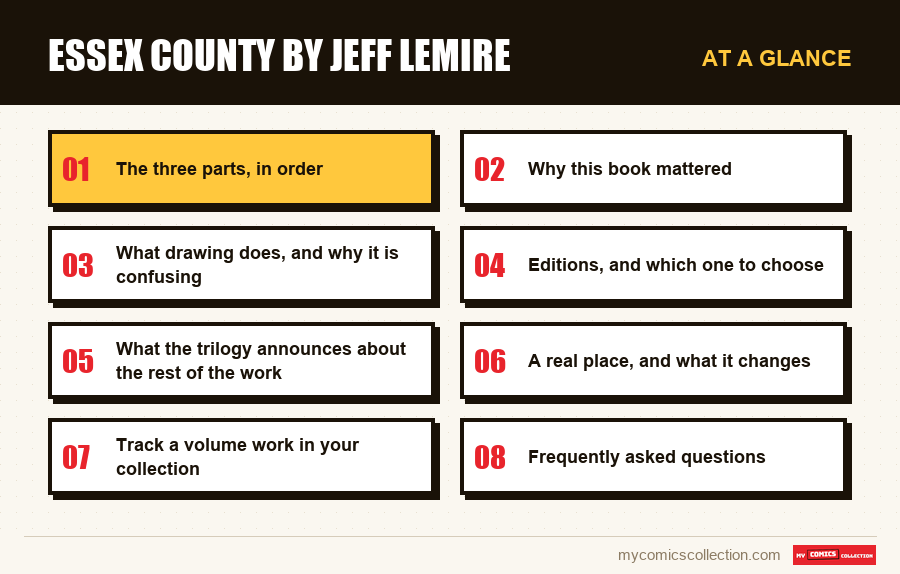
The three parts, in order
The trilogy is read in order of publication. This is not a preference: the third part only works if you have read the first two, because it connects characters that you thought were unrelated.
1. Tales from the Farm (2007)
Lester, ten years old, has just lost his mother. He lives with his taciturn uncle Ken on a farm in the county. The child never takes off his superhero mask and bonds with Jimmy Lebeuf, a former hockey player turned gas station attendant, whose brain was damaged by an impact on the ice.
This is the shortest and most direct part. It establishes the county as a place where we don't talk about what matters.
2. Ghost Stories (2007)
The heart of the trilogy, and by far the longest. Lou Lebeuf, an old deaf man in a retirement home, looks back on his career as a professional hockey player with his brother Vince, and on what separated them for good.
The story alternates present and memories without explicit transition. It is there that Lemire finds the construction which he will then reuse in Royal City et Roughneck.
3. The Country Nurse (2008)
Anne Byrne, traveling nurse, makes her rounds. Each visit revisits a character from the first two parts, and a story dating back to the fire of an orphanage in 1917 ties the whole thing together.
The part that turns three separate stories into one book. Read in isolation, it seems disjointed; read third, it closes everything.
Why this book mattered
Essex County comes at a time when adult North American comics are largely urban and autobiographical. Lemire takes the opposite view: campaign, fiction, hockey, silence. The book was selected in the “Canada Reads” selection of Canadian public radio in 2011: a general literary competition, where a comic strip had no place according to many. She went through with it until the final stages.
This recognition outside the comics field explains part of its availability today: the book is in general bookstores, not just in specialized stores. This is also what makes it a good gift for someone who “doesn’t read American comics”.
What drawing does, and why it is confusing
It must be said frankly: many readers give up on the third page. The line is black and white, shaky, the proportions are unstable, the faces are sometimes barely outlined. On an isolated board, the impression is that of unfinished work.
It works on the scale of the story, not the image. Three concrete reasons:
White as a landscape
The snow, the frozen fields, the ice of the skating rink occupy entire, almost empty pages. The void is not an economy of means: it is the county itself, and the mental space of the characters.
Silence as dialogue
Entire sequences do without text. In characters who don't know how to say what they feel, the absence of bubbles is the point, not a shortcut.
The line as memory
The imprecision of the drawing makes present and memory look alike. This is what allows Ghost Stories to switch from one era to another without warning, and without getting lost.
The mask as confession
Lester doesn't take off his superhero costume. Lemire, who would later write for Marvel and DC, places the genre in its rightful place here: a child's shelter, drawn seriously and without irony.
Editions, and which one to choose
This is the practical point that gets stuck the most, because the book exists in several forms and the titles do not make it clear.
The three separate volumes, as published by Top Shelf between 2007 and 2008. They are found second-hand, often mismatched. Limited interest unless you are looking for the first printings for their own sake: the reading is identical, and bringing together the three generally costs more than the complete one.
The complete The Complete Essex County, which brings together the three parts into a single object, with pages of sketches and additional short stories. This is the preferred edition for reading: the book was designed as a whole, and reading it in one sitting is what does it justice.
French editions. The title circulated in French, but with irregular availability depending on the period. Check before purchasing that the volume offered contains all three parts: some editions have appeared in separate volumes, and a reader who only has the first part will not understand what we are talking about.
The rule that avoids the most common error: do not mix formats on this work. A collector who owns Tales from the Farm in a separate volume and then buys the complete book and finds himself with the first part in duplicate, without the catalog of his store having informed him of this. Decide first, separates or whole, then stick to it.
What the trilogy announces about the rest of the work
Almost everything Lemire writes next is already there, in embryo. This is what makes the book useful even to those who discovered it through Sweet Tooth ou Black Hammer.
The absent or failing father crosses Sweet Tooth, Descender, Royal City et Gideon Falls. He was born here, with Uncle Ken and Lester's father.
The lost brother structure Ghost Stories, then return to the center of Royal City: to the point that we can read the latter as a color repetition of the same knot.
Hockey is not a local setting. It is at Lemire's place where men talk to each other without speaking, and where what they will never say is played out. It is found intact in Roughneck.
The closed rural community will become the farm of Black Hammer, from which superheroes cannot escape. The connection seems distant until you read both: it's the same trap, with capes.
Collecting this series?
Track what you own, what you are missing and what your collection is worth. 7 day trial.
Start my trial →A real place, and what it changes
Essex County exists. It is the southwestern tip of Ontario, the southernmost part of inhabited Canada, an agricultural area wedged between two lakes and bordering Detroit. Jeff Lemire grew up there, in a farming family, before leaving to study cinema in Toronto.
This origin is not a biographical anecdote: it explains why the book escapes the trap of picturesque regionalism. Lemire does not describe a countryside seen from the city. It does not feature folklore or local color, and its characters are never presented as curiosities. The farms are emptying, the young are leaving, the old are staying: it's an observation, not an elegy.
This refusal of the picturesque produces an unexpected effect when reading: the county ends up resembling any countryside in decline, whatever the reader's country. Many French readers recognize things in it that they did not expect from a book on Ontario hockey.
This is also what distinguishes Essex County of his direct successors. Royal City, published ten years later, takes up the declining industrial city, but with a more constructed plot and color drawing. Roughneck takes on hockey and alcohol, but harder and more explicit. Neither of them quite finds the simplicity of the first: which is perhaps the definition of a successful children's book.
Should we start there?
It depends on what you expect. Essex County is the book that explains Lemire, but it is not the easiest to approach: it is slow, silent, and its drawing requires that we give it around a hundred pages.
If you want to be hooked straight away, Sweet Tooth is more appropriate. If you come from superheroes, Black Hammer makes a better bridge. But if you've already read either of them and want to know why this author writes the way he writes, it's here, and nowhere else.
Track a volume work in your collection
Books in separate volumes then republished in their entirety pose a cataloging problem that series in numbers do not pose: it is impossible to know, six months later, whether the shelf contains all three parts or only two. The title on the spine does not say this, and the edition titles are similar.
Saving each volume with its format, rather than the work as a block, is what avoids buying the same story twice under two different covers: the most common error regarding authors that we follow over time.
One last thing, practical. The trilogy can be read in one go in two to three hours, and it benefits a lot from being read like this rather than three times. The time switches of Ghost Stories and the overlaps in the third part assume that we have the faces in mind. Set aside a whole evening for it rather than a subway ride.
Frequently asked questions
In order of publication: Tales from the Farm, Then Ghost Stories, Then The Country Nurse. The third connects characters that the first two presented separately; reading it first robs the whole thing of its effect.
No. Hockey holds the place that football would hold in a European story: a common language between men who have no other. No rules or jargon are necessary, and the book never explains anything about the sport itself.
The complete reading: it brings together the three parts in the single object which corresponds to the author's intention, and contains pages of sketches absent from the isolated volumes. The separate volumes are only of interest for a first printing sought as such.
No plot connection: no common characters or universe. The link is thematic (the damaged lineage, the silence, the closed rural community) and it is clear enough that Essex County retroactively illuminates the other two.
Yes, and it is constant with Lemire when he himself holds the pencil. The unstable line visually brings the memory and the present together, which allows the temporal shifts of Ghost Stories without the slightest explicit reference: neither cartridge, nor change of color, nor box border. The reader understands that he has changed era after two or three pages, exactly as a memory imposes itself without warning. This is a constant choice for Lemire when he draws himself. The unstable line visually brings the memory and the present together, which allows the temporal shifts of Ghost Stories without explicit reference. The series that he entrusts to other designers are visually much more polished.
Catalog your volumes, not just your series
Save each part with its edition and format, and see at a glance what's missing from a multi-volume work.