Road to Perdition (2002) Sam Mendes , with Tom Hanks and Paul Newman, adapts the graphic novel by Max Allan Collins and Richard Piers Rayner (Paradox Press/DC, 1998). The film remains faithful to this tale of gangsters and paternal redemption. Here is the detailed comparison, film versus comics.
A prestigious adaptation of a gangster graphic novel, Road to Perdition brings to the screen a tragedy about fatherhood and revenge in Great Depression-era America. Source-by-source decryption.
As in each article in this series, only verified information (creators, distribution, dates, publishers) is stated; the comparative analysis is ours, without reproducing dialogue or protected images.
Title : Road to Perdition (2002)
Director: Sam Mendes
Actors: Tom Hanks (Michael Sullivan), Paul Newman (John Rooney), Jude Law, Daniel Craig
Exit : July 2002
Studio: DreamWorks/20th Century Fox
Road to Perdition (1998): Max Allan Collins & Richard Piers Rayner
Paradox Press: a label attached to DC
A mafia killer and his son, on the run
Inspired by “Lone Wolf and Cub”(manga)
- Michael Sullivan, Irish mafia killer.
- The escape with his son after a family massacre.
- La revenge and the quest for redemption.
- The framework of the Great Depression (1930s).
- The relationship father-son at the heart of the story.
- The story is tightened and refined.
- Some characters and details are changed.
- The pictorial aesthetic of Sam Mendes dominated.
- Comics are more violent and detailed.
- Some subplots are deleted.
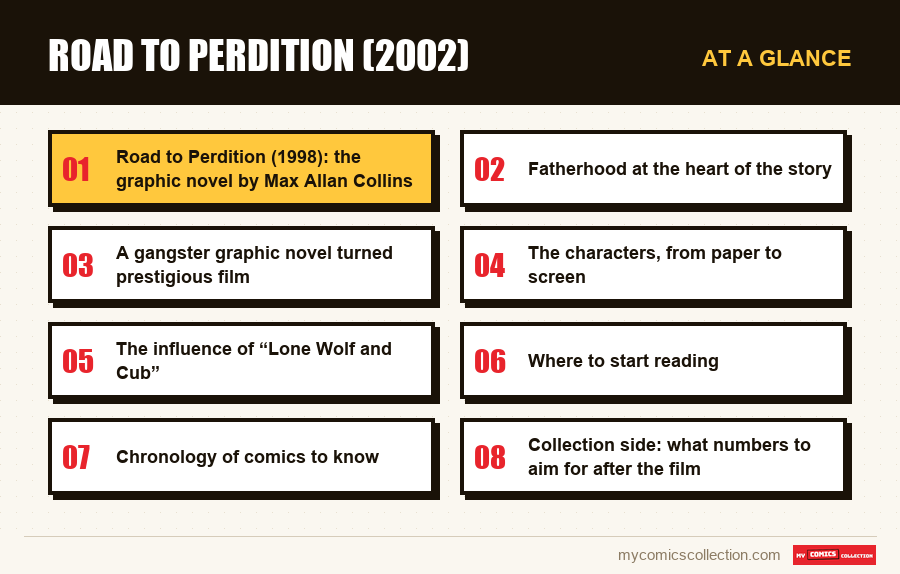
Road to Perdition (1998): the graphic novel by Max Allan Collins
Road to Perdition adapts the graphic novel written by Max Allan Collins and drawn by Richard Piers Rayner, published in 1998 by Paradox Press, a label attached to DC Comics dedicated to adult and realistic stories. The work tells the story of Michael Sullivan, a hitman working for the Irish Mafia in Great Depression-era America in the early 1930s. When his family is massacred following a betrayal, Sullivan flees with his surviving son, beginning a journey of revenge and escape across America. The story earnestly explores themes of fatherhood, loyalty, violence and redemption. Particularly inspired by the Japanese manga “Lone Wolf and Cub”, it transposes the archetype of the warrior accompanied by his child into the world of American gangsters, for a dark and poignant tragedy about blood ties.
Sam Mendes' film is recognized for its faithfulness to the spirit and story of the graphic novel. Tom Hanks plays Michael Sullivan, a mafia killer forced to flee with his son after his family's massacre. The film preserves the plot: the betrayal, the escape, the revenge:, the setting of the Great Depression and above all the father-son relationship at the heart of the story. The tragic dimension, the gravity and the melancholic beauty of the comic strip are restored on the screen. This fidelity to the story and themes makes the film a respectful adaptation. Mendes, however, tightens the story, purifies certain elements, modifies details and imposes his own pictorial aesthetic, where the comic strip is more detailed and in places more violent.
Fatherhood at the heart of the story
What makes Road to Perdition so profound, both comic book and film, is the theme of fatherhood. The story is above all the story of a father and his son, forced by tragedy to take a common journey that brings them closer together. Michael Sullivan, a hardened killer, seeks to protect his son from the violent world that is his and prevent him from following the same path. The very title evokes this quest: to lead the child towards a better future, far from the “perdition” of crime. This relationship, made up of silences, gestures and restrained love, is the emotional heart of the work. The story also explores fatherhood through other figures, notably the mafia boss who is like a father to Sullivan, creating a play of mirrors on transmission and filial loyalty.
The film masterfully deepens this dimension. The relationship between Michael Sullivan and his son, played by Tom Hanks and the young actor, is the emotional thread of the film, treated with restraint and gravity. Sam Mendes explores how a father tries to protect his child from his own legacy of violence, and the complicity that arises from their tragic journey. This dimension, faithful to the comic strip, gives the film its universal scope, beyond the gangster story. For the reader, it illustrates what sets Road to Perdition apart from simple mafia stories: a profound meditation on authorship, transmission and the desire to preserve innocence. The film invites you to discover the graphic novel by Max Allan Collins, whose poignant story of father-son bonds, inspired by “Lone Wolf and Cub”, offered Sam Mendes the material for a cinematic tragedy of remarkable melancholy beauty.
A gangster graphic novel turned prestigious film
Road to Perdition illustrates, like A History of Violence, the potential of adult comics as a source of prestigious cinema. Published by a DC label dedicated to realistic stories, the graphic novel by Max Allan Collins, recognized author of detective novels, was a literary and dark work, far from superheroes. Its adaptation by Sam Mendes, award-winning filmmaker, with a prestigious cast bringing together renowned actors, made it a critically acclaimed art-house film. This trajectory, from a confidential graphic novel to a prestigious film, testifies to the richness of comics beyond popular genres, and to its capacity to inspire ambitious and rewarded cinema.
This dynamic promotes the diversity of comics. Road to Perdition proves that the medium conceals serious, literary and adult stories, worthy of the greatest cinematographic tragedies. The fact that a recognized filmmaker and prestigious actors are taking on a graphic novel testifies to the growing legitimacy of comics as a source of auteur cinema. For the reader, this story is an invitation to explore the richness of the medium, particularly realistic and adult stories that are often overlooked. Road to Perdition reminds us that comics are not limited to superheroes, but encompass works of literary depth capable of inspiring prestigious cinema. It illustrates the fruitful bridge between the graphic novel and the big screen, where dark and poignant stories find a second life through the talent of leading filmmakers and performers.
Collecting this series?
Track what you own, what you are missing and what your collection is worth. 7 day trial.
Start my trial →The characters, from paper to screen
- Michael Sullivan: The mafia killer, true to the comics.
- Michael Sullivan Jr.: The surviving son, at the heart of the story.
- John Rooney: The mafia boss, father figure for Sullivan.
- Connor Rooney: The chief's son, whose betrayal triggers the drama.
- Maguire: The killer on their trail, adapted for the film.
The influence of “Lone Wolf and Cub”
A fascinating dimension of Road to Perdition is its avowed inspiration: the Japanese manga “Lone Wolf and Cub”, a classic of Japanese comics telling the journey of a warrior accompanied by his young son. Max Allan Collins took direct inspiration from this archetype (the lone killer and his child, united in a journey of revenge and survival) and transposed it into the world of gangsters in America during the Great Depression. This influence illustrates the dialogue between global comics traditions, where a Japanese manga classic feeds into an American graphic novel. It testifies to the richness of cultural exchanges within the medium, beyond borders and styles.
This connection enriches the understanding of Road to Perdition. By drawing on “Lone Wolf and Cub”, the work is part of a long tradition of stories about the warrior and his child, a universal theme of fatherhood in the face of violence. The film, by adapting the graphic novel, indirectly inherits this manga influence, transposed into an American setting. This circulation of inspirations illustrates the vitality of comics as a global art, where the works interact and nourish each other. For the reader, this dimension is an invitation to discover both Road to Perdition and “Lone Wolf and Cub”, two major works united by the same archetype. She reminds us that comics are a global medium, where Japanese and American traditions meet to give birth to stories of remarkable depth, of which Road to Perdition is a fine example.
Where to start reading
To discover the source, the graphic novel Road to Perdition by Max Allan Collins and Richard Piers Rayner (1998) is available as a collection. A complete and poignant story, more detailed than the film, it offers the original version of this gangster tragedy. To continue, the manga “Lone Wolf and Cub” which inspired it is an essential classic. This journey reveals the roots of a prestigious film.
Chronology of comics to know
- 1998: Road to Perdition: the graphic novel by Max Allan Collins and Richard Piers Rayner at Paradox Press.
- 2002: Sam Mendes' film faithfully adapts the work.
- 2002+: The success of the film spawned sequels in graphic novels.
Collection side: what numbers to aim for after the film
Road to Perdition points to a prestigious graphic novel. The collection Road to Perdition by Max Allan Collins and Richard Piers Rayner (1998, Paradox Press) is a sought-after target for collectors, due to its status as the source of a lauded film. The original editions are popular with fans of adult comics and gangster stories. Reissues are available to readers. These numbers cover generally affordable budgets. As always, condition and gradation determine value; relying on real recent sales is strongly recommended.
Its place in the saga and for the collector
Road to Perdition will remain as a prestigious and faithful adaptation of a gangster graphic novel, transformed by Sam Mendes into a tragedy about fatherhood. For the collector, it highlighted the work of Max Allan Collins and Richard Piers Rayner at Paradox Press. It illustrates the richness of adult comics as a source of auteur cinema. Beyond the film, the original graphic novel is worth discovering, just like “Lone Wolf and Cub” which inspired it. Road to Perdition reminds us that comics, in all their diversity, can inspire prestigious and poignant films, well beyond the superhero universe.
The Verdict: A Faithful Paternal Tragedy
- Loyalty: Michael Sullivan the killer, the escape with his son after the massacre, revenge, the Great Depression and the father-son relationship come from the comics.
- Freedoms: the story tightened and refined, certain characters and details modified, the pictorial aesthetic of Mendes, the comic more violent and detailed, subplots removed.
- Collectible numbers: the collection Road to Perdition (1998, Paradox Press/DC).
Road to Perdition faithfully adapts the graphic novel by Max Allan Collins and Richard Piers Rayner, bringing to the screen the story of a mob killer and his son on the run in Great Depression-era America. Faithful to the story and the theme of fatherhood while purifying the plot, the film is a prestigious tragedy. For both the reader and the collector, it is an invitation to discover the graphic novel and “Lone Wolf and Cub”.
Frequently asked questions
Yes. The film adapts the graphic novel Road to Perdition by Max Allan Collins and Richard Piers Rayner, published in 1998 by Paradox Press, an adult DC label. The work tells the story of a mafia killer and his son on the run. The film adapts it faithfully.
Yes, largely. Sam Mendes keeps the plot: the betrayal, the escape, the revenge:, the setting of the Great Depression and the father-son relationship at the heart of the story. However, it tightens the plot, purifies certain elements and imposes its pictorial aesthetic, where the comic strip is more detailed and violent.
Fatherhood. The story is above all the story of a father, a hardened killer, seeking to protect his son from his world of violence and to prevent him from going down the same path. The title evokes this quest to lead the child away from the “perdition” of crime. This is the emotional heart of the work.
Max Allan Collins was directly inspired by this classic Japanese manga, telling the journey of a warrior and his young son. He transposed this archetype, the lone killer and his child, into the world of gangsters in America during the Great Depression, illustrating the dialogue between global comics.
The collection Road to Perdition by Max Allan Collins and Richard Piers Rayner (1998, Paradox Press) is the target, due to its status as the source for a lauded film. The original editions are popular, and the reissues are accessible to readers.
Does the film make you want to collect? Estimate the value for free of your numbers (Road to Perdition…) with our tool based on current eBay listings.