A History of Violence (2005) David Cronenberg , with Viggo Mortensen, adapts the graphic novel by John Wagner and Vince Locke (Paradox Press/DC, 1997). The film retains the concept of an ordinary man with a violent past who resurfaces, while distancing himself from it. Here is the detailed comparison, film versus comics.
A prestigious adaptation of a little-known graphic novel, A History of Violence was praised by critics without many knowing its comic book origin. Source-by-source decryption.
As in each article in this series, only verified information (creators, distribution, dates, publishers) is stated; the comparative analysis is ours, without reproducing dialogue or protected images.
Title : A History of Violence (2005)
Director: David Cronenberg
Actors: Viggo Mortensen (Tom Stall), Maria Bello, Ed Harris, William Hurt
Exit : September 2005
Studio: New Line Cinema
A History of Violence (1997): John Wagner & Vince Locke
Paradox Press: a label attached to DC
Tom McKenna: a man with a hidden past
A thriller: on violence and identity
- Un ordinary man with a hidden violent past.
- Un heroic act who exposes his secret.
- The return of his criminal past who catches up with him.
- The theme of the violence and identity.
- La family confronted with the truth.
- The plot and END differ markedly.
- Cronenberg refocuses on psychology and the couple.
- Le pass of the hero is treated differently.
- The film explores the ambiguity more than action.
- Comics are more direct and pulp.
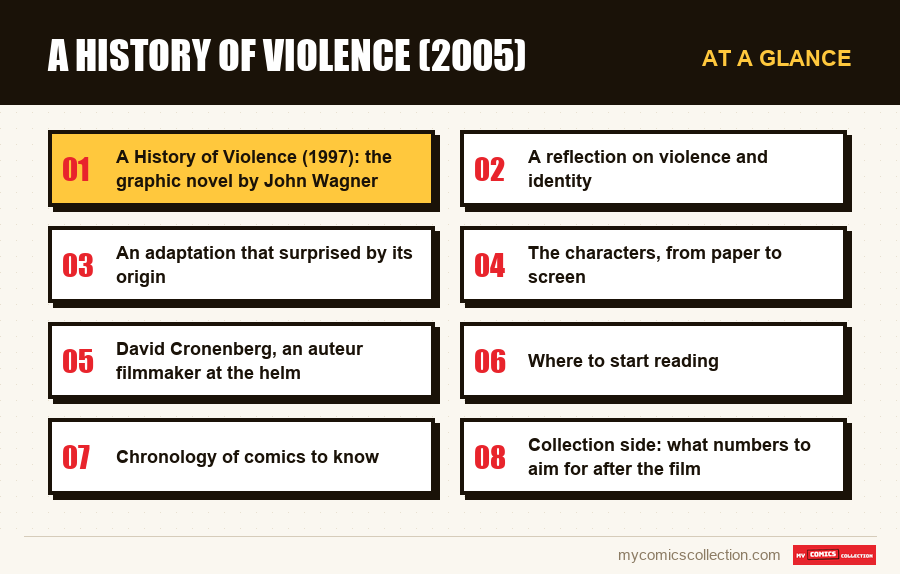
A History of Violence (1997): the graphic novel by John Wagner
A History of Violence adapts the graphic novel written by John Wagner (co-creator of the famous Judge Dredd) and drawn by Vince Locke, published in 1997 by Paradox Press, a label attached to DC Comics dedicated to adult and realistic stories. The comic tells the story of Tom McKenna, an ordinary man leading a peaceful life with his family, owner of a small establishment. When he heroically foils a violent robbery, his action attracts the attention of the media and brings to the surface a past that he had carefully buried: that of a man linked to organized crime. Criminals from his former life then come to hunt him down, endangering his family and his peaceful existence. The graphic novel explores themes of violence, identity, the past and redemption, in a dark and realistic thriller with a pulp tone.
David Cronenberg's film takes up the central concept: Tom Stall (McKenna in the comics), an ordinary man, foils a violent robbery, which exposes his hidden criminal past and attracts those who hunt him. Viggo Mortensen plays this man whose dual identity resurfaces. The film retains the premise (the heroic act revealing a secret, the past catching up with the protagonist, the threat to the family) and above all the central theme of violence and identity. This base respects the spirit of the comic strip. Cronenberg, a filmmaker renowned for his exploration of psychology and the body, however makes notable changes, refocusing the story on psychological ambiguity, the couple and the nature of violence, while modifying the plot and the ending.
A reflection on violence and identity
The heart of A History of Violence, both comic and film, is a profound reflection on violence and identity. The story asks disturbing questions: can we really escape our past? Is the capacity for violence an indelible part of oneself? Can a man change his nature, or is violence lurking within him, ready to resurface? Tom, by defending his family with deadly efficiency, reveals an aptitude for violence which contradicts his image of a peaceful man, causing turmoil among those close to him as well as within himself. This exploration of duality, the ordinary man and the killer that he was or could be, gives the work its depth and its universal scope, going beyond a simple thriller.
Cronenberg's film masterfully deepens this dimension. Renowned for his interest in transformation, psychology and the dark side of humanity, the filmmaker makes A History of Violence a disturbing meditation on the nature of violence and its place in identity. It explores the effect of the secret revealed on the couple and the family, the moral ambiguity of the protagonist and the disturbance caused by his ability to kill. This approach, more psychological and ambiguous than the comic strip, earned the film major critical recognition. For the reader, it illustrates how a filmmaker can take material to explore its themes in greater depth. A History of Violence invites you to discover the graphic novel by John Wagner, whose powerful concept on violence and identity inspired one of its author's most acclaimed films, a fruitful dialogue between comics and auteur cinema.
An adaptation that surprised by its origin
A particularity of A History of Violence is that many were unaware, when it was released, that it was an adaptation of a graphic novel. Hailed by critics as a major work by David Cronenberg, the film has often been perceived as an original auteur thriller, as its comic book origin was little known. This situation illustrates a recurring phenomenon: prestigious cinematographic works taken from comic books, the source of which remains in the shadows. A History of Violence, published by an adult DC label dedicated to realistic stories, was a confidential comic book, far from superheroes. Its adaptation by a renowned filmmaker gave immense visibility to a concept born in the pages of a little-known graphic novel, without the general public still knowing its origin.
This dynamic promotes the richness of comics beyond superheroes. A History of Violence proves that the medium contains adult, psychological and literary stories capable of inspiring demanding auteur cinema. The fact that the comic strip origin has been little known testifies to the unsuspected diversity of comic strips, often reduced in the collective imagination to superheroes alone. For the reader, this story is an invitation to explore the richness of the medium, in particular the labels dedicated to adult and realistic stories. A History of Violence reminds us that behind certain prestigious art-house films lie little-known graphic novels, and that comics, in all their diversity, are a major source of inspiration for cinema, well beyond the superhero universes that dominate the popular imagination.
Collecting this series?
Track what you own, what you are missing and what your collection is worth. 7 day trial.
Start my trial →The characters, from paper to screen
- Tom Stall / McKenna: The man with a hidden violent past, faithful to the concept of the comics.
- Edie / his wife: The wife confronted with the truth, developed in the film.
- The criminals: Those from Tom's past who are stalking him.
- Tom's son: Confronting the legacy of violence.
- Richie: Figure from Tom's criminal past.
David Cronenberg, an auteur filmmaker at the helm
The prestige of A History of Violence owes a lot to its director, David Cronenberg, an auteur filmmaker known for his exploration of psychology, the body and the dark side of humanity. By taking on the graphic novel, Cronenberg brought his singular vision to it, transforming a pulp thriller into a disturbing and ambiguous meditation on violence. His approach, privileging psychological tension, unease and moral complexity over pure action, has elevated the source material to the status of a lauded work of arthouse cinema. This meeting between a graphic novel with a strong concept and a demanding filmmaker illustrates the potential of comics as a source for ambitious cinema, far from superhero blockbusters.
This collaboration illustrates how an auteur filmmaker can transcend a source to make it a personal work. Cronenberg didn't just adapt the concept: he reinterpreted it through his thematic obsessions, deepening the ambiguity and confusion. This approach, far removed from literal fidelity, produced a work distinct from comics but faithful to its central idea. For the reader, it reminds us that the richest adaptations sometimes arise from a creative reappropriation of the source. A History of Violence is as much a Cronenberg film as it is an adaptation of Wagner and Locke. It invites you to discover the original graphic novel, whose powerful concept offered a great filmmaker material conducive to the exploration of his favorite themes, proving the richness of comics as a breeding ground for auteur cinema.
Where to start reading
To discover the source, the graphic novel A History of Violence by John Wagner and Vince Locke (1997) is available as a collection. A complete and autonomous story, more direct and pulp than the film, it offers the original version of the concept. Vince Locke's black and white artwork serves the realistic, dark tone. This little-known comic strip reveals the foundations of a acclaimed art-house film.
Chronology of comics to know
- 1997: A History of Violence: the graphic novel by John Wagner and Vince Locke from Paradox Press.
- 2005: David Cronenberg's film adapts and deepens the concept.
- 2005+: The critical success of the film revives interest in comics.
Collection side: what numbers to aim for after the film
A History of Violence points to a little-known graphic novel. The collection A History of Violence by John Wagner and Vince Locke (1997, Paradox Press) is a sought-after target for collectors, due to its status as the source of a lauded arthouse film. The original editions are popular with fans of adult and realistic comics. Reissues are available to readers. These numbers cover generally affordable budgets. As always, condition and gradation determine value; relying on real recent sales is strongly recommended.
Its place in the saga and for the collector
A History of Violence will remain as a prestigious adaptation of a little-known graphic novel, transformed by David Cronenberg into a disturbing meditation on violence. For the collector, it highlighted the often overlooked work of John Wagner and Vince Locke at Paradox Press. It illustrates the richness of comics beyond superheroes. Beyond the film, the original graphic novel deserves to be discovered for its strong concept. A History of Violence reminds us that the medium conceals adult and literary stories, capable of inspiring demanding auteur cinema, and that behind certain prestigious films hide little-known comics.
The verdict: a strong concept reinterpreted by an author
- Loyalty: the ordinary man with a violent past, the heroic act exposing his secret, the criminal past which catches up with him, the theme of violence and identity, the family confronted with the truth come from comics.
- Freedoms: the different plot and ending, the refocusing on psychology and the couple, the past treated differently, the exploration of ambiguity, the more direct and pulp comics.
- Collectible numbers: the collection A History of Violence (1997, Paradox Press/DC).
A History of Violence adapts the graphic novel by John Wagner and Vince Locke, retaining the concept of an ordinary man whose violent past resurfaces after a heroic act. Faithful to the theme of violence and identity but reinterpreted by David Cronenberg as an ambiguous psychological meditation, the film is a lauded work of art. For both the reader and the collector, it is an invitation to discover the original graphic novel.
Frequently asked questions
Yes. The film adapts the graphic novel A History of Violence by John Wagner (co-creator of Judge Dredd) and Vince Locke, published in 1997 by Paradox Press, an adult DC imprint. Many were unaware of this origin, as the film was perceived as an original work of authorship.
In its concept, yes: an ordinary man whose violent past resurfaces after a heroic act, the theme of violence and identity. David Cronenberg, however, modifies the plot and the ending, refocusing the story on psychological ambiguity and the couple, where the comics are more direct and pulp.
About an ordinary man with a hidden violent past, who foils a robbery, which exposes his secret and brings his criminal past to the surface. The work explores violence, identity and the past: can we escape our nature? Is the capacity for violence an indelible part of oneself?
Known for his exploration of psychology and the dark side of humanity, Cronenberg transformed a pulp thriller into a disturbing and ambiguous meditation on violence. His psychological approach elevated the material to the status of a critically acclaimed work of auteur cinema.
The collection A History of Violence by John Wagner and Vince Locke (1997, Paradox Press) is the desired target, due to its status as the source for a lauded film. The original editions are popular with fans of adult comics, and the reissues are accessible.
Does the film make you want to collect? Estimate the value for free of your issues (A History of Violence…) with our tool based on current eBay listings.