There is no mandatory reading order for Rick Remender: each of his series is entirely self-contained. No prequels, no sequels, no crossovers: only one title is the exception, a shared universe series that he didn't create. The order proposed here is therefore an order of discovery, constructed so that each reading illuminates the next. He begins with the most accessible title, saves his founding work for later, and ends with the exception that reverses all the others.
A bibliography without obligatory continuity poses a different problem from that of a shared universe: there is no order to respect, but there are good and bad entry points.
This article provides a complete journey in five steps, explains the reasoning behind each, and points out the two order errors that cause this author to wrongfully abandon the book.
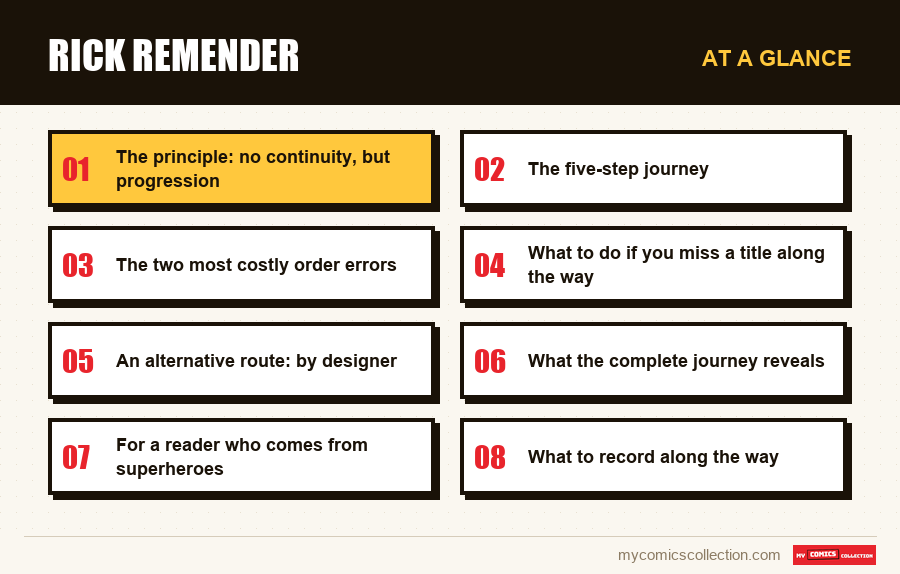
The principle: no continuity, but progression
A common confusion must be cleared up straight away. For an author of series belonging to their creators, there is no common universe: his titles do not respond to each other, do not share characters, and do not imply any order.
But they are similar in substance while differing radically in form. A poorly ordered journey therefore gives the impression of rereading the same thing, or on the contrary of changing author for each title: two ways of missing what makes it coherent.
The order proposed here therefore aims for a balance between two pitfalls: alternating genres to avoid weariness of a single register, and spacing out the most thematically closest titles sufficiently so that the echoes between them are noticed without ever giving the impression of a repetition. This is not the only defensible order, but it is the one that causes the fewest casualties among new readers.
The five-step journey
1. The school story
The most accessible and immediately readable title. One volume is enough to know if its tone suits you, without committing to a series.
It is the fastest and most representative test in its way.
2. A long-running genre series
Its dimensional science fiction, to see what he does with a concept over time and discover that it completely changes visual register from one title to another.
3. A short title
Its urban anticipation or its road story. Two volumes, a breath of fresh air, and the demonstration that the short format makes it more tense.
4. The founding work, then fantasy
His first notable series can be savored once we recognize what it announces. His fantasy, the most demanding, comes next: this is where he pushes his motif furthest.
The fifth stage is optional and can be chosen according to taste, each responding to a different curiosity: its period with a major publisher for those who come from superheroes and want to see what they do under the constraint of continuity, their spy comedy for those who want to measure how far they can stray from their register, or their underwater story for those who have clearly identified their mechanics and wish to see them work in reverse. None of these three readings is necessary for understanding the whole; they complete the picture rather than construct it.
The two most costly order errors
Start with the founding work
This is the most common error, and yet it seems logical. This title is rougher than the following ones, and its purchase is complicated by successive editions with different layouts.
Start with his comedy
She gives an entirely false image of him. A reader who continues with his fantasy would think he has changed author: the tone has nothing in common.
Start with fantasy
Its slow pace and world delivered without explanation make it a poor test. A reader who drops out at the first arc will wrongly conclude that the author is not for them.
Start with his optimistic story
This is the only one of his titles where he reverses his usual conclusion. Read first, it cannot be seen as the exception that it constitutes.
The rule that sums it all up. Start with the simplest title, not the most important. They're two different things, and confusing them is what makes this author give up before he knows what he's doing.
His most seminal work and his most ambitious series are both poor entry points, for opposite reasons.
What to do if you miss a title along the way
A practical question often arises: should we wait until we have the complete series before starting?
The answer is no, and for a reason which has to do with the editorial model. His personal series have never been revived or renumbered, and their bound volumes remain available or reprinted regularly. A title started today can be completed tomorrow, without the risk of coming across an incompatible edition.
The only exception concerns his founding work, the successive editions of which divide the chapters differently. On this specific title, it is better to identify the edition chosen before purchasing the first volume, otherwise the sequel will not fit together.
For everything else, we can move forward in stages without planning. It's a comfort that shared universes never offer, and it arises directly from the absence of collective continuity.
How long does this route take?
The question deserves a numerical answer, because it conditions commitment and few articles ask it.
The first four stages represent approximately fifteen bound volumes. At the rate of one volume per week, a comfortable pace which leaves time to read something else, the main course takes one quarter.
The cost follows the same scale. In second-hand bound volumes, the whole is in the same order of magnitude as a handful of novels, and there is no obligation to acquire everything in advance: each step is decided after the previous one.
This progressiveness is a real advantage of this type of bibliography. In a shared universe, it is difficult to enter without purchasing several series simultaneously to understand a crossover. Here, one volume at a time is enough, and each stop is a clean stop: we can interrupt ourselves after any stage without leaving any story unresolved.
Collecting this series?
Track what you own, what you are missing and what your collection is worth. 7 day trial.
Start my trial →An alternative route: by designer
There is another way to go through this bibliography, less obvious and sometimes more satisfying.
Since each series is entrusted to a unique artist from start to finish, you can choose your readings by drawing rather than by pitch. A reader who likes exploded layouts, another who prefers a dense and mineral line, a third who seeks watercolor: everyone will find their title.
This route has a concrete advantage. The graphic gap between two of his series often exceeds that which separates two different authors, so much so that a reader disappointed by one has a good chance of finding what he wants in another: provided he chooses on the drawing rather than on the summary.
It’s also a way to discover artists who we will then follow elsewhere. Several of the artists in his series have their own work, and this reading thread is at least as reliable as following a screenwriter.
What the complete journey reveals
Read in this order, the whole reveals something that each individual title does not show.
The same mechanism recurs everywhere, in incomparable forms: someone obtains what they wanted, and the payment lasts. The decor changes each time because its function is constant: to make a subject legible that would not be treated directly.
Once this thread has been identified, rereading the first titles gives more than the first reading. What passed for adventure becomes the establishment of a debt, and details taken for decoration take on their meaning.
This is the best reason to follow an order rather than drawing randomly: the journey produces a meaning that the titles taken separately do not contain.
For a reader who comes from superheroes
A particular case deserves its own journey, because the starting point completely changes the best order.
A reader accustomed to major publishers would do well to start with this author's period of commission, particularly his clandestine mutant series. The setting is familiar to him, the codes too, and he will discover a screenwriter without having to change universe.
The transition then occurs naturally towards his personal series, because the themes are the same. The motif of debt contracted voluntarily already appears in his commissioned works, a character regains the use of his legs in exchange for servitude, and you just have to follow it to arrive at his fantasy, which makes it the entire subject of a story.
The reverse order works less well for this profile. Going directly from a superhero universe to a graphic novel about self-destruction requires an adaptation that the order period makes unnecessary, since it serves precisely as a bridge.
What to record along the way
A journey spread over months requires a minimum of account keeping, and three pieces of information are enough.
Editing and chapter range of each volume. This is the only point where this segment is not forgiving: the volumes do not designate the same content from one presentation to another.
Le dessinateur of each series. It guides subsequent readings if you take the graphic route, and it identifies the series as surely as its title.
What you thought of the title. On a bibliography where the themes respond to each other, finding your print six months later is worth more than a numerical note: especially when deciding whether to continue.
Questions fréquentes
None. Each is entirely self-contained, with no prequels, sequels or obligatory crossovers. The proposed order is an order of discovery intended for each reading to illuminate the next, not a narrative constraint.
Because the most important is not the simplest, and confusing the two makes this author give up before knowing what he is doing. His founding work is rougher than the following ones and its purchase is complicated by successive editions; his most ambitious series is the slowest and most opaque.
Without any problem, since nothing depends on anything: none of its titles presupposes the reading of another, and skipping a step leaves no gap in understanding. The journey simply loses its cumulative effect: the motif which runs through all his work is all the more noticeable as we have seen several variants of it in genres which have nothing in common. Skipping two consecutive titles mainly deprives this benefit, not the intrigue.
No, except for his founding work, the successive editions of which divide the chapters differently. On all other titles, the numbering has never been restarted and the volumes remain available: what we start today can be completed without risk of incompatibility.
Both work, and the second is often more satisfying than you imagine. Each series having a unique artist from the first to the last chapter, choosing by drawing gives readings visually consistent with one's tastes, and it is the best recourse for those who have been disappointed by a title without knowing why.
A journey spread over months is held in writing
Edition, range of chapters, designer: three fields that avoid repurchasing what we already have.