All of Rick Remender's series tell the same thing in different genres: someone gets what they wanted, and the payment lasts their entire life. The tyrant of his fantasy grants wishes to create obligations. The soldier in his superhero series regains the use of his legs in exchange for servitude. The scientist in his science fiction gets his machine and loses his family. Recognizing this pattern changes the way we choose what we read, and explains why our stories make us uncomfortable.
This author is readily described as dark, which is true but explains nothing. Many authors are dark without producing the same effect.
What is unique to it is precise mechanics, reused from one series to another under incomparable packaging. This article describes it, shows where it operates, and explains what it means for a reader who is hesitant to get involved.
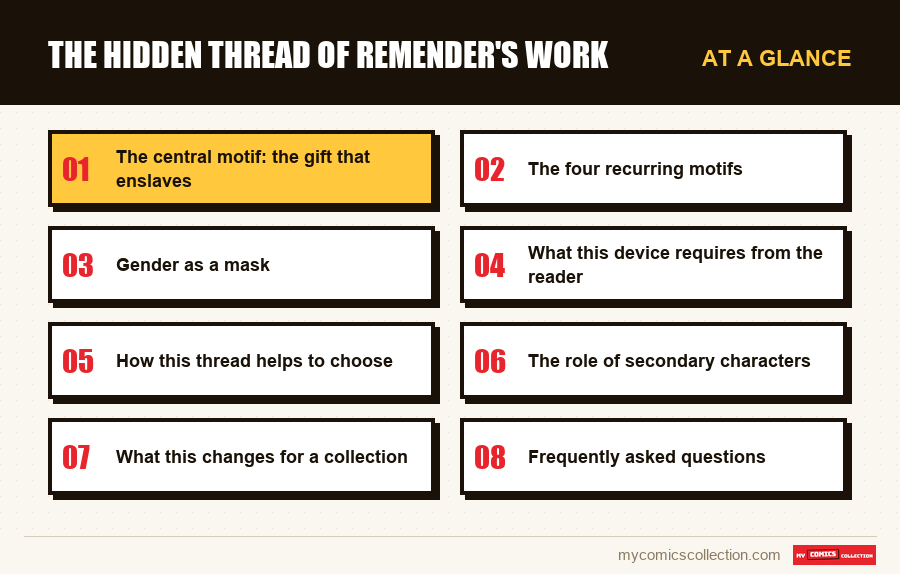
The central motif: the gift that enslaves
This is not a vague theme but a repeatable narrative device, and it returns with remarkable consistency.
In his fantasy, the tyrant does not rule by force. He grants wishes (the healing of a child, a harvest, revenge) and each wish granted binds the one who made it. His empire is made up of grateful obligated people, not forced subjects. We cannot rejoice in his fall without harming all those who owe him something.
In his work for a major publisher, the same mechanism appears in another form: a mutilated soldier regains the use of his legs thanks to a creature who will never let him go. The benefit is perfectly real, and the debt that accompanies it is never extinguished.
In his dimensional science fiction, no one gives a gift, but the scientist grants himself what he desired, and each subsequent jump is repayment. The donor and the obligee are here the same person, which makes the mechanics even more cruel.
The four recurring motifs
The protagonist responsible for his misfortune
Its main characters are almost never victims of external circumstances. They did something, early in the story or before it, and everything else follows from that.
This is what prohibits comfortable identification, and what makes reading uncomfortable for part of the public.
The family as a field of ruins
Absent father, child in danger, siblings who no longer speak to each other. The motif runs through almost all of his series without ever repeating itself exactly.
Addiction as a driver, not a trait
Alcohol, drugs, constant entertainment: for him, addiction is not a detail of characterization but what moves the plot forward.
Violence that leaves traces
His stories are violent, but the wounds do not disappear between two chapters. This is what sets them apart from the action entertainment their summaries might reduce them to.
Gender as a mask
This is the point that best explains the coherence of his work despite its apparent diversity.
A straightforward account of alcoholism and remorse would be unbearable for several hundred pages. A direct account of paternal guilt too. By disguising them as space adventure, science fiction or fantasy, he achieves two things: the reader enters through the entertainment, and the author gives himself the right to be frontal once it is established.
Gender is therefore not a trade dress, it is a door. And it changes with each series precisely because its function is constant: to make readable a subject which would not be treated directly.
This reading explains a frequent criticism leveled at his beginnings. The first chapters of its founding series seem light, almost good-natured. This is not the clumsiness of a young author: it is the door that must be crossed before the shift takes place.
What this device requires from the reader
Give up the comfortable camp
Its antagonists are right and its protagonists are wrong. A reader looking to know who to support will be left dissatisfied from start to finish.
Accept that the beginning lies
The tone of the first chapters does not announce that of the rest. Judging one of its series on its first arc systematically leads to being mistaken about what it is.
Do without redemption
His characters do not redeem themselves according to the expected schedule. Some people don't redeem themselves at all, and the story doesn't present them as a failure.
Tolerate that nothing can be repaired
What is destroyed remains destroyed. There is no going back, no resetting, no parallel dimension where everything would be okay.
The exception worth knowing. Only one of its titles escapes this regime: its underwater story, carried by a woman who continues to hope when everything indicates that she should not.
This is not naivety but a position defended without irony: which, for this author, constitutes the most unexpected gesture in his entire bibliography. It is also the title that its audience followed the least, which is probably not a coincidence.
Where does this core probably come from?
A caution is necessary before going further: none of what follows is biography, only what the stories themselves reveal.
A detail comes up too often to be accidental. His characters don't regret having failed: they regret having successful. The scientist gets his machine. The soldier finds his legs. He who makes a wish before the tyrant obtains it. None of these stories tell of disappointed ambition; all tell of a satisfied ambition whose price we then discover.
It is a reversal of the dominant pattern in genre fiction, where the obstacle is external and the victory final. Here the obstacle is success itself, and there is nothing to overcome since the damage has already been done in the first chapter.
This also explains why his stories never end in a confrontation. You can't fight a debt you incurred voluntarily: you can only decide what you do with it. Its ends are choices, never victories.
Collecting this series?
Track what you own, what you are missing and what your collection is worth. 7 day trial.
Start my trial →Why does this motif speak so much today?
A reading is necessary with hindsight, without there being any need to force it.
The gift that enslaves describes contemporary mechanisms quite accurately: a service provided free of charge in exchange for lasting dependence, immediate comfort paid for later, an ease offered which removes freedom. Its story of urban anticipation, where the population lives on a constant drip of entertainment, was an exaggeration when it was published and is much less so today.
This does not make him a thesis author: he demonstrates nothing and never concludes. But it explains why his stories stand up to time better than many genre titles from the same period.
For a reader, the practical consequence is simple: these series can be reread, and rereading often gives more than the first reading, once we have identified the mechanism at work.
How this thread helps to choose
Since the motif is constant and only the genre changes, the choice of a series is made on the decor and the design, never on the substance.
A reader who hated one of his series for its tone will probably hate another. But someone who has stopped for a formal reason (a drawing that doesn't speak to them, a pace that's too slow, a genre that bores them) has a good chance of finding what they're looking for elsewhere without changing anything about their tastes.
This is a useful distinction to make before abandoning this author. Is the complaint about what the story says, or how it is told? In the second case, another series changes everything; in the first, none will be suitable.
The role of secondary characters
One last feature is worth noting, because it distinguishes his stories from most series built around a tormented protagonist.
His secondary characters are not stooges responsible for commenting on the hero's decline. They have their own calculations, their own debts, and they regularly put their interests before those of the group. An ally can betray without it constituting a spectacular reversal: it was simply in his interest.
This autonomy has a direct effect on reading. It prevents us from relying on anyone, and it multiplies the points of view from which the central dilemma arises. The same moral choice does not have the same weight depending on who looks at it.
For a reader, this means that a careful rereading reveals complete secondary trajectories that we had taken for decoration. This is especially clear on his longer series, where multiple characters go through their own version of the main arc in the background.
What this changes for a collection
A reader who has identified this thread organizes his library differently, and this has concrete consequences.
Arranging his titles by genre (science fiction with science fiction, fantasy with fantasy) disperses a work that only makes sense when collected together. Arranging them by author brings them into dialogue, and we then see stories responding to each other that seemingly nothing brings together.
This also applies to what we record. Noting the genre of a series is of little use to him, since it changes with each title without the subject matter varying. Note the designer is much more so: it is the real variable, and the one which explains why two of his series give incomparable impressions.
Finally, this reading rehabilitates its least followed titles. His short series and his single optimistic story are not minor works but variations on the same core, and one of them is the only one where he attempts something else.
Frequently asked questions
In substance yes, in experience no. The core is identical from one title to another, but the genre, the rhythm and especially the designer change completely: to the point that two of his series read in succession can seem written by two different authors.
Above all, we must accept that no character is entirely defensible and that damage cannot be repaired. It's not exactly the same as darkness: his stories aren't desperate, they simply refuse easy consolation.
Because the chosen register, the genre adventure, serves to bring the reader in before the real subject appears. This contrast is deliberate and is found in several of his series: judging a title on its first arc leads to being mistaken about its nature.
Only one, his underwater story, which defends hope without irony and without turning it around at the end. This is the most unexpected gesture in his bibliography, and probably one of the reasons why this title was less followed than the others by his usual audience.
More than most genre series, yes. Once the mechanism has been identified, the first chapters are reread differently: what passed for adventure becomes the establishment of a debt, and the details that we had taken for decoration take on their meaning.
Sort by author, not by genre
For him the genre changes with each series without the subject matter varying: it is the designer who makes the difference.