In short
The Reverse-Flash key issues start with The Flash #139 (September 1963), where Eobard Thawne debuts as Professor Zoom, and #153 (1965), which gives him his name. Cary Bates and Carmine Infantino close his Silver Age and Bronze Age story in #324 (1983). Geoff Johns then rebuilds him in The Flash: Rebirth and Flashpoint, and The Button in 2017 carries him into Batman's world.
A key issue list for a villain works differently from one for a hero. The best entries are not the books where he wins, but the ones that change what he is: a debut, a name, a death, a rewrite. Eobard Thawne has all four, spread over sixty years, which makes him an unusually clean subject for a ranked list.
The ranking below is editorial judgment built on checked facts. Cover dates, story titles and creator credits were verified against reference pages. Nothing here depends on current market data, so the order reflects story weight and collecting logic.
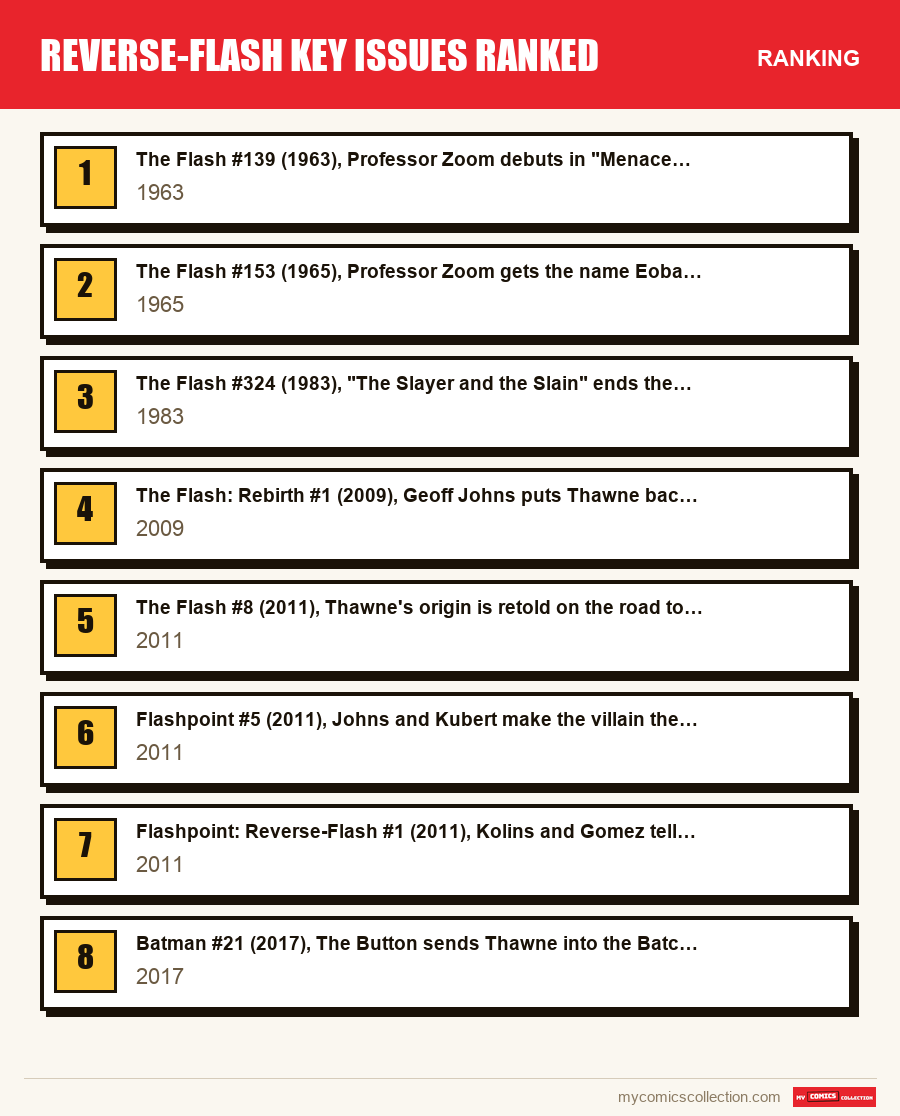
1: The Flash #139 (1963), Professor Zoom debuts in "Menace of the Reverse-Flash"
This is the anchor of any Reverse-Flash collection. The issue is cover dated September 1963, with a story by John Broome, pencils by Carmine Infantino and inks by Joe Giella. The plot sends a future criminal to a relic of the hero's career, which he converts into reversed speed; he styles himself Professor Zoom and loses to Barry Allen at the finish. The conceit of a villain who mirrors the hero is complete on the page, even though the psychology is still simple.
What the issue adds to a collection is origin, not depth. It does not contain the name Eobard Thawne, and it does not contain the later tragedy. For a buyer, the practical points are the usual Silver Age ones: check the spine for stress lines, look for color breaks along the fold, and read a graded label for a restoration notice before you read the grade. Judge the cover by looking at it, not by a listing line.
The issue earns the top place because every other entry in this list leans on it. Remove #139 and the later stories have nothing to revise, undo or avenge. If you can own only one book from the character's history, this is the one that makes the others make sense.
2: The Flash #153 (1965), Professor Zoom gets the name Eobard Thawne
Issue #153, from 1965, is the book where the civilian name Eobard Thawne appears. Broome and Infantino are credited again, so the creators of the debut are back. For readers who care about continuity, this is the issue that turns a costume and a code name into a person.
Its place in the ranking reflects how collectors treat identity reveals. A name story is a smaller event than a debut, but it is the hinge for everything the modern writers did with the character, from his family tree to his obsession with the Flash legacy. The title listing is the key detail to watch: the issue is not catalogued as a debut, so it can sit quietly in a bin while the first appearance draws the attention.
When you buy it, apply the same checklist as for any mid-1960s DC book. Compare the cover date and the volume, inspect the spine and the staples, and read the holder label if the copy is graded. Because this book sits between the debut and the death story, it is also a good candidate for a sensible mid-grade copy in a set you plan to complete in order.
3: The Flash #324 (1983), "The Slayer and the Slain" ends the villain
In August 1983, Cary Bates wrote and Carmine Infantino drew the story in which Barry Allen kills the Reverse-Flash. The villain had murdered Barry's first wife, Iris, years earlier, and he returns to threaten Barry's wedding to Fiona Webb; Barry stops him for good. The aftermath leads into the story known as the trial of the Flash, which runs through the following years of the title.
This is the death issue, and it matters for collectors because it shows the character as a real threat, not as a recurring gimmick. The later resurrections gain meaning because of this scene. Reading #324 together with the issues just before it is the best way to see what Bates and Infantino built.
For buying, remember that the Bronze Age book is a different type of object from the Silver Age ones: later paper, different color printing and a different cover price era. The short run that leads into it is also a natural partial set, so you can aim for the death issue first and add its lead-in numbers later.
4: The Flash: Rebirth #1 (2009), Geoff Johns puts Thawne back at the center
Geoff Johns wrote and Ethan Van Sciver drew The Flash: Rebirth, a six-issue mini-series that ran from 2009 into early 2010 and returned Barry Allen to the main Flash role. Thawne is the true villain of the story: he is behind the tragedies in Barry's past, he corrupts the Speed Force with a negative version of it, and he is revealed as the man who murdered Barry's mother, Nora Allen.
Issue #1 is the entry point, and it earns the rank because the whole mini-series is a restatement of what the Reverse-Flash means. The Silver Age villain wanted to be the Flash. The modern villain wants to ruin the man behind the mask. That shift shaped almost every story that followed, including the television version many readers know.
The series is also easy to collect, because it is a finite set of six numbers by one writing and art team. Buy the set, not a single issue, and check whether you want variant covers, which are a separate subject covered in the guide to Flash variants.
5: The Flash #8 (2011), Thawne's origin is retold on the road to Flashpoint
In the third volume of The Flash, issue #8, cover dated February 2011, retells Thawne's origin for the post-Rebirth era. It sits between the end of the Rebirth mini-series and the start of the Flashpoint event, and it opens the run of issues #8 to #12 that served as the prelude to Flashpoint and was later collected as The Road to Flashpoint.
The reason it ranks in the middle is that it is a bridge issue. It is not a debut, a death or a rewrite on the scale of the books above, but it is the clearest single-issue statement of how Johns-era continuity treated the villain between the two big events. A collector who wants a complete modern arc should keep it on the list, even if a casual buyer can skip it.
Be careful with the numbering. This is volume three, and the same issue number exists in other volumes, so verify the cover date and the title on the listing before you pay.
Do you collect this series?
Track what you own, what you are missing and what your collection is worth. 7-day trial.
Start my trial →
6: Flashpoint #5 (2011), Johns and Kubert make the villain the pivot of the event
Geoff Johns wrote Flashpoint with Andy Kubert as penciler, and the five-issue series ended with issue #5 in August 2011. Thawne is a central antagonist: Barry Allen suspects him of altering history, and the story reveals that the altered timeline came from Barry's own trip back to stop Thawne from killing his mother. Thawne claims that makes him a living paradox who can die without erasing himself, and Batman kills him before Barry restores the timeline.
The reason to buy #5 specifically is that it resolves the villain's arc in the event. The earlier numbers build the mystery, while the final issue explains the cause and the cost. It belongs on a Reverse-Flash list even though the event is broader than the character, which is why the full event is also covered in the Flashpoint key issues guide.
Collectors should also note that Flashpoint led into the relaunch of DC's line in 2011, so the final issue has a second layer of interest as a publishing turning point, independent of the Reverse-Flash storyline.
7: Flashpoint: Reverse-Flash #1 (2011), Kolins and Gomez tell the one-shot
The one-shot Flashpoint: Reverse-Flash was written by Scott Kolins and drawn by Joel Gomez, with a cover by Ardian Syaf and Vicente Cifuentes. It is a tie-in from the event period, built around the villain, and it fits a collector who wants every standalone book centered on Thawne.
Its ranking is lower because it is a tie-in and not a story that changes the character. The appeal is completeness: one issue, one clear subject, and a self-contained creative team. If you are building a Reverse-Flash shelf, this is a low-risk addition once the major books are in place.
As with any event tie-in, make sure the listing names the exact one-shot. Several Flashpoint tie-ins carry similar titles, and a title search without the character name can bring back the wrong book.
8: Batman #21 (2017), The Button sends Thawne into the Batcave
The Button crossover ran through Batman #21 and #22 and The Flash #21 and #22 in 2017. Tom King and Jason Fabok created the Batman chapters, with King and Joshua Williamson co-writing #22, while Williamson and Howard Porter created the Flash chapters. In the story, Thawne appears in the Batcave, fights Batman, takes the Button and returns badly damaged.
This is the most recent entry and the least tied to the character's Silver Age roots. It makes the list because it shows Thawne working as a plot device across two franchises, which is a different use from the earlier stories. Seen from the 1963 debut, it is a distant bookend.
The Batman side is the issue most collectors search for, because it is a Batman crossover with a villain from the Flash line. Check the cover date and the volume, because several Batman and Flash volumes share the same issue numbers.
How to build the set and what to avoid
A sensible order is to buy the books that carry the most story weight first, in the sequence that matches your budget and your tolerance for condition risk. Start with the debut if you want the anchor, add the name story and the death story, and then fill in the modern books, which are easier to find in good condition. If the Silver Age books are out of reach, the modern entries make a coherent set on their own: Rebirth, the third-volume issue, Flashpoint and The Button tell the villain's recent story.
The main trap is name confusion. Zoom in modern listings usually means Hunter Zolomon, a rival of Wally West. Daniel West, a later Flash-family character, also used the name. Inertia debuted in the Impulse series in 1999, and he is not Eobard. A listing that says "Reverse-Flash" without a year may be about any of these, so always check the volume and the cover date.
The second trap is skipping the label. For graded copies, read the restoration notice and the grade together, and compare several sold copies from the same grading company before you pay. Slab labels are decoded in the Flash CGC grading guide. The third trap is assuming the character stayed fixed. DC has revised Thawne several times since Flashpoint, including in the 2020 storyline Finish Line, so the list above describes the version of Thawne that these particular issues define.
Frequently asked questions
The Flash #139, cover dated September 1963, is the debut of Professor Zoom, the original Reverse-Flash. John Broome, Carmine Infantino and Joe Giella created the story "Menace of the Reverse-Flash." The later books gain their meaning from this one, which is why it sits at the top of the list.
From 1965, issue #153 is where Eobard Thawne gets his name. Issue #139 presents the villain only as Professor Zoom. The debut and the naming story sit in two different books.
The Flash #324, from August 1983, titled "The Slayer and the Slain," is the death story. Cary Bates wrote it and Carmine Infantino drew it. The villain had murdered Barry's first wife, Iris, years earlier, and here he threatens Barry's wedding to Fiona Webb, which is why Barry stops him for good.
Not exactly. Eobard Thawne used the alias Professor Zoom and is the original Reverse-Flash. Hunter Zolomon, usually called Zoom, is a separate villain who is mainly tied to Wally West. Daniel West and Inertia are also different characters. Always check the volume and cover date.
Look at Rebirth (Johns, Van Sciver), Flashpoint #5 (Johns, Kubert) and Batman #21 from The Button (King, Fabok). They tell the villain's recent story and are generally easier to find in good condition than the Silver Age books.
Own a Reverse-Flash key from the 1960s or 1980s? Estimate its value from its grade before you decide whether to sell, grade or keep it.
Estimate my comic