The premium paid for a Rick Remender alternative cover ranges from zero to one hundred and fifty percent depending on the title, and it depends on one thing: how many variants are circulating. Asking prices observed on August 28, 2026 on the American market, raw copies: Deadly Class #1 wonders $9.99 standard and $24.99 alternative: but only 13 variants are on sale. Black Science #1 poster $9.99 either way, with 24 variations available. The more variations there are, the less they are worth.
This is a relationship that can be read directly in the numbers, and it contradicts the idea that alternative coverage would be inherently worth more.
This article gives the complete statement on four titles, shows the correlation, and draws from it a method that can be used before any purchase of a variant: from this author or elsewhere.
La méthode
The count covers the first four numbers, as they could be observed on August 28, 2026 across the Atlantic. These are requests from sellers on open listings, never completed transactions.
Lots, collections and reissues are excluded. Above all, only raw copies are retained: including certified copies would make the note weigh more heavily than the illustration, when it is precisely the illustration that we seek to isolate.
The division between standard and alternative is made on the wording of the ad. This is an accepted limit: a seller who does not write the word will see his copy counted as standard. The count of variants is therefore rather underestimated than the reverse.
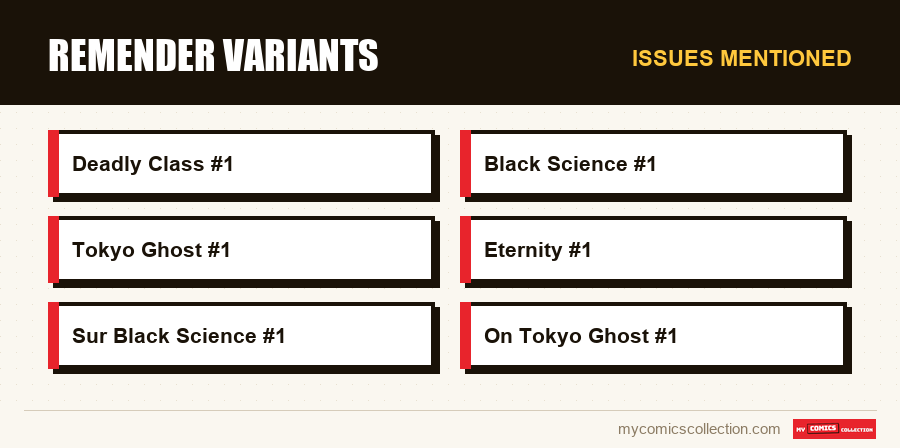
The statement
Deadly Class #1: the highest premium
Standard : $9.99 on 104 listings.
Variant: $24.99 off only 13 ads ($2.49-$79.99).
Two and a half times the standard price, and this is precisely the title where there are the fewest alternative covers in the entire survey.
Tokyo Ghost #1: a real bonus
Standard : $12 from 103 listings.
Variant: $19.99 on 25 listings ($4.74-$149.52).
Two thirds more than standard coverage. A clear and solid gap, on the title whose designer is the most sought after of all.
Seven to Eternity #1: negligible premium
Standard : $14.53 from 107 listings.
Variant: $15 off 30 ads ($3.40-$99.99).
Three percent difference, for the largest number of available variations of the statement.
Black Science #1: no bonus
Standard : $9.99 on 91 listings.
Variant: $9.99 on 24 listings ($1.99-$139.99).
Exactly the same price, down to the penny. On this title, the mention “variant” in an advert strictly does not justify any additional charge.
The relationship that the numbers reveal
Let's arrange the four titles by number of variants in circulation, and the premium reads itself.
13 variantes pour Deadly Class: 150% bonus. 24 variations pour Black Science: prime nulle. 25 variantes pour Tokyo Ghost: 67% premium. 30 variantes pour Seven to Eternity: 3% bonus.
The progression is not perfectly regular, four points do not draw a curve, but the two extremes are unambiguous: the title where the fewest variants circulate displays by far the highest premium, the one where there are the most variants displays almost none. Tokyo Ghost partially escapes the alignment, and this is explainable: its designer is the most collected of those who work with the author, which supports a demand that abundance is not enough to crush.
The prudent formulation is therefore this: the relative rarity of the variants explains most of the premium, the notoriety of the designer explains the rest. Neither factor is sufficient alone.
Why some titles have few variations
L'année de parution
The practice of alternative hedging has intensified over time. A series launched earlier has structurally less than a recent series.
La notoriété au lancement
A publisher multiplies the covers on a title that he is eagerly awaiting. A series launched without guarantee of success receives less, and becomes rare in hindsight.
Demand from outside
An adaptation attracts buyers who did not collect. They look for the distinctive object, which empties the stock of variants without it being replenished.
The stock never replenishes
Unlike bound volumes, an alternate cover is not reprinted. What has been sold circulates, what has disappeared does not come back.
The question to ask before paying a premium. How many variations of this number are on sale right now? It's a free count, which takes one minute, and it predicts the premium better than any odds list.
Around 30 copies available simultaneously means no seller can hold a high price. A dozen completely changes the situation.
What the word “variant” doesn’t say
The ranges in the statement make this limit obvious, and it is the main source of buyer error.
Sur Black Science #1, variants range from $1.99 to $139.99 with a median of $9.99. On Tokyo Ghost #1, from $4.74 to $149.52. These seventy-fold deviations do not describe different states of the same object but covers whose print runs have nothing comparable.
Two objects that nothing compares are found under the same label: the one that we found in a pile on the counter, and the one that had to be ordered by the dozen to be entitled to it. The first being a hundred times more numerous, it is he who decides the median.
The consequence is direct: an ad which only indicates “variant cover” without specifying which one describes, in the vast majority of cases, a copy of the current segment. Items that warrant a significant premium are designated by their ratio, never by the word alone.
Collecting this series?
Track what you own, what you are missing and what your collection is worth. 7 day trial.
Start my trial →Deadly Class, and the effect of an adaptation
This title concentrates the two identified factors, which explains why it stands out so much.
On the one hand, it is a series launched without guarantee, which has therefore not benefited from an extensive cover program: thirteen variants in circulation compared to thirty for a title launched later with an already known author.
On the other hand, its adaptation to the screen brought buyers from outside the collection. These buyers are not looking to complete a series: they want an object, and preferably as distinctive as possible.
The result combines narrow supply and broad demand, which is exactly the setup that produces a premium. The same title in standard copy remains at $9.99: one of the cheapest of its production. The adaptation did not move the series, it moved a very specific segment of its market.
What the relationship means for the future
If the premium depends on the number of variants in circulation, then it is not fixed, and the direction in which it moves is predictable.
An alternate cover is not reprinting. The initial stock is all that will ever exist, and it only gets dispersed: some copies enter collections and do not come out, others become damaged. The number of simultaneous announcements can therefore only decrease over time.
This also applies to securities which currently do not display any premium. The twenty-four variants currently available on one of them will not be twenty-four in ten years, and the zero premium observed today is not definitive.
However, two precautions are necessary before drawing a strategy from this. The first is that this movement is slow: it is measured in years, not months, and it does not compensate for the cost of prolonged storage. The second is that it assumes stable demand: if interest in a security dies, the scarcity of supply produces no increase, due to a lack of buyers.
What to record
The word alone does not provide information about anything usable. Three additions transform it into data.
Its identifier. A letter, or failing that the author of the illustration. Without it, it is impossible to later attach your copy to one or the other end of a scale that goes from ten to one hundred and forty dollars.
The payout ratio, if known. This is what separates a current object from a truly constrained object. The information never appears on the comic itself and is permanently lost if it is not noted upon purchase.
The amount paid, and the day. When the same title covers objects ranging from two to one hundred and forty dollars, no external reference value really concerns you: it averages things that you do not own. Your own purchase trace concerns the copy you have.
A line reading “Tokyo Ghost #1, variant” will never tell if it’s the $20 copy or the $150 one. The precision of the coverage removes the ambiguity once and for all.
Should you buy the variant?
On two of the four titles noted, the question does not arise: the premium is zero or negligible, and the choice is entirely a matter of taste. Take the cover you like.
On the other two, the arbitration becomes real. Paying two and a half times the standard price requires knowing precisely what cover you are buying: otherwise you are paying a supposed rarity on an item that may not be.
The reasonable approach consists of two actions: count the variants on sale, then identify which one is offered. If one of the two pieces of information is missing, the premium requested is not justifiable, whatever the title.
There remains one case where the premium is paid without calculation: when you like the illustration more than the main cover. This is a perfectly valid reason, and probably the best one. It simply has the merit of being accepted as an aesthetic choice rather than presented as an investment.
Frequently asked questions
No, and the statement shows it clearly: on one of the four titles, both are asking for exactly the same price. The observed premium ranges from zero to one hundred and fifty percent, and it depends mainly on the number of variants in circulation.
Counting the variants currently on sale for the targeted number. Around thirty copies available simultaneously prevent any significant premium; a dozen allows for a significant one. This count takes a minute and predicts better than any published list of values.
Because the word covers objects that are incommensurable: a widely distributed second cover and a print run reserved for the biggest purchasers bear the same label. The difference of seventy times between the minimum and the maximum does not measure the condition of the copies but the difference in print run between two illustrations.
It can, and the statement offers an example: the adapted title displays the highest premium, while remaining one of the least expensive in standard coverage. The effect therefore does not relate to the entire series but to its most distinctive segment, the one sought by buyers from outside the sector.
No, and that is what distinguishes these objects from the bound volumes. An alternate cover is not reprinted: what was printed then is all that will ever exist. A scarcity in this segment is therefore lasting, where the unavailability of a bound volume is only a delay in reprinting.
Ten dollars or a hundred and forty, under the same word
Noting which cover you have is the only way to know later.