Collecting the first issues of all of Rick Remender's major series costs less than eighty dollars. Asking prices observed on August 28, 2026 on the American market, raw copies: its first six most sought-after issues range from $9.99 to $16.10, with 117 to 135 ads available on each. No supply tension, so no reason to pay above the median or accept a poorly described item.
It is one of the most accessible bibliographies among authors of this level of notoriety, and this is due to a simple reason: his series are recent, widely printed, and nothing triggers speculation.
This article gives the figures, explains where the money really goes when you think you're getting a deal, and suggests a purchase order for anyone building a collection without a particular budget.
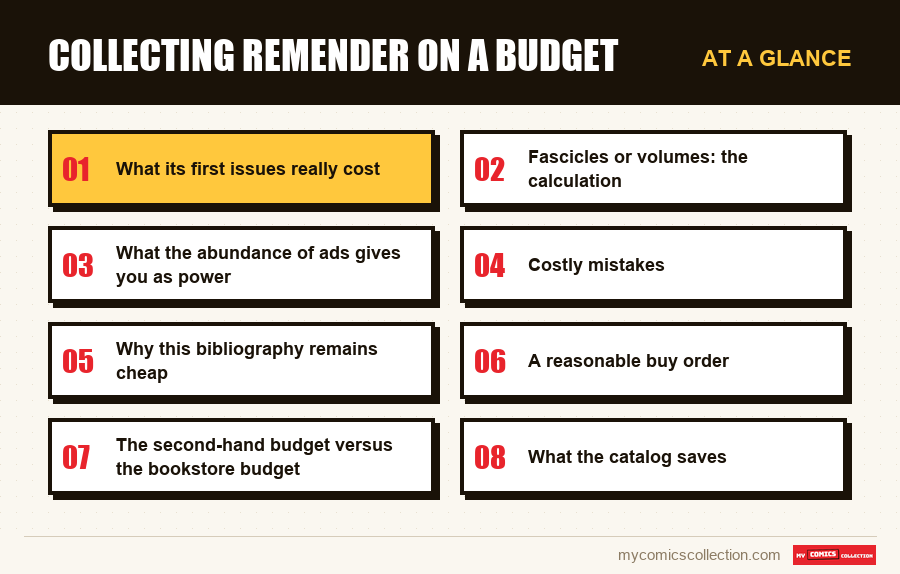
What its first issues really cost
The statement of August 28, 2026 relates to the American market, raw copies only, batches and reissues excluded. These are current listings, not closed sales: a seller always lists higher than he closes.
The top of the range
Its founding series leads to $16.10 of median out of 132 ads, followed by his fantasy at $14.99 out of 135 ads.
These are the two most expensive, and they remain below the price of a new bound volume.
The middle
His story of urban anticipation $12.99 out of 128 ads, his school story $10.50 out of 119 ads.
The bottom
Its dimensional science fiction series and its underwater story $9.99 each, on 117 and 121 advertisements.
Two major series, both acclaimed, at the price of a completely ordinary booklet from a major publisher.
The total
The six combined represent approximately $74 at the observed medians, before shipping costs: which weigh heavily if purchased separately, from six different sellers.
Where does the money go when you think you're saving?
Three expense items regularly cancel out the desired savings, and none appear in the displayed price.
Shipping costs. This is the first. Each of these titles has ads for less than $1.30, sometimes $0.99. These are almost never damaged copies but call prices: the seller in volume is remunerated on the postage. Always compare shipping included: the order of listings changes completely.
Separate purchase. Six orders from six sellers cost six shipments. A seller who offers multiple titles and consolidates shipments saves more than any negotiation on unit price.
The duplicate edition. This is the most expensive and least visible item. Buying a bound volume for which you already have the chapters in another presentation amounts to paying twice for the same reading. On this author's old series, the risk is real.
The most profitable rule of all. Of these titles, more than a hundred copies are permanently available. You never need to decide quickly.
This means in concrete terms: requiring clear photographs of the corners and the edge, rejecting any announcement without a description of condition, and refusing disproportionate shipping costs. The next seller offers the same thing.
Fascicles or volumes: the calculation
The question is decided differently depending on the objective, and confusing the two is the main source of unnecessary expense.
To read, bound volumes are significantly more economical. A volume brings together an entire arc for the price of one or two individual issues, and it avoids the risk of a series with holes. Over a series of around forty numbers, the difference amounts to hundreds of dollars.
To collect, only the first few numbers warrant a search. The following issues have no availability pressure and are available in abundance at almost zero price: acquiring them one by one is like paying again for a reading already owned.
The least expensive strategy combines the two: read the entire volume, and separately acquire only the first issues of the series you care about. It is also the one that produces the most coherent collection.
What the abundance of ads gives you as power
The most useful figure in the statement is not a price but a count: between 117 and 135 simultaneous announcements depending on the titles. It completely changes the buyer's position.
On a tight market, an old title of which only a few copies circulate, the buyer suffers: he takes what is available, in the state in which it is available, at the asking price. On these titles, it's the opposite. The seller who refuses to photograph his copy loses the sale, because a hundred others offer the same thing.
Concretely, this allows us to set conditions that we would not dare elsewhere: ask for a photo of the edge and the four corners, demand that the condition be described in words and not just noted, refuse a shipment without rigid protection. These requirements are pushing out a lot of ads, and that's fine: there are more than enough left.
This is also what makes any form of emergency unnecessary. An ad that disappears will be replaced within a week by an equivalent one. The only cost of patience here is not having the item right away.
Costly mistakes
Pay extra for “variant”
The word says nothing about the draw. A widely distributed second cover and a truly constrained edition bear the same label. Without knowing which one, we pay a note.
Confusing unavailability and scarcity
A volume out of print new for a few months can easily be found second-hand at the same price. Short series are reprinted more slowly, without creating value.
Buy a volume without checking its edition
On his older series, several presentations group the chapters differently. The volume number does not designate the same content from one edition to another.
Aim for a certified copy from the outset
The difference ranges from five to eleven times the gross price. It's a legitimate choice, but it's a collecting budget, not a reading budget, and the two are easily confused.
Collecting this series?
Track what you own, what you are missing and what your collection is worth. 7 day trial.
Start my trial →Why this bibliography remains cheap
It's worth understanding where this affordability comes from, because it's not guaranteed and it explains where the market might move.
Three factors play together. His series are recent: the oldest dates from the mid-2000s: therefore printed in the era of controlled print runs and rapid reprints. They are completed, which removes the announcement effect that boosts a current series. And they don't have almost no objects of speculation: neither first appearance of a character called on screen, nor event number registered in a collective continuity.
The only factor that has moved one of its titles is a screen adaptation, and its effect has been limited and focused: the volumes have been reprinted in quantity, making them more easy to find, while only the first booklet has stretched slightly.
In other words, accessibility is due to the very nature of these series. A major adaptation would be required for another title for the picture to change, and this would, as before, only affect a single issue per series.
A reasonable buy order
For those who build without hurrying, the following order limits regrets and duplication.
First purchase: a bound volume. That of his school story, the most accessible of his production. Around fifteen dollars to find out if the author suits you, without committing to a series.
Second phase: two other series in volumes. A science fiction and a fantasy, to measure the extent of its register. This is where we discover that his titles are much less similar than expected.
Third phase: the first numbers. Once we know which series we want to keep, we look for their first issues: in a single bulk order if possible, which divides the shipping costs.
Then only: certification. If you care about it, it comes last, out of the two or three titles that really matter to you. Never at the beginning, where she multiplies the budget without contributing anything to the reading.
The second-hand budget versus the bookstore budget
A final comparison is worth asking, because it is rarely made and it reverses a widespread intuition.
Buying new bound volumes in bookstores costs more for the chapter than buying second-hand booklets, but only for short series. On a long series, the calculation is completely reversed: around forty issues at a few dollars each far exceed the price of the four or five volumes which group them together.
The threshold is around ten numbers. Below, buying second-hand by the booklet remains competitive and provides the original covers. Above this, the bound volume clearly gains, and the gap widens with the length of the series.
We must add a factor that the price does not express: time. Gathering forty issues requires dozens of transactions, as many postage costs, and months of searching for the missing issues. Four volumes can be purchased in one order.
What the catalog saves
In this bibliography, most unnecessary spending comes from a lack of information, not a lack of discipline.
Three fields are enough to avoid them. L'édition in a bound volume, which prevents you from purchasing the same chapters twice. Le format, which distinguishes a fascicle from a volume bearing the same title. La couverture, on the first issues, which explains the most spectacular price differences.
Let's add the price paid and its date. In a market where medians move little but where ranges range from one to three hundred dollars, your own history provides better information than an external reference value.
The question that an inventory must answer before each purchase is always the same: “do I already have these chapters, in another form?” » A list of titles will never tell. A list with the edition and format answers it immediately.
Questions fréquentes
Nothing indicates this. Each of these titles has more than one hundred and seventeen announcements available simultaneously, which excludes any supply tension. Patience costs less than haste here, and allows you to wait for a correctly described copy.
Almost never. These are entry prices intended to rise to the top of the sorting by price, with the seller being paid on shipping. Once shipping is added, these items frequently cost more than a median listing from a seller who charges reasonable shipping.
All at once if you find a seller offering multiple titles, because consolidating shipments saves more than any single discount. On the other hand, there is no obligation to acquire everything in the same month: the offer is stable and the medians change little.
Yes, and this bibliography is particularly suitable for it. The first six major issues represent approximately seventy-five dollars at observed medians, and full reading in bound volumes remains accessible. This is not much for an author of this notoriety.
This entirely depends on your goal, and you need to decide that before you spend. It multiplies the cost by five to eleven depending on the titles without changing anything when reading, since a sealed copy can no longer be opened. It is justified on the two or three titles that you value most, never as a default acquisition method.
The most common expense is a duplicate
Buying a volume for which you already have the chapters in another edition costs more than any price difference.