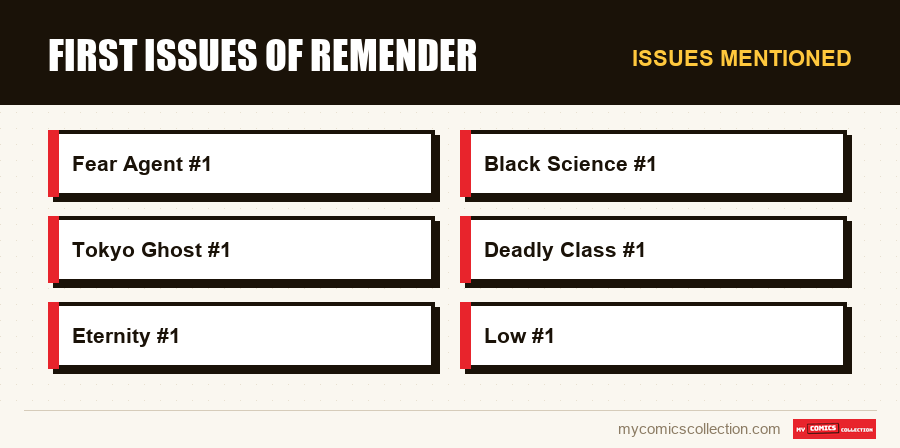
On the first issues of Rick Remender, the price ranking changes completely depending on whether we look at the raw or certified copies. Asking prices observed on August 28, 2026 on the American market: gross, Fear Agent #1 leads to $16.10 and Black Science #1 brings up the rear at $9.99. In certified, the order is reversed:Tokyo Ghost #1 dominates at $150 with 28 listings, while only third in gross. The certification multiple varies from 5,3 à 11,5 fois selon les titres.
First six issues, only one writer, six different artists. The survey allows a rare comparison: that of titles which share everything except their artist.
And this is precisely where the gap lies. This article presents the figures, explains why the two rankings diverge so much, and draws a rule that can be used on any author's title.
La méthode
What is measured here are demandes de vendeurs: announcements opened on August 28, 2026 on the American market, never completed transactions. The gap between the two is not neutral: we systematically state higher than we conclude.
Lots, reissues and collections are discarded: they collapse the medians without describing the same object. Raw and certified copies are counted séparément, never mixed: these are two distinct markets, and confusing them produces an average that describes nothing.
The number of announcements is indicated each time. This is information at least as useful as the price: a median calculated on three advertisements is not worth a median calculated on one hundred and thirty.
The statement, raw and certified
Fear Agent #1: premier en brut
Brut : médiane 16,10 $ sur 132 annonces (0,99-259 $).
Certifié : median $99 across 6 listings.
The highest raw median in the statement, for the oldest title. But only 6 certified copies on sale: the certification market largely ignores this.
Tokyo Ghost #1: premier en certifié
Brut : médiane 12,99 $ sur 128 annonces (1,92-203,90 $).
Certifié : median $150 on 28 annonces.
Third in gross, first in certified, and by far the most certified title in the survey. The multiple reaches 11.5 times.
Deadly Class #1: largest relative gap
Brut : médiane 10,50 $ sur 119 annonces (0,99-299,99 $).
Certifié : median $110 across 7 listings.
Fourth in raw, second in certified. A raw copy asks for just over $10 while the certified one goes for over $100.
Black Science #1: last on both sides
Raw : médiane 9,99 $ sur 117 annonces (1-199,99 $).
Certified: median $54.99 on 3 listings only.
The only title in the survey to appear in last position in both rankings, with the lowest multiple.
The two remaining titles complete the picture. Seven to Eternity #1 asks for $14.99 gross on 135 listings, and $80 certified on 14 listings: second in gross, second to last in certified. Low #1 shows $9.99 gross on 121 listings and $89 certified on 4 listings.
The two rankings, side by side
Ranked by asking price, the six titles are not at all in the same order depending on the market considered.
In raw: Fear Agent ($16.10), Seven to Eternity ($14.99), Tokyo Ghost (12,99 $), Deadly Class ($10.50), then Black Science et Low tied ($9.99).
En certifié : Tokyo Ghost ($150), Deadly Class ($110), Fear Agent (99 $), Low ($89), Seven to Eternity ($80), Black Science ($54.99).
Alone Black Science occupies the same position in both. All the others move, and two of them in three ranks. The gross price of a security therefore does not make it possible to predict its certified price., which contradicts the intuition according to which certification would apply an approximately constant coefficient.
Why the gap, when the screenwriter is the same
Certification follows the designer
This is the main explanation. Tokyo Ghost is designed by Sean Murphy, an artist widely followed by collectors. Its 28 certified ads do not reward the scenario but a graphic signature sought for its own sake.
Adaptation creates a certified market
Deadly Class wonders $10.50 gross but $110 certified. The adaptation has attracted buyers from the general public, who willingly buy a sealed object rather than a booklet to evaluate themselves.
Seniority affects the raw, not the certified
Fear Agent leads the raw ranking because it is the oldest and least reprinted. But seniority alone does not create a demand for certification: 6 announcements, compared to 28 for a more recent title.
Few announcements, fragile median
Three certified announcements for Black Science, four for Low. At this level, the median describes a handful of sellers rather than a market: it should be read with caution.
The certification multiple, and what it reveals
Comparing the certified price to the gross price gives a more meaningful indicator than either of the two taken in isolation.
It ranges here from 5.3 times For Seven to Eternity à 11.5 times For Tokyo Ghost. In other words, having a copy certified does not produce the same effect depending on the title: the ratio varies more than double.
And it doesn't track the gross price. Fear Agent, the most expensive in raw terms, displays a multiple of only 6.1. Deadly Class, fourth in gross, reached 10.5. What this multiple measures is the intensity of the certification request on a given security, not its intrinsic value.
The consequence is direct for anyone considering having a copy certified: the operation does not have the same interest depending on the title, and the number of certified advertisements already on sale is a much better indicator than the gross price.
What these numbers don't say. An asking price is not a sale price, and a certified median calculated over three listings does not describe a market.
These statements are used to compare segments to each other: raw versus certified, one title versus another, and not to value a precise copy. For this, only the exact rating, coverage and actual sales history of the issue concerned are of any value.
Collecting this series?
Track what you own, what you are missing and what your collection is worth. 7 day trial.
Start my trial →The Seven to Eternity case, which qualifies the rule
A title resists explanation by the designer, and it deserves attention rather than dismissing it.
Seven to Eternity is designed by Jerome Opeña, a widely recognized artist, and it has 14 certified listings: the second highest total in the survey. The request for certification therefore indeed exists. Yet its certified median is second to last, at $80, and its lowest multiple of all.
The explanation lies in supply rather than demand. Fourteen certified copies available simultaneously is enough for no seller to hold a high price: buyers have the choice. Conversely, the 6 certified copies of Fear Agent support a higher median on a less popular stock.
This refines the rule rather than contradicting it. The designer creates the certification request; it is the number of certified copies in circulation which sets the price. Both mechanisms can be read in the same statement, and confusing one with the other leads to overestimating a title simply because it is highly certified.
Minimums at one dollar, again
Four of the six stocks have a minimum below $1.30, and Fear Agent as Deadly Class drop to $0.99 while their medians are ten times higher.
These ads almost never describe a damaged copy. It's a call price: the volume seller places a low number to appear at the top of the sorting by price, and is paid on shipping costs. Including shipping, the copy often costs more than an ad displayed at its median.
The practical rule is simple: in this segment, a minimum range is not an opportunity, it is a ranking artifact. Comparing prices including shipping removes most of these ads.
What to note in your catalog
The reading shows that three pieces of information separate two copies of the same number.
Raw or certified, and the grade. This is the heaviest variable: a factor of five to eleven depending on the titles. A catalog which does not record this distinction does not allow any further estimation.
The cover. The maximums observed: up to $299.99 on a raw copy: refer to particular covers, not copies in better condition.
What you paid, and when. When a range extends from $1 to $300 for the same number, your own purchase history provides better information than an external reference value, which aggregates unrelated objects.
A line reduced to “Tokyo Ghost #1” leaves it unclear whether we are talking about the $13 booklet or the $150 sealed object: a factor eleven of uncertainty about one's own collection. Adding state and coverage removes the ambiguity permanently.
What to remember if you buy today
To read, all these titles are accessible: between $10 and $16 for a first issue of a acclaimed series, with more than a hundred announcements available for each. No supply tension, so no reason to rush.
For collecting, the gap between the two markets is useful information. A raw copy purchased for $10 on a title with a high multiple represents potential that the same price on a title with a low multiple does not offer: provided you know that certification has a cost, and that it does not guarantee any rating.
Finally, the abundance of raw advertisements, from 117 to 135 depending on the titles, means that there is never reason to accept a poorly described copy. The choice is wide enough to require sharp photographs of the corners and edge.
Frequently asked questions
Because they measure different demands. The gross price mainly reflects the rarity of the print and the age, while the demand for certification largely follows the designer and the notoriety acquired after the fact. The same screenwriter on six titles precisely highlights this gap.
That's not what these numbers show, which are asking prices at a given time and not sales history. A high multiple indicates established demand for certification, which makes it easier to resell a graded copy: this is liquidity information, not a forecast.
With caution only. A median calculated over three listings describes the intent of three sellers, not a market. It remains useful to note that a certification market is almost non-existent for this title, which is in itself information.
The answer depends entirely on the title, and the number of certified listings already for sale is the best indicator available. On a stock that has less than five, there is practically no reference market to value the result. The operation also has a cost, and no rating is guaranteed in advance.
No, the reading relates to the American market, where the supply is deepest. In France, the same booklets in the original version are rarer and generally command a higher price, while the translated editions fall into a separate market which cannot be directly compared.
Raw or certified: a factor of five to eleven
This is the heaviest variable in the statement, and the one that a catalog most often forgets to record.