
Alongside his three well-known series, Rick Remender has published several shorter titles which are the best deals in his bibliography. Tokyo Ghost, drawn by Sean Murphy, lasts around ten issues. Low, with Greg Tocchini, is his only frankly optimistic work. Death or Glory et The Scumbag complete the whole. Asking prices observed on August 28, 2026: their first numbers are wondering around $10 to $13 in raw copy, with more than one hundred and twenty advertisements available on each.
These titles suffer from a simple disadvantage: they are short, therefore less visible on the shelves, and no one spontaneously recommends them.
It's a shame, because they contain some of his best pages, and one of them is even the most certified title of his entire production, which is not insignificant. This article reviews each and which one to choose depending on what you're looking for.
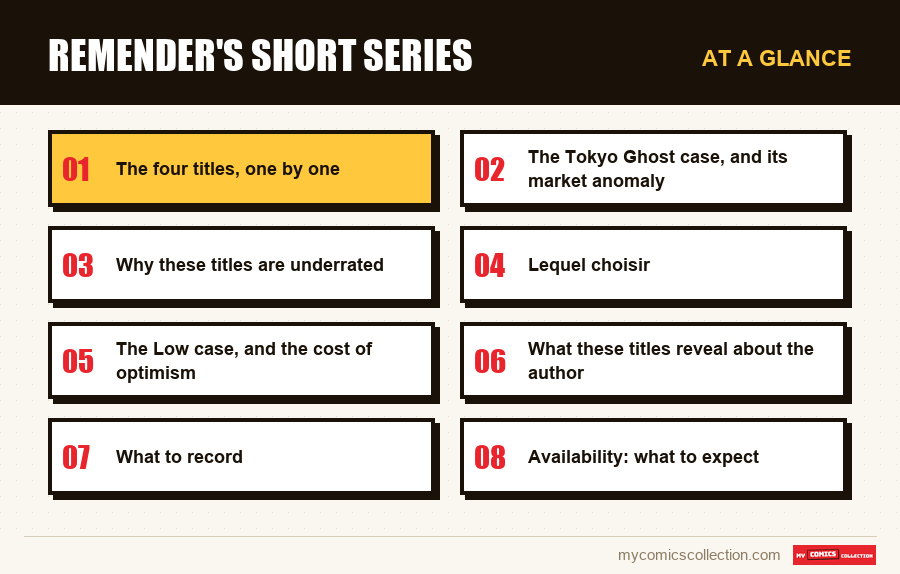
The four titles, one by one
Tokyo Ghost: le plus spectaculaire
A future where the population lives on a constant drip of entertainment, and two agents responsible for enforcing order in this chaos. Drawing by Sean Murphy.
This is the title where drawing takes up the most space: saturated pages, disproportionate architecture, constant energy. About ten issues, a complete story.
Low: le plus inattendu
The sun goes out, humanity survives at the bottom of the oceans, and one woman continues to hope. Drawing by Greg Tocchini, with almost liquid colors.
It is his unique story driven by optimism: not naive, but assumed as a moral position. For this author, it is a singularity.
Death or Glory: le plus nerveux
A chase rooted in the culture of outlaw truckers, designed by Bengal. The pace is that of an action film, with remarkably readable driving scenes.
The Scumbag: le plus atypique
A spy comedy where the fate of the world rests on a loathsome individual. Each issue changes artist, making it a graphic anthology as much as a story.
The Tokyo Ghost case, and its market anomaly
This title deserves separate treatment, because its numbers tell something useful about how this market works.
Asking prices observed on August 28, 2026 on the American market, lots and reissues excluded: its first issue is in question 12,99 $ en exemplaire brut, out of 128 ads. It is an average price, in third position among the author's first issues.
But in certified copy, the median reaches $150 on 28 listings: the highest price and the greatest number of noted copies of his entire production. The ratio between the two markets exceeds eleven times.
The explanation is not in the script. It comes down to the designer: Sean Murphy is closely followed by collectors, independently of the writers with whom he works. The certification market here rewards a graphic signature, not a story.
For a buyer, the consequence is twofold. A raw copy remains accessible at $13, making it a very affordable read. But if you are aiming for a graded copy, know that you are entering a market where demand is structured and prices are held.
Why these titles are underrated
Too short to be visible
A series of around ten issues takes up one or two volumes on the shelf, compared to five or ten for long series. It disappears visually, and booksellers promote it less.
Rarement recommandés en premier
When we recommend this author, we cite his three known series. Short titles come fourth in a conversation that often ends first.
Very distant registers
A spy comedy and a contemplative underwater story do not have the same audience. A reader who liked one may hate the other: which confuses word of mouth.
Less frequent reissues
Short series are reprinted less often than flagship titles. Some volumes become temporarily difficult to find new, without this reflecting lasting scarcity.
The real advantage of these titles: they end. Each fits in one or two volumes and tells a complete story, without a multi-year commitment or risk of interruption.
For a reader who hesitates to commit, or to offer, these are much better entry points than long series: provided you choose the appropriate register.
Lequel choisir
The four titles are not aimed at the same reader, and the choice is made more on tone than on quality.
For drawing above all, prenez Tokyo Ghost. It's the one whose pages impress the most, and its story about entertainment addiction has gained relevance since its publication.
For a story that feels good, prenez Low. It is the only one of his production from which one comes away with a feeling of momentum rather than despondency: an exception notable enough to be noted.
For pure action, take Death or Glory. The pace never slows down, and the driving sequences have a clarity that this genre rarely achieves in comics.
Pour être surpris, prenez The Scumbag. It is the most confusing title of the set, and its device, a different designer for each issue, makes it a unique object in its bibliography.
The Low case, and the cost of optimism
A title from this set deserves to be defended separately, because it is most often dismissed for the wrong reason.
Low asks for $9.99 in raw copy out of 121 advertisements as of August 28, 2026, and has only four certified copies for sale. It is, with one of its other titles, the cheapest and least certified of its production: in other words the one that the market watches the least.
This lack of interest is difficult to explain by quality. Greg Tocchini's drawing is among the most singular in the publisher's catalog: shapes that dissolve, color applied in masses, legibility that is sometimes precarious, and that is precisely what divides. A reader accustomed to the clean division of action series may find these pages confusing.
The bottom also divides. The story defends a position, continuing to hope when everything indicates that you should not, and it defends it without irony. In an author whose trademark is dejection, this sincerity disconcerted part of his audience.
For a buyer today, this translates into a simple opportunity: it is its most graphically ambitious title at the price of its most banal title. At ten dollars for a first issue, the trial costs little.
Collecting this series?
Track what you own, what you are missing and what your collection is worth. 7 day trial.
Start my trial →What these titles reveal about the author
Read together, these four stories correct an impression that his long series wrongly give.
He is readily described as a monotonous author, obsessed with self-destruction and guilt. These motifs are present, but the short format pushes it to vary: comedy in one case, hope in another, pure action in a third.
The format also affects the writing. A dozen issues prohibit digressions and force decisions: which produces stories that are significantly more tense than its long series, some of which stretch out.
Finally, these titles show the extent of its graphic network. Four series, four very different artists, including one who changes with each issue: this is where we best measure that he writes for someone, never in the abstract.
What to record
On short series, two catalog errors recur regularly.
The confusion between the single volume and the series. Many of these titles fit into a single bound volume which bears the name of the series without a volume number. Recorded as is, we no longer know if it is the complete or a first volume of which the sequel is missing.
The designer's oversight on titles with multiple artists. In a series where each number changes hands, it is the information that distinguishes the issues from each other: much more than their number.
Let's add the distinction between raw copy and graded copy, which weighs here up to eleven times the price on one of the titles. This is the field whose absence makes any further estimation impossible.
A list which bears “Tokyo Ghost» without further clarification will not allow us to say whether it describes a volume at $20 or a sealed issue at $150. Two additional fields are enough to remove the ambiguity for good.
Availability: what to expect
The survey gives a reassuring indication of these titles: their first issues each have more than one hundred and twenty simultaneous announcements in raw copies. There is therefore no supply tension, and no reason to accept a poorly described or overpaid item.
The situation is different for new bound volumes. As short series are reprinted less often than flagship titles, certain volumes experience periods of unavailability in bookstores. This does not reflect lasting scarcity but a slower reprint cycle.
The practical consequence is that it is better do not confuse temporary unavailability with a value. A volume that cannot be found new for a few months can easily be found second-hand, at a price that has not changed.
Where to place them in a reading journey
After one or two long series, but without waiting any longer. They are not suitable as a first read: not because of difficulty, but because their brevity gives a partial picture of what the author is doing over time.
In third or fourth position, they fulfill a useful function: they show his real range, which is broader than his three known titles would suggest. This is also the moment when we can appreciate what the short format changes to our writing.
For a reader who has not been hooked on his long series, finally, they constitute a legitimate second chance. The most common complaint, the heaviness of the tone, applies much less here.
Frequently asked questions
Most fit into one or two bound volumes, which is precisely their interest. However, check the mention of the chapters contained before purchasing: some titles exist in full presentation and in separate volumes, and nothing on the cover always indicates this.
Because his designer is very collected for himself, independently of the screenwriters with whom he works. The statement shows 28 copies noted for sale on this title alone, compared to three to seven on the other series by the same author: a difference which cannot be explained by any difference in scenario.
Yes, and it's even the author's only series in this case. Each number constitutes a distinct object by its artist, which changes the logic: you may want a precise number for its drawing rather than for its place in the story. Registering the designer then becomes essential.
None, these four titles are completely independent of each other and long series. The only order that matters is that of your tastes: the registers range from comedy to contemplative science fiction, and nothing connects one to the other.
Nothing suggests this, and the short format on the contrary imposes a tension on it that its long series sometimes lose on certain arcs. Their lower notoriety is due to their on-shelf visibility and recommendation habits, not to a difference in ambition or execution.
A volume for $20 or a sealed booklet for $150
On these titles, the format and the state make all the difference, and a line which bears the title alone says neither.