French editions of Rick Remender's series constitute an entirely separate market from that of American issues, and the two are not comparable. A translated volume is not valued like an original booklet: it has no alternative covers, no certification, no organized collector's market. On the other hand, it costs significantly less per chapter and can be found in bookstores. The only real pitfall is cutting: a French volume does not necessarily cover the same chapters as an American volume of the same number.
Many French-speaking readers discover this author in translation, then wonder if the original booklets are worth the effort. The answer depends entirely on what you're looking for, and this article explains it in detail.
It also explains how to identify what you own, which is not trivial when two objects with the same title contain different things.
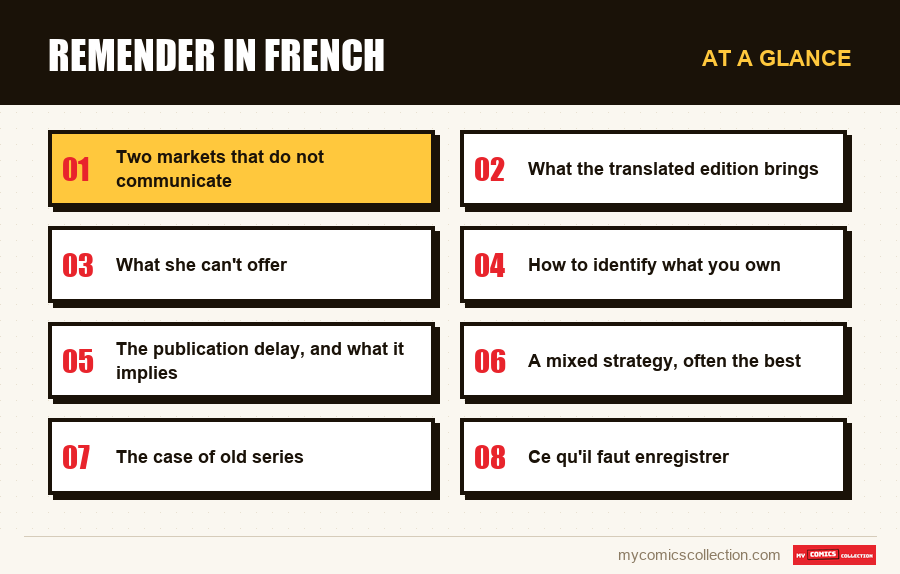
Two markets that do not communicate
This is the point that must be asked before everything else, because it governs all purchasing decisions.
An American booklet and a translated volume are not two versions of the same object but two distinct objects, with different buyers and unrelated pricing logics. The first belongs to an organized collector's market; the second at a book market.
The consequence is clear: a rating observed on an original booklet says nothing about the value of a translated volume, and vice versa. Comparing the two, as announcements sometimes do, amounts to comparing incomparable things.
This does not establish any hierarchy. The translated volume wins on reading comfort, accessibility and price per chapter; the original booklet wins over the original cover and the possibility of organized resale.
What the translated edition brings
A significantly lower cost per chapter
A volume brings together several chapters for the price of two or three individual booklets. Over a long series, the difference amounts to hundreds of euros.
Availability in bookstores
No searching, no international shipping costs, no waiting. A title in the catalog is ordered and arrives.
No risk of holey series
A volume contains a complete arc. We never find ourselves with a missing chapter in the middle of a plot.
An object made to be reread
Binding, paper, format: a volume is stored in a library and reopened. A stapled booklet does not stand up to repeated rereading.
What she can't offer
The original covers
A volume bears a single illustration, often that of the first chapter. The other covers sometimes appear in the gallery, sometimes not at all.
No certification market
Certification is a practice born from the stapled booklet. It does not apply to a bound book, and no reference exists to promote a noted volume.
A delay in publication
The translation appears after the original, sometimes a long time. A reader who wants to follow an ongoing series has no other choice than the original version.
Incomplete series in French
Not all of his series have been translated, and some have been partially translated. Checking before committing avoids getting stuck.
The trap of cutting, you absolutely must know. A French “volume 2” and an American “volume 2” do not necessarily contain the same chapters: publishers group them according to their own formats.
A reader who starts in translation then switches to the original, or the other way around, therefore risks repurchasing chapters that he or she owns, or skipping some. The only reliable information is original number range that each volume contains, usually indicated on the credits page.
How to identify what you own
Three checks remove any ambiguity, and they take a few seconds.
The credits page. It almost always indicates which original numbers the volume includes. It is the stable unit between all editions, in all languages, and the only one that allows two objects to be compared.
The year of publication. The same series may have had several successive French presentations, with different divisions. The year distinguishes them where the title is not enough.
The format. Soft, hardback volume, or edition bringing together several volumes: these objects do not sell at the same price and do not contain the same quantity of story.
Noted at the time of purchase, these three pieces of information make any subsequent verification unnecessary. Omitted, they require you to physically reopen each volume to know what you have.
The publication delay, and what it implies
A translation necessarily appears after the original, and the gap varies greatly from one title to another. This has three practical consequences that are best anticipated.
A current series cannot be followed in translation. The reader who wants to discover a title at the time of its publication has no other choice than the original version. This is the only case where the booklet is necessary for reasons of reading and not for collection.
Le risque d'interruption existe. A series whose sales disappoint may see its translation stop midway, leaving the reader with an unfinished story. Checking the number of volumes published and the regularity of their rhythm gives a useful indication before committing.
The offset protects against interrupted series. This is the symmetrical advantage, rarely mentioned: when a translation appears, the original is generally finished. The French-speaking reader therefore knows, before beginning, if the story has an ending: information which the original reader did not have.
Should we switch to the original booklets?
The question arises especially for a reader who has discovered the author in translation and wonders if he is missing something. Three scenarios.
To read, no. The text is the same, the plates too. A reader who is not bothered by the translation has nothing to gain by returning to the original, other than additional cost and research.
For the covers, yes. This is the only content that the volumes do not restore in full. A reader who cares about the illustrations of each chapter will find in the fascicles something that the translation does not give.
For value, only on the first numbers. In this segment, the collector's market is only interested in the first issues of each series. Buying the following in the original version after having read them in translation amounts to paying twice for the same reading without compensation.
Collecting this series?
Track what you own, what you are missing and what your collection is worth. 7 day trial.
Start my trial →A mixed strategy, often the best
The most economical combination is to read in translation and acquire in the original version only what the translation cannot provide.
Concretely: the French volumes for the entire story, plus only the first American issues of the series we really care about. This approach costs a fraction of what a full collection would cost in its original version.
It has a second, less obvious advantage. The first issue in a series is an object that we keep and do not reread: the story being available in volume, there is no reason to handle the collector's copy. His condition is self-preserving, which is never the case for a copy that is also used for reading.
It is also the strategy that produces the simplest inventory: a list of volumes for reading, a short list of issues for the collection, and no overlap in between.
The case of old series
A title by this author poses more difficulties than the others in translation, and for the same reason as in the original version.
His founding work has gone through several successive editions, with more than one publisher, with divisions that do not correspond. This problem already exists in the original market; translation adds an additional layer of possible groupings.
On this specific title, the general rule therefore becomes imperative: identify the edition before purchasing the first volume, and stick to it until the end. Mixing two presentations inevitably produces duplicate chapters and missing chapters, sometimes without being noticed until several volumes have passed.
His more recent series do not pose this problem: they have only been divided up, and the volumes follow one another without ambiguity. Vigilance is therefore only necessary on this title, but it is really necessary there.
Ce qu'il faut enregistrer
On a mixed collection, four fields are enough and the first is decisive.
La langue et l'édition. Without it, two lines with the same title describe different objects, and the inventory becomes unusable when completed.
The original chapter range. It is the common unit between the two markets, the only one which allows us to know whether a proposed volume completes the collection or doubles it.
The format. Soft, hardback, integral: they contain neither the same quantity of story nor the same resale value.
For booklets only: cover and condition. These two fields have no equivalent on a translated volume, which in itself is information to know.
What a translated collection is worth for resale
A question often arises from readers who have built up a library in French: what are these volumes worth if you wish to part with them?
The answer is less discouraging than one might imagine, but it follows a different logic. A translated volume is resold like a book: on its condition, on its availability as new, and on current demand. A title out of print from the publisher sells better than a title in permanent reprint, whatever its interest.
Two factors matter more than elsewhere. The first is the complétude: an entire series sells much better than isolated volumes, because a buyer is looking to read a story, not to fill a gap. The second is the condition of the edge and the spine, the only visible points of wear on a volume stored upright.
What doesn't matter, however: the cover, since there is only one, and the certification, which does not exist on this format. An honest description and a few photographs replace any label here.
Frequently asked questions
The question doesn't really make sense, because these are two markets that don't communicate. The volume is part of the book market, the fascicle of an organized collector's market with its alternative covers and its certification. A value observed on one does not provide any information about the other.
Not necessarily, and that's the main pitfall. Each publisher groups the chapters according to its own formats, so that a volume bearing a given number does not necessarily contain the same thing from one edition to another. Only the original number range, indicated on the credits page, allows comparison.
On the story and the boards, nothing. What we don't find are the covers of each chapter: a volume only has one, and the others appear in the gallery or not at all. This is the only content that the hardcover version does not reproduce in full.
No, and some are only partially so. It is better to check the status of the translation before starting a long series, otherwise there is a risk of getting stuck in the middle of a story and having to switch to the original version with the cutting problem that this entails.
Read the entirety in translated volumes and only acquire in the original version the first issues of the series you care about. This approach avoids paying twice for the same reading, and it has the secondary advantage of preserving the condition of the collector's copies, which never need to be handled since the story is available elsewhere.
Two objects, one title
Language, edition, and chapter range distinguish what looks similar on a shelf.