On the same booklet linked to Red Skull, Tales of Suspense No. 79, the sellers do not defend the same argument: one aligns the characters present, another announces the first appearance of an object that has nothing to do with them, a third is content with an “essential” without saying what. The August 30, 2026 statement shows five announcements with radically different wording and yet separated by less than five dollars. These reasons add up in the demand, none is enough on its own, and to keep a collection you must note all those that concern you, not just the one that triggered the purchase.
There is a very concrete way to measure how “wanted” a booklet is: open the list of current ads and read the titles that the sellers have typed. Not the prices first, the titles. A trivial number produces ten interchangeable labels, a series, a number, a state. A number that counts produces something completely different: each seller chooses the argument he believes to be decisive, and these choices do not overlap. This is exactly what we observe on number 79 of Tales of Suspense, a booklet that Red Skull collectors inevitably come across.
The survey conducted on August 30, 2026 on a general auction site, American market, gives a clear image of this phenomenon. Be careful what you look at: these are amounts claimed by sellers on listings that are still open, not completed transactions. No one paid these amounts; they only say what sellers hope to get on a given day. The copies passed by a verification body were counted separately, because mixing an authenticated and graded copy with an example hand-described by its owner amounts to adding two objects which do not trade in the same way.
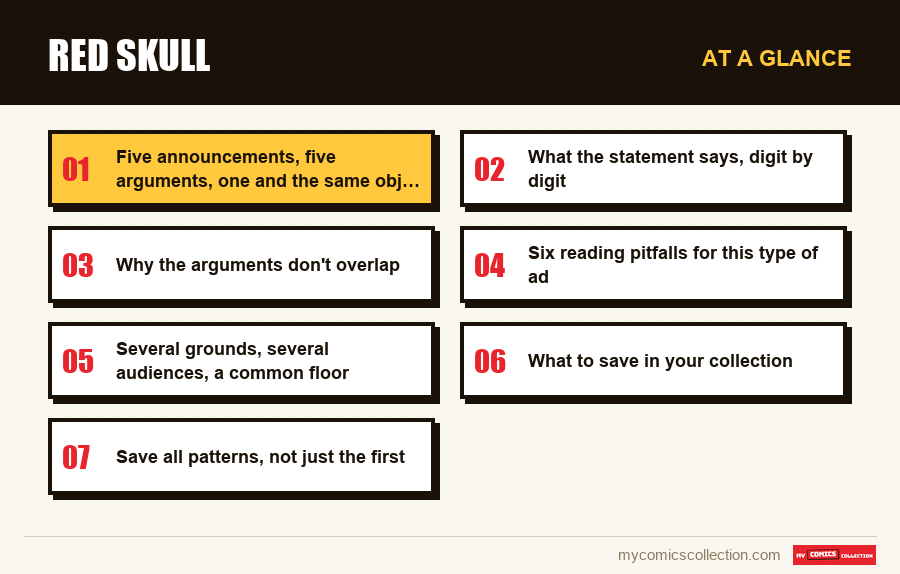
Five announcements, five arguments, one and the same object
The five cheapest ads in the survey all relate to the same issue. They don't tell the same story. The first lists the characters: Iron Man, Captain America, Sub-Mariner, Red Skull, all mentioned in the title, at $19.99. The second, at the same price, is satisfied with a generic label, a number described as essential, without ever specifying what would make it such. The third takes word for word the logic of the first, from another seller, at $20.00. The fourth, at $22.99, highlights the first appearance of an object, the cosmic cube, without mentioning any of the characters that the others had placed at the top. The fifth, at $24.30, ignores all that and sells one condition and one series: a low grade, lightly toned pages, and a year the series was launched, 1959, which is not the year this issue was published.
What the statement says, digit by digit
52 annonces non vérifiées
On the request associating the character and the number, fifty-two advertisements described by their sellers, without going through a verification body. Minimum $19.99, median value $50.00, maximum $225.00. A workforce of this size allows us to speak of an order of magnitude; it still does not allow us to talk about prices paid.
13 annonces vérifiées seulement
Thirteen is not enough. Minimum $50.00, central value $127.99, maximum $2,100.00. Such a number does not support any conclusion on a price level: two announcements removed or added would be enough to move the central value dramatically. The figure is given for what it is, a count, not a reference.
A difference of less than five dollars
From $19.99 to $24.30, the five cheapest ads fit within a narrow range even though their arguments have nothing in common. In other words, the market does not reward the argument chosen by the seller: it has already integrated all the reasons and sets a common floor.
A maximum that proves nothing
The high $2,100.00 of the verified range is an isolated ask. It expresses the hope of a seller, possibly on an exceptional specimen, and says nothing of what a buyer would accept. It is mentioned to give the amplitude of the list, never as a reference value.
An essential clarification before going any further: all this was noted only once, on August 30, 2026. A photograph taken at a single moment cannot show a movement. Nothing in these figures allows us to say that the fascicle is rising, falling or stabilizing: there should be at least two comparable surveys, spaced apart, carried out on the same perimeter. Any sentence like “this number is going up” would here be a pure and simple invention.
The classic trap is to read the verified range as a scale of value: $50 at the bottom, $2,100 at the top, so "it's worth somewhere in between." This is false on two counts. Firstly because they are requests; then because thirteen advertisements do not constitute a usable sample.
The honest reading is in one sentence: the bottom of the unverified list is dense and coherent, which gives an idea of the floor requested; the rest concerns individual situations that must be examined one by one, announcement by announcement, without ever averaging.
Why the arguments don't overlap
An old booklet carries several layers of interest that were deposited at different times. There is what is in the pages: characters, a confrontation, an object introduced for the first time. There is what the subsequent publication made of it, that is to say the retrospective importance acquired by an element that became central decades later. And there is the physical object itself, its condition, its provenance, its possible verification. Each seller chooses the layer he knows best, or the one he believes will sell the most.
Whoever aligns Iron Man, Captain America, Sub-Mariner and Red Skull in its title is betting on character search. He knows that four names increase the number of queries that may come across his ad. Whoever announces the first appearance of an object is betting on another population: buyers who follow the origins of narrative elements and don't care who appears on the cover. Whoever sells condition and grade is betting on buyers who already know what they want and are only looking for the copy with the right level of conservation. None of these three sellers are wrong. They are just aimed at different people.
This observation has a direct consequence on the way of building an ensemble around a character. If you only search by name, you miss the ads written by those who sell the object or condition; if you only search by state, you miss the ones that focused on characters. A cohesive Red Skull set: the issue is covered in depth in the reading route dedicated to the character: is built by crossing entrances, not by settling into just one.
There is also a lesson on wording. Between the ad that says “essential” without specifying anything and the one that specifically names a first appearance of an object, the second is infinitely more useful, even when the item it names is not the one you were looking for. A generic mention cannot be verified, cannot be indexed, cannot be compared; it takes up space and transmits nothing. A precise mention, even if off-topic for you, tells you something about the booklet and allows you to check it. The seller who writes vaguely deprives himself of an argument; the buyer who reads vaguely deprives himself of information.
Six reading pitfalls for this type of ad
Single search entry
Searching only by character name leaves out of scope all ads that have focused on the item, condition or series. On this specific number, two of the five cheapest ads do not mention the character sought in their title.
The year in parentheses
Two advertisements for the same object here display two different years: one that of publication of the issue, 1966, the other that of the launch of the series, 1959. The second does not date the copy. Mistaking the year of the title for the year of printing creates lasting record errors.
The label without content
“Essential number” without complement adds nothing and cannot be verified. It's not a lie, it's an absence of information. At the same price, systematically prefer the ad that names what is at stake.
Verified and unverified in the same basket
The thirteen advertisements placed by a verification body and the fifty-two described by hand do not describe the same commercial object. Adding them together produces a range that doesn't correspond to anything real.
The maximum taken for a value
An amount much higher than the rest of the list is an individual request. It reflects the hope of a seller on a given date. Using it as an estimate benchmark is the quickest way to overpay.
A unique pattern chosen
Retaining only the argument that convinced you amounts to erasing the others. However, it may be one of those you ignored who will maintain the demand in ten years, and you will not remember it.
Collecting this series?
Track what you own, what you are missing and what your collection is worth. 7 day trial.
Start my trial →Several grounds, several audiences, a common floor
The most natural hypothesis regarding these five announcements is that a booklet sought for several reasons attracts several audiences simultaneously, and that this superposition supports the level of requests from below: no one goes below a certain threshold because everyone knows that another type of buyer can pass. This is a coherent explanation. It is not demonstrated. Five announcements observed on a given day do not constitute proof, and it would be dishonest to present this reading as anything other than a lead.
What is solid, however, is the initial observation: the market has already aggregated the reasons. The seller who knows only one argument gets about the same asking price as the one who knows three. The information is therefore not in the title of the ad: it is in the convergence of the titles. When five unrelated formulations end up at the same level, it is the level that is the information, not the formulations.
This reasoning applies beyond a single character. Issues where several heroes share the same publication mechanically accumulate audiences, and we find the same mechanics on the major milestones in Captain America's history, whose cross-appearances with other series produce exactly this type of multiple labels. The practical consequence is the same everywhere: identify all the reasons before deciding what you are prepared to pay.
There remains the question of the amount. If the bottom of the unverified list is between $19.99 and $24.30 regardless of the argument put forward, then paying significantly more is financing an additional layer (higher condition, verification, provenance) and not the narrative argument itself, since that is already present in the cheaper listings. Knowing what extra you are buying is the only way to judge whether the difference is justified.
What to save in your collection
Write down all the patterns, not just yours. If you bought this issue for Red Skull, also note that it contains Iron Man, Captain America and Sub-Mariner, and that at least one seller sees it as a first appearance of an item. Each of these patterns can, alone, render the desired booklet later. In ten years, you will remember the reason for the purchase and no other.
Separate the year of publication from the year the series was launched. The statement shows two advertisements for the same object bearing two different years, 1966 and 1959, without either being false: one dates the number, the other dates the series. A collection record must distinguish the two fields, otherwise the confusion propagates with each subsequent search.
Record the verification status as a separate piece of data. A copy authenticated and noted by an organization and a copy described by its owner are not comparable. In this number, thirteen advertisements fall under the first case and fifty-two under the second. Mixing the two in the same personal estimate creates a value that does not exist anywhere.
Date each amount you enter. The figures cited here are inquiries from August 30, 2026, on open listings, not closed sales. An amount without date or nature becomes unusable in a few months: we no longer know whether it was a request or a price paid, nor whether it was high or low for the time.
Keep the exact wording of the original ad. Copying the title as it was written (with its characters, its condition, its year in parentheses) allows you later to reconstruct what the seller was highlighting and to understand what you really paid. A file that only keeps the number and the price loses this trace permanently.
Because each seller chooses the argument he knows or believes to be the most effective. One lists the characters present, another announces a first appearance of an object, a third sells a state and a note. None are false; they are aimed at different buyers. The remarkable fact is that these five announcements are within a range of less than five dollars, which suggests that the market has already added up the patterns regardless of how they are presented.
No, and nothing in this data allows us to say so. The reading was carried out only once, on August 30, 2026. A single measurement describes a state at a time, it cannot show an evolution. At least two comparable surveys, separated in time and carried out on the same research perimeter, would be necessary to speak of any movement.
Very little, as it stands. It is based on only thirteen announcements, a number too small to support any conclusion on a price level: the removal or addition of two announcements would shift the central value considerably. The maximum, in particular, expresses a seller's hope for a specific item and does not constitute a benchmark.
It's not about distrust but about utility. A generic statement without complement does not provide any verifiable information: it says neither what is happening in the booklet, nor why it would matter. At a comparable price, the ad that specifically names the element in play is much better, even when that element is not the one you were initially interested in, because it gives you something to control.
Remember that a year placed in parentheses after a series title often designates the launch of this series, not the publication of the issue in hand. This explains why two advertisements for the same item here display 1966 on one side and 1959 on the other. In a collection sheet, these two pieces of information must occupy two separate fields, otherwise the error is repeated each time you consult it.
Save all patterns, not just the first
A booklet kept for one reason often hides three others. My Comics Collection allows you to record for each issue the characters present, the year of publication distinct from that of the series, the verification status and the amount recorded with its date, so that none of this depends on your memory.