This work is one of the rare comics to have massively entered school libraries, and this circuit changes everything when reading it. A copy is read by dozens of successive children, over several years, without any having chosen it. Being available is not the same as being recommended, and a work read under these conditions is judged on criteria that have nothing to do with those of a reader who purchased it.
Understanding this circuit explains part of the diffusion of the work and part of the contradictory opinions that we read about it.
This article describes what this circuit imposes, what it brings to the work, what it costs, and why this series was particularly suited to it.
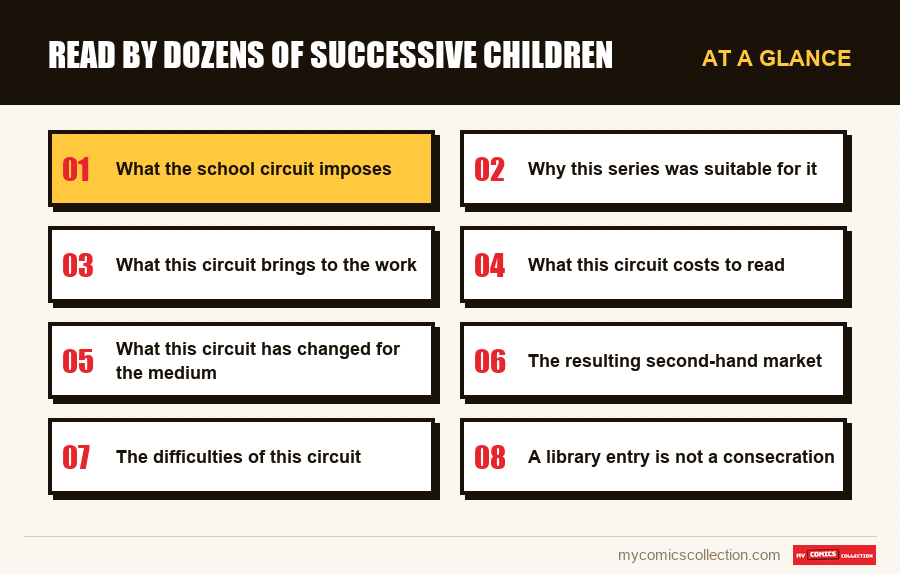
What the school circuit imposes
Four constraints which do not exist anywhere else, and which determine which books enter there.
An unchosen reading. The child takes what is on the shelf. He neither looked for this book, nor heard about it, nor decided to devote time to it: which immediately eliminates works that require prior membership.
Une lecture fragmentée. It is done in installments, between two activities, often interrupted and resumed days later. A story that requires continuity loses a lot.
Intensive handling. A copy passes through dozens of hands, with what that implies of wear and tear. The binding is as important as the content.
A prescription from an adult. Someone has decided that this book can be made available, which assumes that there are no apparent problems with it.
These four constraints form a severe filter. Most long and demanding works do not survive there, not by censorship but by practical inadequacy.
Why this series was suitable for it
Entry without prerequisites
No knowledge of the medium, no shared universe, no pre-existing characters. A child who has never read a comic book can start.
This is the most difficult condition to meet and eliminates most of the production.
Autonomous volumes
Each volume reads with real benefit even without the others, which is suitable for fragmented reading and an incomplete library.
An immediate hook
The comic register at the beginning is captured in a few pages, without requiring the patience that an adult reader would grant.
A solid object
Hardcover format, thick paper, design intended for circulation. This was not the case with the original fascicles.
What this circuit brings to the work
Three benefits, the last of which is never mentioned.
A readership by cohorts. A copy in the classroom library reaches successive children for years. The ratio between copies sold and readers reached has no equivalent in bookstores.
Lasting legitimacy. A book present in an educational establishment becomes a reference by its very presence, regardless of what the critics think of it.
A transmission between generations. Adults who read it as children offer it in turn, which sets up a cycle that the market alone does not produce.
This third effect is probably the most decisive over time. A work that enters this circuit remains there through a social mechanism rather than by its commercial notoriety, which makes it much less vulnerable to fashion.
The setback is real and it must be named. A work associated with the school circuit becomes difficult to recommend to an adult, who spontaneously places it among children's literature.
It is the same mechanism as that of the animal drawing or the round line observed elsewhere: a characteristic which opens one audience closes another. Here, the legitimacy gained on one side is paid for by a downgrading on the other.
What this circuit costs to read
You have to be precise, because these conditions do not do justice to a work built over time.
Long construction is falling by the wayside. A child who reads three volumes over two years perceives neither the progressive shift, nor the installations, nor the echoes between stories. He reads an adventure, which is not false but very incomplete.
Order is not guaranteed. A library rarely has the entire series, and there's nothing stopping you from starting in the middle. On a continuing narrative, this is a considerable loss.
The judgment is formed at the beginning. The first third being the most accessible and the most available, it is he who remains, and it is precisely the part which gives the least accurate idea of the whole.
These three losses explain an observable phenomenon: many adults remember this work as a sympathetic comedy and are completely unaware of what becomes of it. They are not wrong about what they have read.
What this circuit has changed for the medium
The effect goes beyond this work and deserves to be asked, because it concerns the entire place of comics.
For decades, the medium was kept away from educational institutions, viewed at best as entertainment with no formative value. The rare presences were a matter of tolerance rather than choice.
The passage of long and constructed works in this circuit has modified this position, not through a theoretical debate but through practice: teachers and librarians noted that these books were read, and read by children who were put off by the text alone.
This is an argument that nothing can replace. A work that makes someone who does not read read obtains a legitimacy that aesthetic considerations would not have produced.
This development has since benefited much more demanding works, which would not have passed through the door without the precedents. The benefit is collective and it is rarely attributed to those who opened it.
The resulting second-hand market
A concrete consequence is of direct interest to the buyer, and it is observable in the advertisements.
Establishments renew their funds, and the withdrawn volumes go out in batches. They therefore arrive on the second-hand market in large quantities, at irregular intervals, and in very uneven conditions.
This explains the abundance of cheap copies bearing marked traces of use.: labels, stamps, dull corners, broken spines. These are not examples neglected by individuals but examples that have done their job.
For a reader, this is a godsend: these volumes read perfectly and cost a fraction of new. For someone looking for a beautiful copy, it is, on the contrary, noise to sort through.
The distinction is made without difficulty in the advertisements, the sellers almost always mentioning the institutional origin of these examples: a mention which should be read as useful information on the history of the object, and not as a defect that the seller would seek to conceal.
Collecting this series?
Track what you own, what you are missing and what your collection is worth. 7 day trial.
Start my trial →The difficulties of this circuit
Incomplete series
Few funds have all the volumes, and the missing ones are not replaced as a priority.
Rapid wear
The most widely read copies are withdrawn and then replaced, which supplies the second-hand market with very tired volumes.
Random playing order
The child takes what is available, and the numbering of the volumes is not always legible on the spines.
A definitive ranking
Once classified as children's literature, the work remains there, even for readers who would otherwise be interested in it.
A library entry is not a consecration
It is worth distinguishing two things that are often confused when we talk about this circuit.
Being present in a collection means that an adult has found the book acceptable and useful. This is a real and limited validation: it is about adequacy, not literary merit.
Many mediocre works meet these criteria perfectly, and many remarkable works will never enter due to lack of being adapted to the format or the audience.
Presence in the school library therefore measures compatibility, not quality, and using it as an argument for recommendation is misleading in both directions.
What is really remarkable here is not to have entered it, but to have entered it without having been designed for that. The work was written as a self-publishing epic for an adult specialty boutique audience, and it turned out to be compatible by accident.
How to read or have people read despite this circuit
Three recommendations, if we want the work to be read for what it is.
Ensure availability of the suite. The main obstacle is not interest but access: a child who finishes one volume and cannot find the next one moves on to something else.
Prevent the tone from changing. Without this information, a young reader who finds the beginning childish will not know that it is worth continuing.
Suggest a reread later. This is the only way to recover what fragmented reading has caused us to lose, and the work lends itself particularly well to it.
This last recommendation is the one that gives the most. A work read in pieces at ten years old and reread in a row at twenty is not the same work, and many readers are unaware that they have this benefit available.
What to record
On a work that circulates more than it is owned, the record must follow the copies and not the title.
The volumes lent, to whom and since when. This is the dominant use of this series (we lend it to children, to colleagues, to friends who doubt the medium) and a set that is incomplete because three volumes are out cannot be distinguished from a set that is incomplete because they are missing.
Without this trace, we buy back volumes that we already own and which are lying dormant with someone, a common error on a work that is so much on loan.
The status of each volume upon return, noted at this time: a copy intended to circulate wears out quickly, and knowing which one is still presentable determines which one can be loaned again without embarrassment.
These two mentions deal with a collection whose function is to be disseminated: a rare case that inventories designed for conservation do not foresee at all.
Frequently asked questions
Because it meets four conditions that are rarely met: no prior knowledge required, self-contained volumes that support fragmented reading, an immediate comic hook, and a solid object designed to circulate. The first condition alone eliminates most of the production.
The long construction: neither the progressive shift, nor the installations, nor the echoes between stories are perceptible when you read three volumes over two years, in random order. He reads an adventure: which is not false, but very incomplete.
Because the first third is the most accessible and the most available in funds: it is he who remains. But it is precisely the part which gives the least accurate idea of the whole. These readers are not mistaken about what they have read: they simply have not read the rest.
No, it measures compatibility. Many mediocre works meet these criteria and many remarkable works will never fit into them. What is remarkable here is that it was entered without having been designed for that: the work was aimed at an adult audience of a specialist boutique.
By rereading in a row, later. This is the only way to recover what reading in pieces has caused us to lose, and the work lends itself particularly well to it. A series read in bits and pieces at ten years old and picked up again in one go at twenty is simply not the same work.
What volumes are out there right now?
On a series that is loaned so much, a set that is incomplete because it was loaned looks like an incomplete set, period.