Coloring this work was not an aesthetic operation but a market repositioning: moving from the comics section to children's literature. The reading of August 29, 2026 gives the measure of this:60 ads for colored volumes, $9.99 median and starting at $2.89, with no certified copy. These books were made to be read and loaned, not kept. It is an editorial success and a non-collector's item.
Both propositions are true simultaneously, and confusing them leads to misjudging the operation.
This article explains what the colorization has changed, what the reading shows, who each version is for, and why the lack of collectible value is not a flaw.
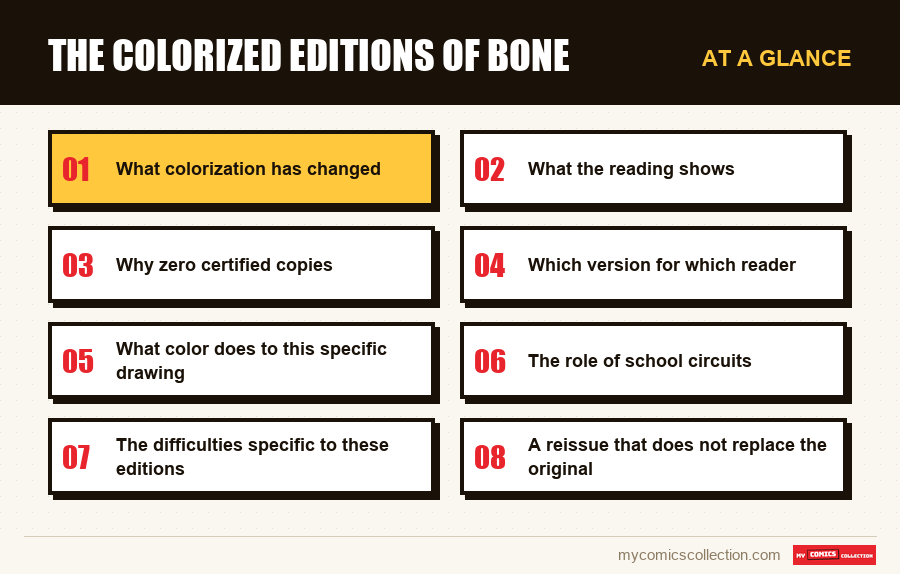
What colorization has changed
We must separate three transformations which are often reduced to a single one.
The support. Volumes bound in the format of books for young people, sold in general bookstores and in schools, replace booklets of comics sold in specialized stores.
The circuit. These editions reach readers who never enter a comic book store, particularly through educational distribution channels.
The reading itself. Color makes it easier to follow a large cast over a long epic, which is what really matters to a beginning reader.
These three changes converge towards a single objective. It was not a question of improving the work but of making it accessible to an audience who would never have encountered it, and it is a different undertaking from that which one supposes when speaking of “color version”.
What the reading shows
The following comes from fixed price listings collected on August 29, 2026. These are amounts requested by sellers, counted separately according to raw or certified state.
Colorized volumes
60 ads, of $2.89 to $99.99 requested, median $9.99. No certified announcement.
Several volumes of the collection at $3.20 and $3.99.
Original numbers, for comparison
Raw median between $9.99 and $23.00 according to the request, and a certified cash payment 16 to 65 ads.
A clear contrast on certification
Dozens of certified copies on one side, zero on the other. This is the clearest difference noted between two forms of the same work.
A crowded offer
The search also returns unrelated works, which complicates identification and indicates non-specific referencing.
Why zero certified copies
This figure deserves explanation, because it summarizes the entire logic of these editions.
These are books, not booklets. The certification applies to comics in stapled format and has no current equivalent for a bound bookstore volume.
The price would not justify it. At a median of $9.99, the operation would cost more than the item, as in all the inexpensive segments observed in this campaign.
There is nothing to establish. Certification is mainly used here to decide a print run rank: a central question on the original issues and irrelevant on continuously reprinted volumes.
These three reasons combine and make the figure inevitable. Zero therefore does not indicate a lack of interest but an inadequacy of the system, which is very different.
We must resist the easy conclusion. An edition without collectible value is not an edition without value: it was simply designed for another use.
These volumes put the work into the hands of more readers than the original installments would have ever reached. It is a success which cannot be measured in a statement of announcements, and which no figure in this file can express.
Which version for which reader
The question really arises, and the answer depends entirely on usage.
For a child, the colored version. The format, binding and color make everything easy: handling, following characters, resuming after an interruption.
For an adult discovering the work, indifferently. Both say the same thing. Black and white shows the drawing better, color is read more quickly; neither advantage is decisive.
To observe graphic work, black and white. The line was designed for him, with contrasts and mass management designed without color.
To lend, the colorized version without hesitation. It survives traffic better, and it is a frequent use on this work.
What color does to this specific drawing
Beyond the commercial repositioning, we must examine the effect on the boards themselves, because it is not neutral.
The drawing is based on a difference in treatment: simple and round characters on one side, decorations and human figures much more detailed on the other. In black and white, this difference is immediately perceptible: two line regimes coexist in the same box.
Color reduces this gap. By unifying the surfaces under the same logic of shades, it visually brings together elements that the line separated, and the strangeness of the characters in their world fades a little.
This is not a serious loss, and it is probably a gain for the intended reader: a child does not need to perceive this device to follow the story, and the readability he gains more than compensates.
But a reader who is interested in graphic construction loses something real. This is the strongest argument for black and white, and is more accurate than preferring the original on principle.
The role of school circuits
One aspect of this operation deserves to be developed, because it explains the extent of the diffusion.
Sales channels intended for schools operate differently from bookstores: group orders, prescription by adults, low prices, and a long lifespan since the copies remain in the class library for years.
A book that enters this circuit reaches readers in successive cohorts, which no sale in store allows. A single copy can be read by dozens of children.
This explains two observable things in the reading. First of all, the often average condition of the copies in circulation: they have been used a lot. Then the relative abundance of supply, these volumes emerging in batches when establishments renew their funds.
For a buyer, the consequence is direct: it is one of the rare segments where very cheap examples can easily be found, on condition of accepting traces of use that this circuit makes inevitable.
Collecting this series?
Track what you own, what you are missing and what your collection is worth. 7 day trial.
Start my trial →The difficulties specific to these editions
Clean numbering
The colored volumes follow their own division, without corresponding to the numbering of the issues.
Rapid wear
Designed to be read and loaned, many copies in circulation bear marked traces of use.
A vague referencing
The search returns unrelated works, which lengthens sorting despite a limited supply.
Two states of the same story
Nothing on a sheet constructed under the title distinguishes the colorized version from the original.
A reissue that does not replace the original
A point of vocabulary deserves to be raised, because it conditions the way in which we arrange these volumes.
We commonly speak of "reissue", a term which suggests a replacement: the new version would make the old one obsolete. This is not the case here, and the two forms have continued to circulate in parallel for years.
Rather, these are two editions intended for two audiences, coexisting without really competing with each other. A buyer of original booklets does not fall back on the colorized volumes, and a parent buying for a child does not turn to booklets.
This coexistence is visible in the statement: the two forms maintain distinct offers, with unrelated price levels, states and certification logics.
For a collection, the practical consequence is that there is no absolute preferred version, contrary to what the word reissue suggests. The useful question is never "which one is good" but "which one for what use", and having both forms is perfectly defensible: many readers do it without seeing a duplicate.
What this operation says about the profession
The case goes beyond this work and sheds light on a considerable editorial evolution.
Getting a comic book from the specialized circuit to the general bookstore requires changing almost everything about the object: format, binding, color, price, and even the way we talk about it. This is a remanufacture, not a reissue.
Few works support this treatment. You need a long, autonomous story, without external continuity, and accessible to a reader who does not know any codes of the medium: conditions that most series do not meet.
This filled them all, which explains why it was used as a demonstration. The success of these editions showed that a young audience existed outside the specialized circuit, on condition that we seek them out where they are.
This is probably the most lasting effect of this work, and it is not reflected in any price list. Here again, what the market measures and what counts do not overlap.
What to record
On a work existing in two states and loaned a lot, the sheet must answer a very concrete question.
Which copy you lend and to whom. This is the main use of the colorized version (it circulates, comes back damaged or does not come back) and a collection which includes both states has every interest in knowing which one is released. Noting the loan also avoids buying back a volume that we believe is lost and that is lying dormant with someone.
This seems prosaic. On a work whose social function is precisely to be transmitted, it is information that is most often used.
The colorimetric state of each volume, since nothing on a sheet constructed in the title distinguishes the two versions, and their respective numberings do not correspond.
These two mentions treat a collection made to circulate rather than to be preserved: a rare case, and which no inventory designed for valorization provides for.
Frequently asked questions
No, she repositions it. The objective was not to improve the story but to make it accessible to readers who never enter a specialized store: children's bookstore format, binding, school distribution. This is a different undertaking than what one assumes when talking about color version.
Three cumulative reasons: these are bound volumes and not fascicles, the median price of $9.99 would not justify the operation, and there is no print run rank to be established on continuously reprinted books. Zero indicates an inadequacy of the system, not a lack of interest.
No collector's value, and that's not a fault: they were designed to be read and loaned. They put the work in the hands of a number of readers that booklets would never have reached: an achievement that no list of advertisements can express.
The colorized version without hesitation: format, binding and color make it easier to handle and follow the characters, and it survives circulation much better. To observe graphic work, on the other hand, black and white is essential: the line was designed for it.
No, few can stand it. You need a long, autonomous story, without external continuity and accessible to a reader unfamiliar with the codes of the medium. This work fulfilled all these conditions, which explains why it served as a demonstration that a young audience existed outside the specialized circuit.
Who has your copy right now?
On a work made to circulate, this is the information that an inventory most often provides.