This work can be read in its entirety for around twenty dollars, provided you give up the one expensive item. As of August 29, 2026, the colored volumes are asked from $2.89 and the body of the series in numbers from $1.50. What matters is the first number in the first draw, the certified level of which reaches $150.00 to $525.00 of median according to the measurement. Get it out of the way and the budget obstacle disappears entirely.
It is one of the rare great works where reading and collecting have incommensurable costs.
This article gives the three quantified access routes, the resulting purchasing method, the pitfalls specific to this budget, and what to follow when you buy little.
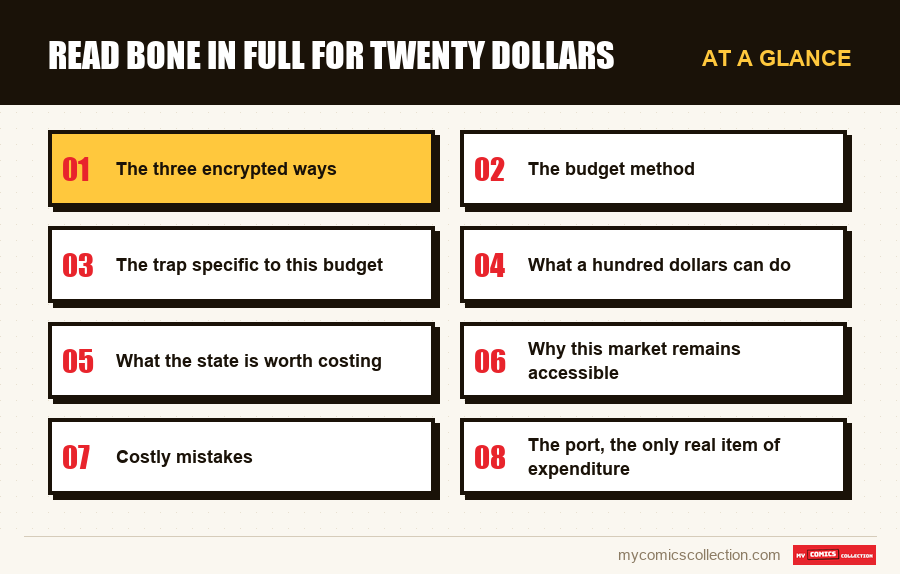
The three encrypted ways
The following is from an August 29, 2026 report for fixed price listings. These are prices asked by sellers, counted separately according to raw or certified state.
Colorized volumes
60 ads, from $2.89, median $9.99. Several volumes between $3.20 and $3.99.
The cheapest and easiest route: a few volumes cover the entire story.
Current numbers
149 ads on broad research, from $1.50, median $9.99. Mid-series issues at $1.99 and $2.00.
The first number
Raw: median $12.98 to $23.00 according to the request. Certified: $150.00 to $525.00 of median, out of 37 to 65 advertisements.
This is the only truly costly item in the entire work.
The series after
163 ads from $1.00, median $7.16. It is purchased entirely in a single batch.
The budget method
Three levels, each with a clear response.
Twenty dollars: used colorized volumes. At $2.89 and $3.99 each, several volumes cover a large part of the story in a production designed to last. It's the best possible expense at this level.
Fifty dollars: a set of current numbers. At $1.50 or $2.00 each in bulk purchase, you get a considerable portion of the series in its original form, in black and white.
Beyond that: the choice becomes qualitative. Complete in numbers, aim for nice copies, or switch to the first number: three different projects between which you have to decide rather than progress randomly.
This progression has a useful property: each level gives a coherent whole rather than a fragment. You can stop at any one without having an incomplete object in your hands.
The first number in the first draw is the only obstacle, and it is optional. Nothing in a reading collection requires it: the story it contains can be read in any edition and in any volume.
It is an original part, purchased for what it is. Mistaking it for a necessary link leads to indefinitely postponing a project that could start today for twenty dollars.
The trap specific to this budget
It is particular to this work and it must be named, because it cancels out the savings made elsewhere.
On a series where the first prints are worth multiples of the next ones, a low-budget buyer is structurally exposed to believe that he is making a deal. A first issue ad for a few dollars sounds like exactly what he's looking for.
However, these advertisements exist in number, and they almost all concern late prints: perfectly honest, correctly described by serious sellers, but unrelated to the object sought.
The rule is therefore reversed compared to intuition. On this series, a low price on the first issue is information on the draw, not on the good deal: and checking it takes ten seconds.
A buyer who ignores this rule will end up owning several copies of the same issue, all late, purchased on occasion and without ever obtaining what they were aiming for.
What a hundred dollars can do
The order of magnitude deserves to be asked, because it is surprising for a work of this reputation.
A hundred dollars well distributed covers the entire story in colorized volumes, a significant part of the series in original issues, and the entirety of the author's subsequent series: or most of what he published.
The same amount buys, on the certified side, approximately half a copy of the first issue.
The comparison is not intended to disqualify the purchase of a collection, which meets another need. Elle sert à situer : reading this work costs as much as a meal, collecting it costs several hundred dollars, and these are two projects that can be carried out separately.
Many readers discover late that they wanted the first and believed they had to go through the second.
What the state is worth costing
The question of deciding between a tired copy and a fine copy arises differently depending on the part of the work concerned, which is unusual.
On current numbers, the state matters little. With a certified market almost absent on these references and medians around ten dollars, there is nothing to indicate that a beautiful copy will be valued more. The criterion becomes purely practical again: a correct copy can be read, a broken copy cannot.
On colored volumes, condition counts for use. Many come from school circuits and have served a lot. If the volume is intended to be loaned in turn, it is better to start with a solid copy.
On the first number in the first draw, the state controls everything. This is the only benchmark where the difference between two states is in the hundreds of dollars, and where certification makes economic sense.
Applying the same requirement everywhere would be a mistake in both directions: paying a state premium on two-dollar issues, or neglecting state on the one piece where it decides the price.
Why this market remains accessible
It is worth explaining why such a famous work has not become expensive as a whole, because it is not obvious.
There are many late draws. The series was reprinted as its reputation grew, which put a considerable volume of copies into circulation: the opposite of a cult work remaining confidential.
The colorized volumes absorbed the reading demand. A reader who wants to discover the work turns to them, which removes pressure that the issues would otherwise have experienced.
The series is complete and available. Nothing can't be found, so nothing warrants a search bonus.
These three factors have a common effect: they concentrate all the market tension on a single reference, the first number in the first draw, and leave everything else at ordinary levels.
It is a configuration favorable to the reader and it is stable: nothing indicates that it would evolve, the causes which produce it being structural.
Collecting this series?
Track what you own, what you are missing and what your collection is worth. 7 day trial.
Start my trial →Costly mistakes
The late print taken for the original
The first number for a few dollars exists in number. It's another item, not an opportunity.
Purchasing individually
At $1.50 per issue, individual shipping multiplies the cost. Batch is the only sensible approach.
Duplicate between versions
Colorized volumes and original numbers cover the same story under unmatched numbering.
The neglected state on volumes
Many colored copies come from school circuits and bear marked traces of use.
The port, the only real item of expenditure
On one or two dollar examples, the arithmetic shifts entirely, and it is the parameter that a buyer controls best.
A $1.50 issue shipped alone is several times its list price once shipping is added. The same number taken from a shipment of twenty copies amounts to a fraction of this total.
Seeking the lowest unit price is therefore the wrong strategy: a seller displaying $2.50 per issue but grouping twenty copies is significantly less expensive than a seller at $1.50 from whom one takes one piece.
This rule applies to all inexpensive collections, and it is particularly decisive here because the abundant supply really makes it possible to build up large lots from the same seller.
Three or four well-chosen bulk orders are enough to cover most of the series. Thirty individual orders would cost more for less results.
A word on the pace of purchase
The question of the moment rarely arises on this work, and it is worth saying why.
Nothing indicates tension in the accessible segments: the offer is continuous, the colored volumes are regularly reprinted, and the current issues are constantly circulating. Waiting costs nothing on the part of the work that makes up a reading collection.
The reasoning is reversed on the tense reference alone. There, the first print offer is not renewed, and hesitating has a real cost, but it is precisely the purchase that a small budget rules out.
In other words, patience is free exactly where one buys, and costly where one does not buy. This is a comfortable situation and rare enough to be reported.
Build up without dispersing
A particular risk awaits opportunistic buying here, and it is easy to avoid by deciding in advance.
Three forms of the same story circulate: colorized volumes, original issues, and various reissues. Buying as you find produces a mixture of which we can no longer tell what it covers.
The parade consists of choosing a shape and completing it, treating others as one-off acquisitions with no objective of completeness.
This does not prohibit having both versions: it is even defensible, they serve different uses. But you have to know which one to complete, otherwise you won't complete any of them.
It is the decision that costs the least and changes the most: it is made in one minute and determines everything that follows.
What to record
With a low budget on this work, the sheet must resolve an ambiguity that the price alone does not resolve.
For each copy of the first issue, the edition rank as it appears on the object. This is the only place in this collection where the same item can be worth two dollars or three figures, and a buyer on a budget has the most to lose by confusing the two: they will accumulate several without ever getting the one they were aiming for.
Noting this rank also prevents you from mistakenly repurchasing what you already own in the belief that you are improving your collection.
The form of each acquisition: colorized volume, original number, reissue: since three forms cover the same story with numberings that do not correspond, and a sheet organized by the title does not distinguish them.
These two mentions cost a few seconds and protect against the only two possible unnecessary expenses on this work.
Frequently asked questions
About twenty dollars in used colorized volumes, at $2.89 and $3.99 each. It's the best possible expense at this level, in a manufacturing designed to last. Fifty dollars allows you to obtain a considerable part of the series in original issues, purchased in batches.
Nothing requires it in a reading collection: the story it contains can be read in any edition and any volume. It's an original part, buy it for what it is: confusing it with a necessary link postpones a project that could start today.
These are late prints, honestly described by serious sellers. On this series, a low price on the first issue is information about drawing rank, not a sign of a good deal, and checking it takes ten seconds.
The entire story in colorized volumes, a significant part of the series in original issues, and the entirety of the author's subsequent series. The same amount buys about half a certified copy of the first issue: reading costs as much as a meal, collecting costs several hundred dollars.
By choosing one form and completing it, the others become one-off acquisitions without any objective. Three forms of the same story circulate with unmatched numbering: having both versions is inadmissible, but you have to know which one you are completing otherwise you will not complete any of them.
What rank, what form?
Two mentions which protect against the only two possible unnecessary expenses on this work.