After an epic that became a classic, the author published a science fiction series for adults, and the public didn't follow it. As of August 29, 2026, she wonders $7.16 median out of 163 gross ads, from $1.00, with a single certified ad. Same author, same publishing house, same complete self-publishing. What has changed is the register, and it is enough to make a readership that we thought acquired disappear.
This is the clearest case that can be observed of what the loyalty of an audience really covers.
This article describes what the series offers, what the reading says about it, why the transition failed commercially, and who it is suitable for despite everything.
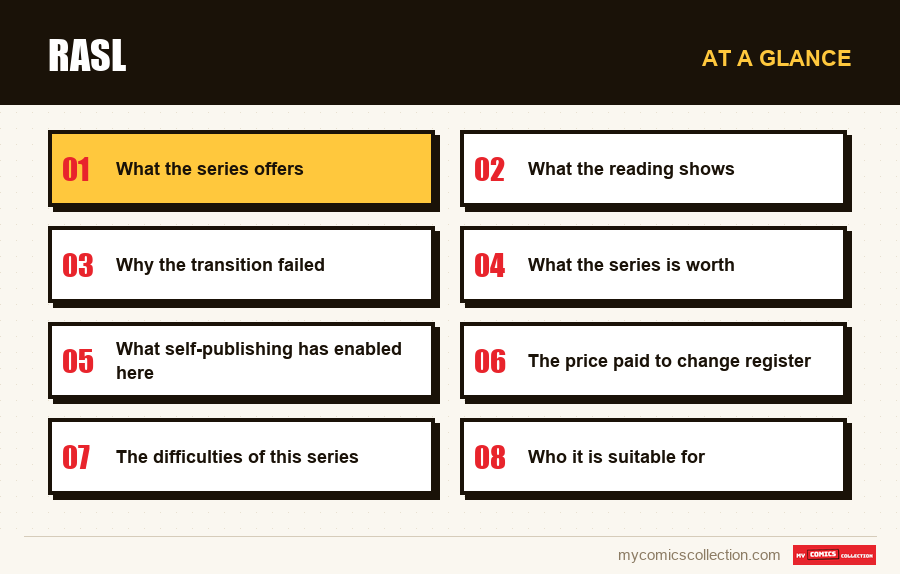
What the series offers
The contrast with the above is total, and it must be stated frankly.
The register is adult. Violence, sexuality, morally questionable main character, dark novel atmosphere. Nothing is intended for a young reader, unlike the work that made the author known.
The genre is science fiction. Travel between parallel worlds, speculative physics, irreversible consequences. We are far from fantasy and comedy.
The drawing changes function. The feature remains recognizable but serves a realistic register, with urban and desert settings treated for their own sake rather than as a background for gags.
In other words: everything that defined the previous work is absent, except the hand. It's a sure bet, and it's also the exact description of his business problem.
What the reading shows
Figures from a statement dated August 29, 2026 on fixed price advertisements: amounts requested by sellers, counted separately according to raw or certified state.
The series
163 ads raw, of $1.00 to $295.53 requested, median $7.16. Certified: just one ad, at $499.99.
The first number is among the $1.00 entries.
The previous work, for comparison
Raw median between $9.99 and $23.00 according to the request, and a certified payment of 16 to 65 ads.
The gap in certified attendance is an order of magnitude.
Yet an abundant supply
163 ads, more than most searches conducted on the previous work. This is not an uncommon title.
No scarcity
From the first issues to $1.00 fifteen years after their publication: the initial stock was never absorbed.
Why the transition failed
Four causes combine, and none relates to the quality of the series.
The acquired readership could not keep up. A significant part of the audience for the previous work was young, or had discovered it in a school environment. This audience was not the recipient of an adult series, and neither were its prescribers.
The recommendation did not transfer. A bookseller or teacher who recommended the previous work could not follow up on this one, which cut off the main distribution channel.
The intended readership was unaware of the author. Readers of adult science fiction did not know him, or knew him as an author for children: an unfavorable association in this context.
The name promised something else. This is the cruelest: his considerable notoriety actively worked against this project by setting up an expectation that it did not satisfy.
This is a textbook case of the trap of specialized notoriety. Being known for a specific thing is a strength for doing it again and a handicap for everything else.
An unknown author who would have published this same series would have presented it without constraint. The well-known author had to first undo an expectation before proposing his own: work that few series survive.
What the series is worth
A direct assessment, since the price gives no indication.
The device is solid. A thief who travels between parallel worlds to steal works of art, with increasing physical consequences, provides clear mechanics and concrete stakes.
The construction is tight. Unlike the previous epic, the series is short and concludes. Nothing is lying around, which is consistent with the black register.
The drawing is the best argument. Desert settings treated in large spaces, more marked management of shadow than before, and work on light that the comic register did not allow.
What it doesn't have: the scale and attachment of the previous work. It is an effective series of two hundred pages, not a monument, and the comparison, inevitable, systematically harms it.
What self-publishing has enabled here
One point deserves to be underlined, because it changes the reading of this commercial failure.
The series was published by the author's structure, the same one which had carried the previous work. No external publisher had to validate the project, evaluate its market, or refuse it.
Which means this series probably wouldn't have existed otherwise. A traditional house would have made the calculation set out above (unsuitable acquired audience, indifferent target audience) and concluded without difficulty that it should not be published.
The fact that it exists is therefore directly attributable to the self-publishing model, exactly as in the other cases observed throughout this campaign: this model does not guarantee success, it guarantees possibility.
This is also what allows us to judge it calmly. This is not a project poorly evaluated by a publisher, but of an author who did what he wanted knowing what it would cost.
The price paid to change register
A broader observation, which applies to many authors and which is rarely made.
An author identified with a registry has two options, and neither is comfortable. Staying in this register ensures him an audience and exposes him to the criticism of repeating himself. Leaving it costs him this audience without guaranteeing him another one.
The second choice is almost always the most expensive in the short term, and this is the one that was made here. The figures in the survey precisely measure the price: a median lower than that of the previous work, and a certified portion reduced to a single advertisement.
It must be added that this cost is not only commercial. A series that does not find its audience receives few comments, therefore few recommendations, therefore even fewer readers: the mechanism closes in on itself.
For a reader, the consequence is paradoxical and favorable: these works are permanently available, permanently cheap, and permanently ignored. They are one of the few places where attention pays more than budget.
Collecting this series?
Track what you own, what you are missing and what your collection is worth. 7 day trial.
Start my trial →The difficulties of this series
A misplaced expectation
Arriving through the previous work leads to looking for what is not there, and to missing what is there.
Un fond scientifique exigeant
The story is based on physics concepts presented quickly, which requires attention.
Un protagoniste peu aimable
He is selfish, lying and destructive. The story doesn't redeem it, which is disconcerting coming from endearing characters.
Un référencement faible
Little recommended and little commented on, it is doing poorly despite an abundant supply.
Purchasing precision is necessary before going any further. With 163 listings in circulation and one dollar entries, this series can be purchased in its entirety in a single lot from a single seller, for less than the price of a new bound volume. This is the method of acquisition to be favored without hesitation: the shipping entirely dominates the expense, and the series being short and concluded, there is no reason to build it up in successive stages.
Who it is suitable for
Three profiles, two of which are positive.
To a reader of black narrative, yes. Without knowing the author or his previous work, we find a well-executed and complete genre series, at a ridiculous price.
To a reader curious about the author, yes, but afterwards. It shows what he does when he abandons everything he's known for, which is instructive: provided you've read the main work first.
To someone who loved the epic and wants the same thing, no. There is no commonality, and disappointment is predictable.
This last situation is the most frequent, and it explains part of the bad reputation of the series. Many negative opinions criticize this work for not being the other, which is not a criticism.
What this case teaches
The lesson goes well beyond this series, and it is useful to any reader who follows authors.
It is generally assumed that a successful author takes his audience with him. What this case shows is that the public is not attached to the perpetrator but to what he did: and that these two attachments are very different.
The practical consequence is direct: breakthrough works by well-known authors almost always find themselves at knock-down prices, because they fail to find their audience at the time of their publication.
It is, for a reader, a remarkable source. These series are abundant, complete, often well done, and no one is looking for them.
The counterpart is the same as everywhere else in this campaign: these copies will keep the price they have, and you have to buy them to read them.
What to record
On this type of series, the sheet must keep track of a judgment that the market does not provide and that memory distorts.
Your comparative appreciation: what the series brought you independently of the author's main work. Comparison is inevitable and it is bad advice: noting separately what you liked here avoids reducing the series to what it is not when you are asked if it is worth the detour.
This is an unusual use of an inventory, and it addresses a real problem: the reviews available on these works are almost all disguised comparisons.
The date you read it in relation to the main work, because the order completely changes the impression. Read before, it can be judged alone; read afterwards, she judges herself against it, and remembering her own reading order is what allows you to put your own opinion into perspective.
These two mentions serve to honestly evaluate a work that its context undermines, a frequent and rarely equipped situation.
Frequently asked questions
No, and that's the central point. The register is adult (violence, sexuality, morally questionable protagonist) when the previous work was accessible to young readers. A significant part of the acquired public was not the recipient, and neither were its prescribers.
Because the initial stock was never absorbed: 163 advertisements circulated fifteen years later, with first issues at $1.00 and only one certified advertisement. It's not a rare title, it's a title that not many people seek out.
No: the device is solid, the construction tight, and it is concluded. What it doesn't have is the scale of the previous work, and the comparison systematically harms it. Many negative reviews actually criticize it for not being the other, which is not a criticism.
She has done harm, and that is the cruelest thing about it. Being known for a specific thing helps to remake it and handicaps everything else: the author had to first undo an expectation before proposing his own. An unknown person publishing the same series would not have had this work to do.
That the public is not attached to an author but to what he has done: two very different attachments. Hence a source for readers: breakthrough works by well-known authors are almost always found at bargain prices, abundant and complete, without anyone looking for them.
Before or after the main work?
The order of reading changes the entire judgment, and that's what we forget first.