
Rachel Rising is the quickest entry into Terry Moore's work, and his only horror story. A young woman wakes up at the bottom of a shallow grave, with the mark of strangulation on her neck, without the slightest memory of what happened to her. So she investigates her own murder: in a small town whose past includes an episode of witch hunting. Forty-two chapters, six volumes, one story achevé, and a first scene which decides in three pages whether the author suits you.
Where his major work requires a commitment of ninety chapters, this one is tested in one volume and finished in six.
This article explains what it says, what horror allows an author coming from intimate drama, and what you need to know before buying it.
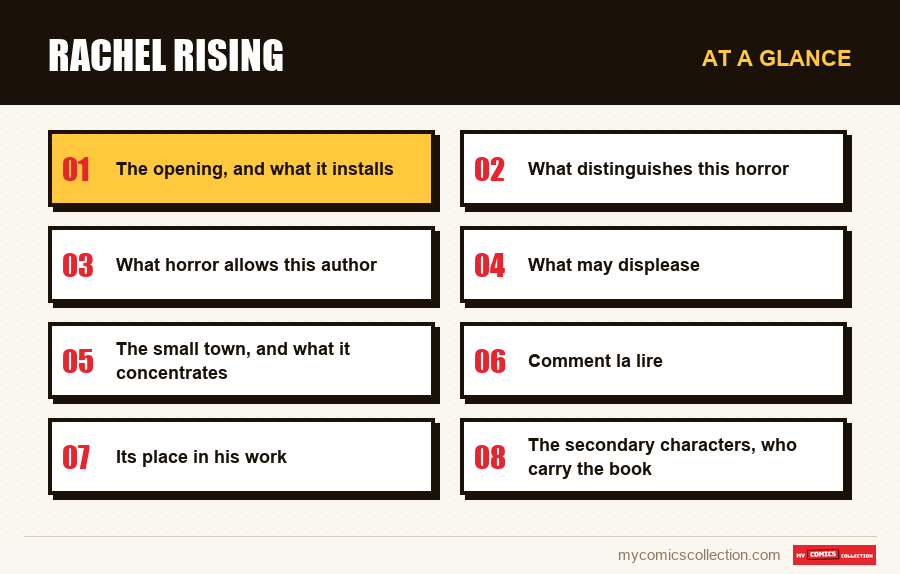
The opening, and what it installs
The book begins with a woman emerging from the ground. No preamble, no context, not the slightest sentence of explanation: she gets up, goes back to the surface, and ends up discovering by examining herself the marks which prove that she was strangled before burying her there.
What follows is not, however, a tale of revenge. Rachel doesn't know who killed her, doesn't know why she's still standing, and above all doesn't know what happened to her in the meantime. The investigation she carries out therefore focuses as much on the identity of her attacker as on her own nature.
The small town where everything takes place has a past, and this past includes deaths that we prefer to forget. It's not a picturesque setting.: the mechanics of the story come directly from what happened there centuries ago.
What distinguishes this horror
Black and white works for the genre
Moore's inking, which served the drama in his other books, here becomes a tool of anxiety: deep blacks, distorted faces, and much left off-camera.
This is probably the best argument to discover his drawing by this title.
Humor amidst the macabre
The dialogue remains funny, even in the most sinister situations. This counterpoint is his signature, and it makes the story tenable.
A horror without overkill
Few free graphic scenes. The fear comes from what the characters gradually understand, not from what they are subjected to in the image.
A short and finished story
Only six volumes, and a conclusion fully written as such. No risk of interruption along the way, no long-term commitment to make.
What horror allows this author
One could believe in an opportunistic change of register. It's the opposite: the genre gives him access to his usual subjects by another route.
His books are all about what we wear without having chosen it: a past, a family, a reputation. Horror makes this littéral: an ancient curse is exactly that, an inheritance that one suffers without having consented to it and which one cannot return.
It also allows him to write characters who cannot die, which shifts the dramatic question. When death ceases to be the issue, what remains at stake becomes more interesting: what we are willing to do, and what we become by doing it.
Finally, the genre allows for a small, hostile, cramped town, where everyone knows each other: a setting that concentrates human relationships in a way that no urban setting allows.
Why it's the best test. A reader who hesitates before the ninety chapters of his major work finds here exactly the same writing, the same dialogues, the same inking: for six volumes instead of twenty.
If the first volume catches your attention, the rest of its bibliography will suit you. If it doesn't hold you back, you'll know it's not a question of format.
What may displease
Responses that take time
The story distills its explanations very gradually. A reader who wants to understand quickly will spend several volumes in the dark.
A growing distribution
The number of characters increases significantly, and some disappear for a long time before returning. A split reading gets lost.
A darker tone than his other books
The humor is present, but the substance is much darker than in his intimate drama. Readers who come by this one may be surprised.
A disturbing child character
One of the most striking secondary characters is a disturbing little girl. It's very successful, and it's frankly uncomfortable.
The small town, and what it concentrates
The choice of setting is worth paying attention to, because it does a lot more work than the summaries suggest.
A town where everyone knows everyone produces constraints that no big city would impose. You cannot disappear into the crowd, you cannot avoid someone for long, and above all you carry a reputation built up before your birth. Families have stories there, and these stories precede individuals.
This is exactly what is needed in a story whose subject is the inheritance that we did not choose. An ancient curse is transmitted by place and blood; we therefore need a place where both still have weight.
The decor also produces the closed doors necessary for the genre. The characters cannot escape-not just because the narrative forbids it, but because they belong to this place in a way that makes leaving unthinkable. It is a social constraint before being supernatural, and it is much more solid.
Comment la lire
Three recommendations, less restrictive than on its other titles.
In volumes, in order. Six volumes which follow one another without ambiguity: this title poses none of the publishing problems which complicate his major work. This is also why it is a better entry point.
Sans trop espacer. Secondary characters come and go, and clues planted early find their explanation late. Reading spread over years loses part of the benefit.
Without looking for connection. The series can be read entirely on its own. A late story by the author brings together characters from several of his books, but it comes well after and does not condition anything.
Collecting this series?
Track what you own, what you are missing and what your collection is worth. 7 day trial.
Start my trial →Its place in his work
It was the title that introduced Moore to a generation of readers who had not followed his debut, and that is understandable.
His major work required considerable commitment and a taste for relationship drama. This offers an entry point through a popular genre, in a reasonable format, without losing anything of what makes it unique: the dialogue, the female characters, the black and white.
It also showed that he could construct a mechanical plot, with revelations and a coherent system, where we expected it mainly on the accuracy of human relationships. This is his best structured book., regardless of the question of gender.
For a reader who discovers his work today, it therefore constitutes the best compromise: sufficiently representative to serve as a test, sufficiently autonomous not to involve anything.
The secondary characters, who carry the book
A particularity of this story surprises readers who have come for the protagonist: it is not always Rachel's scenes that remain in memory.
The author builds around her a group of figures who each have their own ongoing case: a forensic doctor friend, a child who the story makes frankly disturbing, several adults from whom we discover late what they knew. None of these figures are there to comment on the action.
This choice has a direct effect on the rhythm. The story regularly deviates from its main investigation to follow someone else for several pages, which slows down progress and frustrates some readers. On the other hand, the small town ends up actually existing rather than serving as a backdrop.
This is also what explains the length of the six volumes. A supernatural detective story would fit in two; it is the parallel lives which occupy the other four, and this is where most of what is worth reading comes into play.
Côté collection
This title is much simpler to put together than his major work, and for three reasons.
La série est récente: published in the 2010s: therefore printed at a time when the author already had an established audience. The initial print runs have nothing to compare with those of its beginnings, and the first issues remain accessible.
She did not know only one numbering, without interruption or resumption. A number designates one issue and only one, which is not the case for its ledger.
And its six bound volumes follow a unique cutting, without competing presentations at different borders. Volume two contains the same chapters regardless of the copy.
The only vigilance therefore concerns the condition of the issues, as with all stapled items, and the availability of the volumes: an author who publishes himself reprints according to his own means, which produces temporary ruptures without creating lasting scarcity.
Ce qu'il faut enregistrer
This title requires fewer precautions than the others, two fields are enough.
The format. Booklet or bound volume, and where applicable the edition bringing together several volumes. These objects have the same title without containing the same amount of narrative.
The state, for the fascicles. In a market where certification remains poorly developed, it is the detailed description that makes the resale: corners, staples, flatness of the back.
The simplicity of this title is in itself information worth keeping. She explains why it complements each other effortlessly where the major work of the same author requires checking each purchase.
One remark applies to this entire segment: an author who manages his stocks alone sometimes sells part of his prints directly, through conventions or by mail order. These copies are frequently signed, and the signature obtained from the author's hand on a book that he has completely produced does not have the same status as a scriptwriter's dedication on a collective work. This is information worth noting, and one that is very easily lost.
Frequently asked questions
Not necessarily. The fright comes from what the characters gradually discover rather than from graphic scenes, and the humor of the dialogues constantly lightens the story. A reader who is usually put off by the genre may very well find what he is looking for.
Yes, six volumes cover the entire thing and the conclusion was written as such by the author. Nothing is left unresolved, and no continuation is necessary to understand what is happening to the characters.
Because it offers exactly the same writing and drawing as his major work for a commitment four times less, and it poses none of the publishing problems that complicate the purchase of the latter. It is the most economical and reliable test.
The story stands entirely on its own and requires no prior reading. The author later published a title which brings together characters from several of his books, but this one comes much later and in no way conditions the understanding of this series.
Clearly, and this is an additional argument to start there. A single numbering without repetition, a single division into volumes, and prints subsequent to the installation of its audience: three factors which eliminate the verifications imposed by its older series.
A simple title to put together, which is not common with him
A numbering, a division: noting the format is enough here, where his other series require three.